
Biotin: Benefits, Dosage & Side Effects (2026)
Biotin (vitamin B7) is essential for healthy hair, but supplementing it only restores hair growth in the rare case of true deficiency — in everyone else there is no evidence of benefit, and high doses can dangerously distort lab tests like troponin and thyroid panels.
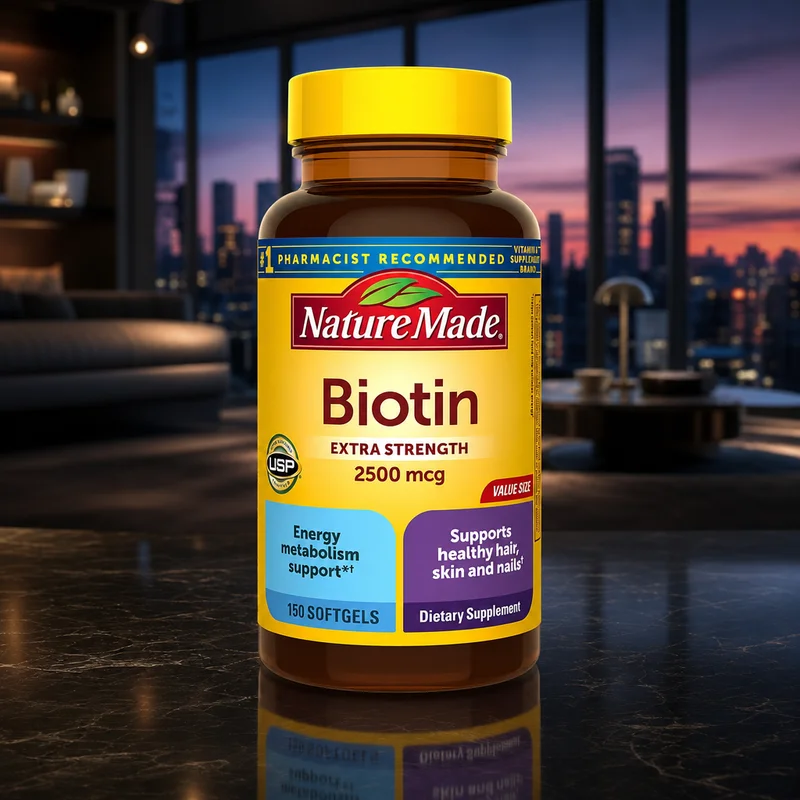
Nature Made Biotin 2500 mcg Extra Strength, 150 Softgels
What is Biotin?
Biotin is vitamin B7 (also called vitamin H) — a water-soluble B-vitamin that acts as a cofactor for five carboxylase enzymes involved in fatty-acid synthesis, gluconeogenesis, and amino-acid metabolism. Those enzymes matter for the tissues that grow fastest, including hair follicles and nail beds, which is the biological reason a genuine biotin deficiency causes hair loss, brittle nails, and a scaly rash. The adult Adequate Intake is only about 30 micrograms a day, and it is easy to hit from a normal diet: egg yolk, liver, nuts, seeds, and salmon all supply it, and gut bacteria synthesize some on their own. Clinically meaningful biotin deficiency is genuinely rare.\n\nThat rarity is the whole story, because the supplement industry sells biotin at 5,000 to 10,000 micrograms per capsule — 150 to 300 times the daily requirement. The marketing logic is a leap: deficiency causes hair loss, therefore extra biotin must grow hair. That inference does not hold. For the overwhelming majority of buyers, who are not deficient, adding more biotin does not give the carboxylase enzymes anything they were lacking, so there is no mechanism by which it would thicken hair or speed growth. The excess is simply filtered out in urine.\n\nSo the honest definition of a biotin supplement is narrow: it is a corrective therapy for a specific, uncommon deficiency, not a hair-growth tonic for healthy people. The two things a buyer actually needs to know are (1) it almost certainly won't do anything for your hair unless you are truly deficient, and (2) at these mega-doses it is one of the few supplements that can produce real medical harm — not through toxicity, but by corrupting the blood tests doctors rely on.
How it works
Mechanistically, biotin is a coenzyme: it attaches to carboxylase enzymes (via holocarboxylase synthetase) that build and break down fats, glucose, and amino acids. Rapidly dividing cells such as hair-matrix keratinocytes depend on this metabolic machinery, which is why a true deficiency shows up first in hair, skin, and nails. Restore biotin in a deficient person and you restore the missing cofactor, and the follicles recover. But this is a repletion effect, not a stimulation effect — once the enzymes are saturated at normal intake, extra biotin has no additional carboxylase to activate, so there is no dose-response for hair growth above adequacy.\n\nThe clinical evidence is unusually clean on this point. Patel 2017 (PMID 28879195), a systematic review of every reported case of biotin used for hair or nail problems, found that improvement occurred only in patients who had an underlying biotin deficiency or a pathology causing one — there was no evidence of benefit in people with normal biotin status. Soleymani 2017 (PMID 28628687) reached the same verdict, framing biotin's popularity as an \"infatuation\" running well ahead of the data: supplementation is justified in genuine deficiency and essentially nowhere else.\n\nThe more urgent mechanism, for the healthy buyer, is not in the hair follicle but in the lab. Many modern immunoassays use a biotin-streptavidin binding system, and circulating biotin from supplements competes with that chemistry, throwing results falsely high or falsely low depending on the assay design. Li 2017 in JAMA (PMID 28973622) showed that healthy adults taking 10 mg/day had multiple hormone assays significantly distorted, including TSH and free T4 — a pattern that can mimic Graves' disease. Moerman 2022 (PMID 32567529) catalogues the clinical stakes: biotin interference can falsely lower troponin (potentially masking a heart attack) and skew thyroid and other hormone panels, leading to misdiagnosis. This is why the practical rule is to stop biotin 48-72 hours before any blood draw.
At-a-glance facts
- What it is
- Vitamin B7 (biotin / vitamin H) — a water-soluble cofactor for five carboxylase enzymes in fat, glucose, and amino-acid metabolism
- Adequate Intake
- ~30 mcg/day for adults; true deficiency is rare on a normal diet
- Typical supplement dose
- 5,000-10,000 mcg (5-10 mg) — 150-300x the daily requirement
- Who it actually helps
- Only people with genuine biotin deficiency; no evidence of hair benefit otherwise (Patel 2017)
- Biggest risk
- Distorts biotin-streptavidin lab assays — troponin, TSH, free T4, hormones (Li 2017, JAMA)
- Before blood tests
- Stop biotin 48-72 hours beforehand and tell your doctor you take it
- Time to effect (deficiency only)
- Hair regrowth over 3-6+ months once repleted; nothing to expect if you're not deficient
- Food sources
- Egg yolk, liver, nuts, seeds, salmon — plus gut-bacteria synthesis
Evidence: Split evidence, honestly weighted low for the typical buyer. Biotin reliably reverses hair loss in genuine deficiency, but that is uncommon. For non-deficient people — the vast majority who buy it for hair — there is no good evidence of benefit: Patel 2017 (PMID 28879195) found clinical improvement only in patients with an underlying deficiency, and Soleymani 2017 (PMID 28628687) concurred that popularity has outrun the data. Meanwhile the harm signal is well established: Li 2017 in JAMA (PMID 28973622) and Moerman 2022 (PMID 32567529) document that supplemental biotin distorts troponin, thyroid, and hormone immunoassays.
Who it's for — and who it isn't
- People with a diagnosed biotin or biotinidase deficiency — the one group where supplementation genuinely restores hair, nails, and skin
- People on long-term anticonvulsants (e.g. valproate, carbamazepine), which can deplete biotin over years of use
- People habitually eating large amounts of raw egg white — its avidin binds biotin and can drive a real, if unusual, deficiency
- Anyone on prolonged parenteral (IV) nutrition or with heavy chronic alcohol use, both recognized routes to low biotin status
- Pregnant or breastfeeding women under medical guidance — marginal biotin depletion is measurable in pregnancy, though a standard prenatal already covers it
- Healthy people with a normal diet hoping for thicker or faster-growing hair — there is no evidence biotin does anything unless you are deficient
- Anyone due for blood work — troponin, TSH, free T4, and hormone panels can be badly skewed; a falsely low troponin can even mask a heart attack
- People whose hair loss actually stems from androgenetic alopecia, telogen effluvium, iron deficiency, or thyroid disease — biotin treats none of these and can hide the tests used to diagnose them
- Anyone assuming 'more is better' — 10,000 mcg mega-doses add no benefit over adequacy and only amplify lab interference
Week-by-week, what happens
- Before you startGet your hair loss properly diagnosed. Most cases are androgenetic, telogen effluvium, iron, or thyroid — not biotin. If you're not deficient, the timeline below is 'no change.'
- If truly deficient — Month 1-2Skin rash and brittle nails tend to improve first. Hair follicles respond slowly, so expect little visible hair change yet.
- If truly deficient — Month 3-6Measurable hair regrowth as follicles recover from repletion. This is a correction of a deficit, not accelerated growth beyond normal.
- If NOT deficient — any timeframeNo expected hair benefit. The one reliable effect of high-dose biotin in a healthy person is skewed lab results.
Safety & contraindications
- Lab-test interference is the number-one safety issue. High-dose biotin corrupts biotin-streptavidin immunoassays: it can falsely LOWER troponin (potentially masking a heart attack) and distort TSH/free T4 (mimicking thyroid disease), plus hormone and other panels. Stop biotin 48-72 hours before any blood draw and tell every clinician you take it (Li 2017, JAMA; Moerman 2022; FDA has issued safety warnings on this).
- Don't self-diagnose deficiency from hair loss. Hair loss almost always has another cause; a biotin megadose won't fix it and can corrupt the very tests (thyroid, ferritin) used to find the real problem.
- Biotin itself has very low toxicity — it's water-soluble, excess is excreted, and there is no established Upper Limit. The danger is diagnostic, not toxicological.
- Mega-doses (10,000 mcg) offer no extra benefit over adequacy and only worsen assay interference — higher is not better.
- In pregnancy or breastfeeding, marginal depletion is real but a standard prenatal already covers biotin; don't add high-dose products without medical advice.
All articles on Biotin
Best Biotin Supplements
9 biotin supplements ranked on third-party testing and purity, dose sensibility, formulation integrity, value per serving and transparency.
Read →Best Saw Palmetto Supplements
9 saw palmetto supplements ranked on standardization and form, dose against the clinical range, third-party testing, tolerability and cost per dose.
Read →Clean Nutra Creatine for Women Review
5 g of creatine buried in a 15-ingredient blend with 10,000 mcg of biotin per scoop, enough to distort common blood tests.
Read →Kirkland Signature Minoxidil 5% (6-Month Supply) Review
The only OTC ingredient FDA-approved to regrow men's hair, at generic pricing — Kirkland is chemically identical to Rogaine's 5% minoxidil at roughly a third of the cost. The non-n
Read →Mielle Organics Rosemary Mint Scalp & Hair Oil Review
The one 'natural' pick with an actual comparative trial behind it — Panahi 2015 found rosemary oil about as effective as 2% minoxidil on hair count over six months, with less scalp
Read →Natrol Biotin Maximum Strength 10,000 mcg, 100 Fast-Dissolve Tablets Review
A strawberry fast-dissolve megadose -- the flashiest format, the least substance.
Read →Nature Made Biotin 2500 mcg Extra Strength, 150 Softgels Review
The only pick pairing an independent USP seal with the one sensible dose in the category -- and the cheapest per serving.
Read →Nature's Bounty Hair, Skin & Nails Gummies (Biotin) Review
The honest wooden spoon — the best-selling 'hair growth' product that does nothing for hair growth, unless you're genuinely biotin-deficient (and almost nobody is). Included last,
Read →Nizoral Anti-Dandruff Shampoo (Ketoconazole 1%) Review
A $15 anti-dandruff shampoo that moonlights as a real, evidence-backed hair-loss adjunct — ketoconazole lowers scalp inflammation and local DHT for about $4 a month, twice a week,
Read →NOW Foods Biotin 5,000 mcg, 120 Veg Capsules Review
The clean all-rounder: a 5,000 mcg vegan cap from a UL-audited facility at a third of the boutique price.
Read →Nutrafol Men Hair Growth Supplement Review
The most credible of the expensive hair supplements — and that's the highest praise it earns. A ~$88/month botanical blend whose supporting trials are manufacturer-run and small. N
Read →Nutricost Biotin (Vitamin B7) 10,000 mcg, 240 Capsules Review
The budget champion: 240 capsules for ~$17, the cheapest cost per serving in the set -- if you accept a 10 mg megadose.
Read →Pure Encapsulations Biotin 8 mg, 120 Capsules Review
The purest formula on the list -- just biotin and cellulose -- for buyers who prioritize hypoallergenic labels over price.
Read →Solaray Timed-Release Biotin 5,000 mcg, 60 VegCaps Review
A two-stage timed-release cap -- an interesting idea that a water-soluble vitamin doesn't actually need.
Read →Solgar Biotin 5,000 mcg, 100 Vegetable Capsules Review
The most allergen-friendly bottle here -- vegan, gluten- and dairy-free and Kosher -- at a fair mid-tier price.
Read →Sports Research Biotin 10,000 mcg with Organic Coconut Oil, 120 Veggie Softgels Review
A 10,000 mcg softgel suspended in coconut oil -- a slick 'absorption' story for a vitamin that's already water-soluble.
Read →The Ordinary Multi-Peptide Serum for Hair Density Review
The best-value entry in the hype tier — a cheap, cosmetically pleasant peptide serum whose actives (Redensyl, Procapil, Capixyl) have ingredient-supplier data but no strong indepen
Read →THORNE Biotin (Vitamin B7), Third-Party Certified, 60 Capsules Review
Practitioner-grade purity with genuine third-party certification -- the cleanest premium bottle, if you can justify the 8 mg megadose.
Read →Titanium Derma Roller (540 Needles, 0.25 mm) Review
A ~$12 titanium derma roller is the single best free multiplier on minoxidil that exists — in Dhurat 2013, microneedling plus minoxidil produced roughly four times the hair count o
Read →Vegamour GRO Hair Serum Review
Priced like medicine, evidenced like a candle — a $48-a-month plant serum backed by little more than the brand's own before-and-after photos. It smells nice and photographs well; i
Read →FAQ
Does biotin actually make your hair grow?
Only if you're genuinely biotin-deficient — which is rare. Patel 2017 (PMID 28879195) reviewed every reported case and found improvement only in people with an underlying deficiency; there was no evidence of benefit in people with normal biotin levels. If you eat a normal diet, adding biotin gives your enzymes nothing they were lacking, so there's no mechanism for it to thicken or speed up hair. The excess is simply excreted in urine.
How do I know if I'm actually biotin-deficient?
Genuine deficiency is uncommon and usually has an obvious cause: biotinidase deficiency (genetic), long-term anticonvulsant use, prolonged IV nutrition, heavy alcohol use, or eating lots of raw egg white (its avidin binds biotin). Signs include hair loss together with a scaly red rash around the eyes/nose/mouth and brittle nails. If you just have thinning hair and none of these risk factors, biotin deficiency is very unlikely to be the cause, and a doctor should look at thyroid, iron, and hormonal causes instead.
Why does biotin mess up blood tests, and what should I do?
Many modern lab tests use a biotin-streptavidin binding system, and supplement-level biotin competes with that chemistry — throwing results falsely high or low depending on the assay. Li 2017 in JAMA (PMID 28973622) showed even standard doses distorted hormone assays in healthy adults, and Moerman 2022 (PMID 32567529) documents falsely low troponin (which can hide a heart attack) and skewed thyroid panels. The rule is simple: stop biotin at least 48-72 hours before any blood test, and always tell your clinician you take it — especially in an emergency.
Is 10,000 mcg of biotin too much?
It's not toxic — biotin is water-soluble and there's no established Upper Limit, so excess is excreted. But it's pointless and not risk-free: once you're at adequacy, more biotin does nothing extra for your hair, and these mega-doses are exactly what cause the dangerous lab-test interference. There's no upside to going above the ~30 mcg you already need, and a real downside at 5,000-10,000 mcg.
If not biotin, what actually helps hair growth?
It depends on the real cause, which is why diagnosis comes first. Androgenetic (pattern) hair loss responds to proven treatments like minoxidil; telogen effluvium often resolves once the trigger (stress, illness, crash diet) passes; and deficiency-driven shedding responds to correcting the actual deficit — iron and zinc are far more common culprits than biotin. A dermatologist and a basic blood panel (ferritin, thyroid) will get you further than a hair-skin-nails gummy.
Are biotin 'hair, skin and nails' gummies worth it?
For most people, no. These products are built on the deficiency-to-everyone leap that the evidence doesn't support (Soleymani 2017, PMID 28628687), they're dosed far above any physiological need, and the high biotin content can interfere with your lab work. Unless you have a diagnosed deficiency, the money is better spent on identifying why your hair is actually thinning.
Sources & further reading
- Patel 2017 (biotin-for-hair review)A Review of the Use of Biotin for Hair Loss
Systematic review of all reported cases of biotin used for hair and nail problems. Every instance of clinical improvement occurred in patients with an underlying biotin deficiency or a pathology causing one; there was no evidence that biotin benefits hair growth in people with normal biotin status. The cornerstone paper behind the honest 'only helps if deficient' verdict.
- Soleymani 2017 (concurring review)The Infatuation With Biotin Supplementation: Is There Truth Behind Its Rising Popularity? A Comparative Analysis of Clinical Efficacy versus Social Popularity
Critical review concluding that biotin's popularity for hair and nails has run far ahead of the evidence. Supplementation is supported only in genuine deficiency; routine use in non-deficient people is not evidence-based and carries a real risk of laboratory-assay interference.
- Li 2017, JAMA (assay interference in healthy adults)Association of Biotin Ingestion With Performance of Hormone and Nonhormone Assays in Healthy Adults
In healthy adults taking 10 mg/day of biotin, multiple immunoassays were significantly distorted — including falsely altered TSH, free T4, and PTH — demonstrating that even standard supplement doses corrupt biotin-streptavidin-based lab tests and can produce misleading results.
- Moerman 2022 (biotin interference review)Sense and nonsense concerning biotin interference in laboratory tests
Review of the clinical stakes of biotin interference: supplemental biotin can falsely lower troponin (risking a missed heart attack) and distort thyroid and other hormone immunoassays, leading to misdiagnosis. Reinforces the rule to stop biotin 48-72 hours before blood testing and disclose use to clinicians.