
Collagen: Benefits, Dosage & Side Effects (2026)
Collagen is the most abundant structural protein in the body; supplemental hydrolyzed peptides have RCT support for joint comfort and skin elasticity, while undenatured type II collagen (UC-II) is a separate, low-dose form for osteoarthritis.
The Collagen market in numbers
Our independent analysis of 12 collagen products, scored on three proprietary indices — the SAC Product Score™, Transparency Index™, and real Cost-Per-Effective-Dose™. Updated October 2026.
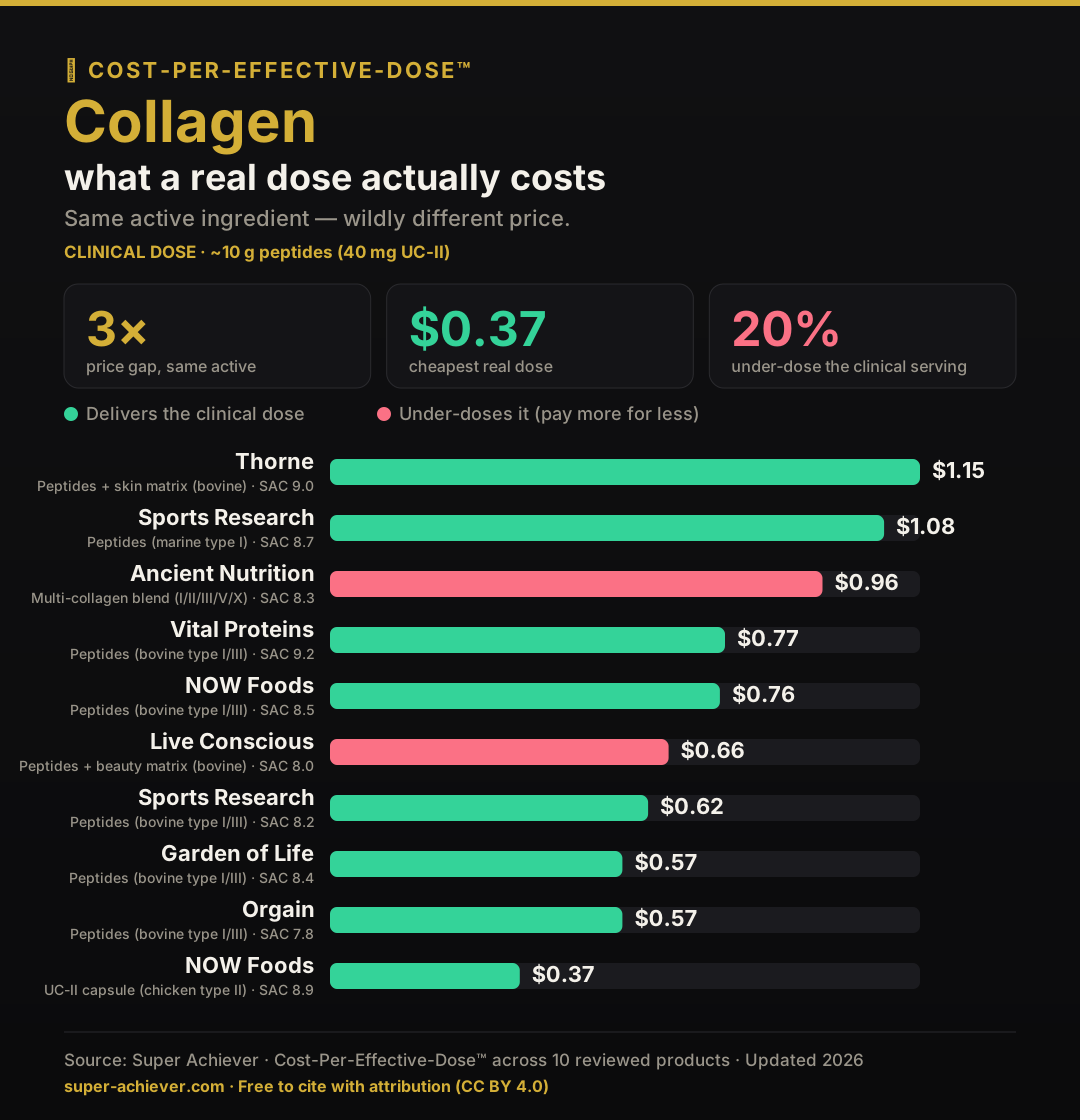
| # | Product | SAC Product Score™ | TXI™ | CPED™ | |
|---|---|---|---|---|---|
| 1 | Vital Proteins Collagen PeptidesPeptides (bovine type I/III) | 9.2 | 20 | $0.77 | |
| 2 | Thorne Collagen PlusPeptides + skin matrix (bovine) | 9.0 | 40 | $1.15 | |
| 3 | NOW UC-II Undenatured Type II CollagenUC-II capsule (chicken type II) | 8.9 | 40 | $0.37 | Best value |
| 4 | Sports Research Collagen Peptides (Marine)Peptides (marine type I) | 8.7 | 40 | $1.08 | |
| 5 | NOW Collagen PeptidesPeptides (bovine type I/III) | 8.5 | 40 | $0.76 | |
| 6 | Garden of Life Grass Fed Collagen PeptidesPeptides (bovine type I/III) | 8.4 | 70 | $0.57 | Most transparent |
| 7 | Ancient Nutrition Multi Collagen ProteinMulti-collagen blend (I/II/III/V/X) | 8.3 | 0 | $0.96 | Under-dosed |
| 8 | Garden of Life Wild Caught & Grass Fed Collagen Hyaluronic AcidPeptides + HA (bovine + marine) | 8.3 | 70 | $0.93 | |
| 9 | Sports Research Collagen Peptides (Bovine)Peptides (bovine type I/III) | 8.2 | 70 | $0.62 | |
| 10 | Live Conscious Collagen PeptidesPeptides + beauty matrix (bovine) | 8.0 | 20 | $0.66 | Under-dosed |
| 11 | Nutricost Collagen Peptides (Vanilla)Peptides (grass-fed bovine, flavored) | 8.0 | 20 | $0.56 | |
| 12 | Orgain Collagen PeptidesPeptides (bovine type I/III) | 7.8 | 20 | $0.57 |
Methodology. SAC Product Score™ blends our editorial rating (RCT quality, dose, safety, value) 50/50 with community ratings. Transparency Index™ (0-100) = third-party certification (0-50) + public batch COA (0-30) + dose honesty (0-20). Cost-Per-Effective-Dose™ is the real price of one clinical dose, not one marketed "serving". Free to cite with attribution to Super Achiever.
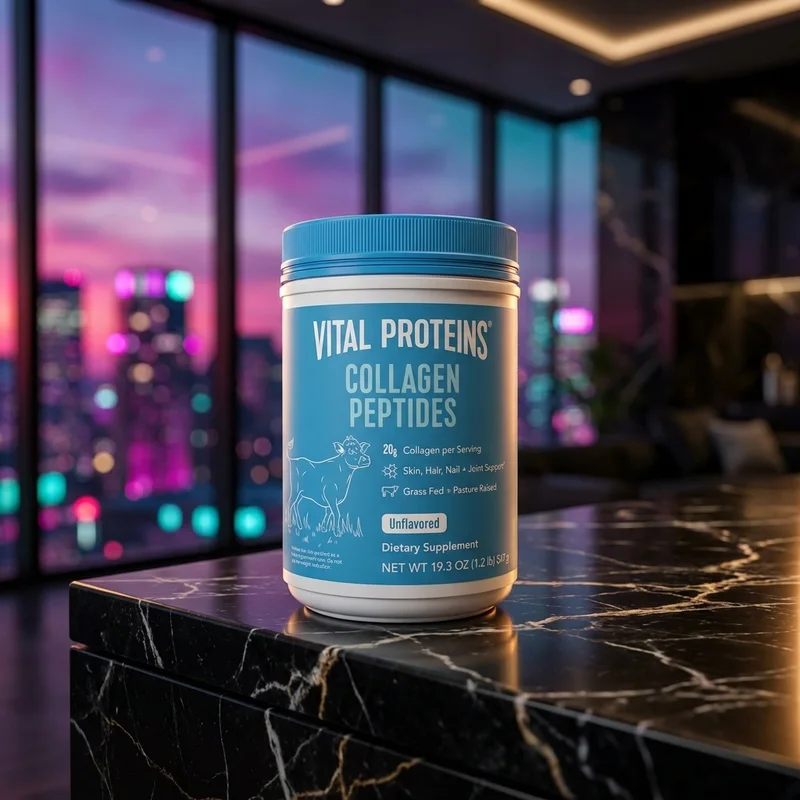
Vital Proteins Collagen Peptides
What is Collagen?
Collagen is the most abundant protein in the human body — the structural scaffold of skin, tendons, ligaments, cartilage, and bone. It is what gives connective tissue its tensile strength and skin its firmness, and the body's own collagen production declines steadily from the mid-20s onward, which is the biological backdrop to both joint wear and skin aging.
Supplemental collagen comes in two genuinely different categories that buyers constantly conflate. The first is HYDROLYZED COLLAGEN (also called collagen peptides or collagen hydrolysate) — collagen broken into small, readily-absorbed peptides, dosed at roughly 10 g/day. This is the form behind the joint-comfort and skin-elasticity trials: the peptides are absorbed, some reach connective tissue, and certain peptide fragments appear to signal fibroblasts and chondrocytes to up-regulate matrix production. The second is UNDENATURED TYPE II COLLAGEN (UC-II) — a tiny ~40 mg dose of intact type II collagen from chicken cartilage that works through an entirely different mechanism (oral tolerance / immune modulation in the gut) and is specific to osteoarthritis.
Source matters less than form: bovine, porcine, marine (fish), and chicken-sternum collagens differ mainly in their type mix (type I dominant in skin/bone, type II in cartilage) and in suitability for pescatarian/halal/kosher diets. What does NOT work is eating gelatin and expecting skin or joint results without hitting the studied dose — the trials used standardised peptide or UC-II products at defined doses, not a scoop of bone broth.
How it works
For joints, there are two evidence streams. UC-II (undenatured type II collagen) at 40 mg/day works through oral tolerance: small amounts of intact type II collagen interacting with gut-associated immune tissue appear to down-regulate the autoimmune-style inflammatory attack on joint cartilage. In Lugo 2016 (PMID 26822714), 40 mg UC-II beat both placebo AND a standard glucosamine+chondroitin combination on total WOMAC score and all three subscales (pain, stiffness, function) over 180 days in knee-OA patients. Separately, hydrolyzed collagen at 10 g/day reduced activity-related joint pain in athletes over 24 weeks in Clark 2008 (PMID 18416885) — here the mechanism is substrate + signalling: absorbed peptides supply building blocks and appear to stimulate cartilage matrix synthesis.
For skin, hydrolyzed peptides have a solid RCT base. Proksch 2014 (PMID 23949208) randomised women to 2.5 or 5.0 g/day collagen peptides or placebo and measured objective improvements in skin elasticity over 8 weeks, with effects persisting after the supplementation period. The proposed mechanism mirrors the joint story: specific peptide fragments survive digestion, reach the dermis, and signal fibroblasts to increase collagen, elastin, and hyaluronic-acid production.
The hair and nail story is the weakest of the three. Collagen supplies the amino acids (glycine, proline, hydroxyproline) used to build keratin-associated structures, and there is early evidence for nail growth and strength — but rigorous hair-specific trials are thin. The honest position: collagen is a reasonable supporting player for hair, downstream of the much stronger joint and skin evidence, not a primary hair-loss treatment.
At-a-glance facts
- Two forms, two jobs
- Hydrolyzed peptides ~10 g/day (skin + general joint) · UC-II 40 mg/day (osteoarthritis)
- Skin trial dose
- 2.5-5 g/day collagen peptides (Proksch 2014)
- Joint trial dose
- 10 g/day hydrolysate (athletes) or 40 mg UC-II (knee OA)
- Time to felt effect
- Skin: 8-12 weeks · Joints: 8 weeks to 6 months
- Sources
- Bovine, marine (fish), porcine, chicken — pick by diet + type (I for skin/bone, II for cartilage)
- Co-factor
- Take with vitamin C — required for collagen cross-linking + synthesis
- Cost range (US)
- $15-40 / month depending on form + dose
- Stack synergy
- Vitamin C (synthesis cofactor), Curcumin + Omega-3 (joint inflammation), Hyaluronic acid (skin)
Evidence: Solid RCT support for the two best-studied uses. Lugo 2016 (PMID 26822714) found 40 mg UC-II superior to placebo AND glucosamine+chondroitin on WOMAC in knee OA; Clark 2008 (PMID 18416885) showed 10 g/day hydrolysate reduced athletes' joint pain over 24 weeks; Proksch 2014 (PMID 23949208) demonstrated objective skin-elasticity gains from 2.5-5 g/day peptides. Hair-specific evidence is comparatively thin — collagen is a supporting, not primary, hair lever.
Who it's for — and who it isn't
- Anyone with knee or general osteoarthritis — UC-II (40 mg) beat glucosamine+chondroitin on WOMAC in a head-to-head RCT
- Active people with training-related joint aches — 10 g/day hydrolyzed collagen reduced joint pain in athletes over 24 weeks
- Anyone targeting skin elasticity, hydration, and fine lines — collagen peptides have repeatable RCT support over 8-12 weeks
- People over ~35 — endogenous collagen synthesis is declining, so the structural-support rationale strengthens with age
- Anyone who wants a single supplement that touches joints, skin, hair and nails — collagen is the broadest structural-tissue play
- Anyone expecting a fast result — both the joint and skin effects take 8 weeks to 6 months of daily dosing to show
- People treating hormonal (pattern) hair loss as the primary goal — collagen is a supporting player; saw palmetto + correcting deficiencies do more
- Anyone relying on bone broth or gelatin for results — those don't reliably hit the studied peptide/UC-II doses
- Strict vegans/vegetarians — all collagen is animal-derived (bovine, marine, porcine, chicken); there is no true plant collagen, only 'boosters'
Week-by-week, what happens
- Week 1-4No felt change — collagen works structurally and cumulatively. Take consistently with vitamin C; nails may be the first thing to respond.
- Week 4-8Skin hydration and early elasticity improvements become measurable (Proksch 2014 window). Athletes notice less training-related joint ache.
- Week 8-12Skin elasticity + fine-line improvements reach trial magnitude. Joint-comfort gains build.
- Month 3-6Osteoarthritis benefits (UC-II) reach the WOMAC improvements seen in Lugo 2016. Maintenance phase — effects persist with continued dosing.
Safety & contraindications
- Collagen is a food protein and very well tolerated; the most common complaints are mild — fullness, a lingering taste, or minor digestive upset. Take with food if sensitive.
- It is animal-derived (bovine, marine, porcine, chicken). Choose marine for pescatarian diets; check for halal/kosher certification if relevant. There is no genuine vegan collagen — 'vegan collagen boosters' supply cofactors, not collagen.
- Allergen note: marine collagen is a fish product — avoid with fish/shellfish allergy. Bovine and chicken sources carry their own allergen considerations.
- Quality + contamination: collagen is rendered from animal tissue, so source quality matters. Buy from brands that publish third-party testing for heavy metals.
- It is not a complete protein (low in tryptophan) — don't count collagen toward your total daily protein target for muscle; it's a structural-tissue supplement, not a protein source.
- Pair with vitamin C, which is required for collagen synthesis and cross-linking; many products include it for this reason.
All articles on Collagen
Best Collagen Supplements
Collagen ranked across both forms — hydrolyzed peptides (skin + connective) vs undenatured type II UC-II (osteoarthritis) — by form, source, third-party testing, and value.
Read →Ancient Nutrition Multi Collagen Protein Review
The broadest coverage in one scoop — for the buyer who doesn't want to choose.
Read →Garden of Life Grass Fed Collagen Peptides Review
The sourcing-certification pick — certified grass-fed, full dose, cofactor built in.
Read →Garden of Life Wild Caught & Grass Fed Collagen Hyaluronic Acid Review
20 g bovine + fish collagen with 120 mg hyaluronic acid, listed by NSF under NSF/ANSI 173; about $1.87 a scoop. 8.3/10.
Read →Live Conscious Collagen Peptides Review
The complete beauty scoop at a value price — vitamin C done right, biotin oversold.
Read →NOW Collagen Peptides Review
Real type I/III peptides at the lowest cost-per-gram on the list.
Read →NOW UC-II Undenatured Type II Collagen Review
The osteoarthritis pick — 40 mg of a genuinely different mechanism.
Read →Nutricost Collagen Peptides Vanilla Review
11 g collagen hydrolysate per scoop with stevia (reb M) at about $0.62 a serving; no certifier listing or COA found. 8.0/10.
Read →Orgain Collagen Peptides Review
The dependable, widely-stocked generalist — good, just not category-leading.
Read →Sports Research Collagen Peptides (Bovine) Review
The clean-label, certification-forward bovine peptide.
Read →Sports Research Collagen Peptides (Marine) Review
The cleanest marine collagen — for fish-source and pescatarian buyers.
Read →Thorne Collagen Plus Review
The skin use case done properly — peptides plus the cofactor in one scoop.
Read →Vital Proteins Collagen Peptides Review
The safe default collagen tub for skin and general connective tissue.
Read →FAQ
Collagen peptides vs UC-II — which one do I buy?
They're different supplements for different goals. Hydrolyzed collagen PEPTIDES (collagen hydrolysate) are dosed at ~10 g/day and are the form behind the skin-elasticity and athlete joint-pain trials — buy these for skin, nails, and general joint/connective-tissue support. UNDENATURED type II collagen (UC-II) is a tiny 40 mg dose that works through a completely different (immune/oral-tolerance) mechanism and is specific to osteoarthritis — in Lugo 2016 (PMID 26822714) it beat glucosamine+chondroitin on knee-OA WOMAC. If your goal is skin or you want broad structural support, peptides. If your goal is diagnosed knee osteoarthritis, UC-II is the more targeted (and far smaller) dose.
Does collagen actually do anything for skin, or is it marketing?
For skin elasticity and hydration, the RCT evidence is real and repeatable. Proksch 2014 (PMID 23949208) randomised women to 2.5-5 g/day collagen peptides versus placebo and measured objective improvements in skin elasticity over 8 weeks, with effects persisting afterward — and several later trials have replicated the direction. The mechanism is that specific peptide fragments survive digestion and appear to signal dermal fibroblasts to make more collagen and elastin. It's not instant — judge it at 8-12 weeks — and it won't replace sunscreen or retinoids, but the 'collagen does nothing for skin' claim is outdated.
Will collagen regrow my hair?
Be skeptical of strong hair claims. Collagen supplies the amino acids your body uses to build keratin structures, and there's early evidence for nail growth and strength — but rigorous hair-specific trials are thin. The honest take: collagen is a reasonable supporting player for hair, downstream of its much stronger joint and skin evidence. If hormonal (pattern) hair loss is your actual problem, a DHT lever like saw palmetto and correcting deficiencies (iron, zinc) will do more than collagen.
Bovine, marine, or chicken — does the source matter?
Less than the form, but it's not irrelevant. The main differences are the collagen TYPE mix and dietary fit. Type I (dominant in bovine and marine) is the skin/bone/tendon collagen; type II (chicken sternum, the UC-II source) is cartilage collagen. Marine collagen is favored for pescatarians and has small, well-absorbed peptides but is a fish allergen. Bovine is the most common and cost-effective for general peptides. For osteoarthritis specifically, the studied product is chicken-derived UC-II at 40 mg.
Do I need to take vitamin C with collagen?
It's a smart pairing. Vitamin C is a required cofactor for the enzymes that synthesise and cross-link collagen in your tissues — without adequate vitamin C, the body literally can't build collagen properly (the extreme case is scurvy). Many collagen products bundle vitamin C for this reason. You don't need a megadose; ordinary vitamin-C sufficiency is enough to support the pathway.
Sources & further reading
- Lugo 2016 (UC-II, knee OA)Efficacy and tolerability of an undenatured type II collagen supplement in modulating knee osteoarthritis symptoms: a multicenter randomized, double-blind, placebo-controlled study
191 knee-OA subjects, 180 days: 40 mg/day undenatured type II collagen (UC-II) significantly reduced total WOMAC and all three subscales (pain, stiffness, function) versus both placebo AND glucosamine+chondroitin. The head-to-head trial behind UC-II's osteoarthritis claim.
- Clark 2008 (athletes' joint pain)24-Week study on the use of collagen hydrolysate as a dietary supplement in athletes with activity-related joint pain
147 athletes, 24 weeks: 10 g/day collagen hydrolysate significantly reduced activity-related joint pain versus placebo. The first long-duration trial showing hydrolyzed collagen improves joint pain in an active population.
- Proksch 2014 (skin elasticity)Oral supplementation of specific collagen peptides has beneficial effects on human skin physiology: a double-blind, placebo-controlled study
69 women, 8 weeks: 2.5-5 g/day collagen peptides produced objective improvements in skin elasticity versus placebo, with effects persisting after the supplementation period. A cornerstone trial for collagen's skin claim.