
Curcumin: Benefits, Dosage & Side Effects (2026)
Curcumin is the principal anti-inflammatory polyphenol in turmeric, with RCT evidence matching NSAIDs for knee-osteoarthritis pain — but only in bioavailability-enhanced forms, since raw curcumin is poorly absorbed.
The Curcumin market in numbers
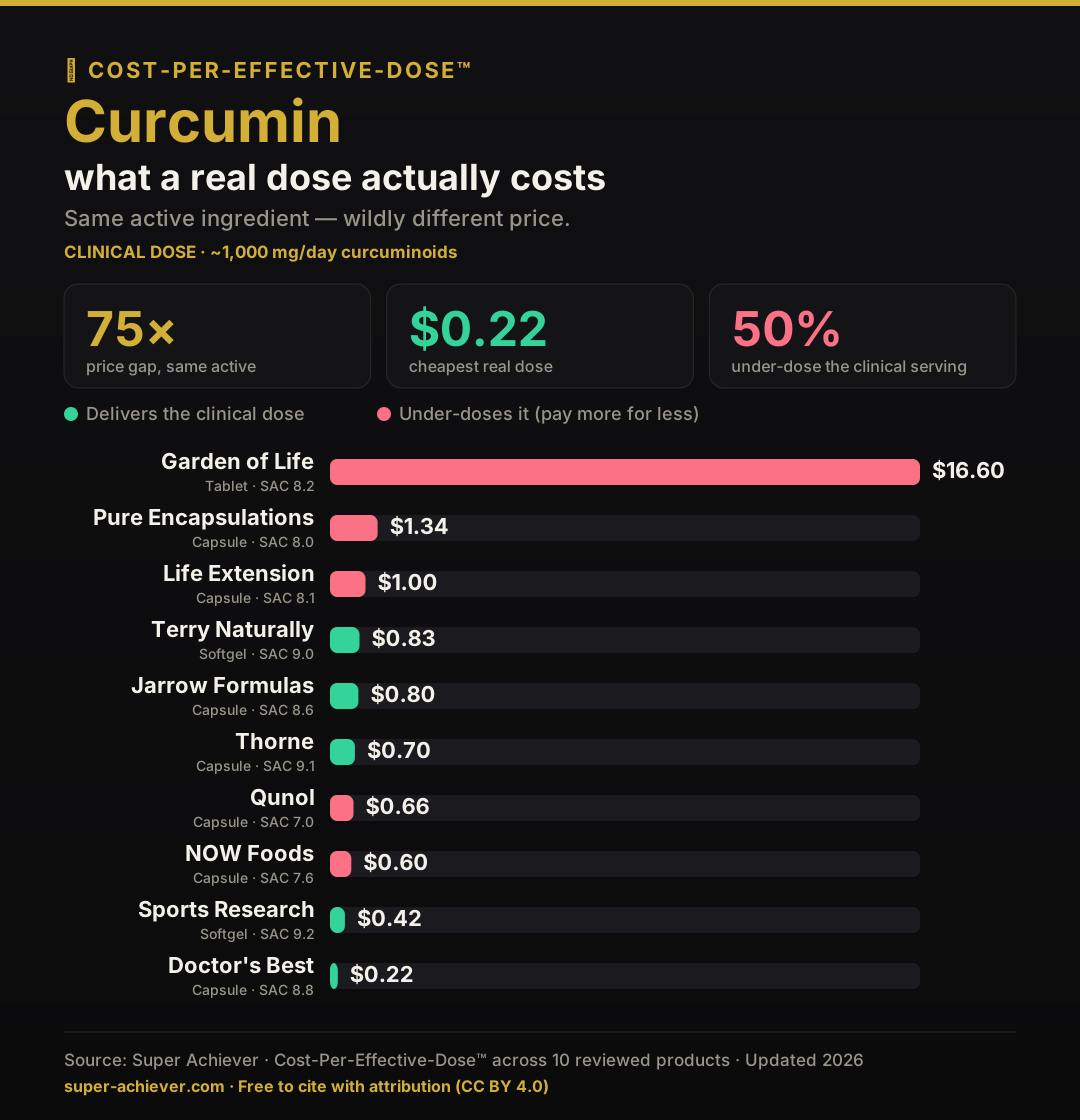
Our independent analysis of 10 curcumin products, scored on three proprietary indices — the SAC Product Score™, Transparency Index™, and real Cost-Per-Effective-Dose™. Updated October 2026.
| # | Product | SAC Product Score™ | TXI™ | CPED™ | |
|---|---|---|---|---|---|
| 1 | Sports Research Turmeric Curcumin C3 Complex + BioPerineSoftgel | 9.2 | 20 | $0.42 | Most transparent |
| 2 | Thorne Meriva-SF (Curcumin Phytosome)Capsule | 9.1 | 20 | $0.70 | |
| 3 | Terry Naturally CuraMed (BCM-95)Softgel | 9.0 | 20 | $0.83 | |
| 4 | Doctor's Best High Absorption Curcumin C3 Complex + BioPerineCapsule | 8.8 | 20 | $0.22 | Best value |
| 5 | Jarrow Formulas Curcumin Phytosome (Meriva)Capsule | 8.6 | 20 | $0.80 | |
| 6 | Garden of Life mykind Organics TurmericTablet | 8.2 | 0 | $16.60 | Under-dosed |
| 7 | Life Extension Super Bio-Curcumin (BCM-95)Capsule | 8.1 | 0 | $1.00 | Under-dosed |
| 8 | Pure Encapsulations Curcumin 500 with BioPerineCapsule | 8.0 | 0 | $1.34 | Under-dosed |
| 9 | NOW Curcumin Extract (95% Curcuminoids)Capsule | 7.6 | 20 | $0.60 | Under-dosed |
| 10 | Qunol Turmeric Curcumin ComplexCapsule | 7.0 | 0 | $0.66 | Under-dosed |
Methodology. SAC Product Score™ blends our editorial rating (RCT quality, dose, safety, value) 50/50 with community ratings. Transparency Index™ (0-100) = third-party certification (0-50) + public batch COA (0-30) + dose honesty (0-20). Cost-Per-Effective-Dose™ is the real price of one clinical dose, not one marketed "serving". Free to cite with attribution to Super Achiever.
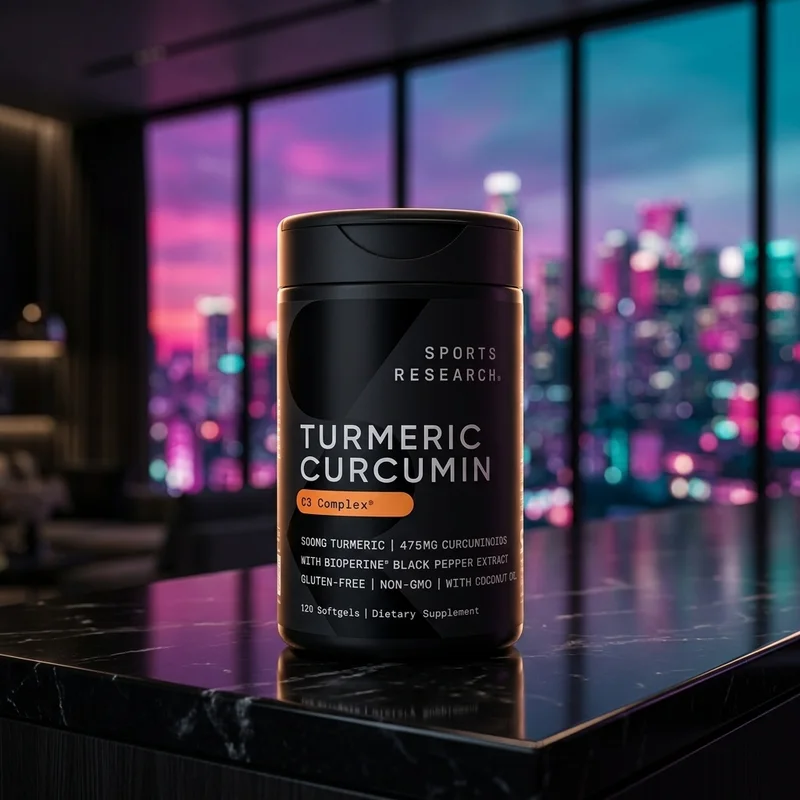
Sports Research Turmeric Curcumin C3 Complex + BioPerine
What is Curcumin?
Curcumin is the main curcuminoid in turmeric (Curcuma longa) — the yellow polyphenol behind the spice's colour and the molecule behind almost all of turmeric's measured health effects. Turmeric root is only about 2-5% curcuminoids by weight, which is why "turmeric" and "curcumin" are not interchangeable: a teaspoon of culinary turmeric delivers a tiny, sub-therapeutic curcumin dose, while the supplement category is standardised concentrated extract (typically 95% curcuminoids).
The defining problem with curcumin is bioavailability. Plain curcumin is poorly water-soluble, badly absorbed in the gut, rapidly metabolised by the liver, and quickly excreted — so a large fraction of a standard capsule never reaches the bloodstream. This is the single most important thing a buyer needs to understand, because it splits the market into products that work and products that don't. The clinical trials almost never used plain curcumin; they used absorption-enhanced formulations: curcumin plus piperine (black-pepper extract, which slows curcumin's metabolic clearance), or branded phospholipid/micellar/nanoparticle systems (Meriva, Longvida, BCM-95, Theracurmin) engineered specifically to raise blood levels many-fold over the raw compound.
So the practical definition of a useful curcumin supplement is: a standardised 95%-curcuminoid extract delivered in a bioavailability-enhanced form. "Turmeric 500 mg" on a budget label, with no curcuminoid percentage and no absorption enhancer, is the product to skip — it's the form the evidence base did not test.
How it works
Curcumin's anti-inflammatory action is broad and multi-target rather than a single mechanism. Its best-characterised lever is inhibition of NF-κB, the master transcription factor that switches on inflammatory gene programs; by damping NF-κB signalling, curcumin lowers downstream production of pro-inflammatory cytokines (TNF-α, IL-1β, IL-6) and inflammatory enzymes (COX-2, 5-LOX, iNOS). This is mechanistically distinct from NSAIDs, which block COX enzymes directly — curcumin works further upstream, which is part of why it produces a comparable pain effect with a very different (and generally gentler) side-effect profile.
The clinical payoff shows up most clearly in osteoarthritis. Kuptniratsaikul 2014 (PMID 24672232) randomised knee-OA patients to a standardised Curcuma domestica extract versus ibuprofen and found the curcumin arm non-inferior on pain and function — with significantly fewer gastrointestinal adverse events than ibuprofen. The Daily 2016 meta-analysis (PMID 27533649) pooled the arthritis RCTs and concluded that roughly 1,000 mg/day of curcumin produced meaningful reductions in pain (VAS) and WOMAC scores versus placebo. Wang 2021 (PMID 33511486) reached the same direction in a more recent systematic review of turmeric extracts for knee OA: real symptomatic benefit with a favourable safety profile.
Beyond joints, the same NF-κB / cytokine down-regulation is why curcumin is studied for systemic inflammation — trials report reductions in circulating inflammatory markers such as CRP. The effect size is real but dose- and formulation-dependent: it is a genuine anti-inflammatory, not a painkiller you feel in an hour, and the benefits accrue over weeks of consistent dosing with an absorbable product.
At-a-glance facts
- Active compound
- Curcuminoids (turmeric is only ~2-5% by weight; extracts are standardised to 95%)
- Trial dose
- ~1,000 mg/day curcuminoids for osteoarthritis (Daily 2016)
- Form is everything
- Use piperine-paired or phospholipid/micellar forms (Meriva, Longvida, BCM-95, Theracurmin) — raw curcumin is poorly absorbed
- Time to felt effect
- Joint pain: 4-8 weeks of consistent dosing (not an acute painkiller)
- Mechanism
- Upstream anti-inflammatory — inhibits NF-κB → lowers TNF-α, IL-6, COX-2 (distinct from NSAIDs)
- Timing
- With a fat-containing meal (fat-soluble); split AM/PM for steadier levels
- Cost range (US)
- $15-35 / month for a properly formulated, absorption-enhanced extract
- Stack synergy
- Omega-3 (parallel anti-inflammatory), Boswellia (5-LOX pathway), Collagen (joint structure)
Evidence: Strong, consistent RCT base for osteoarthritis. Kuptniratsaikul 2014 (PMID 24672232) found a standardised turmeric extract non-inferior to ibuprofen for knee OA with fewer GI side effects; Daily 2016 (PMID 27533649) meta-analysed the arthritis RCTs and found meaningful pain/WOMAC reductions at ~1,000 mg/day; Wang 2021 (PMID 33511486) confirmed the direction for turmeric extracts in knee OA. The decisive caveat is bioavailability — benefits track with absorption-enhanced formulations, not raw curcumin.
Who it's for — and who it isn't
- Anyone with knee or hand osteoarthritis — curcumin matched ibuprofen on pain + function in head-to-head RCTs, with far fewer GI side effects
- People who can't tolerate NSAIDs long-term — curcumin offers a gentler route to similar pain relief via a different (upstream) mechanism
- Anyone managing chronic low-grade inflammation — the NF-κB / cytokine down-regulation lowers markers like CRP over weeks
- Active people with training-related joint aches and stiffness — a reasonable daily anti-inflammatory base, often stacked with omega-3
- Buyers willing to pay for a real, absorbable formulation — this is one of the few supplements where form is the difference between effect and nothing
- Anyone expecting a fast painkiller — curcumin is a slow, cumulative anti-inflammatory, not an acute analgesic; judge it over 4-8 weeks
- People on blood thinners (warfarin, DOACs) or antiplatelet drugs — curcumin has mild antiplatelet activity and can add to bleeding risk; clear it with your prescriber
- Anyone buying raw 'turmeric powder' capsules with no curcuminoid % and no absorption enhancer — that's the form the evidence did NOT test
- People with gallstones or bile-duct obstruction — curcumin stimulates bile flow and can aggravate these conditions
Week-by-week, what happens
- Week 1-2Little felt change — curcumin works cumulatively, not acutely. Take consistently with fatty meals; don't judge it yet.
- Week 3-4Early responders notice reduced morning joint stiffness and easier movement. Inflammatory markers begin trending down on bloodwork.
- Week 4-8Osteoarthritis pain + function improvements reach the magnitude seen in the trials (Daily 2016 timeline). This is the window to judge efficacy.
- Week 8+Maintenance. Effects persist with continued dosing; they fade if you stop, since curcumin modulates ongoing inflammatory signalling rather than curing the underlying cause.
Safety & contraindications
- Curcumin has mild antiplatelet/anticoagulant activity. If you take warfarin, a DOAC, aspirin, or other antiplatelet drugs, talk to your prescriber before adding it — the additive bleeding risk is the main real-world concern.
- It stimulates bile flow and gallbladder contraction. Avoid therapeutic doses if you have gallstones or a bile-duct obstruction.
- Generally very well tolerated at supplement doses; the most common complaint is mild GI upset (nausea, loose stools), usually at high doses or on an empty stomach. Take with food.
- Piperine (black-pepper extract) is added to boost absorption — but it also inhibits drug-metabolising enzymes (CYP3A4, etc.) and can raise blood levels of some medications. If you take prescription drugs, prefer a piperine-free absorption system (phospholipid/micellar) and check interactions.
- Stop curcumin 1-2 weeks before scheduled surgery because of the antiplatelet effect.
- Buy standardised 95%-curcuminoid extracts in a named bioavailable form from brands that publish third-party testing — turmeric supplements have been a target for adulteration and heavy-metal (lead) contamination at the cheap end.
All articles on Curcumin
Best Curcumin Supplements
Curcumin supplements ranked by bioavailable form first (phytosome / BCM-95 / Longvida / C3 + BioPerine beat raw turmeric), then dose, third-party testing, and cost per absorbed mg.
Read →Doctor's Best High Absorption Curcumin C3 Complex + BioPerine Review
The cheapest curcumin that actually works — same C3 + BioPerine science, half the price.
Read →Garden of Life mykind Organics Turmeric Review
The cleanest organic label on the list — but a wellness dose, not a clinical one.
Read →Jarrow Formulas Curcumin Phytosome (Meriva) Review
The value entry point to phytosome absorption — same Meriva, far less money.
Read →Life Extension Super Bio-Curcumin (BCM-95) Review
The value BCM-95 — same no-pepper high-absorption form as CuraMed, lower price.
Read →NOW Curcumin Extract (95% Curcuminoids) Review
A quality 95% extract — but you have to solve the absorption yourself.
Read →Pure Encapsulations Curcumin 500 with BioPerine Review
The cleanest standardized-extract label — same C3 + BioPerine, clinician-grade formulation.
Read →Qunol Turmeric Curcumin Complex Review
A convenient drugstore turmeric with real (but modest) absorption tech.
Read →Sports Research Turmeric Curcumin C3 Complex + BioPerine Review
The default first-time curcumin pick — real absorption at the best price.
Read →Terry Naturally CuraMed (BCM-95) Review
The premium essential-oil-complex form — high absorption, no black pepper.
Read →Thorne Meriva-SF (Curcumin Phytosome) Review
The maximum-absorption curcumin form — clinician-grade, soy-free, piperine-free.
Read →FAQ
Turmeric vs curcumin — what's the difference, and which do I buy?
Turmeric is the whole root/spice; curcumin (more precisely, the curcuminoids) is the active fraction inside it, making up only about 2-5% of turmeric by weight. Cooking with turmeric delivers a tiny, sub-therapeutic curcumin dose. For an actual effect you want a supplement standardised to 95% curcuminoids in an absorption-enhanced form. So: buy a 'curcumin' or 'turmeric extract' product that states the curcuminoid percentage AND an absorption system — not a plain 'turmeric 500 mg' capsule.
Why does bioavailability matter so much for curcumin?
Plain curcumin is poorly water-soluble, badly absorbed, rapidly metabolised by the liver, and quickly excreted — so much of a standard capsule never reaches your blood. The clinical trials almost never used plain curcumin; they used enhanced forms: curcumin + piperine (black pepper, which slows clearance), or engineered phospholipid/micellar/nanoparticle systems (Meriva, Longvida, BCM-95, Theracurmin) that raise blood levels many-fold. This is the single biggest mistake buyers make — a cheap, unformulated turmeric capsule is the form the evidence base did not test, and largely doesn't work.
Does curcumin really work as well as ibuprofen for joint pain?
For knee osteoarthritis, the head-to-head data are genuinely impressive. Kuptniratsaikul 2014 (PMID 24672232) randomised patients to a standardised turmeric extract versus ibuprofen and found curcumin non-inferior on pain and function — with significantly fewer gastrointestinal side effects. The Daily 2016 meta-analysis (PMID 27533649) pooled the arthritis RCTs and found meaningful pain reductions at ~1,000 mg/day. The catch: it's not an acute painkiller. You take it daily and judge it at 4-8 weeks, not in an hour.
How much curcumin should I take, and when?
The osteoarthritis trials cluster around ~1,000 mg/day of curcuminoids (often split into two doses), in an absorption-enhanced form. Take it with a meal containing fat, since curcumin is fat-soluble. If you're using a high-potency branded delivery system (Longvida, Theracurmin, Meriva), the effective curcuminoid dose can be lower because more of it is absorbed — follow the product's standardisation, not the raw milligram number on a cheap label.
Is curcumin safe to take every day long-term?
For most people, yes — it's one of the better-tolerated supplements at standard doses, and the trials ran for weeks to months. The real cautions are specific: it has mild antiplatelet activity (a concern if you're on blood thinners or heading into surgery), it stimulates bile flow (avoid with gallstones), and piperine-containing products can alter how you metabolise some medications. If you take prescription drugs, prefer a piperine-free absorption system and check interactions with your pharmacist.
Should I stack curcumin with anything for joints?
Curcumin and omega-3 are the natural anti-inflammatory pair — they work through parallel pathways and are the two best-evidenced joint/inflammation supplements. Boswellia adds a complementary mechanism (it inhibits 5-LOX, which curcumin only partly touches). Collagen targets the structural/cartilage side rather than inflammation, so it stacks without overlap. A reasonable joint base is curcumin + omega-3, adding boswellia for stubborn osteoarthritis and collagen for cartilage support.
Sources & further reading
- Kuptniratsaikul 2014 (vs ibuprofen)Efficacy and safety of Curcuma domestica extracts compared with ibuprofen in patients with knee osteoarthritis: a multicenter study
Randomised, multicenter trial: a standardised turmeric (Curcuma domestica) extract was non-inferior to ibuprofen for knee-osteoarthritis pain and function over 4 weeks, with significantly fewer gastrointestinal adverse events. The cornerstone head-to-head trial behind curcumin's joint claim.
- Daily 2016 (arthritis meta-analysis)Efficacy of Turmeric Extracts and Curcumin for Alleviating the Symptoms of Joint Arthritis: A Systematic Review and Meta-Analysis of Randomized Clinical Trials
Systematic review + meta-analysis of arthritis RCTs: ~1,000 mg/day of curcumin produced significant reductions in pain (VAS) and WOMAC scores versus placebo. Concluded turmeric/curcumin extracts are effective for arthritis symptoms, while flagging the need for larger, better-standardised trials.
- Wang 2021 (knee-OA systematic review)Effectiveness of Curcuma longa Extract for the Treatment of Symptoms and Effusion-Synovitis of Knee Osteoarthritis
Recent systematic review of turmeric/Curcuma longa extracts for knee osteoarthritis: consistent symptomatic pain benefit with a favourable safety profile versus placebo, reinforcing the older RCT base.