
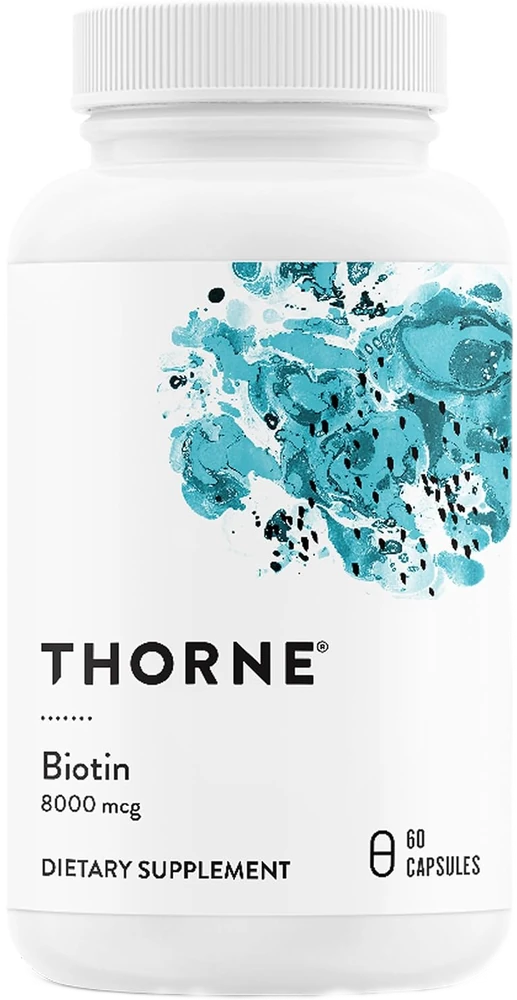
THORNE Biotin (Vitamin B7), Third-Party Certified, 60 Capsules Review
 #2 of 9 · Best Third-Party Tested✓ Label verified · Supplement Facts read Sep 7, 2026
Real retailer photo, cut out. Label unedited.
Consider it. The cleanest premium capsule -- but the 8 mg dose is overkill for most buyers. Third-Party Certified, hypoallergenic, superbly made.
~$16~$0.27/serving
Why It Scores 7.9 — And The Label Line Behind Each Number
Third-Party Testing & Purity
30% of scoreThird-Party Certified through Thorne's multi-lab testing program, one of the most rigorous in the supplement industry. Just behind Nature Made's USP seal only because USP is a single universally recognized standard.
- Testing
- Third-Party Certified (Thorne multi-lab program)
Dose Sensibility
25% of score8,000 mcg is a frank megadose that no diet requires and that maximizes troponin/thyroid immunoassay interference (Li 2017, PMID 28973622). This is the pick's biggest weakness and the main reason it sits below Nature Made.
- Dose
- 8 mg (8,000 mcg) per capsule
Formulation Integrity
20% of scoreHypoallergenic capsule with minimal excipients; gluten-, dairy- and soy-free. Genuinely clean formulation with practitioner-grade sourcing.
- Form
- d-Biotin capsule
Value per Serving
15% of score~$0.27/serving is the highest cost per serving in the set. You are paying a real premium for the certification and purity.
- Count
- 60 capsules / 60-day supply
- Serving size
- 1 capsule daily
- Cost per serving
- ~$0.27
- Price
- ~$16
Suitability & Transparency
10% of scoreExcellent transparency and clinician trust; hypoallergenic profile suits sensitive users. Loses a little only because the megadose narrows who it is genuinely appropriate for.
- More Specs
- Free-from
- Gluten, dairy & soy-free; hypoallergenic
Label verified. Every figure read from the Supplement Facts photo, Sep 7, 2026.
Marketing Claims Vs. Reality
Third-Party Certified
Thorne runs a documented multi-lab third-party certification program; the certification is genuine and among the most rigorous QC processes in the industry.
Hypoallergenic, practitioner-grade formulation
The capsule uses minimal excipients and is free of gluten, dairy and soy; Thorne is widely used by clinicians, consistent with the hypoallergenic claim.
8 mg supports hair, skin and nail health
Biotin is a keratin-metabolism cofactor, but benefit is demonstrated only in deficiency (Patel 2017, PMID 28879195). The 8 mg level exceeds any dietary need for a healthy person.
Appropriate everyday dose
No diet requires 8,000 mcg, and this dose maximizes immunoassay interference (Li 2017, PMID 28973622; Moerman 2022, PMID 32567529). It is a therapeutic megadose, not an everyday amount.
What Our Test Actually Found
Genuinely the cleanest certification
Thorne's multi-lab third-party program is a real, verifiable credential -- second only to USP here. For buyers who prioritize testing rigor above all, this is a legitimate top-two choice.
The dose is the problem
8 mg is roughly triple Nature Made's already-generous 2,500 mcg. Because biotin only helps hair in deficiency, the extra milligrams add no benefit -- only a larger lab-interference footprint.
You pay for the badge
At ~$0.27/serving this is the most expensive pick per capsule. The premium is real and buys real purity, but the megadose means much of it is spent on biotin the body simply excretes.
Right buyer, narrow fit
If a clinician diagnosed a deficiency, this is arguably the best capsule to correct it. For a healthy person chasing hair growth, it is superb quality aimed at a problem they don't have.
Full analysis: all pros & cons (8), buy if / skip if
- Third-Party Certified through Thorne's multi-lab program
- Hypoallergenic capsule with minimal excipients
- Gluten, dairy and soy-free
- Clinician-trusted, practitioner-grade brand
- Excellent labeling transparency
- 8,000 mcg is a megadose no diet requires
- Priciest per serving in the set (~$0.27)
- High dose maximizes troponin/thyroid lab interference
- A clinician has actually diagnosed a biotin deficiency
- You want practitioner-grade, third-party-certified purity
- You need a gluten-, dairy- and soy-free hypoallergenic capsule
- You want the lowest sensible dose (choose Nature Made instead)
- You care about cost per serving -- this is the priciest here
Third-Party Certified, hypoallergenic, superbly made. Best if a clinician diagnosed a deficiency and you want the purest capsule. For everyone else the megadose buys nothing but a bigger lab-interference footprint at the highest price per serving here.
Thorne is the brand clinicians reach for, and this hypoallergenic capsule earns that reputation: Third-Party Certified through Thorne's multi-lab program, minimal excipients, free of gluten, dairy and soy. The catch is the dose -- 8,000 mcg is a megadose no diet requires, which maximizes lab-interference risk and pushes the cost to the highest per serving in the set.
Superb quality aimed at a problem most buyers don't have

This is the best choice if a clinician has actually diagnosed a deficiency and you want the cleanest possible capsule. For everyone else the 8 mg dose is overkill that buys nothing but a bigger lab-interference footprint at the highest price per serving in the set. The certification and formulation are excellent; the dose is the reason it lands second rather than first.
If This Doesn’t Fit — Try These
 01
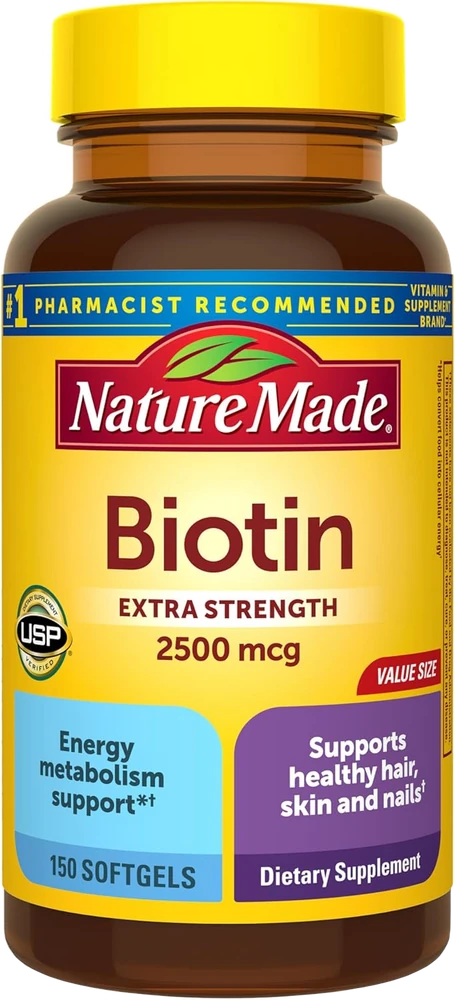
01Nature Made Biotin 2,500 mcg
Our take: If you're going to take biotin at all, this is the one to buy.
 04
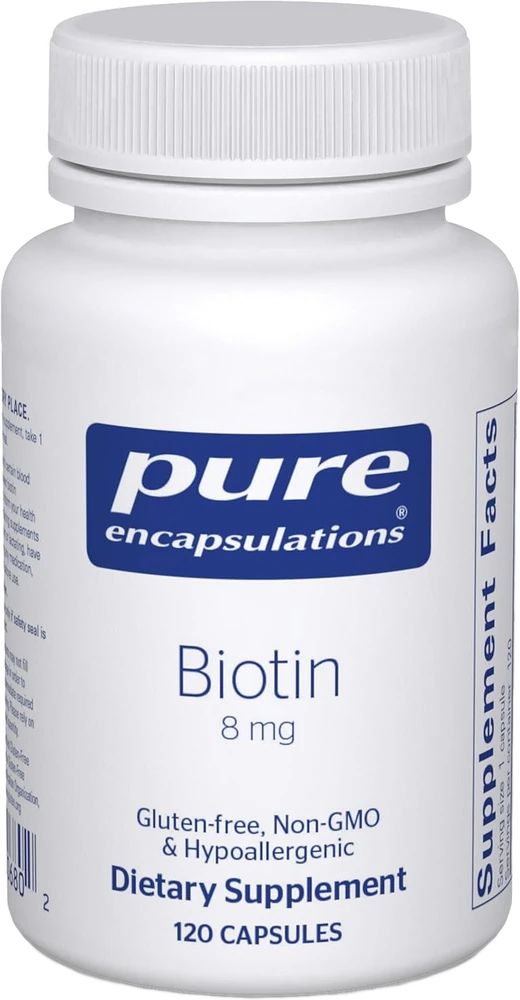
04Pure Encapsulations Biotin 8 mg
Our take: Buy it if hypoallergenic purity is your top priority and you don't mind paying up.
 03
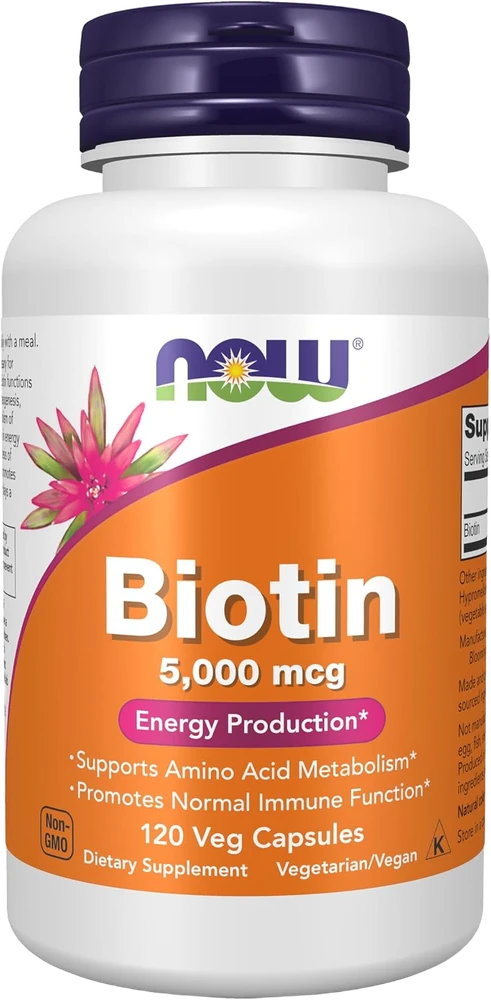
03NOW Biotin 5,000 mcg
Our take: The best pick for someone who wants a clean, allergen-friendly capsule from a brand that actually runs its own testing labs, without paying boutique prices.
Quick Answers
Is Thorne worth the higher price?
For the certification and hypoallergenic purity, yes -- it is genuinely one of the best-tested bottles here. But the 8 mg dose adds no hair benefit over a much cheaper, lower-dose option, so the value case depends on why you're buying.
Do I need 8,000 mcg of biotin?
Almost certainly not. No normal diet requires it, and biotin only helps hair in true deficiency. A clinician-diagnosed deficiency is the main scenario where this dose makes sense.
Will this interfere with my lab tests?
More than most, because of the high dose. Biotin at this level can distort troponin and thyroid immunoassays (Li 2017; Moerman 2022). Stop it several days before bloodwork and tell your doctor.
Is it suitable for allergies?
Yes -- it is hypoallergenic and free of gluten, dairy and soy, which is one of its genuine strengths.
Sources & Further Reading
3 peer-reviewed sources, each linked to PubMed
- [1] Patel DP, Swink SM, Castelo-Soccio L. A Review of the Use of Biotin for Hair Loss. Skin Appendage Disord. 2017;3(3):166-169. PMID 28879195 — A Review of the Use of Biotin for Hair Loss. Biotin improves hair only in genuine deficiency; no benefit is demonstrated in healthy people, so doses above a modest replacement level add no hair benefit.
- [2] Li D, Radulescu A, Shrestha RT, et al. Association of Biotin Ingestion With Performance of Hormone and Nonhormone Assays in Healthy Adults. JAMA. 2017;318(12):1150-1160. PMID 28973622 — Association of Biotin Ingestion With Performance of Hormone and Nonhormone Assays in Healthy Adults. Higher biotin doses more strongly distort troponin, thyroid and hormone immunoassays, increasing the risk of clinically misleading lab results.
- [3] Moerman KL, et al. Biotin interference in immunoassays. Clin Chim Acta. 2022. PMID 32567529 — Biotin interference in clinical immunoassays. Supplemental biotin interferes with a range of biotin-streptavidin-based immunoassays, corroborating the need to stop high-dose biotin before laboratory testing.
Affiliate disclosure: every Amazon link uses our Associates tag (superachieverclub-20). We earn a small commission at no cost to you; it funds independent reviews. We never accept payment to change a ranking.