
Spirulina: Benefits, Dosage & Side Effects (2026)
Spirulina is a protein-dense blue-green cyanobacterium (Arthrospira platensis) with randomized-trial evidence for allergic-rhinitis symptoms and blood lipids at 2-3 g a day, judged on dose and clean sourcing.
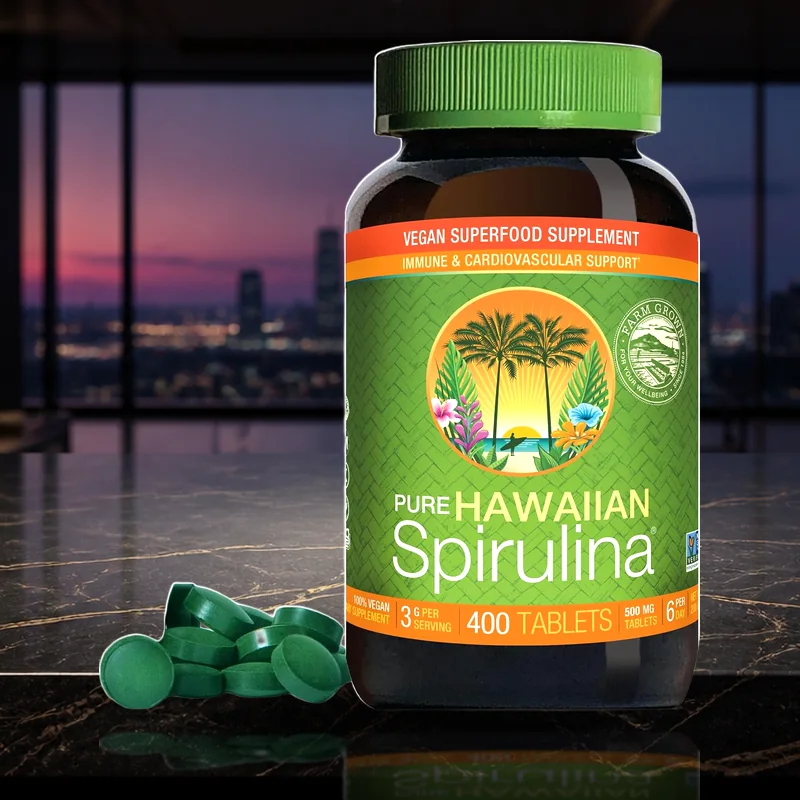
Nutrex Hawaii Pure Hawaiian Spirulina 500 mg Tablets
What is Spirulina?
Spirulina is the dried biomass of Arthrospira platensis, a filamentous cyanobacterium ("blue-green alga") that has been eaten around alkaline lakes in Chad and Mexico for centuries and is now farmed in controlled ponds in Hawaii, California, India, China and Taiwan. By dry weight it is roughly 60 percent protein, with iron, B vitamins, gamma-linolenic acid, carotenoids and the blue pigment protein c-phycocyanin that gives it its colour and most of its pharmacology.
It is sold as a powder (typically a 3 g teaspoon or scoop) and as 500 mg or 1,000 mg tablets. Because it is a whole organism rather than an extract, dose is counted in grams, and the human trials used 1-8 g a day, most often 2-3 g. A single 500 mg tablet, the most common retail format, is a sixth of that.
How it works
Spirulina's effects come from several constituents rather than one active. C-PHYCOCYANIN inhibits inflammatory enzymes and scavenges radicals in cell and animal work, and it is the leading explanation for the allergy findings: in a six-month placebo-controlled trial 2 g a day reduced nasal discharge, sneezing, congestion and itching in allergic rhinitis (Cingi 2008), and a twelve-week study found 2,000 mg a day cut interleukin-4, the cytokine that drives allergic responses, by about a third (Mao 2005).
The LIPID and GLUCOSE effects are the best-replicated: meta-analyses of randomized trials show lower total cholesterol, LDL and triglycerides, higher HDL, and lower fasting glucose and diastolic pressure at 1-8 g a day (Serban 2016; Huang 2018), plausibly through phycocyanin's effect on hepatic lipid handling and the algae's polysaccharide and protein content displacing other calories. Small weight and waist reductions appear in people with obesity (Moradi 2019).
A PERFORMANCE signal exists but is thin: 6 g a day for four weeks increased time to fatigue and fat oxidation during a two-hour run in trained men (Kalafati 2010). Immune-marker changes in older adults come from a small open-label study (Selmi 2011). None of it supports 'boosting immunity' as a general claim.
At-a-glance facts
- What it is
- Dried Arthrospira platensis, a blue-green cyanobacterium; ~60% protein by dry weight with c-phycocyanin, iron, GLA and carotenoids
- Studied dose
- 2 g/day (allergic rhinitis, 6 months); 1-8 g/day pooled in the lipid meta-analyses; 6 g/day in the endurance trial
- Typical retail serving
- 3 g teaspoon or scoop of powder; 500 mg or 1,000 mg tablets (six 500 mg tablets = 3 g)
- Best-evidenced effects
- Fewer allergic-rhinitis symptoms; lower total cholesterol, LDL, triglycerides and fasting glucose
- Time to effect
- Cytokine shift by 12 weeks; symptom relief measured at 6 months; lipid changes in 2-6 month trials
- Key active
- C-phycocyanin — only Earthrise prints its content (165 mg per 3 g) among the products we ranked
- The real caveat
- Contamination: heavy metals and cyanotoxins from uncontrolled water; buy named-pond, tested or organic-certified
- Safety flags
- Phenylketonuria (phenylalanine); autoimmune disease; a printed Prop 65 lead warning on one budget powder
- Evidence level
- 3 of 5 — several RCTs and meta-analyses, modest effect sizes, allergy and lipid outcomes
- Cost range (US)
- ~$0.13 to $0.64 per 3 g dose; tablets from a named US farm cost the most
Evidence: Randomized, placebo-controlled trials and meta-analyses exist for allergic-rhinitis symptoms and for lipids and glucose, but effect sizes are modest, most trials are small and short, and the broad 'immune' and 'detox' claims have no human-trial support.
Who it's for — and who it isn't
- Seasonal allergy sufferers who want a food-based lever with a six-month placebo-controlled trial behind it
- People working on cholesterol, triglycerides or fasting glucose alongside diet, where meta-analyses show modest gains
- Vegans and vegetarians who want a dense plant source of protein and iron
- Endurance athletes curious about the fat-oxidation and time-to-fatigue signal at 6 g a day
- Anyone who wants a 'superfood' that has actually been through randomized trials
- People with phenylketonuria — spirulina is rich in phenylalanine
- People with autoimmune conditions or on immunosuppressants, without clinician input; it is immunologically active
- Anyone buying it as a general 'immune booster' or a cure for anything; the evidence is allergy, lipids and glucose, modest in size
- Buyers who will take one 500 mg tablet a day and expect the effects of the 2-3 g trials
- Anyone unwilling to check sourcing; poorly controlled cultures can carry heavy metals or cyanotoxins
Week-by-week, what happens
- Day 1-7Nothing to feel. Spirulina is a food; expect green-tinted stools and possibly mild bloating as you start, no acute effect.
- Week 4-12Allergy symptoms may begin to ease. The cytokine study saw interleukin-4 fall by twelve weeks at 2 g a day; if seasonal symptoms are your reason, start well before the season.
- Month 3-6Lipid and glucose changes show on a blood test, not by feel. The six-month rhinitis trial measured its symptom reductions at the end of the period.
- OngoingA daily 2-3 g food with a sourcing rule. Effects do not accumulate beyond the studied ranges; stop and consult a clinician if you have PKU or an autoimmune condition.
Safety & contraindications
- Contamination is the caveat that matters. Spirulina is grown in water and concentrates heavy metals from it, and open or poorly controlled cultures can be contaminated by toxin-producing cyanobacteria. An analysis of eighteen algae dietary supplements detected cyanotoxins in a subset of products (Roy-Lachapelle 2017). Buy from a named, controlled pond with stated testing, or with organic certification, and treat a printed California Prop 65 lead warning as a signal about the growing environment.
- Phenylketonuria: spirulina is protein-dense and rich in phenylalanine, so people with PKU should avoid it.
- Autoimmune conditions and immunosuppressant medication: spirulina shifts cytokine production in human studies, which is the point for allergies and a reason for caution if your immune system is already being modulated. Talk to a clinician first.
- Iodine is not the issue it is for seaweed. Spirulina is a freshwater cyanobacterium and its iodine content is low; the thyroid caveats attached to kelp and sea moss do not transfer.
- Common side effects are digestive and mild: green stools, gas or bloating in the first week, occasionally nausea at high doses. Start with 1-2 g and build to the studied 2-3 g.
- It is a food, not a treatment. Spirulina does not replace antihistamines, statins or glucose-lowering medication; the trial effects are modest additions on top of a diet, not substitutes for care.
All articles on Spirulina
Best Greens Powder
The 9 best greens powders ranked on label transparency (full doses vs proprietary blends), active content, third-party testing & safety record, value and taste — honestly framed as veggie-gap insurance, not a vegetable replacement, with the 2026 Live it Up Salmonella recall as the case for why testing carries 20%.
Read →Best Spirulina Supplements
8 spirulina powders and tablets ranked on dose vs the trials, contaminant control and label transparency — every Supplement Facts panel read by us.
Read →AG1 (Athletic Greens) Review
The NSF-certified all-in-one benchmark — exceptional, and exceptionally priced.
Read →Amazing Grass Greens Blend Superfood Review
The cheapest credible certified-organic greens — about $0.90 a serving.
Read →Anthony's California Spirulina Powder, 8 oz Review
US-grown spirulina powder that discloses iron, calcium and potassium per 3 g teaspoon and costs a quarter a dose; not organic.
Read →Bloom Nutrition Greens and Superfoods Review
The best-tasting, most repurchasable greens powder — with a proprietary-blend label.
Read →BulkSupplements Organic Spirulina Powder, 500 g Review
The budget organic pick: 3 g per teaspoon, 167 servings, USDA Organic, no Prop 65 warning, but a bare panel with no mineral disclosure.
Read →Earthrise California Spirulina 500 mg Tablets Review
The most transparent panel in the category: 165 mg c-phycocyanin, 1.5 mg iron and 2 g protein per 3 g, grown in one California pond.
Read →Garden of Life Raw Organic Perfect Food Green Superfood Review
Certified-organic juiced farm greens with a named probiotic — the whole-food purist's pick.
Read →Huel Daily Greens Review
AG1-style breadth at roughly half the price — the value-density pick.
Read →Jocko Fuel Daily Greens Review
The most transparent label in a category built on proprietary blends.
Read →KOS Organic Super Greens Review
Certified-organic greens that actually taste good — erythritol-free, prebiotic-based.
Read →Micro Ingredients Organic Spirulina Powder, 1 lb Review
The cheapest organic 3 g dose here, cGMP and third-party-lab-tested per the label, but the same label carries a California Prop 65 lead warning.
Read →Nested Naturals Super Greens Review
Budget-organic greens with a real per-batch testing claim.
Read →NOW Certified Organic Spirulina 1,000 mg Double Strength Tablets Review
The organic tablet that does the most with the least: 1,000 mg per tablet, no other ingredients, USDA Organic, GMP, at roughly $0.11 a tablet.
Read →Nutrex Hawaii Pure Hawaiian Spirulina 500 mg Tablets Review
The reference spirulina: 3 g per serving from a single named Hawaiian farm, third-party tested, with the iron and protein actually printed on the panel.
Read →Nutricost Organic Spirulina 500 mg Tablets, 240 Count Review
A USDA/CCOF organic 500 mg tablet with no other ingredients for about a nickel; six a day to match what the trials used.
Read →Primal Harvest Primal Greens Review
The broadest single-scoop variety — and the least transparency per dollar.
Read →Vimergy USDA Organic Spirulina Powder, 250 g Review
A tightly certified organic 3 g scoop from a brand that trades on testing, at roughly double the price of the budget organic powders.
Read →FAQ
Does spirulina actually boost your immune system?
Not in the way the marketing implies. What the trials show is more specific: 2 g a day for six months reduced allergic-rhinitis symptoms versus placebo, and 2,000 mg a day lowered interleukin-4 in allergy patients. A small open-label study in older adults found higher haemoglobin and immune-marker changes at 3 g a day. That is 'modulates allergic responses', not 'prevents colds'; there is no trial showing fewer infections.
How much spirulina should I take a day?
Count grams, not tablets. The allergic-rhinitis trial used 2 g a day; the lipid meta-analyses pooled 1-8 g; the endurance trial used 6 g. A 3 g teaspoon or scoop of powder, or six 500 mg tablets, is a sensible daily target. One 500 mg tablet is a sixth of that and should not be expected to do what the trials did.
Is spirulina safe? What about heavy metals?
Spirulina itself is safe for most people at 2-3 g a day; the risk is what grew with it. It concentrates heavy metals from its water and can be contaminated by toxin-producing cyanobacteria in uncontrolled cultures. Buy from a named controlled pond (Hawaii and California farms print theirs), from a brand that states testing, or with organic certification. One budget powder we ranked prints a Prop 65 lead warning; we scored it down for exactly this reason.
Powder or tablets?
Powder reaches the studied 3 g in one teaspoon and costs less per gram; tablets are tasteless and portable but 500 mg tablets need six for the same dose. Choose powder if you already make smoothies, tablets if taste will make you quit. Either way, judge the product on serving size in grams and on where it was grown.
Does spirulina lower cholesterol?
Modestly, yes. Meta-analyses of randomized trials found lower total cholesterol, LDL and triglycerides and higher HDL with spirulina at 1-8 g a day over two to six months. The effect is real but small compared with a statin; think of it as an addition to diet, checked with a lipid panel rather than by feel.
Spirulina or chlorella?
Different organisms: spirulina is a cyanobacterium, chlorella a green micro-alga with a tough cell wall that must be cracked. Spirulina has the larger and more consistent human-trial base for allergy and lipids; chlorella's evidence is smaller. If you want the trial-backed option, spirulina is it.
Sources & further reading
- Cingi C, et al. Eur Arch Otorhinolaryngol. 2008;265(10):1219-23.The effects of spirulina on allergic rhinitis
In a six-month double-blind, placebo-controlled trial, 2 g of spirulina a day significantly reduced allergic-rhinitis symptoms including nasal discharge, sneezing, congestion and itching versus placebo.
- Mao TK, Van de Water J, Gershwin ME. J Med Food. 2005;8(1):27-30.Effects of a Spirulina-based dietary supplement on cytokine production from allergic rhinitis patients
Twelve weeks of 2,000 mg spirulina a day reduced interleukin-4 production by about a third in allergic-rhinitis patients, a shift away from the allergic cytokine profile; 1,000 mg did not.
- Serban MC, et al. Clin Nutr. 2016;35(4):842-51.A systematic review and meta-analysis of the impact of Spirulina supplementation on plasma lipid concentrations
Pooling seven randomized trials, spirulina supplementation lowered total cholesterol, LDL and triglycerides and raised HDL, with doses across the trials ranging from about 1 to 8 g a day.
- Huang H, Liao D, Pu R, Cui Y. Diabetes Metab Syndr Obes. 2018;11:729-742.Quantifying the effects of spirulina supplementation on plasma lipid and glucose concentrations, body weight, and blood pressure
A meta-analysis of randomized trials found spirulina reduced total cholesterol, LDL, triglycerides, fasting glucose and diastolic blood pressure, with the largest lipid effects at higher doses and longer durations.
- Moradi S, et al. Complement Ther Med. 2019;47:102211.Effects of Spirulina supplementation on obesity: A systematic review and meta-analysis of randomized clinical trials
Across five randomized trials, spirulina produced small reductions in body weight, body-fat percentage and waist circumference, with the weight effect concentrated in participants with obesity.
- Kalafati M, et al. Med Sci Sports Exerc. 2010;42(1):142-51.Ergogenic and antioxidant effects of spirulina supplementation in humans
Four weeks of 6 g spirulina a day in trained men increased time to fatigue and fat oxidation during a two-hour run and raised blood glutathione, in a crossover placebo-controlled design.
- Selmi C, et al. Cell Mol Immunol. 2011;8(3):248-54.The effects of Spirulina on anemia and immune function in senior citizens
Twelve weeks of 3 g spirulina a day in adults over 50 raised haemoglobin, particularly in women, and increased markers of immune activity in a small open-label study of forty participants.
- Karkos PD, et al. Evid Based Complement Alternat Med. 2011;2011:531053.Spirulina in clinical practice: evidence-based human applications
A review of human studies concluded spirulina has the most consistent evidence for lipid-lowering and allergic-rhinitis symptom relief, with immune-marker effects that are promising but drawn from small trials.
- Roy-Lachapelle A, Solliec M, Bouchard MF, Sauvé S. Toxins (Basel). 2017;9(3):76.Detection of Cyanotoxins in Algae Dietary Supplements
Analysis of eighteen algae dietary supplements detected cyanotoxins in a subset of products, underlining that cultivation control and finished-product testing, not the algae species alone, determine safety.