
KOS Organic Super Greens Review
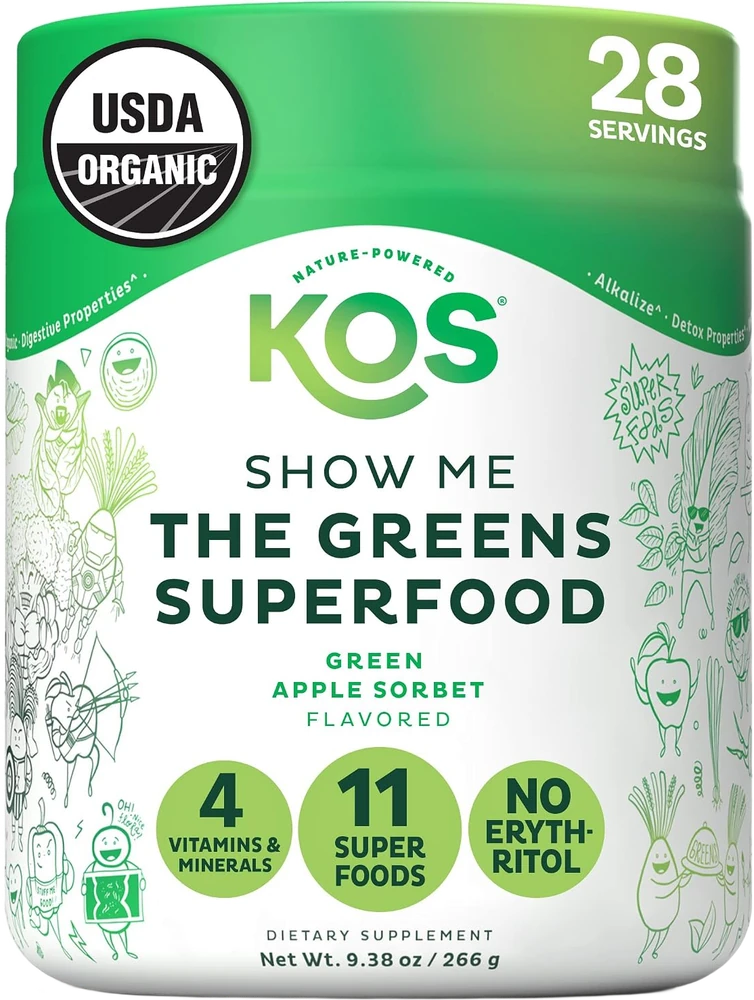 #5 of 9 · Best organic flavored✓ Label verified · Supplement Facts read Sep 7, 2026
Real retailer photo, cut out. Label unedited.
Consider it. Certified-organic greens that actually taste good — erythritol-free, prebiotic-based. KOS is USDA Organic and third-party tested, with a genuinely good green-apple flavor at 1g sugar and no erythritol — a rare combination — and it does digestion support with prebiotic fiber rather than an unverifiable probiotic blend.
$45 / 28 servings$1.61 / serving
Why It Scores 7.4 — And The Label Line Behind Each Number
Label transparency
30% of scoreAbove-average on certifications and honesty, mid-pack on disclosure. KOS states its USDA Organic (CCOF) certification and a third-party-testing claim, and it's refreshingly upfront that it uses prebiotic fiber rather than implying an unverifiable probiotic dose. But its wheatgrass/oat-grass and greens amounts are disclosed per blend, not per individual ingredient — so it's more honest than a proprietary-blend product about what it is, without fully itemizing amounts.
- Certifications
- USDA Certified Organic (CCOF), third-party tested per listing, GMP facility
Active content
25% of scoreThe limiter on its score. KOS delivers a certified-organic greens blend plus prebiotic fiber and acacia gum for digestion — a sensible, honest stack — but it has no probiotics and no enzymes, so its active load is narrower than the gut-focused picks. Good organic greens and a real prebiotic approach, but lighter on the active breadth that brands like Jocko, AG1 and Huel offer.
Third-party testing & safety record
20% of scoreA genuine strength. USDA Certified Organic (CCOF) and a stated third-party-testing claim, made in a GMP facility — both meaningful, independently-backed signals in a category where supply-chain contamination caused a 2026 recall elsewhere. Among the best testing profiles here, just behind AG1's NSF certification and on par with the other USDA-Organic picks.
Value per serving
15% of scoreFair but not cheap. At $44.99 for 28 servings (not 30), KOS is about $1.61 a serving — pricier than Bloom, Garden of Life and Amazing Grass, and a bit more than its blend depth strictly justifies. You're paying for the organic certification, the testing, the erythritol-free flavor and the clean prebiotic approach rather than for sheer ingredient volume. Reasonable for the package, not a value leader.
- Servings
- 28 per tub (not 30)
- Price
- $44.99 DTC ≈ $1.61 per serving
Taste & mixability
10% of scoreOne of the better-tasting picks, and notable for how it gets there. The green-apple-sorbet flavor (1g sugar, 30 calories) is genuinely pleasant and, crucially, erythritol-free — avoiding the sugar alcohols many low-sugar flavored greens use. A real flavor without the loophole, which makes it easy to drink daily and is a clean compliance advantage.
- More Specs
- Gut support
- Prebiotic-based: organic prebiotic fiber + acacia gum (no probiotics claimed)
- Flavor
- Green apple — erythritol-free, 1g sugar, 30 calories per serving
- Probiotics / enzymes
- None (prebiotic fiber approach instead)
- Disclosure
- Wheatgrass/oat-grass and greens amounts shown per blend, not per ingredient
Label verified. Every figure read from the Supplement Facts photo, Sep 7, 2026.
Marketing Claims Vs. Reality
USDA Certified Organic and third-party tested.
Both the USDA Organic (CCOF) certification and the third-party-testing claim are stated on the listing. These are independently meaningful trust signals — USDA Organic in particular requires verified certified-organic sourcing — and they're the main basis for KOS's strong testing score.
Erythritol-free with real flavor and only 1g of sugar.
The erythritol-free, 1g-sugar, 30-calorie green-apple profile is stated on the listing and is a genuine differentiator: most low-sugar flavored greens rely on erythritol or other sugar alcohols, and avoiding them while still tasting good is uncommon. A verifiable, honest claim.
Supports digestion with prebiotic fiber.
KOS does include organic prebiotic fiber and acacia gum, and prebiotics have a reasonable basis for supporting digestion by feeding existing gut bacteria. The 'partial' reflects that this is a prebiotic (not probiotic) approach delivering a single scoop's worth of fiber — supportive, but not the live-bacteria gut stack some buyers expect, and not a substitute for dietary fiber.
Organic super greens for daily nutrition.
Accurate that it's a certified-organic greens blend suitable as daily supplementation — but 'daily nutrition' shouldn't be read as a vegetable replacement. A scoop lacks the fiber volume and satiety of whole produce, and the greens are disclosed per blend. A clean organic supplement, not a food substitute or a comprehensive multivitamin.
Made in a GMP facility.
The GMP-facility manufacturing is stated on the listing. Standard but meaningful — GMP (Good Manufacturing Practice) compliance is a baseline quality control, and combined with the USDA Organic and third-party-testing claims it rounds out a credible safety profile.
What Our Test Actually Found
An honest answer to the 'fake probiotic' problem
Lots of greens powders add a 'probiotic blend' with no stated CFU, so you can't tell whether the dose does anything. KOS sidesteps that entirely by using prebiotic fiber and acacia gum instead — prebiotics feed the bacteria you already have, and the fiber is part of the disclosed formula rather than an unverifiable claim. It's a smaller gut-support play than a high-CFU probiotic, but it's a more honest one, and that integrity is part of why KOS earns its spot.
Real flavor without the erythritol loophole
KOS's green-apple-sorbet flavor at 1g sugar is genuinely good, and it gets there without erythritol — the sugar alcohol many low-sugar flavored greens lean on and that some people find causes GI upset. Getting a real, low-sugar flavor without that shortcut is uncommon and a clean compliance advantage. For a buyer who wants certified-organic greens they'll actually enjoy and who avoids sugar alcohols, this is the standout attribute.
Certified and tested — the safety profile is strong
USDA Organic (CCOF) plus a stated third-party-testing claim and GMP manufacturing give KOS one of the better safety profiles in the lineup — second only to AG1's NSF certification and on par with the other organic picks. In a category where a contaminated supply chain caused a multi-state Salmonella outbreak elsewhere in 2026, independent certification of organic sourcing is real value, and KOS carries it.
The gaps: no probiotics, fewer servings, higher price
Three honest limitations keep KOS mid-table. It has no probiotics or enzymes, so it's the wrong pick if you want a CFU-counted gut stack. It's 28 servings rather than 30, at about $1.61 a serving — more than Bloom, Garden of Life and Amazing Grass, and a bit more than its blend depth strictly warrants. And its greens are disclosed per blend, not per ingredient. None of these are dealbreakers for the right buyer; they're the reasons KOS is a niche pick rather than a top-three one.
Full analysis: all pros & cons (8), buy if / skip if
- USDA Organic (CCOF) and third-party tested — a strong safety profile
- Genuinely good green-apple flavor at 1g sugar — and erythritol-free, a rare combination
- Honest prebiotic-fiber approach instead of an unverifiable 'probiotic blend'
- GMP-facility manufacturing
- Clean, low-calorie (30 kcal) daily greens
- No probiotics or enzymes — the wrong pick for a CFU-counted gut stack
- 28 servings (not 30) at about $1.61 a serving — pricier than its blend depth suggests
- Wheatgrass/oat-grass and greens amounts disclosed per blend, not per ingredient
- You want certified-organic (USDA/CCOF) greens that genuinely taste good
- You distrust sugar alcohols and want an erythritol-free, low-sugar flavor
- You prefer honest prebiotic fiber over an unverifiable 'probiotic blend'
- Third-party testing and a clean label matter more to you than a high ingredient count
- You want probiotics or enzymes — KOS has neither (try Jocko #1 or AG1 #2)
- You want the cheapest certified-organic greens — Amazing Grass (#6) is far cheaper per serving
- You want per-ingredient disclosure — KOS lists its greens per blend
KOS is USDA Organic and third-party tested, with a genuinely good green-apple flavor at 1g sugar and no erythritol — a rare combination — and it does digestion support with prebiotic fiber rather than an unverifiable probiotic blend. The honest gaps: no probiotics or enzymes, only 28 servings, and a $1.61-per-serving price that outruns its blend depth. Consider it if you want certified-organic greens that taste good and distrust sweetener loopholes; skip it if you want a CFU-counted probiotic stack.
KOS Organic Super Greens occupies a useful niche: a certified-organic greens powder that actually tastes good, without leaning on the shortcuts the category usually takes. It's USDA Organic (CCOF), third-party tested per the listing, and carries a green-apple-sorbet flavor with just 1g of sugar — and it gets there erythritol-free, avoiding the sugar alcohols a lot of low-sugar flavored greens rely on. Its digestion support comes from prebiotic fiber and acacia gum rather than an unverifiable probiotic blend, which is an honest approach to a category full of unstated CFU claims. The trade-offs are clear and fair. KOS has no probiotics or enzymes, so if you want a live-bacteria gut stack it's the wrong pick. It's 28 servings rather than 30, at a $1.61-per-serving price that's more than its blend depth strictly warrants. And its greens are disclosed per blend, not per ingredient. But for a buyer who wants certified-organic greens that taste genuinely good and who distrusts both sweetener loopholes and unverifiable probiotic marketing, KOS is the right answer — used, as always, as a supplement to vegetables rather than a replacement.
Certified-organic greens that taste good without the shortcuts — a clean, honest niche pick.

KOS Organic Super Greens is for the buyer who wants certified-organic greens that genuinely taste good and who is tired of the category's shortcuts. It's USDA Organic and third-party tested, its green-apple flavor is pleasant and erythritol-free (a rare combination), and it supports digestion with honest prebiotic fiber rather than an unverifiable probiotic blend. On integrity and taste, it punches above its rank. It sits at #6 because of real limitations: no probiotics or enzymes, only 28 servings, and a $1.61-per-serving price that outruns its blend depth. If you want a live-bacteria gut stack, Jocko (#1) or AG1 (#2) are better; if you want the cheapest certified-organic greens, Amazing Grass (#6) wins on price; if you want certified whole-food juiced greens, Garden of Life (#3) is the purist option. But if a certified-organic, good-tasting, sugar-alcohol-free, honestly-formulated greens is what you're after, KOS is the pick — a clean daily supplement layered on top of real vegetables, not a replacement for them.
If This Doesn’t Fit — Try These
 04
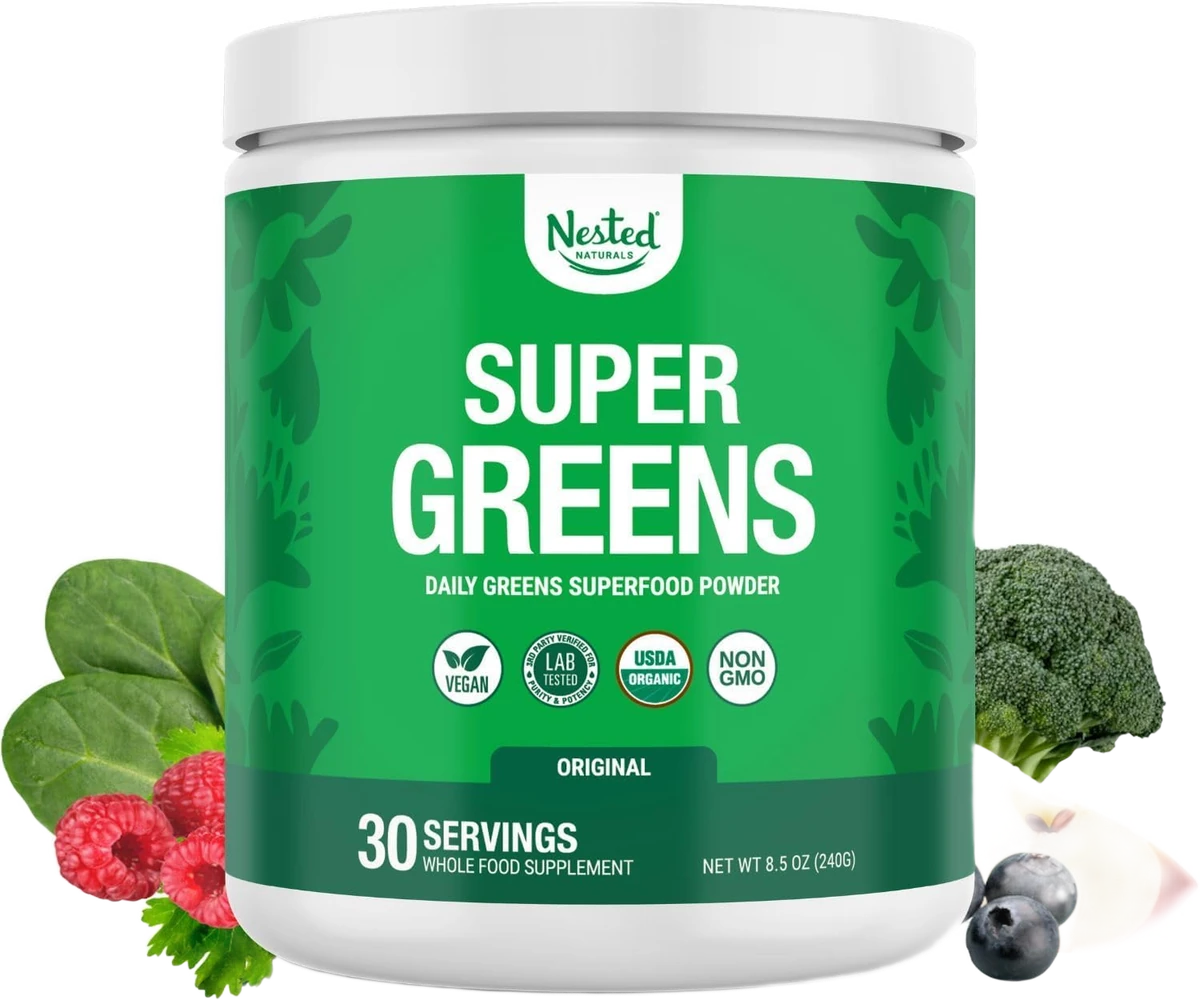
Nested Naturals Super Greens
Nested Naturals punches above its price on the one axis that matters most for safety: it's USDA Organic and the listing states every batch is third-party tested for purity and potency — the kind of paper trail that usually carries a $45+ price tag, here for about $1.10 a serving.
 07
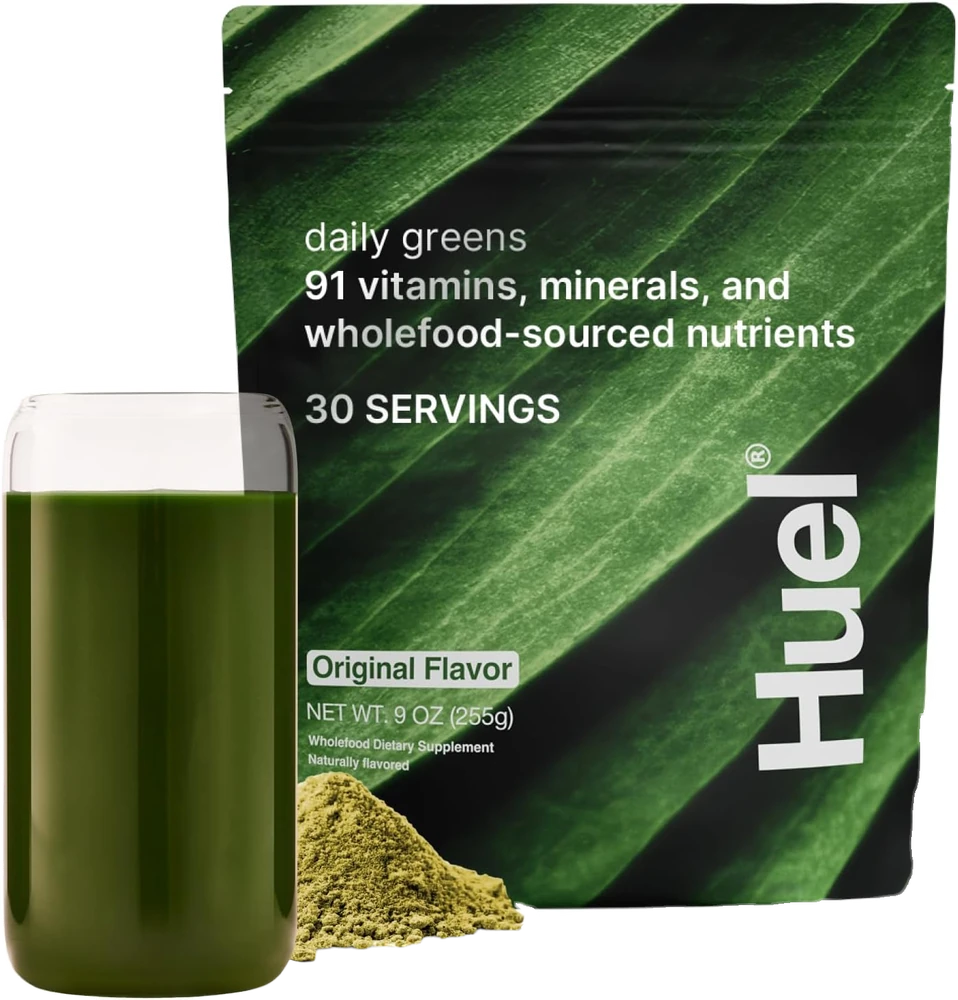
Huel Daily Greens
Huel Daily Greens is what you buy when you want AG1-style breadth without AG1's price: 91 wholefood-sourced ingredients across five named blends, a genuinely pleasant apple-pineapple-mint flavor, and a subscription price near $1.50 a serving.
05KOS Organic Super Greens
KOS earns its spot on certifications and an honest gut claim: it's USDA Organic and third-party tested, it's erythritol-free with a genuinely good green-apple taste, and it does its digestion work with prebiotic fiber rather than an unverifiable CFU number.
Quick Answers
Why does KOS use prebiotic fiber instead of probiotics?
It's a deliberate, and arguably more honest, choice. Many greens powders add a 'probiotic blend' without stating the CFU count, so you can't tell whether the dose is meaningful. KOS instead leans on prebiotic fiber and acacia gum for digestion support — prebiotics feed the bacteria you already have, and the amounts are part of the disclosed formula rather than an unverifiable claim. The trade-off is that if you specifically want supplemental probiotic strains (live bacteria) in your greens, KOS doesn't provide them — you'd want Jocko (#1, 9 billion CFU), AG1 (#2), or a dedicated probiotic alongside it.
Is the green-apple flavor actually good, or just 'good for greens'?
Genuinely good, and notable for what it avoids. KOS Organic Super Greens is described as a green-apple-sorbet flavor with just 1g of sugar and 30 calories — and crucially it's erythritol-free, which is a rare combination. A lot of flavored greens rely on erythritol or other sugar alcohols (which some people find cause GI upset) to taste good with low sugar; KOS gets a real flavor without that loophole. So it's one of the better-tasting picks here on its own merits, not just relative to grassy products.
Will KOS replace my vegetables?
No — like every greens powder, it's a supplement, not a substitute. KOS is a USDA Organic greens blend with prebiotic fiber, designed to be a pleasant daily scoop, but it lacks the fiber volume, food matrix and satiety of whole vegetables, and its greens are disclosed per blend rather than per ingredient. Use it as insurance for the veggie gap that about nine in ten US adults have. Its prebiotic fiber is a small step toward the fiber whole vegetables provide, but a single scoop's worth — keep eating real produce and treat KOS as a supporting player.
Is 28 servings at $45 a fair price?
It's fair but not cheap, and the 28-serving count (rather than the usual 30) is worth noting. At $44.99 for 28 servings, KOS works out to about $1.61 a serving — more than Bloom (~$1.13), Garden of Life (~$1.30) or Amazing Grass (~$0.90), and pricier than its blend depth strictly justifies. What you're paying for is the combination of USDA Organic certification, third-party testing, an erythritol-free real flavor, and a clean prebiotic approach. If that specific package appeals to you it's defensible; if you want the cheapest certified-organic greens, Amazing Grass (#6) delivers that for far less.
Who should buy KOS over the other organic picks?
The buyer who wants certified-organic greens that taste good and who is skeptical of both sweetener loopholes and unstated probiotic claims. Among the USDA Organic options, Garden of Life (#3) is the whole-food, grassy, named-probiotic pick; Amazing Grass (#6) is the cheap, grassy, value pick; and KOS is the good-tasting, erythritol-free, prebiotic-based pick. So choose KOS specifically if taste and an honest 'no unverifiable probiotic, no sugar alcohol' formula matter to you, and you don't need supplemental probiotic strains. If you do want probiotics, look elsewhere.
Sources & Further Reading
3 peer-reviewed sources, each linked to PubMed
- [1] Lee 2022 PMID 34990439 — Adults Meeting Fruit and Vegetable Intake Recommendations — United States, 2019. Only 10.0% of US adults met the vegetable recommendation in 2019. The veggie gap a clean organic greens powder like KOS helps hedge — while its single scoop of prebiotic fiber remains a supplement to, not a replacement for, the fiber whole vegetables provide.
- [2] Chapple 2012 PMID 22093005 — Adjunctive daily supplementation with encapsulated fruit, vegetable and berry juice powder concentrates and clinical periodontal outcomes: a double-blind RCT. Encapsulated fruit/vegetable/berry juice powders raised plasma micronutrient markers in a double-blind RCT. Supportive that concentrated organic produce powders can move micronutrient biomarkers — context for KOS's organic greens, in a related juice-concentrate product class.
- [3] La Monica 2024 PMID 39352252 — The effects of AG1 supplementation on the gut microbiome of healthy adults: a randomized, double-blind, placebo-controlled clinical trial. The category's one product-specific RCT (on AG1) showed a greens powder enriched probiotic taxa. Relevant as contrast: KOS deliberately uses prebiotic fiber rather than probiotics, so it takes a different — and honestly disclosed — approach to the gut than the probiotic-led products.
Affiliate disclosure: every Amazon link uses our Associates tag (superachieverclub-20). We earn a small commission at no cost to you; it funds independent reviews. We never accept payment to change a ranking.