
Greens Powder: Benefits, Dosage & Side Effects (2026)
A greens powder is a concentrated blend of greens, superfoods and probiotics taken as daily micronutrient and veggie-gap insurance — a supplement to vegetables, not a substitute for them.
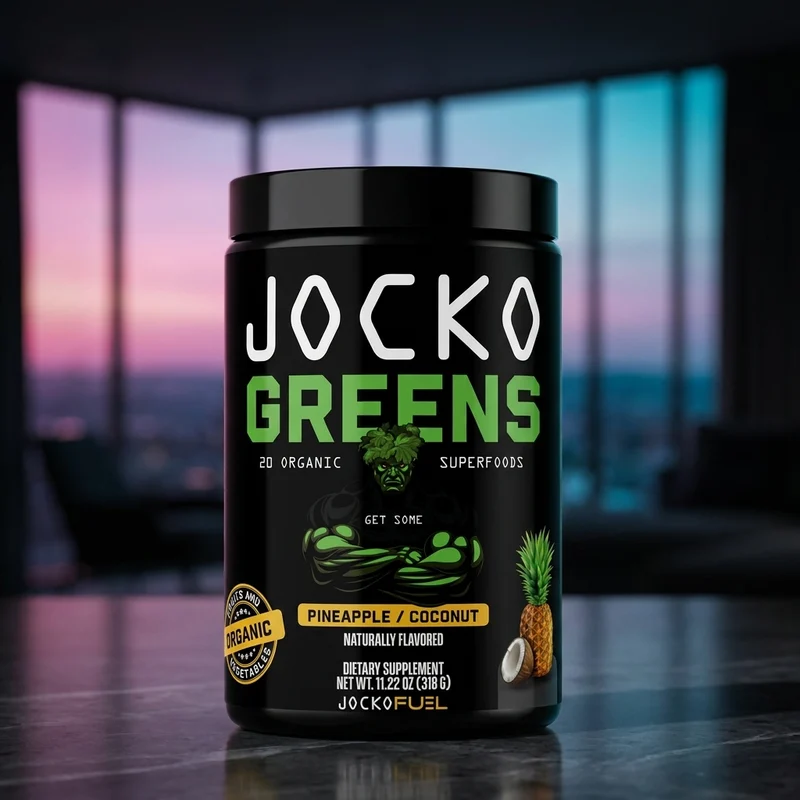
Jocko Fuel Daily Greens
What is Greens Powder?
A greens powder is a powdered blend of dried green vegetables, grasses (wheatgrass, barley grass), algae (spirulina, chlorella), other fruits and vegetables, and usually some combination of probiotics, prebiotics, digestive enzymes, adaptogens and added vitamins — designed to be mixed into water once a day. The pitch is convenience: one scoop as insurance for the vegetables and micronutrients you didn't get from food. That pitch lands because the gap is real — the CDC's most recent national data found only about 10% of US adults meet the vegetable intake recommendation.
The single most important thing to understand before buying one is what a greens powder is NOT: it is not a replacement for eating vegetables. A scoop carries a fraction of the fiber, none of the satiety, and not the intact food matrix of an actual plate of broccoli, spinach and berries. Drying, milling and concentrating produce into a powder also degrades some heat- and light-sensitive nutrients. So the right mental model is gap-insurance — a hedge that nudges your micronutrient and probiotic intake up on the days your diet falls short — not a license to skip produce. Anyone marketing a greens powder as a vegetable replacement is overselling it.
The category is also unusually variable in quality and honesty. Formulas range from fully transparent labels that state the exact amount of each ingredient (rare) to proprietary blends that hide every dose behind one combined number (common), and from NSF-certified or USDA-Organic products to entirely uncertified ones. Because a greens powder pools dozens of agricultural inputs — grasses, algae, moringa, fruits — into one scoop, supply-chain quality and contaminant testing matter more than in a single-ingredient supplement. The defining buyer decisions are therefore transparency (can you see the doses?) and verification (is it independently tested or certified?), far more than the headline ingredient count.
How it works
Greens powders don't have one mechanism — they're a bundle of ingredients, each with its own (often modest) evidence, and the category's honest evidence picture is best understood in three tiers.
FIRST, per-ingredient evidence is the strongest tier, but it usually comes from doses larger than a multi-ingredient scoop provides. Spirulina has GRADE-assessed meta-analysis support for modestly lowering blood pressure — about 4.4 mmHg systolic (Shiri 2024, PMID 39529406) — and chlorella improved total and LDL cholesterol, blood pressure and fasting glucose across 19 RCTs (Fallah 2018, PMID 29037431). Both are common greens-powder algae. The catch: those trials dosed grams of a single algae, often far more than the sprinkle of spirulina or chlorella in a 30-ingredient blend, so you can't assume a scoop delivers a trial-level dose of any one ingredient — especially when the amount is hidden behind a proprietary blend.
SECOND, the fruit-and-vegetable juice-powder concentrate literature shows that concentrated produce powders CAN move real biomarkers. Encapsulated fruit/vegetable/berry juice powders raised plasma micronutrient markers including β-carotene in a double-blind RCT (Chapple 2012, PMID 22093005), and a 12-week trial found a juice concentrate increased skin microcirculation, hydration and density (De Spirt 2012, PMID 21822034). This is encouraging for the 'concentrated produce does measurable things' premise — but it's a purer, juice-concentrate product class than most flavored greens scoops, and those trials are largely industry-funded with surrogate endpoints (blood markers, microcirculation) rather than hard health outcomes.
THIRD, product-specific evidence is the thinnest tier: essentially one trial exists. AG1's own 4-week, randomized, double-blind, placebo-controlled study (La Monica 2024, PMID 39352252) found AG1 enriched two probiotic taxa and was well tolerated with no adverse bowel changes — a real microbiome and tolerability result, but an industry-funded, short-duration study, not a hard-outcome efficacy trial, and specific to one product. The probiotic content of greens powders is also genuinely variable, from 9 billion CFU down to none, and a stated CFU count is the exception rather than the rule. The bottom line on mechanism: greens powders plausibly help nudge micronutrient and probiotic intake — reasonable gap-insurance — but the category as a whole has not been shown to deliver specific health outcomes, and the honest expectation is 'modest supplement,' not 'transformative.'
At-a-glance facts
- What it actually is
- Daily micronutrient + veggie-gap insurance — a supplement to vegetables, NOT a replacement
- Typical dose
- 1 scoop daily mixed in water (≈ 8 oz)
- The veggie gap
- Only ~10% of US adults meet the vegetable recommendation (Lee 2022)
- Evidence picture
- Mostly per-ingredient (spirulina, chlorella) + juice-powder biomarker trials; one product RCT (AG1)
- Probiotic range
- 0 to 9 billion CFU across products — a stated CFU count is the exception, not the rule
- Biggest buyer decision
- Transparency (per-ingredient doses vs proprietary blends) + third-party testing
- Safety note
- Pools many agricultural inputs — testing matters (2026 Live it Up Salmonella recall)
- Cost range (US)
- ~$0.90 to over $3.00 per serving
- Stack synergy
- Vitamin D + Omega-3 for the gaps a greens scoop doesn't cover; a dedicated probiotic if CFU isn't disclosed
Evidence: Category-level hard-outcome RCTs are thin. The honest evidence is per-ingredient (spirulina lowers BP ~4.4 mmHg, Shiri 2024 PMID 39529406; chlorella improves cardiovascular risk markers, Fallah 2018 PMID 29037431 — both at gram-level doses larger than a multi-ingredient scoop) plus fruit/vegetable juice-powder concentrate trials that raise micronutrient biomarkers (Chapple 2012 PMID 22093005; De Spirt 2012 PMID 21822034, mostly industry-funded with surrogate endpoints). Just one product-specific RCT exists (AG1: La Monica 2024 PMID 39352252, a 4-week microbiome/tolerability study). Reasonable as veggie-gap insurance; not demonstrated to deliver specific health outcomes, and not a vegetable replacement.
Who it's for — and who it isn't
- People who genuinely under-eat vegetables (most US adults) and want convenient daily micronutrient insurance — not a replacement for produce
- Travelers and busy people whose diets are inconsistent and who want a portable way to hedge the veggie gap
- Anyone who wants an easy daily probiotic + greens habit and will choose a product with a disclosed CFU count and certification
- Buyers who value label transparency and third-party testing and will pay for a certified, honestly-dosed product
- People targeting general energy and gut-comfort support as a supplement layered on top of a reasonable diet
- Anyone expecting it to replace vegetables — it lacks the fiber, food matrix and satiety of whole produce
- People who already eat plenty of vegetables and fruit — the marginal benefit is small and the cost is real
- Bargain-hunters who only consider proprietary-blend products with no disclosed doses or certification — you can't verify what you're paying for
- Anyone seeking a proven treatment for a specific condition — the category's hard-outcome evidence is thin and mostly per-ingredient
- People with allergies or on medications who haven't checked the (often long, sometimes blend-level) ingredient list, which can include algae, grasses, adaptogens and more
Week-by-week, what happens
- Day 1No felt change expected. A greens powder works by nudging daily micronutrient and probiotic intake, not by producing an acute effect — treat early 'energy' impressions cautiously, as they're easily placebo or just hydration from drinking more water.
- Week 1-2Some people notice digestive changes from the probiotic/prebiotic and fiber content (which can include mild gas or bloating as the gut adjusts). Bowel regularity may shift. This is the most plausible early, real effect.
- Week 3-4Around the window of the one product-specific trial (AG1, 4 weeks), modest microbiome shifts and stable tolerability are the realistic outcomes — not dramatic energy or immunity changes. Consistency is what matters.
- Month 2+Sustained use functions as ongoing micronutrient and probiotic insurance. There's no evidence of accumulating, transformative benefits — the value is steady gap-filling, best judged by whether it's a sustainable, certified, honestly-dosed habit you'll keep.
Safety & contraindications
- Greens powders are generally well tolerated, but the probiotic, prebiotic and fiber content can cause mild gas, bloating or loose stools in the first week or two as your gut adjusts — start with a partial scoop if sensitive.
- Testing genuinely matters here: a greens powder pools dozens of agricultural inputs (grasses, algae, moringa, fruits) into one scoop. In early 2026 a popular brand (Live it Up Super Greens) was at the center of a multi-state Salmonella outbreak traced to its moringa leaf powder, with dozens of cases and 26 hospitalizations before recall. Prefer products with NSF certification, USDA Organic certification, or a stated per-batch third-party-testing claim.
- Read the full ingredient list for allergens and actives — greens powders can contain algae (spirulina/chlorella), grasses (potential issue for grass/gluten sensitivities depending on sourcing), adaptogens (ashwagandha, rhodiola), green tea (caffeine in some), and more, often disclosed only at blend level.
- Some greens powders contain herbs and adaptogens that can interact with medications or are not advised in pregnancy (e.g. ashwagandha). Check with a clinician if you're pregnant, breastfeeding, or on medication.
- It is not a vegetable replacement and not a complete source of fiber — don't let a daily scoop substitute for eating actual produce, which provides fiber, satiety and an intact food matrix a powder can't.
- Proprietary-blend labels hide individual doses, so you can't verify how much of any active you're getting; if a stated probiotic CFU and per-ingredient amounts matter to you, choose a transparent product or add a dedicated, disclosed probiotic.
All articles on Greens Powder
Best Greens Powder
The 9 best greens powders ranked on label transparency (full doses vs proprietary blends), active content, third-party testing & safety record, value and taste — honestly framed as veggie-gap insurance, not a vegetable replacement, with the 2026 Live it Up Salmonella recall as the case for why testing carries 20%.
Read →Best Spirulina Supplements
8 spirulina powders and tablets ranked on dose vs the trials, contaminant control and label transparency — every Supplement Facts panel read by us.
Read →AG1 (Athletic Greens) Review
The NSF-certified all-in-one benchmark — exceptional, and exceptionally priced.
Read →Amazing Grass Greens Blend Superfood Review
The cheapest credible certified-organic greens — about $0.90 a serving.
Read →Anthony's California Spirulina Powder, 8 oz Review
US-grown spirulina powder that discloses iron, calcium and potassium per 3 g teaspoon and costs a quarter a dose; not organic.
Read →Bloom Nutrition Greens and Superfoods Review
The best-tasting, most repurchasable greens powder — with a proprietary-blend label.
Read →BulkSupplements Organic Spirulina Powder, 500 g Review
The budget organic pick: 3 g per teaspoon, 167 servings, USDA Organic, no Prop 65 warning, but a bare panel with no mineral disclosure.
Read →Earthrise California Spirulina 500 mg Tablets Review
The most transparent panel in the category: 165 mg c-phycocyanin, 1.5 mg iron and 2 g protein per 3 g, grown in one California pond.
Read →Garden of Life Raw Organic Perfect Food Green Superfood Review
Certified-organic juiced farm greens with a named probiotic — the whole-food purist's pick.
Read →Huel Daily Greens Review
AG1-style breadth at roughly half the price — the value-density pick.
Read →Jocko Fuel Daily Greens Review
The most transparent label in a category built on proprietary blends.
Read →KOS Organic Super Greens Review
Certified-organic greens that actually taste good — erythritol-free, prebiotic-based.
Read →Micro Ingredients Organic Spirulina Powder, 1 lb Review
The cheapest organic 3 g dose here, cGMP and third-party-lab-tested per the label, but the same label carries a California Prop 65 lead warning.
Read →Nested Naturals Super Greens Review
Budget-organic greens with a real per-batch testing claim.
Read →NOW Certified Organic Spirulina 1,000 mg Double Strength Tablets Review
The organic tablet that does the most with the least: 1,000 mg per tablet, no other ingredients, USDA Organic, GMP, at roughly $0.11 a tablet.
Read →Nutrex Hawaii Pure Hawaiian Spirulina 500 mg Tablets Review
The reference spirulina: 3 g per serving from a single named Hawaiian farm, third-party tested, with the iron and protein actually printed on the panel.
Read →Nutricost Organic Spirulina 500 mg Tablets, 240 Count Review
A USDA/CCOF organic 500 mg tablet with no other ingredients for about a nickel; six a day to match what the trials used.
Read →Primal Harvest Primal Greens Review
The broadest single-scoop variety — and the least transparency per dollar.
Read →Vimergy USDA Organic Spirulina Powder, 250 g Review
A tightly certified organic 3 g scoop from a brand that trades on testing, at roughly double the price of the budget organic powders.
Read →FAQ
Do greens powders actually work — or are they hype?
The honest answer is 'partly, modestly.' Greens powders plausibly help nudge your daily micronutrient and probiotic intake, which is a reasonable hedge given that only about one in ten US adults eats enough vegetables. But the category's hard-outcome evidence is thin: the strongest data is per-ingredient (spirulina and chlorella have meta-analysis support, but at gram-level doses larger than a multi-ingredient scoop), the juice-powder concentrate trials show raised micronutrient biomarkers (a related but purer product class, mostly industry-funded), and exactly one product (AG1) has its own short trial. So they're legitimate gap-insurance, not a proven treatment or a transformative health upgrade — and emphatically not a vegetable replacement.
Can a greens powder replace eating vegetables?
No — this is the single most important thing to understand. A scoop carries a fraction of the fiber, none of the satiety, and not the intact food matrix of actual vegetables, and drying and milling degrades some nutrients. The right way to think about a greens powder is insurance for the veggie gap on days your diet falls short — a supplement layered on top of real produce, not a substitute for it. If you already eat plenty of vegetables and fruit, the marginal benefit is small. Keep eating the broccoli; use the powder to hedge the gap, not to skip the plate.
How important is the probiotic CFU count?
It's one of the clearest quality signals, precisely because so many brands hide it. Probiotic content across greens powders ranges from 9 billion CFU down to none, and a stated CFU count is the exception, not the rule — many products list a 'probiotic blend' with no number, so you can't verify the dose. A disclosed CFU (like Jocko's 9 billion, AG1's 7.2 billion, or Garden of Life's named DE111 strain at 250 million) is more trustworthy than an unquantified one. If the gut benefit is your main reason for buying and the CFU isn't stated, consider a dedicated, disclosed probiotic instead.
Why does third-party testing matter so much for greens powders?
Because a greens powder pools dozens of agricultural inputs — grasses, algae, moringa, fruits — into one scoop, which multiplies the supply-chain points where contamination can enter. This isn't theoretical: in early 2026, a popular greens brand was at the center of a multi-state Salmonella outbreak traced to its moringa leaf powder, with 26 hospitalizations before the recall. NSF certification, USDA Organic certification, or a stated per-batch third-party-testing claim are the signals that the product is independently verified. In a category this ingredient-heavy and this lightly regulated, testing is not a nice-to-have.
What's the difference between a transparent label and a proprietary blend?
A transparent label states the exact amount of each ingredient, so you can see how much spirulina, chlorella, probiotic, etc. you're actually getting. A proprietary blend lists the ingredients but discloses only one combined total for the whole blend, hiding the individual doses — which is common in this category and means you're trusting the brand rather than reading the facts. Full per-ingredient disclosure is rare and valuable; a stated probiotic CFU is a partial step toward it. When two products look similar, the one that tells you the doses is almost always the better-trust buy.
Will a greens powder give me energy?
Be skeptical of strong energy claims. Some greens powders include caffeine (from green tea or guarana) or adaptogens, which can produce a real but non-specific lift; others are caffeine-free, in which case any 'energy' you feel early on is easily placebo or simply the effect of drinking more water. There's no good evidence that the greens themselves produce a meaningful energy boost. If steady energy is your goal, correcting an actual nutrient deficiency (iron, vitamin D, B12) does far more than a greens scoop — use the powder as general micronutrient insurance, not as an energy product.
Sources & further reading
- Lee 2022 (US vegetable intake)Adults Meeting Fruit and Vegetable Intake Recommendations — United States, 2019
Using 2019 national survey data, only 10.0% of US adults met the vegetable intake recommendation (and 12.3% met the fruit recommendation). The epidemiological case for greens powders as veggie-gap insurance — and the honest frame that they supplement, not replace, the vegetables most adults aren't eating.
- La Monica 2024 (AG1 microbiome RCT)The effects of AG1 supplementation on the gut microbiome of healthy adults: a randomized, double-blind, placebo-controlled clinical trial
In 30 healthy adults over 4 weeks, AG1 enriched two probiotic taxa (Lactobacillus acidophilus and Bifidobacterium bifidum) and was well tolerated with no adverse changes in bowel frequency or stool consistency. Essentially the only product-specific greens-powder RCT — an industry-funded microbiome and tolerability study, not a hard-outcome efficacy trial.
- Shiri 2024 (spirulina, blood pressure)The Effect of Spirulina Supplementation on Blood Pressure in Adults: A GRADE-Assessed Systematic Review and Meta-Analysis of Randomized Clinical Trials
A GRADE-assessed meta-analysis found spirulina supplementation lowered systolic blood pressure by ~4.4 mmHg and diastolic by ~2.8 mmHg. Per-ingredient evidence for a near-universal greens-powder algae — at gram-level doses typically larger than the amount in a multi-ingredient scoop.
- Fallah 2018 (chlorella, cardiovascular risk)Effect of Chlorella supplementation on cardiovascular risk factors: A meta-analysis of randomized controlled trials
A meta-analysis of 19 RCTs (797 subjects) found chlorella supplementation significantly reduced total cholesterol, LDL cholesterol, systolic and diastolic blood pressure, and fasting blood glucose. Per-ingredient evidence for another common greens-powder algae — again at gram-level doses larger than a blended scoop provides.
- Chapple 2012 (juice-powder micronutrients)Adjunctive daily supplementation with encapsulated fruit, vegetable and berry juice powder concentrates and clinical periodontal outcomes: a double-blind RCT
A double-blind RCT in which encapsulated fruit, vegetable and berry juice powder concentrates raised plasma micronutrient markers (including β-carotene) and improved a periodontal treatment outcome. Evidence that concentrated produce powders can move micronutrient biomarkers — in a purer juice-concentrate product class than a flavored greens scoop.
- De Spirt 2012 (juice concentrate, skin)An encapsulated fruit and vegetable juice concentrate increases skin microcirculation in healthy women
Over 12 weeks in healthy women, an encapsulated fruit and vegetable juice concentrate increased skin microcirculation (by ~39%), hydration and density versus placebo. A juice-concentrate RCT with a real physiological endpoint — supportive of the 'concentrated produce does measurable things' premise, in a related product class with a surrogate endpoint.