
Quercetin: Benefits, Dosage & Side Effects (2026)
Quercetin is a plant flavonoid with strong antioxidant activity in the lab, but plain forms are barely absorbed and its human immune and allergy benefits are modest — so bioavailability, not dose on the label, is what actually matters.
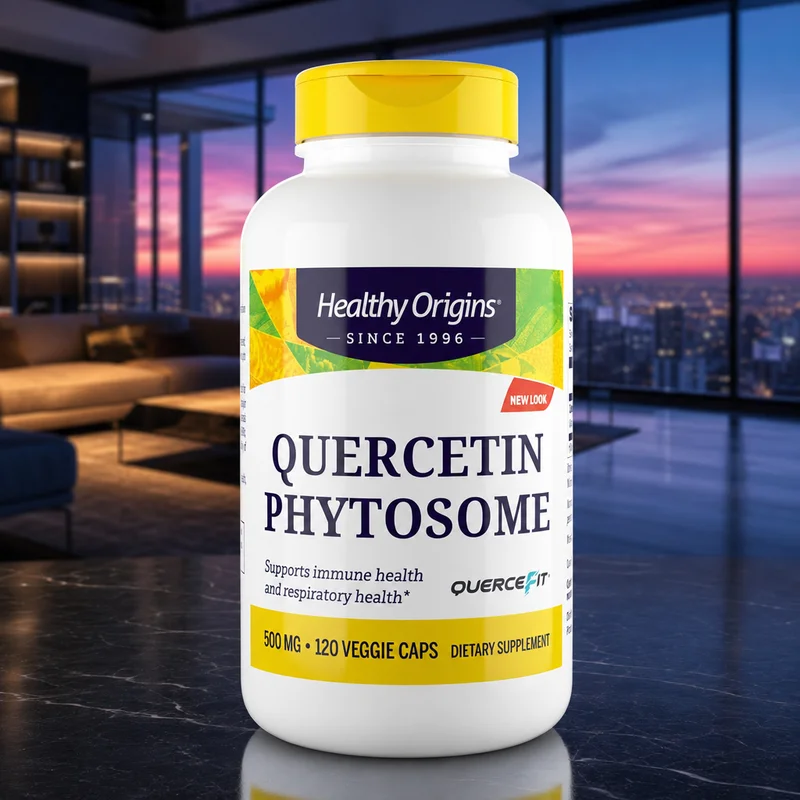
Healthy Origins Quercetin Phytosome (Quercefit)
What is Quercetin?
Quercetin is a flavonol — a yellow polyphenol pigment found in onions, apples, capers, kale, berries, and tea. It's one of the most studied dietary antioxidants and is marketed heavily for immunity, seasonal allergies, and anti-inflammatory support. In a test tube it stabilizes mast cells (the cells that release histamine), scavenges free radicals, and dampens inflammatory signaling, which is where the allergy and immune reputation comes from. The catch most labels bury: ordinary quercetin is poorly water-soluble and poorly absorbed — often under 10% of an oral dose reaches the bloodstream — so a big number on the bottle does not mean a big number in your body.
How it works
Quercetin's biology and its supplement problem are two different things. Biologically, it acts as an antioxidant and mast-cell stabilizer, inhibits inflammatory enzymes and cytokines, and interacts with signaling pathways that regulate immune and vascular tone — effects that are robust in cells and animals. The bottleneck is delivery. Plain quercetin (95%+ isolates, and quercetin-plus-bromelain blends) is hydrophobic and largely destroyed or unabsorbed in the gut, which is why formulators bolt on helpers: bromelain and vitamin C (a mechanistic, mostly animal-based rationale), lipid carriers like MCT and lecithin, and — the best-supported approach — phytosome complexes (Quercefit and similar) that wrap quercetin in phospholipid to raise measured blood levels roughly 10–20x versus the plain powder. Better absorption is proven; that it translates into proven disease or immune outcomes in humans is the part that is still weak.
At-a-glance facts
- Class
- Flavonol (dietary polyphenol antioxidant)
- Typical dose
- 500–1,000 mg/day plain; 250–500 mg phytosome
- Best-absorbed form
- Phytosome (Quercefit / lecithin complex)
- Plain-form absorption
- Low — often under 10% of the oral dose
- Common pairings
- Bromelain, vitamin C, lipid (MCT/lecithin) carriers
- Food sources
- Onions, capers, apples, kale, berries, tea
- Primary goal
- Immune system (also allergy, cardiovascular)
- Evidence for immune/allergy
- Modest and mixed in humans
Evidence: Mechanistic and antioxidant data are strong, but human clinical evidence for immune and allergy benefit is limited and mixed; the most consistent effect is a small blood-pressure reduction at 500 mg/day or more.
Who it's for — and who it isn't
- People who want a well-tolerated antioxidant flavonoid and are willing to pick an absorbable form (phytosome or lipid carrier) rather than the cheapest high-milligram powder
- Seasonal-allergy sufferers looking for a low-risk adjunct to try alongside standard antihistamines, with realistic expectations
- Endurance athletes and frequently-run-down people interested in the modest immune/recovery signal seen in higher-intensity-exercise trials
- People with mildly elevated blood pressure exploring diet-adjacent options at 500 mg/day or more (with medical oversight)
- Anyone expecting a fast or reliable cure for colds, flu, or acute allergy attacks — the human evidence does not support that
- People on drugs metabolized by CYP3A4/P-glycoprotein (e.g., cyclosporine, some statins, certain chemotherapeutics) or on blood thinners, especially with bromelain blends, without a doctor's sign-off
- Anyone who is pregnant or breastfeeding, where supplemental-dose safety is not established
- Bargain hunters buying a plain isolate purely on milligrams — that's paying for quercetin your gut mostly won't absorb
Week-by-week, what happens
- First 1–2 hoursPlasma quercetin peaks and antioxidant activity rises — far higher with a phytosome or lipid form than with plain powder.
- Days 1–7Some users report a mild antihistamine-like effect for allergies, but controlled trials do not show reliable acute relief.
- Weeks 2–8Small blood-pressure reductions appear in trials at 500 mg/day or more; any immune benefit shows up mainly in higher-risk, older, or heavily-exercising users.
- Seasonal / ongoing useOften taken pre-emptively through allergy or cold season; real-world benefit is modest and not guaranteed, and long-term high-dose safety is unproven.
Safety & contraindications
- Generally well tolerated up to about 1,000 mg/day for up to 12 weeks in trials; safety of higher doses or long-term daily use is not established.
- High intakes (over ~1,000 mg/day) have been associated with occasional headache and tingling in the extremities, and there are rare reports of kidney effects — avoid mega-dosing.
- Quercetin inhibits CYP3A4 and P-glycoprotein and can raise blood levels of drugs such as cyclosporine, some statins, and certain chemotherapy agents — clear it with a clinician if you take prescription medication.
- Bromelain-containing combination products can add bleeding risk with anticoagulants/antiplatelets and cause GI upset; use caution if you take blood thinners.
- Not established as safe during pregnancy or breastfeeding at supplemental doses — avoid.
All articles on Quercetin
Best Form of Berberine: HCl vs Phytosome vs DHB
HCl, phytosome, dihydroberberine and blends weighed by evidence vs absorption. HCl wins for most — it carries nearly all 30+ RCTs and its ~1% bioavailability is offset by the standard 1,000-1,500 mg/day split dose.
Read →Best Quercetin Supplements
Why Absorption Decides Everything — And Why the Immune Hype Still Outruns the Data
Read →Double Wood Quercetin with Bromelain Review
A transparent single-brand seller offering the highest-spec plain combo, 96% quercetin plus 200 mg bromelain, still capped by plain-powder absorption.
Read →Healthy Origins Quercetin Phytosome (Quercefit) Review
The only pick built on the actual patented, clinically-studied Quercefit raw material at a 500 mg dose and a sane cost-per-cap.
Read →Life Extension Bio-Quercetin Review
A clever cheap phytosome, but the ~15 mg absolute dose is so low it only makes sense as an add-on, not a standalone quercetin.
Read →NOW Foods Quercetin with Bromelain Review
The classic allergy/immune combo from a trusted mainstream brand at 120 servings, with the honest catch that plain quercetin absorbs poorly.
Read →Nutricost Quercetin with Bromelain Review
The cheapest way to get a high-dose quercetin-bromelain serving that's still third-party tested, if you accept plain-powder absorption.
Read →Solaray QBC Plex (Quercetin, Bromelain & Vitamin C) Review
A long-running three-way immune/allergy blend with a track record, held back by a modest per-serving quercetin dose and thin absorption science.
Read →Sports Research Quercetin with Coconut MCT & Sunflower Lecithin Review
An easy-to-swallow lipid-carrier softgel that beats plain powder on absorption logic, but only 30 count makes daily cost sneak up.
Read →Thorne Quercetin Phytosome Review
The label you trust most: NSF-tier manufacturing and a phytosome format, at a lower dose and higher price than the Quercefit leader.
Read →Toniiq Ultra High Purity Quercetin Review
A pristine 95%+ pure isolate that proves purity is not bioavailability: no bromelain, no vitamin C, no phytosome, so the poorest absorption in the set.
Read →FAQ
Does quercetin actually help with allergies?
In the lab it stabilizes mast cells and blunts histamine release, which is the basis for the allergy claims. In people, the controlled evidence is thin and inconsistent — it may work as a mild adjunct to standard antihistamines for some, but it is not a proven or fast-acting allergy treatment.
Why is bioavailability such a big deal for quercetin?
Plain quercetin is poorly water-soluble and often less than 10% is absorbed, so a 1,000 mg label can deliver very little to your blood. Phytosome complexes (like Quercefit) raise measured absorption roughly 10–20x, which is why the form on the label matters more than the milligram number.
Is a phytosome worth paying more for versus cheap quercetin-with-bromelain?
For absorption, yes — phytosome forms have real human pharmacokinetic data behind their higher blood levels, while the bromelain and vitamin C 'absorption helpers' rest on mechanistic and animal reasoning. Just remember better absorption still hasn't been shown to reliably translate into big clinical benefits.
Does the '50x' or '62x absorption' claim mean it works 50x better?
No. Those numbers come from manufacturer pharmacokinetic studies measuring blood levels, not from clinical outcomes. Higher absorption is genuine; a proportional improvement in immunity, allergy relief, or disease outcomes has not been demonstrated.
What's a reasonable dose?
Trials commonly use 500–1,000 mg/day of plain quercetin, or 250–500 mg/day of a phytosome. Start at the lower end, take it with food, and don't assume more is better — high doses carry more side-effect and drug-interaction risk without proven added benefit.
Can I just eat onions and apples instead?
A quercetin-rich diet is sensible and comes with fiber and other polyphenols, but food delivers only tens of milligrams per day — far below the studied supplement doses. Food is great for baseline intake; it won't replicate a therapeutic trial dose.
Sources & further reading
- Li Y, Yao J, Han C, et al. Quercetin, Inflammation and Immunity. Nutrients. 2016;8(3):167.Quercetin, Inflammation and Immunity
Comprehensive review documenting quercetin's antioxidant, anti-inflammatory and immunomodulatory mechanisms, while noting that clinical translation remains limited.
- Riva A, Ronchi M, Petrangolini G, et al. Improved Oral Absorption of Quercetin from Quercetin Phytosome, a New Delivery System Based on Food Grade Lecithin. Eur J Drug Metab Pharmacokinet. 2019;44(2):169-177.Improved Oral Absorption of Quercetin from Quercetin Phytosome, a New Delivery System Based on Food Grade Lecithin
Phytosome (Quercefit) delivery increased quercetin plasma exposure roughly 20-fold versus unformulated quercetin, confirming the bioavailability advantage.
- Heinz SA, Henson DA, Austin MD, Jin F, Nieman DC. Quercetin supplementation and upper respiratory tract infection: a randomized community clinical trial. Pharmacol Res. 2010;62(3):237-242.Quercetin supplementation and upper respiratory tract infection: a randomized community clinical trial
1,000 mg/day quercetin did not reduce URTI rates overall, with a possible benefit only in a subgroup of older, physically fit participants — illustrating the modest, mixed human immune data.
- Nieman DC, Henson DA, Gross SJ, et al. Quercetin reduces illness but not immune perturbations after intensive exercise. Med Sci Sports Exerc. 2007;39(9):1561-1569.Quercetin reduces illness but not immune perturbations after intensive exercise
In cyclists, quercetin lowered self-reported illness incidence after heavy exertion but did not meaningfully change measured immune markers, pointing to a small and context-dependent effect.
- Serban MC, Sahebkar A, Zanchetti A, et al. Effects of Quercetin on Blood Pressure: A Systematic Review and Meta-Analysis of Randomized Controlled Trials. J Am Heart Assoc. 2016;5(7):e002713.Effects of Quercetin on Blood Pressure: A Systematic Review and Meta-Analysis of Randomized Controlled Trials
Meta-analysis of RCTs found significant but modest reductions in systolic and diastolic blood pressure, mainly at doses of 500 mg/day or higher — quercetin's most consistent human outcome.