
Vitamin C: Benefits, Dosage & Side Effects (2026)
Vitamin C is an essential water-soluble vitamin and immune-cell cofactor whose supplement value is widely oversold: regular dosing modestly shortens cold duration but does not prevent colds in the general population, and oral absorption saturates near 200 mg/day so most of a megadose is simply excreted.
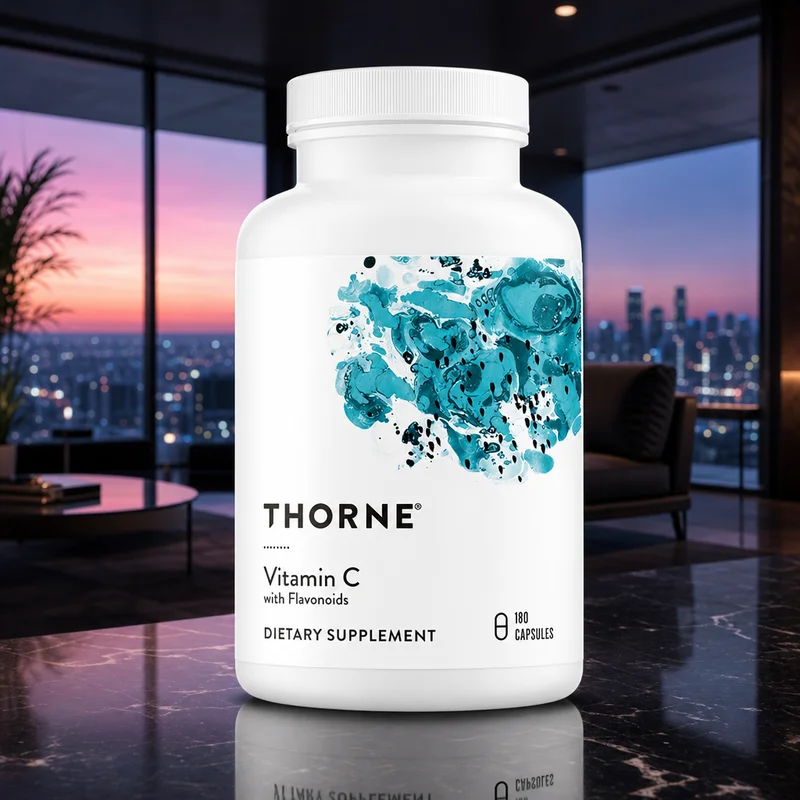
Thorne Vitamin C with Flavonoids, 180 Capsules
What is Vitamin C?
Vitamin C (L-ascorbic acid, or ascorbate) is a water-soluble essential vitamin. Unlike most animals, humans lost the gene for the final enzyme in vitamin C synthesis (L-gulonolactone oxidase), so we cannot make our own and must get it from food — citrus, peppers, broccoli, kiwi and other fruits and vegetables. Biochemically it is a cofactor for a family of enzymes (including the collagen-building hydroxylases) and a potent antioxidant that also regenerates other antioxidants like vitamin E. Frank deficiency causes scurvy; the RDA is modest — about 90 mg/day for men and 75 mg/day for women, with smokers needing roughly 35 mg more.
The single most important thing to understand before buying vitamin C is that oral absorption is tightly regulated and saturable. Plasma and tissue levels plateau at intakes around 200 mg/day; above that, fractional absorption falls and the excess is excreted in urine. Levine 1996 (PMID 8623000) mapped this depletion-repletion curve in healthy volunteers, and Padayatty 2004 (PMID 15068981) showed that at a 1.25 g oral dose bioavailability drops below 50%, while only intravenous administration can push plasma into the high pharmacologic range. In plain terms: for oral vitamin C, more is not more — past a couple hundred milligrams, you largely excrete the difference.
That reframes the whole supplement question. Unlike curcumin, where the battle is bioavailable formulation, vitamin C's active form is cheap, well-absorbed plain ascorbic acid — the buyer's real mistake is dose expectations, not form. A sensible daily immune dose sits in the 200 mg to 1 g range: enough to keep leukocytes and tissues saturated, cheap, and safe. Exotic liposomal or buffered products are fine but rarely necessary, and gram-scale "immune megadoses" mostly buy you expensive urine rather than a proportionally bigger effect.
How it works
Vitamin C's link to immunity is biologically real. It accumulates to high concentrations inside immune cells — neutrophils, lymphocytes and monocytes actively concentrate ascorbate — where it supports chemotaxis (the cells' ability to migrate to infection), phagocytosis, oxidant handling during the respiratory burst, and the apoptosis and clearance of spent neutrophils. It also underwrites the physical barrier: as a cofactor for collagen synthesis it helps maintain skin and epithelial integrity, the body's first line against pathogens. Deficiency measurably impairs these functions and raises susceptibility to infection, which is why correcting a genuine shortfall matters.
But the leap from "supports immune cells" to "take it to beat colds" is where the evidence turns honest and unglamorous. Hemilä & Chalker 2013, the Cochrane review (PMID 23440782), pooled 29 controlled trials in more than 11,000 people and found that regular prophylactic supplementation did not reduce the incidence of colds in the general population — you don't catch fewer colds. It did produce a modest, consistent reduction in cold duration (about 8% in adults and 14% in children) and severity when taken continuously beforehand. The one striking exception: in people under short bursts of extreme physical stress — marathon runners, skiers, soldiers on subarctic exercises — regular vitamin C roughly halved cold incidence. And critically, trials that started high-dose vitamin C only after symptoms appeared showed no consistent benefit.
The pharmacokinetics explain why megadosing doesn't rescue this modest picture. Because oral absorption saturates near 200 mg/day (Levine 1996, PMID 8623000) and bioavailability collapses at gram-scale doses (Padayatty 2004, PMID 15068981), swallowing 2,000 mg cannot flood immune cells with proportionally more ascorbate — the plasma ceiling holds. So the honest synthesis is: vitamin C is a true immune-cell cofactor and repairing deficiency is worthwhile, but for a well-nourished person the payoff of supplementing is a slightly shorter, milder cold — a duration effect, not a prevention effect — and only extreme-exertion athletes see incidence drop.
At-a-glance facts
- Active compound
- L-ascorbic acid (ascorbate) — humans can't synthesise it and must get it from diet
- RDA
- 90 mg/day men, 75 mg/day women; smokers +35 mg/day
- Oral saturation
- Plasma and tissues saturate near ~200 mg/day; above that absorption falls and the excess is excreted (Padayatty 2004, Levine 1996)
- Immune effect
- Modest — shortens cold duration ~8% (adults) / ~14% (children); does NOT prevent colds in the general population (Cochrane 2013)
- Notable exception
- Roughly halved cold incidence in people under extreme physical stress (marathoners, skiers, soldiers)
- Upper limit
- 2,000 mg/day (UL); above this, osmotic diarrhoea and GI upset are common
- Cost range (US)
- ~$5–12 / month — plain ascorbic acid is cheap; exotic forms rarely necessary
- Stack synergy
- Zinc (parallel cold-support), Vitamin D (immune regulation)
Evidence: Solid evidence, honestly modest effect. The Cochrane review (Hemilä & Chalker 2013, PMID 23440782; 29 trials, 11,000+ people) is clear that regular supplementation does NOT reduce cold incidence in the general population, but does modestly shorten duration (~8% adults, ~14% children) and severity — with a striking exception in extreme-exertion groups, where incidence roughly halved. Pharmacokinetic work (Levine 1996, PMID 8623000; Padayatty 2004, PMID 15068981) shows oral absorption saturates near 200 mg/day, so megadosing cannot proportionally raise blood or immune-cell levels. Evidence is strong; the effect it establishes is small.
Who it's for — and who it isn't
- People who want a small, reliable reduction in cold duration and severity from consistent daily use — not prevention, but a shorter, milder cold if one comes
- Endurance and cold-exposure athletes — marathoners, skiers, soldiers — the one group where regular vitamin C roughly halved cold incidence in trials
- Anyone with low dietary intake of fruit and vegetables, and smokers (who need ~35 mg/day more and run lower baseline levels), where correcting a real shortfall genuinely helps immunity
- Budget-minded supplementers — it's one of the cheapest, safest, most water-soluble options and a reasonable daily floor at a saturating dose
- People building a low-cost cold-support stack alongside zinc
- Anyone expecting it to stop them getting sick — regular supplementation does not reduce cold incidence in the general population (Cochrane 2013)
- People who reach for 1,000 mg only after symptoms start expecting a cure — therapeutic dosing begun after onset showed no consistent benefit
- People with hemochromatosis or iron overload — vitamin C boosts non-heme iron absorption and can worsen iron loading
- Men with a history of calcium-oxalate kidney stones — doses of 1 g or more can raise urinary oxalate and stone risk in susceptible people
Week-by-week, what happens
- Taken daily, before illnessThis is how the benefit is earned — continuous prophylactic dosing, not on-demand use. It doesn't reduce how often you get sick; it primes a shorter, milder cold if one comes.
- During a cold (already supplementing)Modestly shorter duration and reduced severity versus not supplementing — on the order of ~8% shorter in adults, ~14% in children (Cochrane 2013).
- Started at symptom onsetNo reliable benefit — trials beginning high-dose vitamin C only after the cold started did not consistently shorten or soften it.
- Correcting a deficiencyIf you were genuinely low (poor diet, smoker), immune and connective-tissue function improve over weeks; overt scurvy symptoms resolve within days to weeks of repletion.
Safety & contraindications
- Very safe and water-soluble — excess is excreted. The tolerable upper limit is 2,000 mg/day; above that, expect osmotic diarrhoea, cramping and nausea. Splitting doses and taking with food reduces GI upset.
- It markedly increases non-heme iron absorption. That's helpful if you're iron-deficient, but a real risk if you have hemochromatosis or iron overload — keep vitamin C away from iron you don't want to absorb.
- High doses (≥1 g/day) can raise urinary oxalate; use caution if you have a history of calcium-oxalate kidney stones.
- It can interfere with certain lab tests — some glucose meters and stool occult-blood tests — so mention it to your clinician or pause it before testing.
- Buy plain ascorbic acid or a buffered form from a brand that publishes third-party testing; you do not need to pay a premium for liposomal or 'immune-boost' megadose products to hit tissue saturation.
All articles on Vitamin C
Best Black Seed Oil Supplements
8 black seed oils and softgels ranked on declared thymoquinone, extraction and testing — only three print a TQ figure; we say which.
Read →Best Elderberry Supplements
9 elderberry supplements ranked on form and bioavailability, standardization and dose, third-party testing, tolerability and value.
Read →Best Quercetin Supplements
Why Absorption Decides Everything — And Why the Immune Hype Still Outruns the Data
Read →Best Spirulina Supplements
8 spirulina powders and tablets ranked on dose vs the trials, contaminant control and label transparency — every Supplement Facts panel read by us.
Read →Best Vitamin C Supplements
9 vitamin C supplements ranked on form and bioavailability, third-party testing, dose strategy, GI tolerance and value per serving.
Read →American Health Ester-C 1000 mg with Citrus Bioflavonoids, 90 Capsules Review
The best-known 'gentle' branded form — non-acidic calcium ascorbate with vitamin C metabolites for acid-sensitive users.
Read →CeraVe Skin Renewing Vitamin C Serum Review
Pure vitamin C that respects your barrier — 10% L-ascorbic acid with CeraVe's three ceramides and hyaluronic acid, in an airtight opaque tube that shields the acid from light and a
Read →Doctor's Best Vitamin C 1000mg with Quali-C, 120 Veg Caps Review
Fully traceable Scotland-made Quali-C in a vegan cap — premium provenance, but the same acidic ascorbic acid inside.
Read →La Roche-Posay Pure Vitamin C10 Serum Review
A derm-brand vitamin C that also resurfaces — 10% pure L-ascorbic acid with salicylic acid to smooth texture and refine tone, in an opaque air-limiting tube. The pick when roughnes
Read →LivOn Laboratories Lypo-Spheric Vitamin C, 30 Packets Review
The only genuine liquid liposome here — real phospholipid encapsulation that measurably beats the oral saturation ceiling.
Read →Mad Hippie Vitamin C Serum Review
The best-built derivative serum — gentle sodium ascorbyl phosphate paired with vitamin E, ferulic acid, and hyaluronic acid in an airless pump, which gives it the strongest oxidati
Read →Maelove Glow Maker Vitamin C Serum Review
The cult MIT-chemist dupe — 15% L-ascorbic acid with vitamin E, ferulic acid, and hyaluronic acid in one lightweight serum. The CE Ferulic actives plus a hydration layer, at a mid-
Read →Nature Made Extra Strength Vitamin C 1000 mg Tablets, 300 Count Review
USP Verified — arguably the most credible independent mark in the aisle — at a benchmark-low cost per milligram.
Read →Naturium Vitamin C Complex Serum Review
A hedge between potency and gentleness — Naturium pairs pure L-ascorbic acid with the stable derivative SAP so you get some peak punch and some staying power, at an approachable pr
Read →NOW Supplements Vitamin C-1000 Complex with Bioflavonoids, Buffered, 180 Tablets Review
Partial calcium-ascorbate buffering, the highest cofactor dose here, and NPA-GMP backing at a friendly price.
Read →Nutricost Vitamin C with Rose Hips 1025mg, 240 Capsules Review
240 splittable capsules at the deepest cost-per-serving here — as long as you ignore the rose-hips halo.
Read →NutriFlair Liposomal Vitamin C 1600mg, 180 Capsules Review
The cheapest 'liposomal' badge on the shelf — but it's a dry lecithin-coated capsule, and the headline milligram number is inflated.
Read →Pure Encapsulations Buffered Ascorbic Acid, 90 Capsules Review
Three mineral ascorbates, hypoallergenic, no fillers — the gentlest, most pH-neutral option for reactive stomachs.
Read →SkinCeuticals C E Ferulic Review
The patented Duke combination every dupe chases — 15% pure L-ascorbic acid, 1% vitamin E, 0.5% ferulic acid at a low pH, in stability-minded amber glass. The reference standard, at
Read →Thorne Vitamin C with Flavonoids, 180 Capsules Review
The pick whose design matches the science: a 500 mg dose built for split dosing, backed by Thorne's brand-wide third-party testing.
Read →Timeless 20% Vitamin C + E Ferulic Acid Serum Review
The value dupe that democratized the CE Ferulic formula — 20% pure L-ascorbic acid with vitamin E and ferulic acid for roughly a seventh of the icon's price. The reason you no long
Read →TruSkin Vitamin C Serum Review
Amazon's runaway vitamin C best-seller — a gentle sodium ascorbyl phosphate serum with vitamin E and hyaluronic acid at a rock-bottom price. Massively popular and easy on the skin,
Read →FAQ
Does vitamin C actually prevent colds?
No — not in the general population. The Cochrane review of 29 trials in over 11,000 people (Hemilä & Chalker 2013, PMID 23440782) found regular supplementation did not reduce how often people caught colds. This is the most common myth about vitamin C. The one exception was people under extreme short-term physical stress — marathon runners, skiers, soldiers — where regular dosing roughly halved incidence.
So what does it actually do for colds?
Taken regularly beforehand, it modestly shortens a cold and makes it a bit milder — about 8% shorter in adults and 14% shorter in children on average. That's a real but small effect: you'll still catch the cold, it just resolves slightly faster. It's a duration effect, not a prevention effect.
Should I take megadoses — isn't more better?
No. Oral vitamin C absorption saturates near 200 mg/day; above that, bioavailability falls and the excess is excreted in urine (Levine 1996, PMID 8623000; Padayatty 2004, PMID 15068981). Swallowing 2,000 mg can't push your blood or immune-cell levels proportionally higher — you mostly buy expensive urine, plus a higher chance of diarrhoea. Only intravenous vitamin C bypasses this ceiling, and that's a separate clinical topic.
Should I take a big dose at the first sign of a cold?
The evidence doesn't support it. Trials that started vitamin C only after symptoms appeared showed no consistent benefit on duration or severity. The modest shortening effect comes from being already on it continuously — a therapeutic 'loading dose' once you're sick isn't reliably useful.
Is vitamin C plus zinc worth it?
It's a reasonable low-cost cold-support stack. They work through different routes — zinc has its own (mixed) evidence for shortening colds, and vitamin C adds a modest duration effect — so pairing them is cheap and low-risk, though neither will prevent a cold. Set expectations at 'slightly shorter and milder,' not 'immune-proof.'
What form and dose should I actually buy?
Plain ascorbic acid at 200 mg to 1 g per day covers tissue saturation for essentially everyone, and it's cheap. Buffered forms are gentler on the stomach; liposomal is marketed for higher absorption but the practical advantage is small once you're at a saturating dose. Take it with food, split larger doses, and don't chase gram-scale megadoses.
Sources & further reading
- Hemilä & Chalker 2013 (Cochrane, common cold)Vitamin C for preventing and treating the common cold
Meta-analysis of 29 controlled trials (11,000+ participants): regular vitamin C supplementation did NOT reduce cold incidence in the general population, but modestly reduced duration (~8% adults, ~14% children) and severity. Incidence was roughly halved in people under extreme short-term physical stress (marathoners, skiers, soldiers). Therapeutic dosing started after symptom onset gave no consistent benefit. The definitive honest picture of vitamin C's immune effect.
- Padayatty 2004 (oral vs IV pharmacokinetics)Vitamin C pharmacokinetics: implications for oral and intravenous use
Oral vitamin C produces tightly controlled plasma concentrations: bioavailability falls below 50% at a 1.25 g oral dose, and only intravenous administration achieves high pharmacologic plasma levels. Establishes why oral megadosing cannot flood the body with ascorbate — the gut caps absorption.
- Levine 1996 (depletion-repletion, RDA basis)Vitamin C pharmacokinetics in healthy volunteers: evidence for a recommended dietary allowance
Depletion-repletion study in healthy volunteers mapping the saturation curve: plasma and tissue ascorbate saturate at modest intakes (around 200 mg/day, with steady-state plasma plateauing), first appearing in urine near 100 mg. The pharmacokinetic foundation for why intakes above ~200 mg/day yield diminishing returns.