
Thorne Vitamin C with Flavonoids, 180 Capsules Review
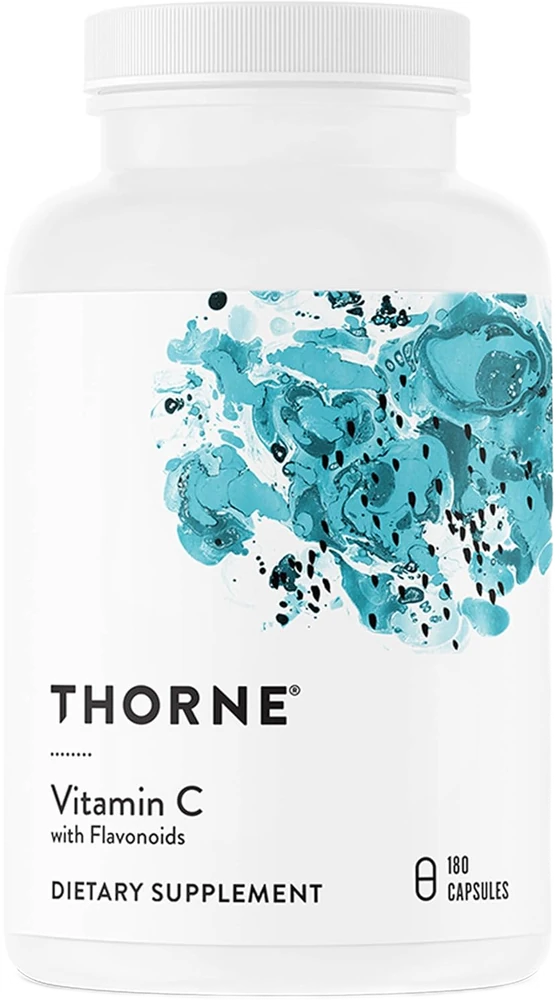 #1 of 9 · Best Overall✓ Label verified · Supplement Facts read Sep 7, 2026
Real retailer photo, cut out. Label unedited.
Buy it. A dose designed around how vitamin C is actually absorbed, from the brand clinicians trust most. You're not buying a magic form here — it's standard ascorbic acid with a little bioflavonoid.
~$25~$0.14 / 500 mg capsule
Why It Scores 7.4 — And The Label Line Behind Each Number
Form & Bioavailability
30% of scoreStandard ascorbic acid with 75 mg citrus bioflavonoids — no absorption-enhancing chemistry, so uptake follows the same saturable curve as any oral C. It earns its points on the 500 mg unit size, which lets you dose near the ~200 mg absorption window rather than overshoot it.
- Form
- Ascorbic acid + 75 mg citrus bioflavonoids
Third-Party Testing & QA
25% of scoreThorne runs one of the deepest brand-wide third-party testing programs in the supplement industry and is a default among clinicians. It's not a per-lot USP seal, but the verification story is the strongest in this group.
- Testing
- Brand-wide third-party certified/tested
- Clean label
- Gluten-free, no corn-derived C
Dose Strategy vs. Clinical Range
15% of score500 mg per capsule is the smartest dose here. Split morning and evening and you stay near plasma saturation without the steep diminishing returns of a 1,000 mg single dose.
- Dose
- 500 mg vitamin C per capsule
GI Tolerance & Suitability
15% of scoreUnbuffered ascorbic acid, so not the gentlest option — but the lower 500 mg unit is inherently easier on the stomach than the gram tablets, and the corn-free, gluten-free formula suits sensitive users.
Value per Serving
15% of scoreAbout $0.14 per 500 mg capsule works out to roughly $0.28 per gram — mid-pack. You're paying for testing rigor, not a low ingredient cost.
- Count
- 180 capsules / 180 servings
- Cost per 1,000 mg
- ~$0.28 (2 caps)
- Price
- ~$25
- Cost per serving
- ~$0.14 / 500 mg capsule
Label verified. Every figure read from the Supplement Facts photo, Sep 7, 2026.
Marketing Claims Vs. Reality
A 500 mg split-dose schedule improves fractional absorption versus a single 1,000 mg dose.
Levine 1996 (PNAS) and Padayatty 2004 (Ann Intern Med) show oral vitamin C absorption is saturable and fractional bioavailability falls at gram doses, so two 500 mg doses stay nearer the absorption window than one 1,000 mg bolus.
Brand-wide third-party tested.
Thorne operates one of the most extensive independent testing programs in the industry and is widely corroborated as clinician-trusted; verification is not limited to a single flagship lot.
The 75 mg citrus bioflavonoids meaningfully boost vitamin C absorption.
Human evidence that bioflavonoids raise vitamin C bioavailability at these doses is weak and inconsistent; treat the flavonoids as a minor cofactor, not an absorption lever.
Clean formula: no corn-derived vitamin C and gluten-free.
Consistent with the product label and Thorne's published sourcing standards.
What Our Test Actually Found
The 500 mg cap is a feature, not a shortfall
Oral vitamin C saturates: Levine's pharmacokinetic data put near-complete plasma saturation around 200-400 mg/day. A 500 mg unit taken twice daily tracks that curve far better than a single 1,000 mg tablet, most of which is excreted.
Testing is the real product
Across this category, independent verification is what separates a trustworthy bottle from a leap of faith. Thorne's brand-wide program is the strongest here, which is why it outranks cheaper picks.
Bioflavonoids are a bonus, not a reason
The 75 mg citrus bioflavonoid content is fine to have, but don't pay a premium for it — the human absorption-boost data are thin. Judge this bottle on dose design and testing.
Two-capsule cost is the honest trade-off
To reach a full gram you take two capsules, roughly doubling cost per gram to ~$0.28. If you only ever want 500 mg/day that's irrelevant; if you want 1,000 mg cheaply, look at Nature Made.
Full analysis: all pros & cons (7), buy if / skip if
- Modest 500 mg/cap is the smartest match to the ~200 mg absorption ceiling — split it across the day for better fractional uptake than one 1,000 mg bolus
- Thorne's clinician-trusted, brand-wide third-party testing is best-in-class for verification
- No corn-derived vitamin C and gluten-free — a genuinely clean formula
- Capsule format (not a horse-pill tablet) makes the twice-daily split genuinely easy to swallow
- You need 2 capsules to reach 1,000 mg, roughly doubling cost per gram
- The split-dose absorption advantage is real but small
- You're mainly paying for testing rigor, not a magic form
- You want one trustworthy bottle and are willing to take it twice a day
- Independent testing rigor matters more to you than cost per gram
- You prefer a clean, corn-free, gluten-free formula
- You want the absolute lowest cost per milligram
- You'd rather take a single tablet once a day and forget it
You're not buying a magic form here — it's standard ascorbic acid with a little bioflavonoid. What you're buying is a 500 mg unit you can split across the day (smarter than a 1,000 mg bolus) plus Thorne's best-in-class brand-wide third-party testing. That combination is why it tops the list even though cheaper bottles exist.
Most vitamin C marketing sells you a bigger number. Thorne quietly does the opposite — a 500 mg capsule that, taken twice a day, keeps you near the absorption window instead of flushing a gram at once. Pair that with the most respected independent-testing program in the aisle, and you have the one bottle we'd hand someone who just wants to get vitamin C right without thinking about it.
The one bottle to buy if you want to get vitamin C right

This wins on the two things that actually move the needle — independent testing and a dose you can use intelligently — rather than on a marketing form. The 500 mg cap lets you dose near the saturation point instead of flushing a megadose. If you want one bottle you can trust and use correctly, start here.
If This Doesn’t Fit — Try These
 02
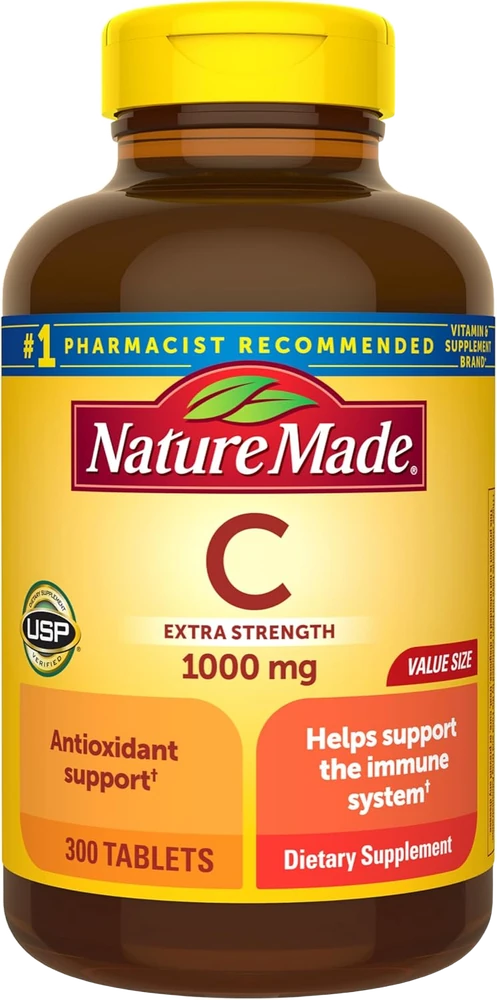
02Nature Made Vitamin C 1,000 mg
Our take: if you want a verified, no-nonsense vitamin C for pennies, nothing here beats it — USP Verification is the reason it sits at #2 despite the harshest form on the list.
 03
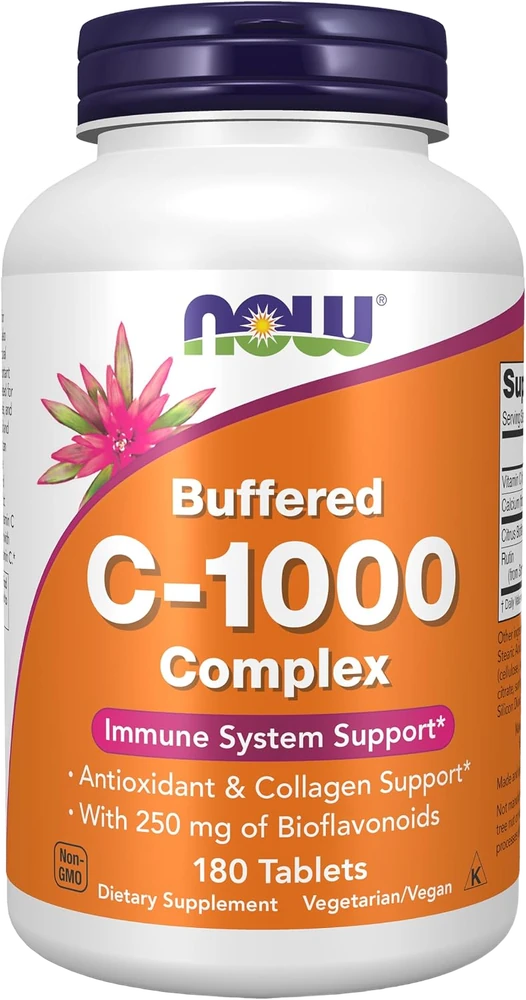
03NOW C-1000 Complex
Our take: the best everyday all-rounder — gentler than plain C, cheaper than the boutique buffered options, from a brand that actually passes independent GMP audits.
Quick Answers
Why is a 500 mg capsule better than a 1,000 mg tablet?
Oral vitamin C absorption saturates near 200-400 mg. Two 500 mg doses spread across the day keep you nearer that window, so a larger fraction is actually absorbed rather than excreted.
Do the bioflavonoids do anything?
Not much at 75 mg. The human evidence that citrus bioflavonoids boost vitamin C absorption is weak, so treat them as a minor bonus rather than the reason to buy.
Is Thorne worth the higher price?
If independent testing matters to you, yes. You're paying for one of the strongest brand-wide third-party verification programs in the category, not for a special form of vitamin C.
Sources & Further Reading
2 peer-reviewed sources, each linked to PubMed
- [1] Levine M, et al. Vitamin C pharmacokinetics in healthy volunteers: evidence for a recommended dietary allowance. Proc Natl Acad Sci USA. 1996;93(8):3704-3709. PMID 8623000 — Vitamin C pharmacokinetics in healthy volunteers: evidence for a recommended dietary allowance. Plasma vitamin C follows sigmoid kinetics with near-complete saturation around 200-400 mg/day and no added plasma benefit above ~400 mg/day, supporting split, moderate dosing.
- [2] Padayatty SJ, et al. Vitamin C pharmacokinetics: implications for oral and intravenous use. Ann Intern Med. 2004;140(7):533-537. PMID 15068981 — Vitamin C pharmacokinetics: implications for oral and intravenous use. Oral vitamin C is tightly regulated by intestinal absorption and renal excretion, so oral megadoses cannot push plasma meaningfully beyond the saturation set point.
Affiliate disclosure: every Amazon link uses our Associates tag (superachieverclub-20). We earn a small commission at no cost to you; it funds independent reviews. We never accept payment to change a ranking.