

Black Seed Oil: Benefits, Dosage & Side Effects (2026)
Black seed oil is cold-pressed Nigella sativa seed oil whose active thymoquinone has randomized-trial evidence for asthma control, allergic rhinitis, blood pressure and lipids; potency varies several-fold, so buy declared oil.
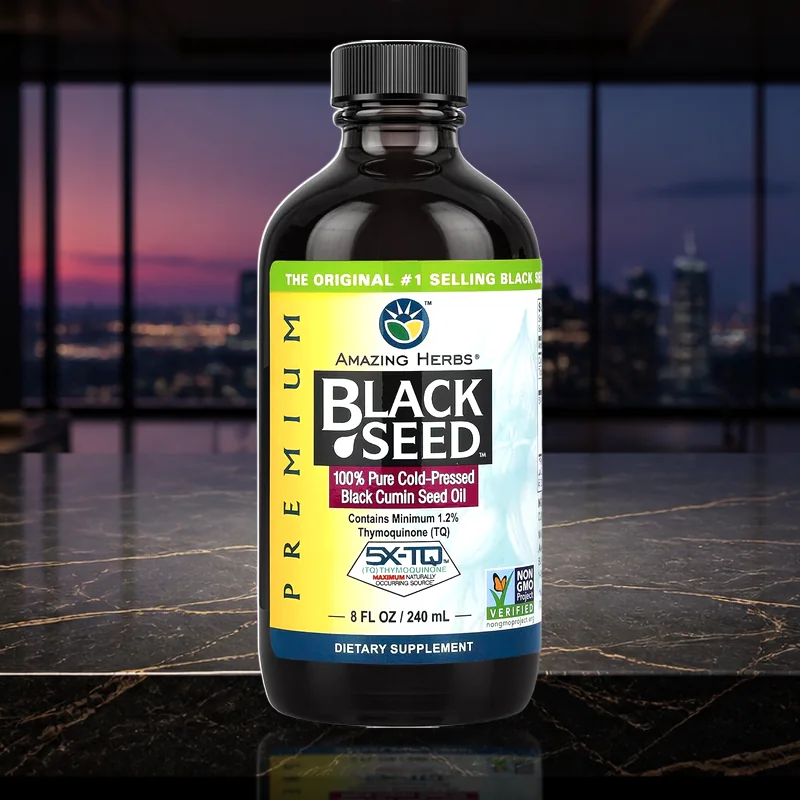
Amazing Herbs Premium Black Seed Oil, 8 fl oz
What is Black Seed Oil?
Black seed oil is pressed from the seeds of Nigella sativa, a flowering plant of the buttercup family grown across the Middle East, North Africa, Turkey and South Asia, where the seed (kalonji, black cumin, habbatussauda) has been used as a spice and remedy for millennia. The oil is roughly 55-60 percent linoleic acid (omega-6) and 20-25 percent oleic acid (omega-9), and carries a volatile fraction whose main component, thymoquinone, is the compound behind nearly all of the measured effects.
It is sold as a liquid (a teaspoon is about 4.5-5 g of oil), as softgels (typically 500-1,000 mg each) and as veggie capsules. Thymoquinone content in cold-pressed oil ranges from a fraction of a percent to over one percent by weight depending on seed variety, origin, pressing temperature and storage, which is why a declared amount or percentage on the panel is the single most useful line on a black seed oil label.
How it works
THYMOQUINONE is the engine. In laboratory work it dampens inflammatory signalling (NF-kB, cyclooxygenase and lipoxygenase pathways), scavenges radicals and modulates histamine release and allergic cytokines, and reviews identify it as the principal active constituent of the seed (Salem 2005). Because the oil is a natural product, the dose of thymoquinone you get depends entirely on how much is in the oil you bought.
AIRWAYS AND ALLERGY are the best-evidenced applications. In an 80-patient randomized, double-blind, placebo-controlled trial, 500 mg of oil twice a day for four weeks improved Asthma Control Test scores and lowered blood eosinophils (Koshak 2017). In a two-week trial of 66 allergic-rhinitis patients the oil reduced congestion, itching, runny nose and sneezing (Nikakhlagh 2011), and a 2024 meta-analysis of the randomized trials confirmed improved symptom scores (He 2024). An older 152-patient study reported lower subjective symptom scores across allergic rhinitis, asthma and eczema at 40-80 mg of oil per kilogram a day (Kalus 2003).
CARDIOMETABOLIC effects are modest and consistent: across eleven randomized trials Nigella sativa lowered systolic and diastolic pressure by about 3 mmHg each (Sahebkar 2016); across seventeen trials it lowered total cholesterol, LDL and triglycerides, with oil preparations raising HDL (Sahebkar 2016); and in type 2 diabetes it lowered fasting glucose and HbA1c (Daryabeygi 2017). Small reductions in weight and waist appear in a pooled analysis (Namazi 2018).
At-a-glance facts
- What it is
- Cold-pressed oil of Nigella sativa seed; ~55-60% omega-6 linoleic acid, ~20-25% omega-9 oleic acid, plus a volatile fraction led by thymoquinone
- Key active
- Thymoquinone (TQ) — content in cold-pressed oil varies several-fold; three of the eight products we ranked print it (48 mg/5 mL, 9.6 mg/1 g, or 0.6%)
- Studied dose
- 500 mg oil twice a day (asthma, 4 weeks); 40-80 mg/kg/day (allergic diseases); most trials 1-3 g a day of oil or seed
- Typical retail serving
- 1 teaspoon (about 4.5-5 g oil) as a liquid; 500-1,000 mg per softgel; half a teaspoon to a teaspoon covers the studied range
- Best-evidenced effects
- Better asthma control and lower eosinophils; fewer allergic-rhinitis symptoms; ~3 mmHg lower blood pressure; lower LDL and triglycerides
- Time to effect
- Allergy and airway symptoms within 2-4 weeks in the trials; blood pressure and lipids over 8-12 weeks
- Storage
- Mostly polyunsaturated fat — oxidises in light and air; dark glass or softgels, cool and dark, refrigerate after opening
- Safety flags
- Additive with BP, glucose and anticoagulant medication; avoid in pregnancy; strong taste and mild GI upset as a liquid
- Evidence level
- 3 of 5 — several small RCTs plus meta-analyses; modest, consistent effects; heterogeneous preparations
- Cost range (US)
- ~$0.12 to $0.47 per gram of oil; ~$0.27 to $0.82 per serving
Evidence: Placebo-controlled trials in asthma and allergic rhinitis and meta-analyses for blood pressure, lipids and glucose give black seed oil a real but modest evidence base; trials are small, preparations vary in thymoquinone, and no trial supports the broad 'cure-all' reputation.
Who it's for — and who it isn't
- People with mild asthma or seasonal allergic rhinitis who want an oil with placebo-controlled trials behind it, as an addition to prescribed care
- People working on blood pressure, cholesterol or fasting glucose alongside diet, where meta-analyses show modest gains
- Buyers who want a traditional remedy but will only pay for one whose thymoquinone content is declared
- Anyone who prefers a whole-food oil over an isolated extract and will store it properly
- Anyone using it instead of asthma inhalers, antihypertensives or diabetes medication; the trial effects are additions, not replacements
- People on blood-pressure, glucose-lowering or anticoagulant medication without clinician input; the oil can add to those effects
- Pregnant women, for whom the seed has traditional uterine-stimulant cautions and no safety data at supplement doses
- Buyers who will accept a 'high thymoquinone' claim from a listing without finding it on the Supplement Facts panel
Week-by-week, what happens
- Day 1-3Taste and digestion. Liquid oil is peppery and can upset an empty stomach; take it with food. No acute effect is expected.
- Week 2-4Allergy and airway symptoms. The rhinitis trial ran two weeks and the asthma trial four; symptom scores and eosinophil counts moved within that window at about 1 g of oil a day.
- Month 2-3Blood pressure and lipids on a test, not by feel. The meta-analyses pool eight- to twelve-week trials; expect a few mmHg and a modest lipid shift.
- OngoingA daily half-teaspoon to teaspoon of declared oil, or two 500 mg softgels, with food, stored dark. Review with a clinician if you take blood-pressure, diabetes or anticoagulant medication.
Safety & contraindications
- Medication interactions are the practical caveat. Black seed lowers blood pressure and glucose in trials, so it can add to antihypertensives and diabetes medication, and thymoquinone has antiplatelet activity in laboratory work, so anticoagulant users should ask a clinician first.
- Pregnancy: the seed has traditional uterine-stimulant cautions and no safety data at supplement doses; avoid. Breastfeeding safety is unstudied.
- The oil is fragile. Over half of it is omega-6 linoleic acid, which oxidises in light and air and degrades thymoquinone with it. Buy cold-pressed oil in dark glass or sealed softgels, store cool and dark, and refrigerate a liquid after opening.
- Potency is not on most labels. Thymoquinone content varies several-fold between oils; if the Supplement Facts panel declares no amount or percentage, treat any 'high TQ' or '3x more TQ' claim in the listing as unverified. Only three of the eight products we ranked print a figure.
- Liquid oil is peppery and can cause mild nausea or heartburn on an empty stomach; take it with food or choose a softgel. Rare allergic skin reactions have been reported with topical use.
- It is an addition, not a replacement. The asthma trial improved control scores on top of usual care; nobody should swap an inhaler, a statin or metformin for a teaspoon of oil.
All articles on Black Seed Oil
Best Black Seed Oil Supplements
8 black seed oils and softgels ranked on declared thymoquinone, extraction and testing — only three print a TQ figure; we say which.
Read →Amazing Herbs Premium Black Seed Oil, 8 fl oz Review
The reference black seed oil: 48 mg thymoquinone per 5 mL declared on the panel, cold-pressed and unrefined, in glass.
Read →Bio Nutrition Premium Black Seed Oil Softgels, 90 Count Review
The softgel pick: 1,000 mg cold-pressed oil per two softgels with 9.6 mg thymoquinone and the omega profile declared, exactly the 1 g dose the asthma trial used.
Read →Heritage Store USDA Organic Black Seed Oil, 8 fl oz Review
An organic, cold-pressed oil in dark glass at a fair price, held back by a panel that says nothing about thymoquinone.
Read →Horbaach Black Seed Oil 2,000 mg Softgels, 120 Count Review
The budget softgel: 2 g of cold-pressed oil per two softgels for about a quarter a day, non-GMO and lab-tested, with no thymoquinone declared.
Read →MAJU Cold-Pressed Black Seed Oil, 8 fl oz Review
The most expensive liquid here, with GMP and third-party-tested seals on the panel but no thymoquinone figure to justify the premium.
Read →Nature's Way Organic Black Seed Oil, 8 fl oz Review
The organic pick: USDA Organic black seed oil standardised to 0.6 percent thymoquinone, with omega-6 and omega-9 declared per teaspoon.
Read →Sweet Sunnah Black Seed Oil, 8 oz Review
A traditional cold-pressed Turkish oil with its fatty-acid composition printed and its thymoquinone left blank, at the lowest price per teaspoon on the list.
Read →Zhou Black Seed Oil 1,300 mg Veggie Capsules, 60 Count Review
A veggie-capsule black seed oil at 1,300 mg per serving whose product listing never shows its Supplement Facts panel; we scored what we could read.
Read →FAQ
What does black seed oil actually do, according to trials?
The best evidence is in airways and allergy: 500 mg of oil twice a day for four weeks improved asthma control and lowered blood eosinophils in an 80-patient placebo-controlled trial, and a two-week trial plus a 2024 meta-analysis found fewer allergic-rhinitis symptoms. Meta-analyses also show blood pressure about 3 mmHg lower, lower LDL and triglycerides, and in type 2 diabetes lower fasting glucose and HbA1c. All modest, all real, none a cure.
How much black seed oil should I take a day?
The asthma trial used 1 g of oil a day in two 500 mg doses; the allergic-disease study used 40-80 mg per kilogram. A teaspoon of liquid is about 5 g, so half a teaspoon to a teaspoon a day covers the studied range, or two 500 mg softgels. More is not better and tastes worse. Take it with food.
Why does thymoquinone content matter, and how do I check it?
Thymoquinone is the compound behind nearly every measured effect, and its content in cold-pressed oil ranges from a fraction of a percent to over one percent depending on the seed and the press. Look for an amount or percentage on the Supplement Facts panel, not in the listing bullets. Among the eight products we ranked, Amazing Herbs prints 48 mg per 5 mL, Bio Nutrition 9.6 mg per 1 g softgel serving and Nature's Way a 0.6 percent standard; the other five print nothing.
Liquid or softgel?
Liquid delivers more oil per dollar and lets you dose by the half-teaspoon, but it is peppery and oxidises once opened. Softgels are tasteless, exact and sealed against air, at a higher cost per gram and a smaller dose per capsule. If taste made you quit before, buy the softgel that declares its thymoquinone.
Is black seed oil safe with blood-pressure or diabetes medication?
Ask your clinician first. The trials show black seed lowers blood pressure and glucose, which is the point for some buyers and a stacking risk for people already medicated for either. Thymoquinone also has antiplatelet activity in laboratory work, so anticoagulant users need the same conversation.
Can I cook with black seed oil?
Not if you want the thymoquinone. The oil is mostly polyunsaturated fat that oxidises with heat, and thymoquinone degrades with it. Take it cold, with food, and keep the bottle in the fridge once opened.
Sources & further reading
- Koshak A, et al. Phytother Res. 2017;31(3):403-409.Nigella sativa Supplementation Improves Asthma Control and Biomarkers: A Randomized, Double-Blind, Placebo-Controlled Trial
Four weeks of 500 mg Nigella sativa oil twice a day improved asthma-control scores and lowered blood eosinophils versus placebo in 80 asthmatics; lung function did not change significantly.
- Nikakhlagh S, et al. Am J Otolaryngol. 2011;32(5):402-7.Herbal treatment of allergic rhinitis: the use of Nigella sativa
In a two-week trial of 66 allergic-rhinitis patients, Nigella sativa oil reduced nasal congestion, itching, runny nose and sneezing compared with placebo.
- He Y, et al. Front Pharmacol. 2024;15:1451881.Meta-analysis of randomized controlled trials assessing the efficacy of nigella sativa supplementation for allergic rhinitis treatment
Pooling the randomized trials, Nigella sativa supplementation improved allergic-rhinitis symptom scores versus control, with the authors noting small trials and heterogeneous preparations.
- Kalus U, et al. Phytother Res. 2003;17(10):1209-14.Effect of Nigella sativa (black seed) on subjective feeling in patients with allergic diseases
In 152 patients with allergic rhinitis, asthma or eczema, black seed oil capsules dosed at 40 to 80 mg per kilogram a day reduced subjective symptom scores over the study period.
- Sahebkar A, et al. J Hypertens. 2016;34(11):2127-35.A systematic review and meta-analysis of randomized controlled trials investigating the effects of supplementation with Nigella sativa (black seed) on blood pressure
Across eleven randomized trials, Nigella sativa lowered systolic blood pressure by about 3 mmHg and diastolic by about 3 mmHg, a modest but consistent effect.
- Sahebkar A, et al. Pharmacol Res. 2016;106:37-50.Nigella sativa (black seed) effects on plasma lipid concentrations in humans: A systematic review and meta-analysis of randomized placebo-controlled trials
Seventeen randomized trials pooled showed lower total cholesterol, LDL and triglycerides with Nigella sativa; seed powder lowered cholesterol more than oil, while oil was associated with a rise in HDL.
- Daryabeygi-Khotbehsara R, et al. Complement Ther Med. 2017;35:6-13.Nigella sativa improves glucose homeostasis and serum lipids in type 2 diabetes: A systematic review and meta-analysis
In type 2 diabetes, Nigella sativa supplementation lowered fasting glucose, HbA1c, total cholesterol and LDL across the pooled randomized trials.
- Namazi N, Larijani B, Ayati MH, Abdollahi M. J Ethnopharmacol. 2018;219:173-181.The effects of Nigella sativa L. on obesity: A systematic review and meta-analysis
Pooling eleven randomized trials, Nigella sativa produced small reductions in body weight, body-mass index and waist circumference compared with control.
- Salem ML. Int Immunopharmacol. 2005;5(13-14):1749-70.Immunomodulatory and therapeutic properties of the Nigella sativa L. seed
A review identifying thymoquinone as the principal active constituent behind black seed's anti-inflammatory, antioxidant and immunomodulatory effects in laboratory and early clinical work.
- Gholamnezhad Z, Shakeri F, Saadat S, Ghorani V, Boskabady MH. Avicenna J Phytomed. 2019;9(3):195-212.Clinical and experimental effects of Nigella sativa and its constituents on respiratory and allergic disorders
A review of clinical and experimental studies concluding that Nigella sativa and thymoquinone show bronchodilatory, anti-inflammatory and anti-allergic effects, with human trials small but consistent in direction.