

Multivitamin: Benefits, Dosage & Side Effects (2026)
A multivitamin is a daily blend of vitamins and minerals that fills common dietary gaps; it is sound nutritional insurance, not a proven longevity or cardiovascular intervention.
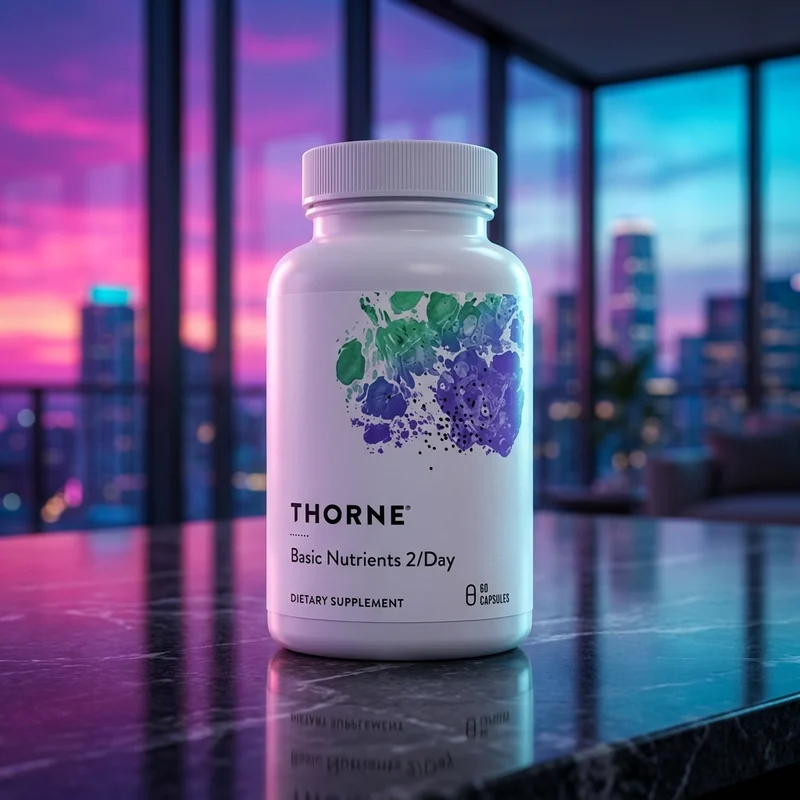
Thorne Basic Nutrients 2/Day
What is Multivitamin?
A multivitamin (or multivitamin-mineral, MVM) is a single daily supplement combining a broad set of vitamins and minerals — typically the B-complex, vitamins A, C, D, E and K, and minerals such as zinc, selenium, iodine, and sometimes iron, calcium and magnesium — at doses meant to fill the gaps in a normal diet rather than to treat any one deficiency at high dose. It is the most widely used supplement in the world, and the most over-promised: the bottle implies vitality and longevity, while the honest job is narrower and genuinely useful — topping up the everyday shortfalls a real diet leaves.
Those shortfalls are real and common. National intake data (NHANES) show large fractions of US adults fall below the estimated requirement for everyday micronutrients — around 95% for vitamin D, 84% for vitamin E, and substantial fractions for vitamins A and C and for magnesium (Reider 2020). A multivitamin is the cheapest, simplest way to close those gaps to roughly 100% of needs. That is the correct mental model: insurance against dietary inadequacy, not a performance drug and not a substitute for food, sleep, training, or medical care.
The quality of a multivitamin is decided by FORMS, not by milligram count. The single clearest tell is folate: the better products use methylfolate (L-5-MTHF), the circulating, ready-to-use form, while cheaper ones use folic acid, a synthetic that the body must enzymatically convert — a step many people perform inefficiently (Pietrzik 2010). The same logic favours methylcobalamin over cyanocobalamin for B12, and chelated minerals (bisglycinate, citrate) over oxides. A good multivitamin also shows restraint: it fills gaps to about 100% of needs rather than megadosing fat-soluble vitamins, and it carries third-party verification (USP, NSF) that the bottle contains what the label claims.
How it works
Mechanistically, a multivitamin works by raising the intake of micronutrients that act as enzyme cofactors and structural components across the body — B-vitamins in energy metabolism and one-carbon (methylation) pathways, vitamin D and calcium in bone and immune signalling, zinc and selenium in immune and antioxidant enzymes, and so on. Where a real deficiency or insufficiency exists, correcting it restores normal function; that is the only setting in which a multivitamin reliably 'does' anything. In a person who is already replete in a given nutrient, adding more of it does little — which is why a multivitamin is best understood as gap-filling, not enhancement.
The clinical-outcome evidence is where honesty matters most, because the trials are large and the results are mixed. The Physicians' Health Study II randomized 14,641 men to a daily multivitamin or placebo for over eleven years. On cancer, it found a modest but statistically significant 8% reduction in total cancer incidence (Gaziano 2012, PMID 23162860). On cardiovascular disease, in the same cohort, it found NOTHING — no reduction in major cardiovascular events, heart attack, stroke, or cardiovascular death (Sesso 2012, PMID 23117775). That split — a small cancer signal, a clear cardiovascular null — is the real evidence picture and the reason no honest source calls a multivitamin a longevity or heart drug.
The newest and most encouraging signal is cognitive, and specifically in older adults. The COSMOS-Mind trial (Baker 2022, PMID 36102337) found that three years of daily multivitamin-mineral supplementation improved global cognition, episodic memory, and executive function in adults aged 65+, with a larger benefit in those with cardiovascular disease — while cocoa extract did nothing. The companion COSMOS-Web trial (Yeung 2023, PMID 37244291) replicated the memory benefit in 3,562 older adults, estimating it as roughly three years of age-related memory change. This is the most promising direction for multivitamins, but note the scope: it is older adults, the effects are modest, and it is not a promise of becoming 'smarter.' Taken together, the mechanism is simple — correct real micronutrient gaps — and the realistic payoff is sound nutritional insurance, a modest cancer-incidence edge over many years, and an emerging cognitive benefit in older age.
At-a-glance facts
- What it really is
- Insurance for dietary gaps — NOT a proven longevity or cardiovascular drug
- Best evidence (cancer)
- Modest 8% lower total cancer incidence over 11+ years (PHS II, Gaziano 2012)
- Best evidence (heart)
- NO cardiovascular benefit in the same large RCT (PHS II, Sesso 2012)
- Newest signal (cognition)
- Improved memory + global cognition in adults 65+ over 3 years (COSMOS-Mind/Web)
- Best folate form
- Methylfolate (L-5-MTHF) — active + circulating — over synthetic folic acid (Pietrzik 2010)
- Best B12 / mineral forms
- Methylcobalamin over cyanocobalamin; chelated (bisglycinate) minerals over oxides
- Sensible dose
- Fills gaps to ~100% of needs — avoid megadosed fat-soluble vitamins (A, E)
- Iron rule of thumb
- Most men + post-menopausal women want iron-FREE; menstruating women often need iron
- Third-party testing
- USP Verified or NSF is the trust tier; in-house GMP only is a lower one
- Cost range (US)
- ~$0.03/day (USP-verified store brand) to ~$1.10/day (clinician-grade)
Evidence: Large RCTs give a mixed, honest picture: PHS II found a modest cancer-incidence reduction (Gaziano 2012, PMID 23162860) but NO cardiovascular benefit (Sesso 2012, PMID 23117775); the COSMOS-Mind/Web trials found a cognition + memory benefit in older adults (Baker 2022, PMID 36102337; Yeung 2023, PMID 37244291). The gap-filling rationale is well-grounded (NHANES inadequacy data, Reider 2020). Rated 3/5 — real, useful insurance with an emerging cognition signal, but NOT a proven longevity or mortality intervention.
Who it's for — and who it isn't
- Anyone whose diet has real gaps — limited variety, restrictive eating, or skipped food groups — wanting cheap, broad nutritional insurance
- Older adults (65+) — the COSMOS trials suggest a daily multivitamin modestly supports memory and global cognition over years
- Menstruating women, who often need the iron a women's multivitamin supplies, and people planning pregnancy (for the folate)
- Vegans and vegetarians, who are structurally short on B12, iron, zinc and sometimes vitamin D from diet alone
- Busy people who want a single insurance bottle and will choose a bioavailable-form, sensibly-dosed, third-party-tested product over a megadose
- Anyone expecting a longevity or heart-disease drug — the largest RCT found no cardiovascular benefit (Sesso 2012); this is gap-insurance, not life-extension
- People who already eat a varied, nutrient-dense diet and have no measured gaps — the marginal benefit of topping up an already-replete person is small
- Anyone using it as a reason to skip real food, sleep, exercise, or medical care — a multivitamin substitutes for none of those
- People with a specific diagnosed deficiency (e.g. iron-deficiency anemia, severe vitamin D deficiency) — that needs a targeted, higher dose, not a multivitamin's gap-level amounts
Week-by-week, what happens
- Day 1No felt effect for most people — a multivitamin corrects gaps biochemically, not perceptibly. Bright-yellow urine just means excess riboflavin (B2) leaving; it's harmless, not a sign of 'working.'
- Week 1-4If you had a genuine shortfall (e.g. low B12, low vitamin D building back up), subtle energy or wellbeing improvements may appear. If you were already replete, expect to feel nothing — that's normal and not a failure.
- Month 1-3Blood levels of any deficient nutrients move toward normal. This is where a multivitamin does its real, invisible work: closing the dietary gaps to roughly 100% of needs.
- Year 1+The outcome-level effects seen in trials operate on this timescale: the modest cancer-incidence edge (PHS II) and the older-adult cognition benefit (COSMOS) accrued over multiple years of consistent daily use, not weeks.
Safety & contraindications
- A standard, sensibly-dosed multivitamin is very safe for most adults — it's designed to fill gaps to roughly 100% of needs, not to megadose. The main risks come from overdoing specific nutrients, not from the concept.
- Iron is the one to watch: iron-containing multivitamins can cause GI upset and constipation, and iron is dangerous in overdose — keep iron-containing products away from children, and don't take an iron multivitamin unless you actually need iron.
- Fat-soluble vitamins (A, E, and high-dose D) can accumulate. Avoid stacking a megadosed multivitamin on top of separate high-dose A or E supplements; pregnant women in particular should avoid high preformed vitamin A (retinol).
- A multivitamin can mask a B12 deficiency: its folic acid/folate can correct the anemia of B12 deficiency while nerve damage progresses silently. If you have deficiency symptoms, get tested rather than self-treating.
- Check for interactions with medications: vitamin K can blunt warfarin; calcium, magnesium, zinc and iron can bind certain antibiotics and thyroid medication (separate dosing by a few hours). Review your multivitamin with a clinician if you take prescription drugs.
- A multivitamin is a supplement, not a treatment. It does not replace a varied diet, and it does not treat a diagnosed deficiency — those need targeted, higher-dose correction under medical guidance.
All articles on Multivitamin
Best Multivitamin for Men
The 10 best multivitamins for men, cohort-ranked with iron-free as rule one (Centrum Men's added iron is the honest reason it ranks near the bottom), methylfolate over folic acid, testing and value — no testosterone fairy tales, gap-insurance framing.
Read →Best Multivitamin for Women
The 9 best multivitamins for women, cohort-ranked on nutrient forms (methylfolate over folic acid), the iron fork (menstruating vs post-menopausal — both addressed honestly), testing and value — gap-insurance framing, explicitly not prenatal advice.
Read →Best Multivitamins
The 10 best multivitamins ranked on nutrient-form quality (methylfolate over folic acid, chelated minerals), sensible non-megadose levels, third-party testing and value — framed honestly as gap-insurance, not a proven longevity drug.
Read →Centrum Men Multivitamin Review
The most complete drugstore men's formula — capped by the iron it shouldn't contain.
Read →Centrum Women Multivitamin Review
The most complete drugstore women's formula — full iron, basic forms, no seal.
Read →Garden of Life Organics Men's Once Daily Review
One vegan whole-food tablet with methylcobalamin and lichen D3, USDA Organic and Non-GMO confirmed, about $0.79/day. 8.1/10.
Read →Garden of Life Vitamin Code Men's Review
The whole-food men's pick — iron-free, folate not folic acid, prostate-tuned, certified.
Read →Garden of Life Vitamin Code Women's Review
The whole-food women's pick — folate not folic acid, food-state iron, certified.
Read →Kirkland Signature Daily Multi Review
USP-Verified gap-insurance for ~$0.03/day — basic forms, but genuinely verified.
Read →MegaFood One Daily Multivitamin Review
The one-tablet whole-food multi — active B forms, empty-stomach-friendly, great value.
Read →NAKED Men's Multi Review
Iron-free two-capsule men's multi with active B12 and B6 and chelated trace minerals, but no product-level test seal. 7.3/10.
Read →NOW ADAM Men's Multivitamin Review
The value men's pick — chelated minerals and men's botanicals at ~$0.49/day; folate is folic acid. 7.5/10.
Read →One A Day Men's Health Formula Review
The men's cost-per-day winner — iron-free done cheap, basic forms, no seal.
Read →One A Day Women's Multivitamin Review
The cheap women-specific tablet — honest basics, every corner cost-engineered.
Read →Optimum Nutrition Opti-Men Review
High-potency men's coverage for lifters — but folic acid, no third-party cert.
Read →Pure Encapsulations O.N.E. Multivitamin Review
Clinician-grade forms in ONE capsule a day — plus bonus antioxidants.
Read →Ritual Essential for Women 18+ Review
The women's pick — USP-Verified, clinically tested, with gentle iron and active folate.
Read →SmartyPants Men's Multivitamin Gummies Review
The best-built men's gummy — buy it only if tablets are truly off the table.
Read →SmartyPants Women's Multivitamin Gummies Review
The best-built women's gummy — buy it only if tablets are truly off the table.
Read →Super Achiever Complete Multivitamin Review
Our own multivitamin, scored like every other bottle: sensible doses in standard forms such as folic acid and oxides, with no outside testing.
Read →Thorne Basic Nutrients 2/Day Review
The cleanest execution of a multivitamin — the category benchmark.
Read →FAQ
Does a multivitamin actually help you live longer or prevent heart disease?
No — and this is the most important thing to be honest about. The largest, longest randomized trial (the Physicians' Health Study II, 14,641 men over 11+ years) found that a daily multivitamin produced NO reduction in major cardiovascular events, heart attack, stroke, or cardiovascular death (Sesso 2012, PMID 23117775). It is not a heart-disease drug and not a proven longevity intervention. What the same trial DID find was a modest 8% reduction in total cancer incidence (Gaziano 2012, PMID 23162860) — real, but small, and accrued over more than a decade. Buy a multivitamin as cheap insurance for dietary gaps, not as a longevity pill.
If the evidence is mixed, is a multivitamin even worth taking?
For many people, yes — as insurance, not as a drug. National data show large fractions of US adults fall short of the requirement for everyday nutrients like vitamin D, vitamin E and magnesium (Reider 2020). A multivitamin is the cheapest, simplest way to close those gaps in forms your body can use. The realistic payoff is correcting real shortfalls (which matters if you have them), a modest cancer-incidence edge over many years, and — the newest signal — a memory and cognition benefit in older adults (COSMOS-Mind, Baker 2022; COSMOS-Web, Yeung 2023). If you already eat a varied, nutrient-dense diet with no gaps, the marginal benefit is small. The honest summary: worthwhile insurance for people with dietary gaps, oversold as a wellness panacea for everyone.
Methylfolate or folic acid — does the folate form matter?
It's the single clearest quality tell in the whole category. Methylfolate (L-5-MTHF) is the active, circulating form of folate your body uses directly; folic acid is a cheap synthetic that has no coenzyme activity until your body enzymatically converts it — a conversion many people perform inefficiently (Pietrzik 2010, PMID 20608755). Methylfolate works regardless of your conversion efficiency, which is why the better multivitamins (Thorne, Pure Encapsulations, Ritual, MegaFood) use it, while NOW ADAM and the budget ones (Opti-Men, Kirkland) use folic acid. It's not a dealbreaker if cost is your constraint and you convert folate well — but if you're choosing on quality, methylfolate is the better form.
Should my multivitamin contain iron?
It depends entirely on who you are. Menstruating women lose iron monthly and often genuinely need it, so most women's multivitamins (like Ritual, #2, and Garden of Life Women's, #4) include it. Most men and post-menopausal women do NOT need supplemental iron and can accumulate too much over time, so men's and unisex formulas (Thorne, the Garden of Life Men's, the NOW and Optimum men's multis) are deliberately iron-free. Taking iron you don't need can cause GI upset and, long-term, iron overload. Rule of thumb: iron-free unless you're a menstruating woman, pregnant, or have diagnosed low iron — and if you suspect deficiency, get a blood test rather than guessing.
Does the COSMOS research mean a multivitamin makes you smarter?
Not quite — read it carefully. The COSMOS-Mind (Baker 2022) and COSMOS-Web (Yeung 2023) trials found that a daily multivitamin improved memory and global cognition in adults aged 60-65 and older, over three years, by a modest amount — COSMOS-Web estimated the memory benefit as roughly three years of age-related change. That's a genuinely encouraging and well-conducted result, and it's the most promising direction for multivitamins. But it is specific to OLDER adults, the effect size is modest, and it's about slowing age-related decline, not boosting a young, healthy brain into being 'smarter.' For older adults it's a real point in the multivitamin's favour; for a 25-year-old it is not evidence of a cognitive edge.
Whole-food multivitamin or synthetic — which is better?
Both can be good; the label matters more than the marketing word. 'Whole-food' multivitamins (like Garden of Life Vitamin Code, #4/#5, and MegaFood, #10) deliver nutrients in a food matrix with added probiotics or enzymes, and they typically use folate rather than folic acid — a genuine plus. The trade-offs are usually a higher pill count (four capsules for some) and lower per-nutrient potencies by design. Synthetic clinician-grade multis (Thorne #1, Pure Encapsulations #3) can match or beat them on form quality (methylated folate, chelated minerals) in fewer pills. Don't pick on the 'whole-food' label alone — check the actual forms (methylfolate vs folic acid), the dosing (sensible, not megadosed), and whether it's third-party tested.
Sources & further reading
- Gaziano 2012 (PHS II — cancer)Multivitamins in the prevention of cancer in men: the Physicians' Health Study II randomized controlled trial
14,641 male US physicians, mean 11.2 years: a daily multivitamin produced a modest but statistically significant 8% reduction in total cancer incidence versus placebo. The largest, longest multivitamin RCT for cancer — a small real benefit, and the honest ceiling of the multivitamin-and-cancer claim.
- Sesso 2012 (PHS II — cardiovascular)Multivitamins in the prevention of cardiovascular disease in men: the Physicians' Health Study II randomized controlled trial
Same 14,641-man cohort, median 11.2 years: a daily multivitamin produced NO significant reduction in major cardiovascular events, myocardial infarction, stroke, or cardiovascular death. The decisive null result — a multivitamin is not a cardiovascular or longevity intervention.
- Baker 2022 (COSMOS-Mind — cognition)Effects of cocoa extract and a multivitamin on cognitive function: A randomized clinical trial (COSMOS-Mind)
2,200+ adults aged 65+, 3 years: daily multivitamin-mineral supplementation significantly improved global cognition, episodic memory, and executive function versus placebo, with a larger benefit in those with cardiovascular disease; cocoa extract had no cognitive effect. The first major signal for multivitamins and older-adult cognition.
- Yeung 2023 (COSMOS-Web — memory)Multivitamin Supplementation Improves Memory in Older Adults: A Randomized Clinical Trial (COSMOS-Web)
3,562 older adults, 3 years: a daily multivitamin significantly improved episodic memory (immediate recall) versus placebo — an effect estimated as roughly 3 years of age-related memory change and sustained across follow-up. Replicates and strengthens the COSMOS-Mind cognition finding.
- Pietrzik 2010 (folate forms)Folic acid and L-5-methyltetrahydrofolate: comparison of clinical pharmacokinetics and pharmacodynamics
L-5-methyltetrahydrofolate (methylfolate) is the predominant circulating, biologically active folate, while folic acid is a synthetic form lacking coenzyme activity that must be enzymatically reduced. The basis for ranking methylfolate multivitamins above folic-acid ones — methylfolate is usable regardless of conversion efficiency.
- Reider 2020 (NHANES — nutrient gaps)Inadequacy of Immune Health Nutrients: Intakes in US Adults, the 2005-2016 NHANES
26,282 US adults across 2005-2016 NHANES: widespread inadequacy of everyday micronutrients — ~95% below the requirement for vitamin D, ~84% for vitamin E, ~46% for vitamin C, ~45% for vitamin A. The empirical basis for the 'multivitamin as gap-insurance' rationale.