
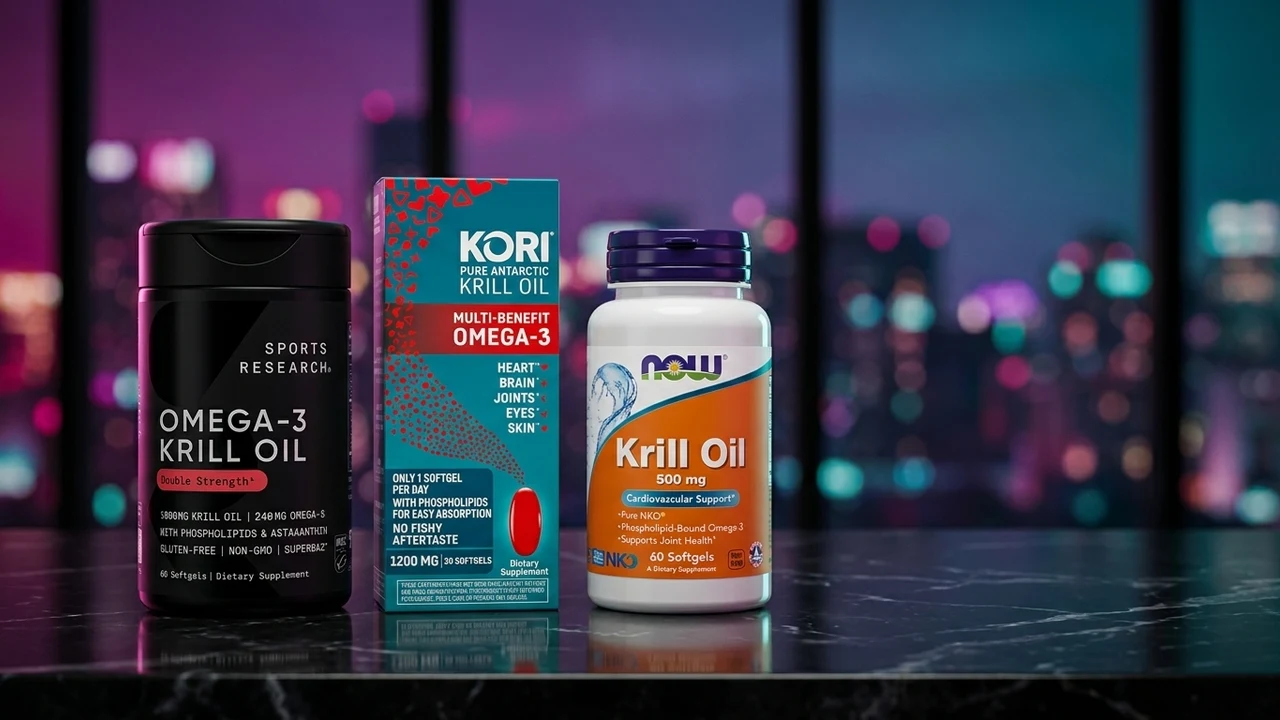
Top 8 Best Krill Oil Supplements (2026)
8 picks — ranked by our 50/50 methodology
- #1Best overall
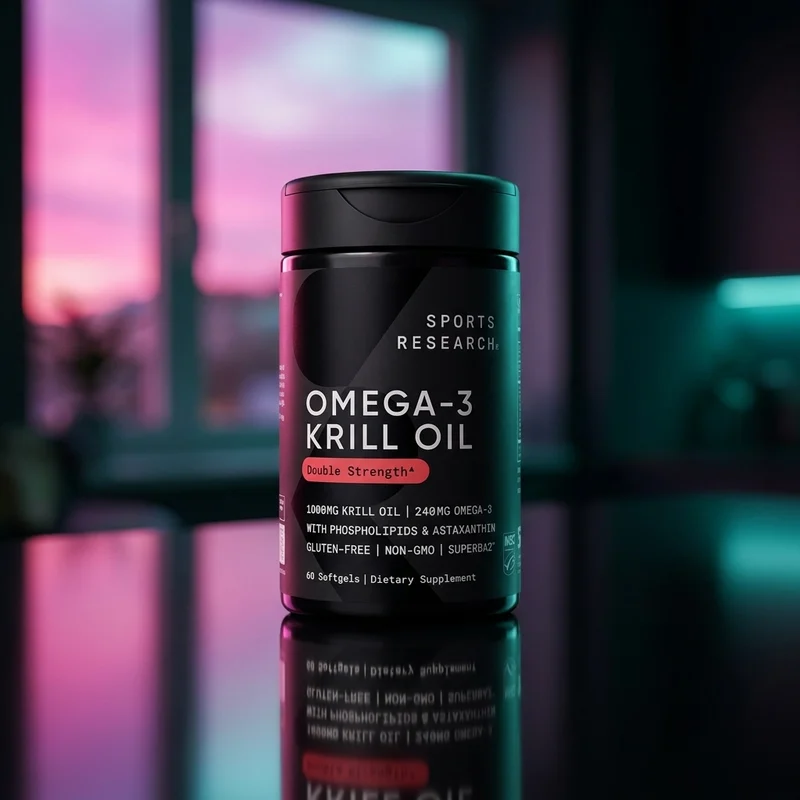
Sports Research Antarctic Krill Oil 1000 mg
Sports Research · Superba2 Antarctic krill, 60 softgels8.8/10SAC Product Score™SAC Product Score™ — how it breaks down- EPA+DHA dose + form30%8.6
- IFOS / oxidation + heavy-metal testing25%9.0
- Source sustainability + provenance20%9.3
- Cost per gram EPA+DHA15%8.2
- Real-world response + tolerance10%8.8
The most EPA+DHA per softgel in the single-cap krill tier (196 mg) from MSC-certified Superba2 Antarctic krill, with 400 mg phospholipids and 1 mg astaxanthin — at the best cost per gram on the list.
- EPA + DHA
- 196 mg per softgel (136 EPA / 60 DHA)
- Phospholipids
- 400 mg per softgel
- Astaxanthin
- 1 mg per softgel
- Source / testing
- Superba2 Antarctic krill · MSC certified · IKOS + heavy-metal tested
Pros- Highest combined EPA+DHA per single softgel in the krill tier (196 mg)
- MSC-certified Superba2 krill with full sea-to-bottle traceability
- Best cost per gram of actives on the list (~$0.40/softgel)
- 1 mg astaxanthin and a clean, near-zero-burp profile
Cons- Even 196 mg EPA+DHA is a fraction of a single fish-oil capsule's 500-900 mg
- Cost per gram of actives still sits above any fish-oil pick
Our take — The default krill buy. Sports Research squeezes the most EPA+DHA into a single softgel of any product here, sources it from MSC-certified Superba2 krill, and charges the least per gram of actives in the category. If you've decided krill is your omega-3 — because of burps or astaxanthin — start here and don't overthink it. The only honest reasons to look elsewhere: you want a clinically-studied branded oil (NOW Neptune NKO #3) or the absolute lowest sticker price (Bronson #4). And if you're chasing a high Omega-3 Index on a budget, this is still the moment to ask whether fish oil is the smarter route.
- #2Best premium
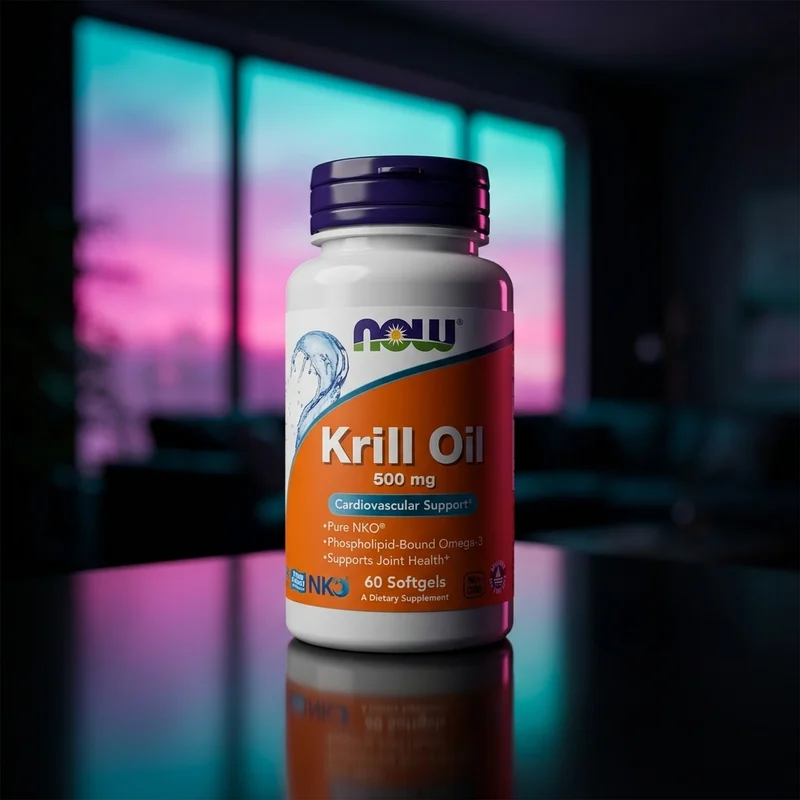
NOW Foods Neptune Krill Oil 500 mg
NOW Foods · NKO (Neptune Krill Oil), 120 softgels8.5/10SAC Product Score™SAC Product Score™ — how it breaks down- EPA+DHA dose + phospholipid form30%7.5
- Testing + contaminant screening25%9.0
- Source + NKO clinical pedigree20%9.0
- Cost per serving / value15%8.5
- Astaxanthin + burp tolerance10%9.0
The most clinically-studied branded krill oil (NKO), Friend of the Sea certified and PCB/heavy-metal tested, backed by NOW's three-decade QC pedigree.
- EPA + DHA
- 190 mg per serving (120 EPA / 70 DHA), 2 softgels
- Phospholipids
- 390 mg per serving
- Astaxanthin
- 750 mcg per serving (esterified)
- Source / testing
- NKO · Friend of the Sea certified · PCB + heavy-metal tested
Pros- NKO is the most clinically-studied branded krill oil on the market
- Friend of the Sea certified, tested free of PCBs, dioxins, and heavy metals
- NOW's 30+ year in-house QC is among the most consistent in supplements
- Excellent cost per serving (~$0.40) for a premium clinical-grade krill
Cons- Requires 2 softgels for a full serving (vs 1 for Sports Research/Kori)
- Lower astaxanthin per serving (750 mcg) than Viva Naturals or Sports Research
- 190 mg EPA+DHA per serving is still modest vs any fish-oil capsule
Our take — The pick for buyers who want the most-researched krill formulation with deep manufacturer QC. NKO (Neptune Krill Oil) is the branded oil behind much of the krill clinical literature, NOW layers on Friend of the Sea certification and full contaminant testing, and the per-serving cost is genuinely good for a premium krill. The only friction is the 2-softgel serving size and a lower astaxanthin dose than the showier picks. If clinical pedigree and QC reassurance matter to you, this is the krill to buy.
- #3Best mainstream
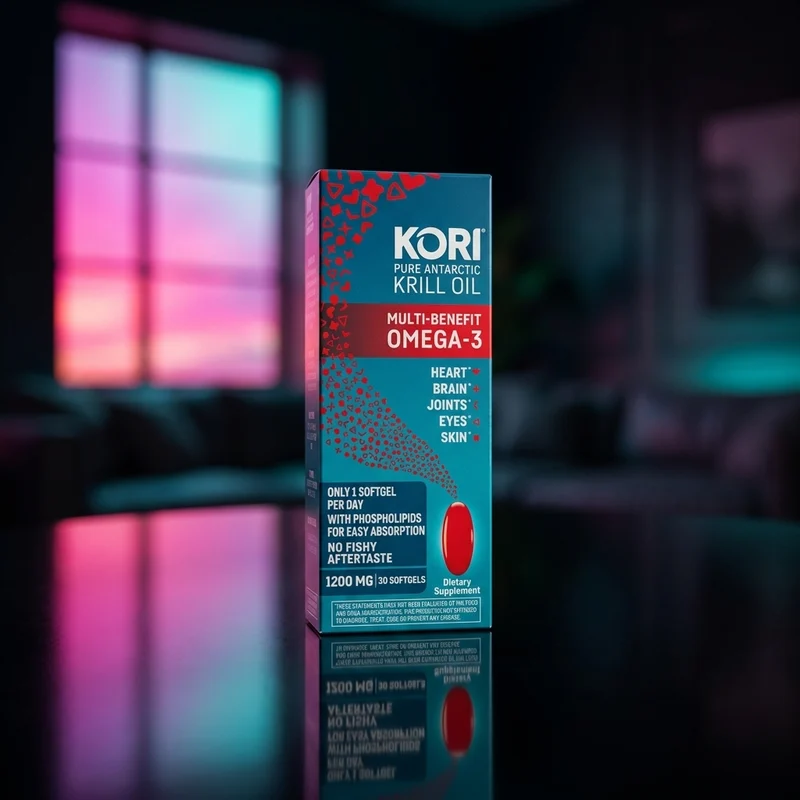
Kori Krill Oil 1200 mg
Kori · Antarctic krill + choline, 30 softgels8.4/10SAC Product Score™SAC Product Score™ — how it breaks down- EPA+DHA dose + form30%8.6
- Third-party + heavy-metal testing25%8.4
- Source sustainability + provenance20%8.4
- Cost per gram EPA+DHA15%7.6
- Astaxanthin + burp tolerance10%9.0
The highest combined EPA+DHA in a single once-a-day softgel (250 mg), with naturally occurring choline and astaxanthin, from the most-trusted mainstream krill brand.
- EPA + DHA
- 250 mg combined per softgel
- Form
- Phospholipid-bound Antarctic krill oil
- Extras
- Naturally occurring choline + astaxanthin
- Dosing
- One softgel daily
Pros- Highest combined EPA+DHA per single softgel on the list (250 mg)
- Once-a-day convenience with naturally occurring choline
- Most recognised mainstream krill brand — easy to re-buy anywhere
- Clean phospholipid burp profile, no fishy aftertaste
Cons- ~$1.00/softgel is 2.5× Sports Research's cost per gram of actives
- Smaller 30-count bottle means more frequent re-orders
- Sustainability certification less prominently disclosed than NKO/Superba picks
Our take — The mainstream pick for buyers who value simplicity and brand familiarity over price optimization. Kori delivers the single highest combined EPA+DHA per softgel here (250 mg), folds in choline, and is stocked in nearly every pharmacy and big-box store. The trade-off is cost: at ~$1.00/softgel it runs more than double Sports Research (#1) per gram of actives. If a once-a-day, grab-anywhere routine matters more to you than squeezing the most omega-3 from every dollar, Kori is the easy answer.
- #4Best phospholipid + astaxanthin load
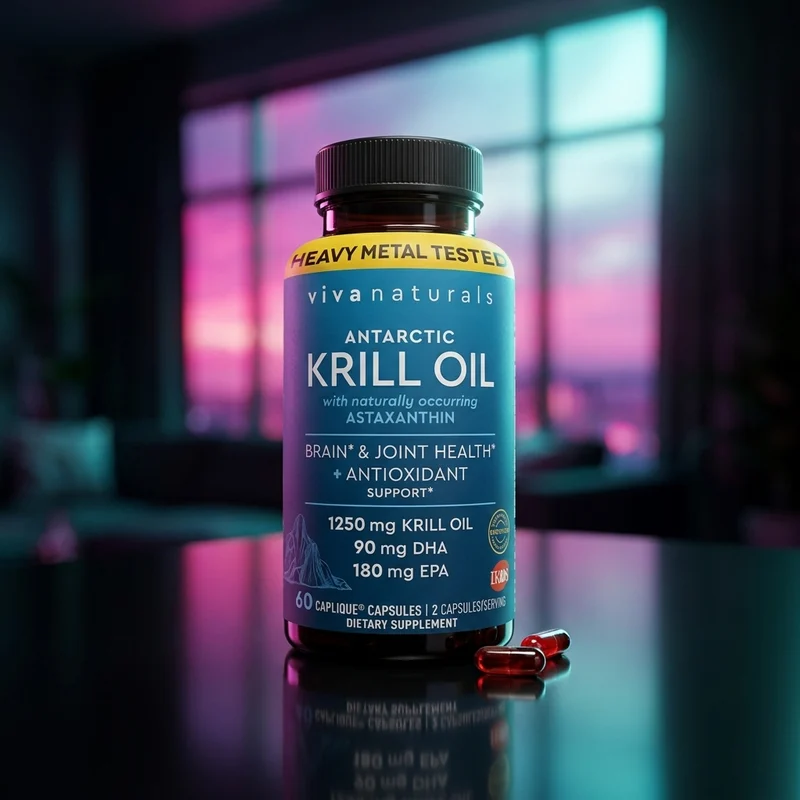
Viva Naturals Antarctic Krill Oil 1250 mg
Viva Naturals · Caplique capsules, 60 countSAC Product Score™ — how it breaks down- EPA+DHA per serving + phospholipid %30%8.5
- Third-party + heavy-metal testing25%8.0
- Sustainability + source20%7.5
- Cost per gram of EPA+DHA15%6.5
- Astaxanthin + burp tolerance10%9.5
The richest phospholipid and astaxanthin load per serving — 575 mg phospholipids and 1.6 mg astaxanthin — in a Caplique capsule engineered to eliminate fishy burps.
- EPA + DHA
- 270 mg per serving (180 EPA / 90 DHA), 2 capsules
- Phospholipids
- 575 mg per serving — highest on the list
- Astaxanthin
- 1.6 mg esterified per serving
- Format / testing
- Caplique capsule · 3rd-party certified for purity + potency
Pros- Highest phospholipid load on the list (575 mg/serving)
- Highest astaxanthin per serving (1.6 mg) among the mainstream picks
- Caplique capsule design for virtually zero fishy burps
- Solid 270 mg combined EPA+DHA per serving
Cons- ~$1.00/serving — well above the value picks per gram of actives
- Full serving is 2 capsules
- Astaxanthin still below standalone-trial doses despite leading the list
Our take — The pick for buyers who specifically want to maximize the krill-unique extras. Viva Naturals leads the list on both phospholipid load (575 mg) and astaxanthin (1.6 mg) per serving, in a capsule built to kill fishy burps. It also posts a respectable 270 mg combined EPA+DHA. The cost lands it mid-pack at ~$1.00/serving. If your reason for choosing krill is the phospholipid-and-astaxanthin story rather than raw dose-per-dollar, this is the most concentrated expression of it here.
- #5Best value
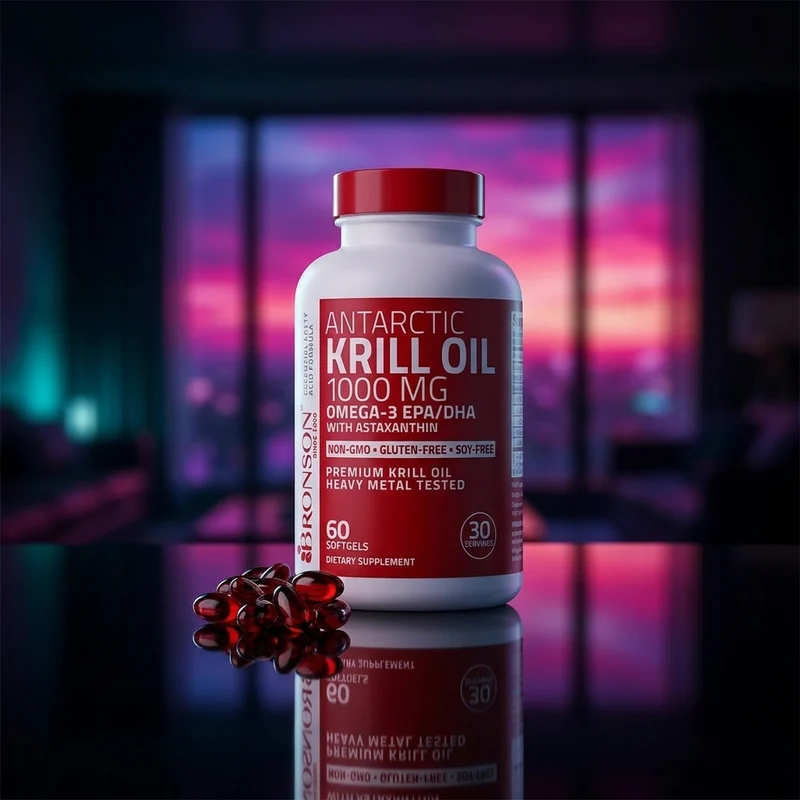
Bronson Antarctic Krill Oil 1000 mg
Bronson · Antarctic krill, 60 softgels7.9/10SAC Product Score™SAC Product Score™ — how it breaks down- EPA+DHA dose + phospholipid form30%7.5
- Third-party + heavy-metal testing25%8.0
- Source sustainability + provenance20%7.0
- Cost per gram EPA+DHA15%9.0
- Astaxanthin + real-world tolerance10%9.0
The cheapest legitimate 1000 mg Antarctic krill on the list, from a pharmacist-founded brand, heavy-metal tested with astaxanthin and phospholipids in every serving.
- EPA + DHA
- Combined EPA+DHA per 2-softgel serving
- Form
- Phospholipid-bound Antarctic krill oil
- Extras
- Astaxanthin + phospholipids
- Testing
- Heavy-metal tested, non-GMO, gluten- and soy-free
Pros- Cheapest legitimate 1000 mg krill on the list (~$0.67/serving)
- Pharmacist-founded brand (1960) with a long QC track record
- Heavy-metal tested, non-GMO, gluten- and soy-free
- Larger 60-softgel bottle than Kori or Viva at a lower price
Cons- EPA+DHA and astaxanthin amounts less prominently disclosed than top picks
- No headline MSC/Friend of the Sea certification on the listing
- 2-softgel serving for the full 1000 mg dose
Our take — The value play. Bronson delivers a credible 1000 mg Antarctic krill oil — heavy-metal tested, astaxanthin included — at the lowest price on the list, from a brand that's been around since 1960. You give up the prominent sustainability certification and precise actives disclosure of the Superba/NKO picks, so it ranks below them on the quality floor. But if your priority is simply getting phospholipid-bound omega-3 with a clean burp profile for the least money, Bronson is the honest budget answer.
- #6Best legacy brand
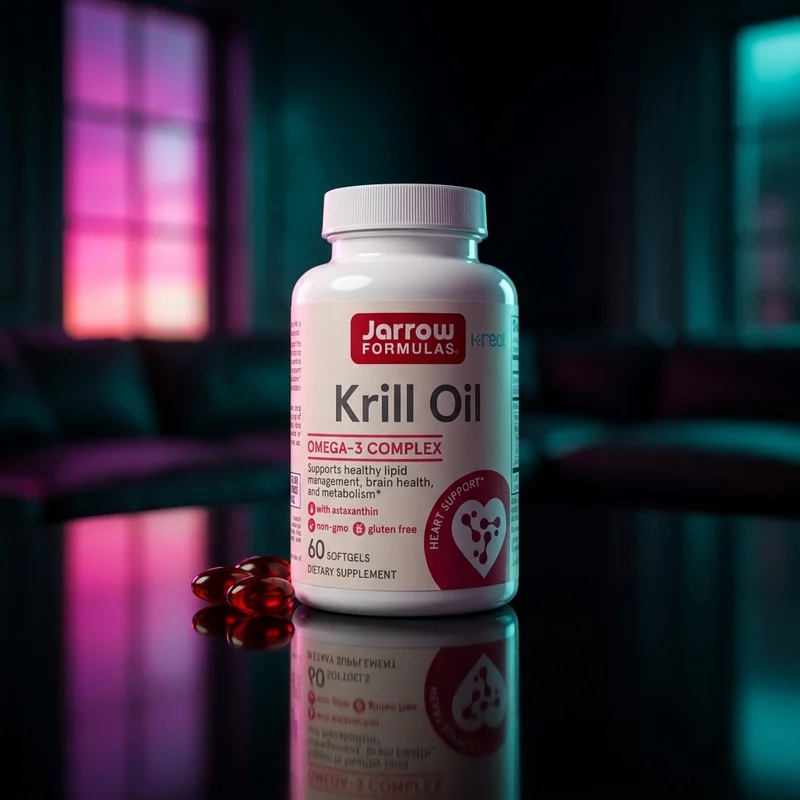
Jarrow Formulas Krill Oil 1200 mg
Jarrow Formulas · phospholipid omega-3 complex, 60 softgels7.6/10SAC Product Score™SAC Product Score™ — how it breaks down- EPA+DHA dose + form30%7.0
- Third-party + oxidation + heavy-metal testing25%8.0
- Source sustainability + provenance20%7.5
- Cost per gram EPA+DHA15%5.5
- Astaxanthin + real-world tolerance10%7.5
A phospholipid omega-3 complex with astaxanthin from a respected legacy formulator with a strong third-party-testing reputation — solid, if unremarkable on astaxanthin.
- EPA + DHA
- 250 mg omega-3 per serving (120 EPA / 65 DHA), 2 softgels
- Form
- Phospholipid omega-3 complex (Antarctic krill)
- Astaxanthin
- 240 mcg per serving
- Testing
- Non-GMO, gluten-free, third-party tested
Pros- Established formulator with a strong third-party-testing reputation
- Solid 250 mg combined omega-3 per serving with phospholipids
- Non-GMO, gluten-free, well-documented label
- Trusted, long-standing brand for cautious buyers
Cons- Lowest astaxanthin per serving among the disclosed picks (240 mcg)
- ~$1.00/serving with no standout dose or sustainability edge
- 2-softgel serving; sustainability certification not headlined
Our take — The legacy-brand safe pick. Jarrow has decades of credibility and a reputation for clean third-party-tested formulas, and its krill complex delivers a respectable 250 mg combined omega-3 per serving. But it doesn't lead on any single axis — astaxanthin is the lowest of the disclosed picks, dose and price are middle-of-the-road, and sustainability isn't headlined. Buy it if you already trust Jarrow's QC; otherwise Sports Research (#1) or NOW Neptune (#3) give you a clearer reason to choose them.
- #7Best for the burp-intolerant
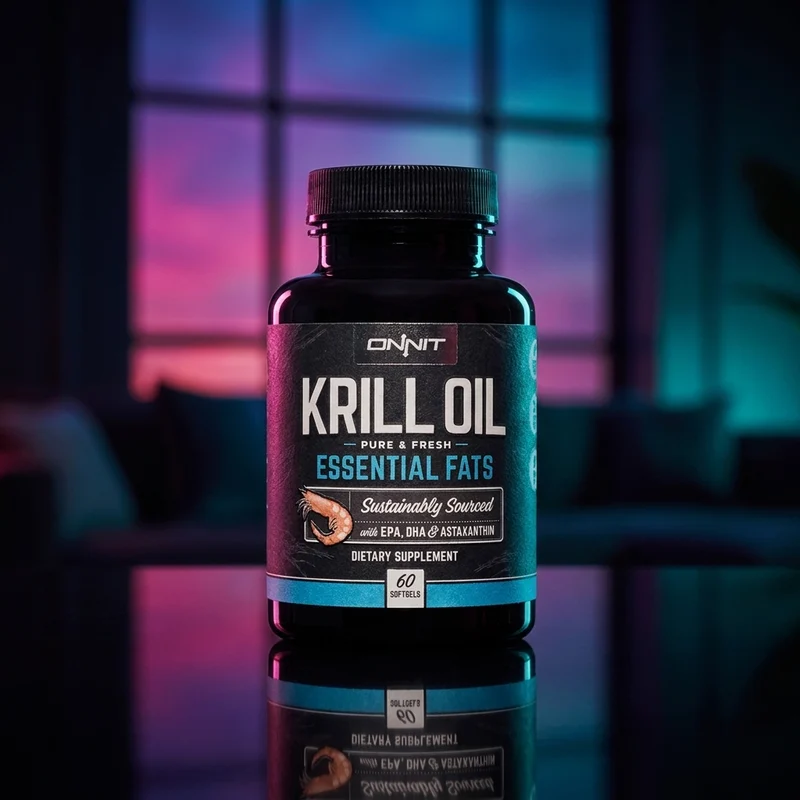
Onnit Krill Oil 1000 mg
Onnit · phospholipid-bound Antarctic krill, 60 softgels7.4/10SAC Product Score™SAC Product Score™ — how it breaks down- EPA+DHA dose + form30%7.0
- IFOS / oxidation + heavy-metal testing25%7.5
- Source sustainability + provenance20%8.0
- Cost per gram EPA+DHA15%5.5
- Real-world response + tolerance10%9.0
The cleanest burp profile and smallest softgel on the list, Antarctic CCAMLR-managed with astaxanthin — but it carries the steepest cost per gram of actives.
- EPA + DHA
- ~250 mg combined per softgel
- Form
- Phospholipid-bound Antarctic krill oil
- Extras
- Astaxanthin antioxidant co-factor
- Source
- Antarctic, CCAMLR-managed / MSC-aligned
Pros- Cleanest burp profile on the list, smaller easy-to-swallow softgel
- ~250 mg combined EPA+DHA per softgel (strong for one cap)
- Antarctic CCAMLR-managed source with astaxanthin co-factor
- Genuinely the right answer for the most burp-sensitive buyers
Cons- Highest cost per gram of actives on the list — pure format premium
- Onnit's brand markup pushes the price well above equivalent krill
- No standout testing/sustainability edge to justify the premium beyond burp profile
Our take — The niche pick for the truly burp-intolerant. If you've tried every krill on this list — and certainly every fish oil — and still want the gentlest possible softgel, Onnit's small, phospholipid-bound cap with astaxanthin is about as easy on the stomach as omega-3 gets. The problem is price: at ~$1.20+/serving it's the most expensive way to buy EPA+DHA here, and the premium is largely brand, not better krill. Worth it only if burp profile is your single overriding concern; otherwise Sports Research (#1) delivers similar tolerability for a third less.
- #8Best drugstore pick
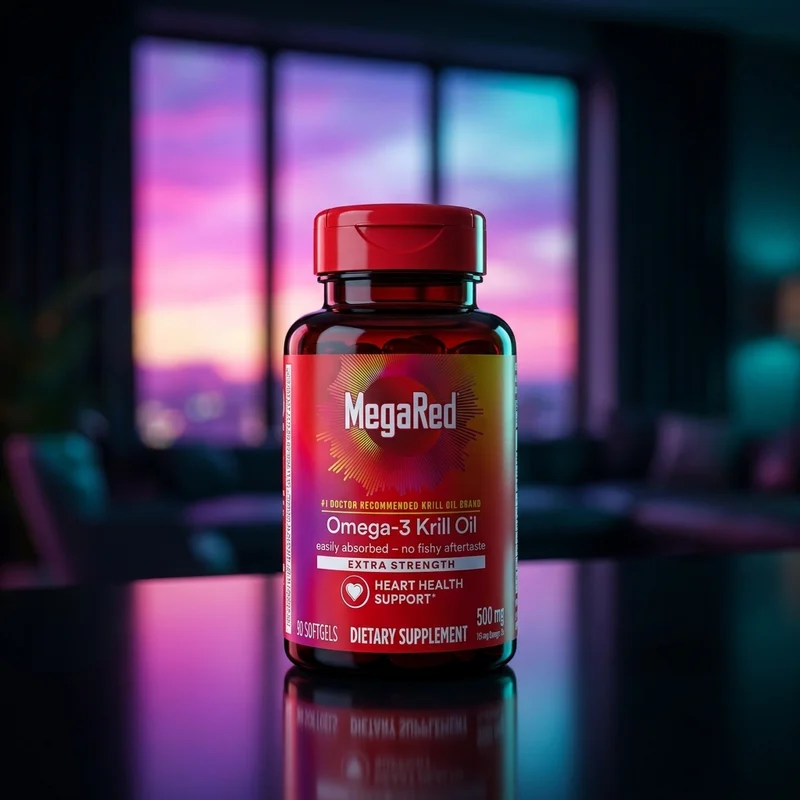
MegaRed Advanced Antarctic Krill Oil 500 mg
Schiff MegaRed · Antarctic krill, 90 softgels7.3/10SAC Product Score™SAC Product Score™ — how it breaks down- EPA+DHA dose + form30%5.0
- Testing / oxidation + heavy-metal QC25%7.0
- Source sustainability + provenance20%8.0
- Cost per gram EPA+DHA15%6.0
- Brand trust + real-world tolerance10%9.5
The most widely available krill brand in America — PureTech-processed for low impurities and a once-daily softgel — but with the lowest EPA+DHA per cap on the list.
- EPA + DHA
- Combined EPA+DHA per once-daily 500 mg softgel
- Form
- Phospholipid-form Antarctic krill (PureTech-processed)
- Extras
- Naturally occurring astaxanthin
- Availability
- Stocked in essentially every US pharmacy + big-box
Pros- Most widely available krill oil — buy it anywhere, no shipping wait
- PureTech process removes salts/impurities for a clean oil
- Once-daily 500 mg softgel, no fishy aftertaste
- Low per-softgel sticker price (~$0.33)
Cons- Lowest EPA+DHA per softgel on the list — a 500 mg krill cap is omega-3-light
- Cost per gram of actives is high once you account for the low dose
- 'Advanced 4-in-1' fish+krill variants muddy which SKU you're actually buying
Our take — The convenience pick. MegaRed is the krill oil you can grab at any pharmacy tonight, it's processed clean, and the per-softgel price looks cheap. The problem is the dose: at 500 mg krill oil per softgel, the combined EPA+DHA is the lowest on this list, so the real cost per gram of actives is higher than the sticker suggests. Fine as a stopgap or for the truly convenience-driven buyer; if you're ordering online anyway, Sports Research (#1) gives you far more omega-3 per dollar.

▸ Affiliate disclosure: every Amazon link uses our Associates tag (superachieverclub-20). We earn a small commission at no cost to you; it funds independent reviews. We never accept payment to change a ranking.
Krill Oil: A Niche Omega-3 Buy, Not a Fish-Oil Replacement
- 01
Krill's one genuine edge is phospholipid delivery — real, but modest.
Krill delivers EPA and DHA bound to phospholipids, the same molecule your cell membranes are built from, earning a real per-milligram absorption edge over fish oil (Ramprasath 2013, Ulven 2011). But the effect is roughly 10-20% per mg, not the 'dramatically superior' framing on the bottle.
- 02
The catch is brutal: krill is omega-3-light and 3-5x more expensive.
A krill softgel carries only ~100-250 mg of combined EPA+DHA, versus 500-900 mg from a single concentrated fish-oil capsule, yet costs 3-5x more per gram of actives. The phospholipid advantage doesn't come close to closing that gap.
- 03
Krill is not a fish-oil replacement — it's a two-group play.
For most people it isn't a replacement; it's a tolerability-and-astaxanthin play for two specific groups: anyone who's quit fish oil over the burps, and anyone who wants astaxanthin baked in. Everyone optimising cost-per-mg of EPA+DHA should run fish oil.
- 04
Astaxanthin is a stability feature, not a therapeutic ingredient.
Krill bundles astaxanthin, the carotenoid that keeps the oil from going rancid and all but eliminates fishy burps. But the per-softgel dose (0.5-2 mg) is far below the 4-12 mg used in dedicated astaxanthin trials — treat it as oil stability, not therapy.
Ramprasath 2013 (PMID 23414128) and Ulven 2011 (PMID 21042875) on krill's phospholipid absorption edge; Harris 2008 (PMID 18774613) on the Omega-3 Index >8% cardiac-risk target; plus Maki 2009 (PMID 19948066), Kohler 2015 (PMID 25884846), and Tou 2007 (PMID 17853062). Six krill studies reviewed.
How we ranked these eight
Each pick was scored 0-10 across five criteria, then weighted to a composite. EPA+DHA per serving and phospholipid load carry the most weight because they directly determine whether a '1000 mg krill oil' softgel actually delivers a useful omega-3 dose. Third-party + heavy-metal testing and sustainability sourcing form the quality floor — krill is a marine product where source traceability (Superba, NKO) and CCAMLR/MSC certification genuinely matter. Cost per gram of actives is the honest economic check that keeps the ranking from rewarding pretty bottles, and astaxanthin content plus real-world burp tolerance is the tiebreaker that reflects why people choose krill at all.
- EPA+DHA per serving + phospholipid %30%
The actives that drive every omega-3 effect, plus the phospholipid percentage that defines krill's delivery edge. We read the supplement-facts panel, not the front-of-bottle 'krill oil mg'.
- Third-party + heavy-metal testing25%
Public oxidation (TOTOX), heavy-metal, and label-vs-actual testing. IKOS certification, Friend of the Sea, and recognised in-house QC all count. Krill concentrates contaminants less than large fish, but verification still matters.
- Sustainability + source20%
MSC / CCAMLR / Friend of the Sea certification and a recognised, traceable krill source (Superba from Aker BioMarine, NKO from Neptune). Uncertified bulk krill is penalised heavily.
- Cost per gram of EPA+DHA15%
Monthly price divided by total grams of combined EPA+DHA. Krill runs $1.50-3.00/g vs fish oil's $0.40-1.00/g — this criterion keeps the ranking honest about the premium.
- Astaxanthin + burp tolerance10%
Astaxanthin content (oil stability + small antioxidant bonus) and real-world burp/GI profile — the actual reasons buyers pick krill over cheaper fish oil.


The bottom line
- 01
Sports Research (#1) is the best krill oil for almost everyone.
It packs the most EPA+DHA per softgel in the krill tier (196 mg) from MSC-certified Superba2 krill, at the best cost per gram, with a clean burp profile. If you've decided krill is your omega-3, start here and don't overthink it.
- 02
Three honest alternatives cover budget, clinical pedigree, and the krill extras.
Bronson (#4) if money is tight; NOW Neptune NKO (#3) for the clinically-studied branded oil with deep QC; Viva Naturals (#5) for the highest phospholipid and astaxanthin load. Kori (#2) is the grab-anywhere once-a-day routine.
- 03
Read the combined EPA+DHA panel, not 'krill oil mg' — and be honest about why.
Krill softgels are omega-3-light (100-250 mg vs 500-900 mg in a fish-oil cap) and cost 3-5x more, and the ~10-20% absorption edge doesn't close that gap. If you're optimising for the most EPA+DHA per dollar, or need the 1-2 g/day cardiovascular range, fish oil wins decisively; with any shellfish allergy, skip krill for a vegan algal-oil omega-3.
Every claim ranked above traces back to one of these
Peer-reviewed studies, meta-analyses and clinical trials behind the picks. Click any citation to read the abstract on PubMed.
- [1]Ramprasath 2013
Enhanced increase of omega-3 index in healthy individuals with response to 4-week n-3 fatty acid supplementation from krill oil versus fish oil
Head-to-head trial: krill oil raised the Omega-3 Index more than an equivalent dose of fish oil over 4 weeks, supporting the phospholipid-delivery absorption advantage — though the effect size is modest, not the 'dramatically superior' marketing framing.
- [2]Ulven 2011
Metabolic effects of krill oil are essentially similar to those of fish oil but at lower dose of EPA and DHA, in healthy volunteers
Krill oil produced metabolic effects and plasma EPA+DHA increases comparable to fish oil despite delivering a lower absolute dose of EPA+DHA — direct evidence for krill's per-milligram phospholipid absorption edge, while underscoring how little EPA+DHA krill actually contains.
- [3]Maki 2009
Krill oil supplementation increases plasma concentrations of eicosapentaenoic and docosahexaenoic acids in overweight and obese men and women
Krill oil raised plasma EPA+DHA to a degree comparable to menhaden (fish) oil at a similar omega-3 dose, confirming bioequivalence of the phospholipid form — the basis for treating krill as a legitimate but expensive omega-3 source.
- [4]Köhler 2015
Bioavailability of fatty acids from krill oil, krill meal and fish oil in healthy subjects — a randomized, single-dose, cross-over trial
Cross-over bioavailability study comparing krill oil, krill meal, and fish oil: confirmed efficient incorporation of EPA+DHA from the phospholipid krill form, with differences between sources that are real but small relative to the dose and cost gap.
- [5]Harris 2008
The Omega-3 Index: a new risk factor for death from coronary heart disease?
Established the Omega-3 Index (RBC EPA+DHA %) as a cardiac-risk marker, with an Index above 8% associated with the lowest risk of death from coronary heart disease — the endpoint that justifies tracking actives intake regardless of source.
- [6]Tou 2007
Krill for human consumption: nutritional value and potential health benefits
Comprehensive review of krill composition: documents the phospholipid-bound EPA+DHA structure and the naturally occurring astaxanthin content that gives krill oil its oxidative stability — the mechanistic basis for the no-burp, rancidity-resistant profile.
More Omega-3 guides
Every form, format and use-case in the Omega-3 cluster — each ranked with the same methodology, so you can jump straight to the angle that fits you.
- Best Omega-3 SupplementsThe definitive omega-3 buying guide — the single best pick for each need across fish oil, algae, and krill. Total EPA+DHA per serving, triglyceride form, and IFOS freshness separate the real ones from under-dosed ethyl ester.
- Best Omega-3 Fish OilOmega-3s ranked by EPA+DHA dose, triglyceride vs ethyl-ester form, IFOS/TOTOX oxidation testing, sustainability — the bottles that survive the rancidity audit.
- Best Omega-3 for InflammationEPA-dominant omega-3 drives the anti-inflammatory effect via resolvins; 2-4 g/day for joint/inflammation endpoints. Ranked by EPA dose, triglyceride form, and IFOS/TOTOX freshness (rancid oil is pro-inflammatory).
- Best Omega-3 for WomenThe same 10-product omega-3 roster re-scored for women — prenatal/preconception DHA (Coletta 2010), postpartum + perimenopausal mood (Freeman 2006), post-menopause heart, skin/hair/nails, swallowability, and a higher-ranked vegan algal pick.