

Turkesterone: Benefits, Dosage & Side Effects (2026)
Turkesterone is an ecdysteroid from the plant Ajuga turkestanica, sold as a natural muscle-builder despite having no good human efficacy trials.
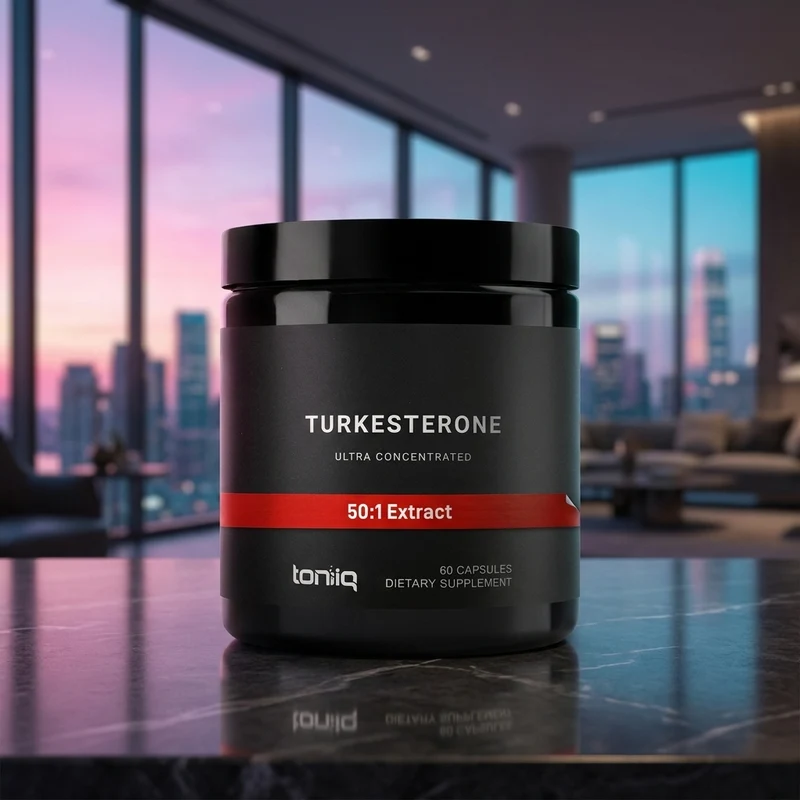
Ultra High Strength Turkesterone, 50:1 Extract (20%)
What is Turkesterone?
Turkesterone is an ecdysteroid — a steroid-like plant compound — extracted from Ajuga turkestanica, a plant native to Central Asia. It belongs to the same broad family as 20-hydroxyecdysone and ecdysterone, the phytoecdysteroids insects use as molting hormones, and a phytochemical analysis of Ajuga turkestanica has confirmed turkesterone is a genuine constituent of the plant, isolated alongside thirteen other ecdysteroids (Guibout 2015, PMID 25953625). Since roughly 2020 it has been marketed aggressively to lifters as a "natural anabolic": a compound that supposedly builds muscle and strength like a steroid but without binding the androgen receptor or carrying steroid side effects.
The single most important thing to understand before buying turkesterone is that this "natural anabolic" claim is not supported by good human evidence. There is no well-conducted randomized controlled trial showing that turkesterone supplements build muscle in people. The entire case is built on two shaky pillars. The first is rodent and test-tube data — ecdysteroids increasing muscle-fiber size in rats and myotube diameter in a dish — which is biologically interesting but does not transfer reliably to humans. The second is a single, much-cited human study that wasn't even on turkesterone: it tested ecdysterone, a related but different compound, and the supplement it used was later shown to contain far less active ingredient than assumed. So the honest mental model is: a plausible-sounding, heavily-hyped ecdysteroid whose marketing has badly outrun its evidence — an experiment, not a proven anabolic.
The category is also one of the worst in all of supplements for adulteration, which makes it unusually risky to buy blind. When independent labs (Nootropics Depot, More Plates More Dates, Greg Doucette and others) have pulled turkesterone products off the shelf and assayed them, they have repeatedly found a fraction of the claimed turkesterone — frequently under 1%, sometimes effectively none, occasionally the wrong plant material entirely. A 2025 randomized double-blind study made the point unmissable: it tested a commercial phytosteroid supplement and measured less than 0.1% of the ecdysterone the label claimed (Isenmann 2025, PMID 40781783). The practical consequence is that a label boasting "20% standardized" or "1200 mg" means nothing on its own. The defining buyer decision here is therefore not dose or delivery tech — it is whether an independent test confirms the extract is actually real.
How it works
The proposed mechanism and the actual human evidence are two very different things, and an honest account has to keep them separate.
THE PROPOSED MECHANISM (animal and in-vitro). In rodents and cell culture, ecdysteroids do appear to do something. A foundational 1976 rat study found ecdysterone accelerated body-weight gain and increased protein content in muscle, while — notably — showing no androgenic effect on castrated immature rats, unlike the anabolic steroid methandrostenolone (Syrov 1976, PMID 1030669). A later mechanistic study reported that ecdysterone induced hypertrophy of rat soleus muscle fibers and increased C2C12 myotube diameter, apparently signaling through estrogen-receptor-beta rather than the androgen receptor (Parr 2014, PMID 24974955). A review by leading ecdysteroid researchers compiled this supportive animal and in-vitro data while weighing whether ecdysteroids genuinely act as anabolic agents (Parr 2015, PMID 26060342). This is the body of work the "natural anabolic" pitch is built on — biologically suggestive, but conducted on ecdysterone in rats and cells, not turkesterone in humans.
THE HUMAN EVIDENCE (essentially absent, and not on turkesterone). The single most-cited human study behind turkesterone hype tested ecdysterone, a different compound: in 46 young men over 10 weeks of strength training, ecdysterone-dosed groups showed greater muscle-mass increases (Isenmann 2019, PMID 31123801). Marketers stop there. They omit the crucial caveats the authors themselves flagged: the supplements used contained far less ecdysterone than labeled, the dosing was therefore uncertain, and the result has never been independently replicated. There is no equivalent trial on turkesterone at all.
WHAT BUYERS ACTUALLY NEED TO KNOW (verification, not mechanism). The most decision-relevant finding in the entire literature is not about how turkesterone works — it's about whether what's in the bottle is real. A 2025 randomized double-blind training study bought a commercial phytosteroid product, assayed it, and found the actual ecdysterone content was under 0.1% of the label claim; the product produced no hypertrophy in a cell model and no advantage over placebo in human training groups (Isenmann 2025, PMID 40781783). That is the honest bottom line on mechanism: even granting the rodent biology, the practical question is moot if the product contains almost none of the compound — which independent testing keeps finding to be the case. So the rational buyer treats turkesterone as unproven and treats third-party verification of the actual extract, not the stated dose or the absorption tech, as the thing that matters.
At-a-glance facts
- What it actually is
- An ecdysteroid from Ajuga turkestanica, marketed as a 'natural anabolic' — with no good human efficacy evidence
- Human efficacy trials
- None on turkesterone. The case rests on rodent/in-vitro data + one flawed study on a DIFFERENT compound (ecdysterone)
- The real buying problem
- Adulteration — independent labs repeatedly found products with under 1% of the claimed turkesterone, sometimes the wrong plant
- Decisive buying criterion
- Third-party verification of the actual extract (posted batch COA / independent assay) — NOT the headline dose or delivery tech
- Typical label dose
- ~500–600 mg Ajuga turkestanica extract per serving, standardized to 10% turkesterone (up to 20% from a 50:1 concentrate)
- What '10% standardized' means
- A claim, not a fact — a 500 mg / 10% capsule states ~50 mg turkesterone, but only an independent assay confirms it's really there
- Common 'absorption' tech
- Hydroxypropyl-β-cyclodextrin complex, liposomal systems, softgels — plausible bioavailability bets, not proof of efficacy
- Posted batch COA?
- None of the most-bought products publishes an actual batch HPLC Certificate of Analysis on its listing
- Cost range (US)
- ~$0.18 to over $2.00 per serving — but cheap unverified extract is still unverified
Evidence: Among the weakest evidence bases in mainstream supplements. There are NO good human RCTs on turkesterone itself. The 'natural anabolic' claim rests on rodent/in-vitro work (Syrov 1976 PMID 1030669; Parr 2014 PMID 24974955; reviewed in Parr 2015 PMID 26060342) plus ONE flawed human study on a DIFFERENT compound — ecdysterone, not turkesterone (Isenmann 2019 PMID 31123801) — whose supplement was later shown to be badly under-dosed and which has never been replicated. Compounding this, a 2025 randomized double-blind study assayed a commercial phytosteroid product at <0.1% of its label claim with no hypertrophy over placebo (Isenmann 2025 PMID 40781783), and independent teardowns repeatedly found products with under 1% of claimed turkesterone. Buy on verification, if at all — not on the dose number, and never as a proven muscle-builder.
Who it's for — and who it isn't
- Experienced lifters who already understand there is no human efficacy evidence and want to run turkesterone purely as a low-stakes personal experiment, eyes open
- Buyers who, if they try it at all, will prioritize a product that makes a credible third-party-testing claim over the one with the biggest dose on the label
- People who specifically want a non-androgenic, non-hormonal compound to experiment with (turkesterone does not appear to bind the androgen receptor in animal data)
- Shoppers who value conservative, transparent labeling — a stated standardization %, the Ajuga turkestanica source, and per-serving milligrams — over 'highest purity' marketing language
- Anyone expecting a proven, steroid-like muscle-builder — no well-conducted human trial shows turkesterone does anything measurable for body composition
- Buyers who would pick on dose or delivery tech alone — independent labs keep finding products with under 1% of their claimed turkesterone, so an unverified label number is worthless
- Drug-tested athletes — ecdysteroids are on WADA's monitoring list, and adulterated products of unknown content are an unnecessary risk
- People who want value for money from a supplement that works — the honest expectation here is 'probably does nothing,' which makes any price a poor deal
- Anyone who would take a 'third-party tested' slogan as proof — without a posted batch COA, the claim is unverified, and that is the whole problem in this category
Week-by-week, what happens
- Day 1No felt change expected, and none should be. Turkesterone has no acute effect; any immediate 'pump' or energy is placebo or the rest of your routine, not the ecdysteroid.
- Week 1-2Still nothing reliably attributable to turkesterone. Be especially skeptical of early progress here — newbie gains, a cleaner diet, or harder training easily masquerade as a supplement 'working.'
- Week 4-6This is the window where the one human ecdysterone study (a different compound) reported differences — but that result rested on uncertain dosing, was never replicated, and does not apply to turkesterone. Expect no verified turkesterone benefit.
- Month 2-3There is no human evidence of accumulating muscle benefit from turkesterone over any timeframe. If you're running it as an experiment, judge it against the honest baseline: probably nothing beyond your training and nutrition — and only if the extract was even real.
Safety & contraindications
- Turkesterone is generally reported as well tolerated in the short term, with mild gastrointestinal upset or nausea the most commonly described complaint — but formal human safety data is thin because rigorous human trials essentially don't exist.
- Adulteration is the headline safety and trust issue, not a side effect. Independent labs (Nootropics Depot, More Plates More Dates, Greg Doucette) have repeatedly found turkesterone products containing under 1% of their claimed turkesterone, sometimes the wrong plant material entirely, and a 2025 study assayed a commercial phytosteroid at <0.1% of label — so you often don't actually know what you're swallowing. Strongly prefer a product with a posted batch COA or a credible independent assay.
- Ecdysteroids are on WADA's monitoring program. Drug-tested athletes should be cautious: an unproven compound of uncertain actual content is an unnecessary risk, and adulterated products could in principle contain undisclosed ingredients.
- There is no established safety data for pregnancy or breastfeeding, and none for long-term daily use; turkesterone's hormonal-adjacent (estrogen-receptor-beta) mechanism in animal data is a further reason for caution in anyone with hormone-sensitive conditions. Check with a clinician first.
- Many listings lead with 'highest purity' or 'third-party tested' language while omitting the actual standardization %, the source plant, or the per-serving milligrams. Treat marketing adjectives as a red flag, not reassurance — without a posted COA, 'third-party tested' is an unverified claim.
- Delivery tech (cyclodextrin complexes, liposomal systems, softgels) is marketed as solving turkesterone's poor bioavailability, but improving absorption of a compound with no proven efficacy doesn't make it work — don't let sophisticated delivery substitute for verification or evidence.
All articles on Turkesterone
Best Turkesterone
The 8 best turkesterone supplements ranked first on third-party verification (independent tests found many products contain under 1% of the claimed turkesterone), then standardization, dose and value — with the blunt frame that there are no good human turkesterone RCTs and verification, not hype, is everything.
Read →5% Nutrition Turkesterone 1200 Review
Biggest numbers, weakest verification-per-dollar — a maximalist stack chasing the wrong metric.
Read →Codeage Liposomal Turkesterone 500 mg Review
The most elaborate delivery system — wrapped around the vaguest verification.
Read →Double Wood Turkesterone Review
The honest 10% standard at the best cost-per-capsule — just not independently verified.
Read →eFlow Nutrition Turkesterone + Cyclodextrin Review
Right instincts, thin substance — a testing claim it doesn't document, on a vague label.
Read →Gorilla Mind Turk-Plex Review
The best-known name and the cyclodextrin formula everyone copies — but no testing claim.
Read →Huge Turkesterone 500 mg (Softgels) Review
A softgel absorption bet at the highest price per serving — and no verified content.
Read →Nutricost Turkesterone 600 mg Review
The cheapest stated-tested extract per serving — sensible value, same evidence caveat.
Read →Toniiq Ultra High Strength Turkesterone Review
The least-unverified pick — strongest testing claim, highest standardization, fair price.
Read →FAQ
Does turkesterone actually build muscle?
There is no good human evidence that it does. No well-conducted randomized controlled trial shows that turkesterone supplements build muscle or improve body composition in people. The 'natural anabolic' claim is built on rodent and test-tube data — ecdysteroids increasing muscle-fiber size in rats and myotubes in a dish — which doesn't transfer reliably to humans, plus one much-cited human study that actually tested a different compound (ecdysterone) using a supplement later shown to be badly under-dosed. So the honest answer is: it's marketed as a muscle-builder, but it has not been shown to be one in humans. Treat it as an unproven experiment, not a proven anabolic.
Isn't there a study showing ecdysteroids work?
There's one, and it's the source of most of the hype — but it comes with caveats marketers leave out, and it wasn't even on turkesterone. A 2019 study tested ecdysterone (a related but different ecdysteroid) in 46 young men over 10 weeks and reported greater muscle-mass gains in the dosed groups. The problem: the authors themselves noted the supplements contained far less ecdysterone than labeled, so the actual dose was uncertain, and the result has never been independently replicated. There is no equivalent trial on turkesterone at all. One non-replicated, under-dosed study on a different compound is not a foundation for the claims made about turkesterone.
Why is third-party verification the most important thing to look for?
Because the documented failure in this category is adulteration, not just weak evidence. When independent labs (Nootropics Depot, More Plates More Dates, Greg Doucette) have assayed turkesterone products off the shelf, they've repeatedly found a fraction of the claimed turkesterone — frequently under 1%, sometimes effectively none, occasionally the wrong plant entirely. A 2025 randomized double-blind study measured less than 0.1% of the ecdysterone a commercial product claimed. So a label saying '20% standardized' or '1200 mg' tells you nothing on its own. The single strongest signal a product is real is a posted batch HPLC Certificate of Analysis, or a credible independent assay of the actual extract — which is exactly what almost no brand provides.
What does '10% standardized' or '20% standardized' actually mean?
It's a label claim about how much turkesterone the extract is supposed to contain: a 500 mg capsule standardized to 10% claims about 50 mg of turkesterone, and a 50:1 extract standardized to 20% claims a higher load. The critical word is 'claims.' Standardization percentages are self-reported by the manufacturer and, in this category, frequently don't survive independent testing. A higher percentage only matters if it's verified — which is why we score the standardization number strictly as a claim and weight third-party verification above it. A big '20%' on an unverified label is not better than a modest '10%' that's actually been assayed.
Do the cyclodextrin, liposomal, and softgel 'absorption' formulations help?
They're reasonable attempts at a real problem — turkesterone is thought to be poorly bioavailable — but none of them is evidence that the compound works. A hydroxypropyl-β-cyclodextrin inclusion complex, a liposomal phospholipid system, or a softgel are plausible absorption bets, not demonstrated advantages, and improving the absorption of a compound with no proven efficacy doesn't make it effective. Worse, listings that foreground elaborate delivery tech are often the ones that stay vague about the actual turkesterone percentage and post no COA — exactly where buyers end up paying for sophistication wrapped around an unverified extract. Don't let fancy delivery stand in for verification or proof.
Is turkesterone safe, and is it a steroid?
Turkesterone is not an anabolic-androgenic steroid and does not appear to bind the androgen receptor in animal data, so it isn't 'a steroid' in the controlled-substance sense, and short-term use is generally reported as well tolerated (mild stomach upset is the usual complaint). But formal human safety data is thin because rigorous trials barely exist, there's no data for pregnancy, breastfeeding or long-term use, and the bigger practical risk is adulteration — you often can't be sure what's actually in the bottle. Ecdysteroids are also on WADA's monitoring list, so drug-tested athletes should be cautious. If you try it, choose a product with a credible third-party-testing claim and talk to a clinician, especially if you have a hormone-sensitive condition.
Sources & further reading
- Isenmann 2019Ecdysteroids as non-conventional anabolic agent: performance enhancement by ecdysterone supplementation in humans
The single most-cited human study behind turkesterone hype — but it tested ECDYSTERONE, a different compound, not turkesterone. In 46 young men over 10 weeks of strength training, ecdysterone-dosed groups showed greater muscle-mass increases. Important caveat, often omitted by marketers: the authors noted the supplements used contained far less ecdysterone than labeled, the dosing was therefore uncertain, and the result has not been independently replicated. It is not evidence that turkesterone supplements build muscle.
- Phytosteroid labeling RCT 2025How reliable is the labeling of a commercial phytosteroid product? A 12-week randomized double-blind training study
The most decision-relevant study in the category. Researchers bought a commercial phytosteroid (ecdysterone/diosgenin) supplement, assayed it, and found the actual ecdysterone content was <0.1% of the label claim and diosgenin only ~10% of claimed. The product produced no hypertrophy in a C2C12 model and no advantage over placebo in two human training groups. Hard evidence that label numbers in this category can be almost entirely fictional — which is exactly why third-party verification, not the stated dose, is the decisive buying criterion.
- Parr 2014Estrogen receptor beta is involved in skeletal muscle hypertrophy induced by the phytoecdysteroid ecdysterone
A mechanistic rodent/in-vitro study: ecdysterone induced hypertrophy of rat soleus muscle fibers and increased C2C12 myotube diameter, apparently via estrogen-receptor-beta signaling. This is the type of animal and cell data the 'natural anabolic' claim is built on — biologically suggestive, but conducted on ecdysterone in rats and cells, not turkesterone in humans, and not a substitute for clinical efficacy data.
- Parr 2015Ecdysteroids: a novel class of anabolic agents?
A review by leading ecdysteroid researchers weighing whether ecdysteroids (including turkesterone) act as anabolic agents. It compiles supportive animal and in-vitro data and notes their commercial marketing as natural anabolics — while making clear that rigorous human efficacy evidence was lacking at the time. A balanced read of why the category is plausible-but-unproven, from the scientists closest to it.
- Guibout 2015The minor ecdysteroids from Ajuga turkestanica
A phytochemical characterization of Ajuga turkestanica — the plant turkesterone is extracted from — isolating fourteen ecdysteroids including turkesterone and 20-hydroxyecdysone via preparative HPLC and 2D-NMR. Establishes what is actually in the source plant and confirms turkesterone is a genuine constituent, but it is purely an isolation/identification study and says nothing about whether supplementing it benefits humans.
- Syrov 1976Anabolic activity of phytoecdysone-ecdysterone isolated from Rhaponticum carthamoides
One of the foundational rodent studies behind ecdysteroid anabolic claims: in rats, ecdysterone accelerated body-weight gain and increased protein content in muscle and several organs, while showing no androgenic effect on castrated immature rats (unlike methandrostenolone). A 1976 animal study — the kind of early rodent data the modern hype leans on, with no human relevance demonstrated and decades before any controlled human work.