

Algae Oil Omega-3: Benefits, Dosage & Side Effects (2026)
Algae oil is the vegan omega-3: preformed DHA (and some EPA) pressed straight from cultured marine microalgae — no fish — with bioequivalent DHA but often low EPA, so the deciding number is the actual mg split.
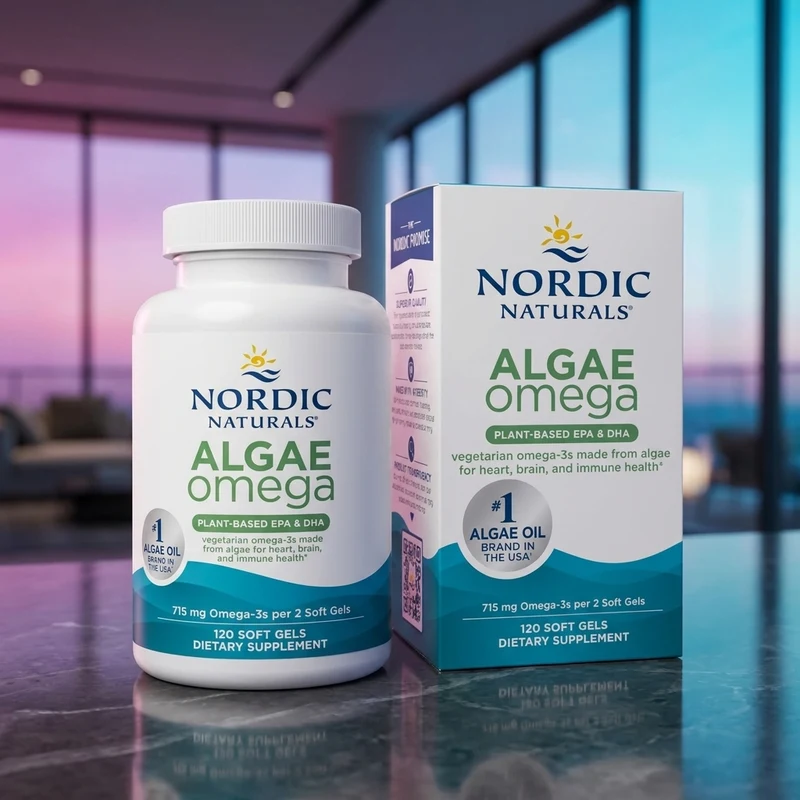
Nordic Naturals Algae Omega
What is Algae Oil Omega-3?
Algae oil is omega-3 — preformed DHA and, depending on the product, some EPA — extracted directly from cultured marine microalgae instead of from fish. This is the part the fish-oil aisle rarely volunteers: the DHA and EPA in fish oil don't originate in the fish. They come from marine microalgae, which fish eat and concentrate up the food chain. Algae oil simply skips the middle-fish, culturing those microalgae (most commonly Schizochytrium, sometimes Nannochloropsis) and pressing the omega-3 straight out. The result is genuinely vegan omega-3 with no fish, no contribution to overfishing, and none of the ocean-borne mercury, PCBs or microplastics that fish oil can carry. For the DHA your brain and eyes run on, it is a legitimate, evidence-backed source — not a fringe substitute.
The single most important thing to understand before buying one is the EPA catch, and it is the whole reason this category is decided on milligrams. The microalgae most brands culture make abundant DHA but comparatively little EPA, so a lot of algae oils are DHA-DOMINANT — and several are flat-out DHA-ONLY. A bottle can advertise "500 mg omega-3" and deliver essentially zero EPA. That is perfectly fine if DHA is all you want (it is the omega-3 most studied for cognition and vision), but if you are replacing fish oil and you care about the EPA side — the form most associated with the cardiovascular and anti-inflammatory work — a DHA-only algae oil quietly leaves it out. You cannot tell from the front of the label. You have to read the split.
The category is also unusually variable in how honestly that split is disclosed, plus in form and testing. Some brands publish exact DHA and EPA milligrams per serving; others lead with a bioavailability story and never print the raw numbers (iwi life's AlmegaPL, for example). Form ranges from absorbable re-esterified triglyceride (rTG) and natural triglyceride down to ethyl ester, and softgel shells range from clean carrageenan-free tapioca to additive-carrying. Because the appeal of algae oil is purity, oxidation control and third-party or per-batch testing (a Eurofins potency check, a verified-low-oxidation claim) matter more here than a big combined "omega-3" number on the front. The defining buyer decisions are therefore the real DHA + EPA milligrams, the form, and whether the oil is independently verified — far more than the headline figure.
How it works
Algae oil works through the same well-mapped omega-3 mechanism as fish oil, because it delivers the same molecules — preformed DHA and EPA — just from the original algal source rather than the fish that ate it. The honest evidence picture is best understood in three parts: the molecules are bioequivalent, the form changes how much you absorb, and EPA is where algae-specific products diverge.
FIRST, the bioequivalence is established, not assumed. In a randomized study, 600 mg/day of DHA from algal-oil capsules raised plasma phospholipid and erythrocyte DHA to the same extent as DHA from cooked salmon (Arterburn 2008, PMID 18589030) — direct evidence that algal DHA is nutritionally equivalent to fish DHA. A more recent randomized, double-blind, placebo-controlled trial found the bioavailability of DHA AND EPA from microalgal oil was statistically non-inferior to fish oil after 6 and 14 weeks (Bailey 2025, PMID 41096614), confirming microalgal oil is a reliable source of both — not just DHA. And on a hard cardiometabolic endpoint, a microalgal DHA+EPA oil providing 2.4 g/day lowered triglycerides to a degree not different from standard fish oil (Maki 2014, PMID 25123060). Once the DHA+EPA is in your blood, it does what omega-3 does: incorporates into cell membranes (especially the DHA-rich synaptic membranes of the brain and the retina) and feeds the inflammation-resolving resolvin/protectin pathway.
SECOND, FORM governs how much of that oil you actually absorb, which is why this hub ranks it as a real axis. In a controlled bioavailability study, re-esterified triglyceride (rTG) form gave the highest uptake — 124% relative to fish-oil triglyceride — while ethyl ester was the lowest at about 73% (Dyerberg 2010, PMID 20638827). So a triglyceride or rTG algae oil delivers more usable omega-3 per stated milligram than an ethyl-ester one, and a carrageenan-free plant softgel (or a clean liquid) beats a shell carrying additives on everyday tolerability.
THIRD, EPA is the axis on which algae products genuinely differ, and DHA alone still has real, specific value. DHA is the dominant fatty acid in brain and retinal membranes, and randomized evidence backs it directly: 1.16 g/day of DHA for six months improved episodic memory and working-memory reaction time in healthy young adults with low dietary DHA (Stonehouse 2013, PMID 23515006). That is exactly why DHA-dominant and even DHA-only algae oils are not worthless — for cognition and vision, DHA is the most-studied omega-3. But EPA is the form most associated with the cardiovascular and anti-inflammatory literature, and the algae most brands use makes little of it. The honest bottom line on mechanism: algae oil reliably delivers the omega-3 benefits of DHA, and of EPA WHEN the product actually contains meaningful EPA — so the milligram split, not the molecule's pedigree, is what decides whether you are getting a complete omega-3 or a DHA supplement.
At-a-glance facts
- What it actually is
- Vegan omega-3 — preformed DHA (and sometimes EPA) pressed straight from cultured marine microalgae, no fish
- The deciding number
- Actual DHA + EPA milligrams per serving — NOT the combined "omega-3" figure on the front
- The honest catch
- Often LOW EPA: many algae oils are DHA-dominant or DHA-only (Schizochytrium makes lots of DHA, little EPA)
- Typical dose
- ~250-500 mg DHA/day (+ EPA when present); 1-2 softgels or a dropper of liquid daily
- Best form
- Triglyceride / re-esterified triglyceride (rTG) absorbs better (~124%) than ethyl ester (~73%) — Dyerberg 2010
- Bioequivalence
- Algal DHA matches the DHA in cooked salmon for raising blood levels (Arterburn 2008); microalgal EPA+DHA non-inferior to fish oil (Bailey 2025)
- Source organism
- Usually Schizochytrium (DHA-rich); some use Nannochloropsis (iwi's AlmegaPL, polar-lipid form)
- Sustainability edge
- Fish-free, no overfishing, zero ocean-borne mercury / PCBs / microplastics; some farm-grown on non-arable land
- Cost range (US)
- ~$0.25 to $1.00+ per serving — pricier per mg omega-3 than commodity fish oil
- Stack synergy
- Vitamin D + a greens/multivitamin for the gaps it doesn't cover; an EPA source if your algae oil is DHA-dominant
Evidence: Strong randomized evidence that the molecule works and is bioequivalent — algal DHA matches cooked-salmon DHA for raising blood levels (Arterburn 2008, PMID 18589030), microalgal DHA+EPA is non-inferior to fish oil for bioavailability (Bailey 2025, PMID 41096614), a microalgal oil lowered triglycerides as much as fish oil (Maki 2014, PMID 25123060), and DHA itself has randomized cognitive support (Stonehouse 2013, PMID 23515006). One notch below the broader omega-3 hub's 5 because the algae-specific trial base is thinner than fish oil's, and EPA delivery is the category's real catch — many algae oils are DHA-dominant or DHA-only, so the honest read is on the per-serving milligram split, not the combined "omega-3" figure.
Who it's for — and who it isn't
- Vegans, vegetarians and anyone avoiding fish who still wants preformed DHA+EPA — algae oil is the only complete plant source of the omega-3s your brain and eyes actually use
- People with a fish or shellfish allergy, or who dislike fishy burps, who want omega-3 without a marine-animal source
- Buyers who specifically want DHA for cognition or vision — DHA is the omega-3 algae oil supplies best, with randomized memory evidence behind it
- Sustainability-minded buyers who want farm-grown, low-impact omega-3 with zero overfishing and no ocean-borne mercury, PCBs or microplastics
- Anyone who will read the label: pick a product that publishes its DHA AND EPA milligrams (and ideally a triglyceride/rTG form and third-party testing) rather than a combined "omega-3" figure
- Anyone who wants balanced EPA+DHA but only checks the front of the bottle — many algae oils are DHA-dominant or DHA-only, so a big "omega-3" number can hide near-zero EPA
- Buyers chasing the lowest cost per gram of total omega-3 — IFOS-certified fish oil delivers 2-3 g EPA+DHA per dollar that algae oil's premium pricing can't match
- People who already eat 3+ servings/week of fatty fish — their Omega-3 Index is likely at target and the marginal benefit of adding algae oil is small
- Those needing a high-EPA, EPA-dominant formulation (e.g. for the mood/depression evidence that favors EPA:DHA >2:1) — most algae oils lean the opposite way, DHA-heavy
- Anyone on anticoagulants without clinician supervision, or who would buy an undated, no-testing oil where oxidation (rancidity) is unknown
Week-by-week, what happens
- Days 1-7No felt change expected, and that's normal — omega-3 works by incorporating into cell membranes over weeks, not by an acute hit. A plus versus fish oil: algae oil rarely causes fishy burps, so tolerability is usually a non-issue from day one.
- Week 2-4Membrane incorporation is underway but below target. Some users notice subtle skin improvements (less dry, more even tone) and, from an inflammatory baseline, early reductions in joint stiffness. Effects are gradual; consistency matters more than dose timing.
- Week 4-8The Omega-3 Index moves toward target at a clinical DHA(+EPA) dose. On bloodwork, triglyceride drops become detectable in people who started elevated (the Maki 2014 endpoint). This is the window where measurable change, if any, shows up.
- Month 2+Around and beyond the Stonehouse DHA-cognition window, DHA's membrane effects on brain and retina are sustained with daily use. Benefits plateau into steady maintenance — best judged by whether it's a consistent habit and, if you needed EPA, whether your chosen product actually carries it.
Safety & contraindications
- Algae oil is generally very well tolerated and, unlike fish oil, rarely causes fishy burps or aftertaste — a real everyday-tolerability advantage. Mild GI upset is possible at higher doses; take it with food if sensitive.
- Read the DHA AND EPA milligrams, not the combined "omega-3" figure: many algae oils are DHA-dominant or DHA-only, so a product can imply balance it doesn't have. If EPA matters to you, confirm a meaningful EPA number is printed — don't infer it from a big total.
- Omega-3 has a mild antiplatelet (blood-thinning) effect. If you take warfarin, apixaban or other anticoagulants, or you're approaching surgery, talk to a clinician before supplementing, especially above ~3 g/day combined EPA+DHA.
- Oxidation is the quality risk that matters here: rancid (oxidized) omega-3 is mechanistically counterproductive. Prefer products that state oxidation/TOTOX control, verified-low-oxidation, or third-party/per-batch testing; liquids oxidize faster than capsules once opened — refrigerate and use within the stated window.
- Check the softgel shell and additives if you're sensitive — a carrageenan-free plant (tapioca) softgel is cleaner than one carrying additives, and some brands' variants differ (some Testa SKUs list carrageenan). Confirm the exact SKU when carrageenan-free matters.
- If you're pregnant or breastfeeding, DHA is specifically important — but dose and product choice are worth confirming with your clinician rather than assuming any "omega-3" bottle delivers enough DHA, since some carry little.
All articles on Algae Oil Omega-3
Best Algae Oil Omega-3
The 9 best vegan algae-oil omega-3 supplements ranked on actual DHA + EPA milligrams per serving, form and absorption (triglyceride vs ethyl ester), purity and oxidation testing, value and sustainability — with the honest catch that many algae oils are DHA-dominant and low in EPA, so the milligrams matter.
Read →Best Omega-3 Fish Oil
Omega-3s ranked by EPA+DHA dose, triglyceride vs ethyl-ester form, IFOS/TOTOX oxidation testing, sustainability — the bottles that survive the rancidity audit.
Read →Calgee Vegan Omega 3 Review
The cheapest verified omega-3 per milligram — Eurofins-tested, 120-count value.
Read →Future Kind Vegan Omega-3 (500 mg DHA + EPA) Review
A clean, ethical, DHA-forward algae oil — lighter on EPA than the top picks.
Read →Garden of Life Minami Algae Omega-3 Vegan DHA Review
The highest pure DHA here, verifiably fresh — but DHA-only, not a complete omega-3.
Read →iwi life Omega-3 Whole-Body (AlmegaPL) Review
The most sustainable algae omega-3 — but you're buying the story, not a stated dose.
Read →MaryRuth Organics Omega-3 Liquid Drops (400 mg DHA) Review
The best no-pill omega-3 here — effectively DHA-only, and it oxidizes faster once opened.
Read →NatureBell Vegan Omega-3 Algae Oil Review
DHA-only vegan algae oil: 500 mg DHA and 100 mg DPA per 3 softgels, no EPA line, testing claim unverified. 7.4/10.
Read →Nordic Naturals Algae Omega Review
The balanced, verified vegan omega-3 that actually carries EPA — the right default.
Read →Ovega-3 Vegan Algae Omega-3 Review
The budget gateway — a genuinely balanced vegan omega-3 at the lowest price here.
Read →Sports Research Vegan Omega-3 (Carrageenan Free) Review
Both omega-3s in one clean, carrageenan-free capsule — the convenience pick.
Read →Testa Omega-3 DHA + EPA Review
Maximum DHA that still carries EPA — rTG form, low contaminants, two-month bottle.
Read →FAQ
Is algae oil as good as fish oil?
For the molecules, yes — with one caveat you have to check. The DHA and EPA in fish oil originally come from marine microalgae; fish just concentrate it. Algae oil delivers the same preformed DHA and EPA directly, and the evidence backs the equivalence: algal DHA raises blood DHA as much as the DHA in cooked salmon (Arterburn 2008), and microalgal DHA+EPA is non-inferior to fish oil for bioavailability (Bailey 2025) and lowered triglycerides as much as fish oil in a trial (Maki 2014). The caveat is EPA: many algae oils are DHA-dominant or DHA-only, whereas most fish oil carries both. So algae oil is as good as fish oil molecule-for-molecule — provided the specific product actually contains the EPA you want. Read the split.
Why is the EPA in algae oil so often low?
Because of the algae. The microalgae most brands culture — usually Schizochytrium — naturally make abundant DHA but comparatively little EPA, so the oil pressed from them is DHA-heavy by default. That's why a bottle can honestly say "500 mg omega-3" and still deliver essentially zero EPA: nearly all of it is DHA. Some products add or select for more EPA and reach a balanced split (the top picks in our ranking carry meaningful EPA), but plenty are DHA-dominant or outright DHA-only. You can't tell from the front of the label — the combined omega-3 number hides it. The only reliable move is to read the per-serving DHA and EPA milligrams separately.
Do I actually need EPA, or is DHA enough?
It depends on your goal. DHA is the omega-3 most studied for cognition and vision — it's the dominant fatty acid in brain and retinal membranes, and a randomized trial found DHA improved memory and reaction time in young adults (Stonehouse 2013). So if brain and eye support is your aim, a DHA-dominant or even DHA-only algae oil is genuinely useful. EPA is the form more associated with the cardiovascular and anti-inflammatory literature (and EPA-dominant ratios have the better mood/depression evidence). If you're replacing fish oil to cover that side too, you want a product that actually carries EPA — choose from the balanced top of the ranking rather than a DHA-only pick, or pair a DHA-only algae oil with a separate EPA source.
What form should I look for — and does it matter?
It matters, and the answer is triglyceride or re-esterified triglyceride (rTG) over ethyl ester. In a controlled bioavailability study, rTG was absorbed best (124% relative to fish-oil triglyceride) while ethyl ester was the lowest at about 73% (Dyerberg 2010) — so a triglyceride/rTG algae oil delivers more usable omega-3 per stated milligram. Beyond form, a carrageenan-free plant (tapioca) softgel or a clean liquid is gentler than a shell carrying additives, and oxidation/third-party testing (a Eurofins per-batch potency check, a verified-low-oxidation claim) tells you the oil is what it claims and isn't rancid. Form, testing and the mg split — in that combination — are what separate a strong algae oil from a weak one.
Is algae oil more sustainable than fish oil?
Yes, and it's the category's core appeal. Algae oil is grown, not caught: culturing microalgae skips the fish entirely, so it contributes nothing to overfishing and carries none of the ocean-borne mercury, PCBs or microplastics that accumulate up the marine food chain. Some brands go further — iwi life's AlmegaPL algae is farmed on non-arable land using essentially zero fresh water. The honest trade-off is cost: algae oil is pricier per gram of total omega-3 than commodity fish oil, because cultivation and extraction cost more than pressing oil from already-caught fish. If a low-impact, fish-free supply chain matters to you, algae oil is the clearly more sustainable choice — you're paying a premium for it.
Can liquid algae oil replace softgels?
Yes, for anyone who can't or won't swallow capsules — kids included — a liquid algae oil (taken by dropper, often orange-flavored) delivers the same omega-3 with flexible dosing. The two things to know: liquids oxidize faster than capsules once the bottle is opened, so refrigerate it and use it within the stated window; and the no-pill liquids on the market tend to be DHA-dominant or effectively DHA-only (our best liquid pick carries ~400 mg DHA but only a trace of EPA). So a liquid is the right format choice for pill-averse users — just apply the same rule as everywhere else and check the EPA milligrams before assuming it's a complete omega-3.
Sources & further reading
- Arterburn 2008Algal-oil capsules and cooked salmon: nutritionally equivalent sources of docosahexaenoic acid
In a randomized study of 32 healthy adults, 600 mg/day of DHA from algal-oil capsules raised plasma phospholipid DHA (~+80%) and erythrocyte DHA (~+25%) to the same extent as DHA from assayed portions of cooked salmon. Direct evidence that algal-oil DHA is nutritionally equivalent to the DHA in fish — the foundation of treating algae oil as a genuine fish-oil alternative for DHA.
- Bailey 2025Comparative Bioavailability of DHA and EPA from Microalgal and Fish Oil in Adults
A randomized, double-blind, placebo-controlled trial in 74 adults found that the bioavailability of DHA and EPA in plasma phospholipids from microalgal oil was statistically non-inferior to fish oil after 6 and 14 weeks, despite differences in production and composition. Confirms microalgal oil is a reliable, bioavailable source of BOTH DHA and EPA — not just DHA.
- Maki 2014A new, microalgal DHA- and EPA-containing oil lowers triacylglycerols in adults with mild-to-moderate hypertriglyceridemia
In 93 adults with hypertriglyceridemia, a microalgal oil providing 2.4 g/day DHA+EPA lowered triglycerides to a degree not different from a standard fish oil, and significantly more than a corn/soy oil control over 14 weeks. Evidence that a balanced microalgal DHA+EPA oil delivers a recognized cardiometabolic omega-3 effect comparable to fish oil.
- Dyerberg 2010Bioavailability of marine n-3 fatty acid formulations
In 72 volunteers taking ~3.3 g/day EPA+DHA for 2 weeks, re-esterified triglyceride (rTG) form gave the highest bioavailability (124% relative to fish-oil triglyceride), while ethyl ester was the lowest (~73%). The basis for ranking triglyceride/rTG algae oils above ethyl-ester forms on the absorption axis.
- Stonehouse 2013DHA supplementation improved both memory and reaction time in healthy young adults: a randomized controlled trial
In 176 healthy young adults with low dietary DHA, 1.16 g/day DHA for 6 months improved episodic memory (in women) and working-memory reaction time (in men) versus placebo. Randomized evidence that DHA specifically — the omega-3 algae oil supplies best — supports cognition, which is exactly why DHA-dominant algae oils still have real value.