
Top 10 Best Algae Oil Omega-3 for Cognition & Focus (2026)
 01 · Best overall✓ Label verified · Supplement Facts read Sep 7, 2026
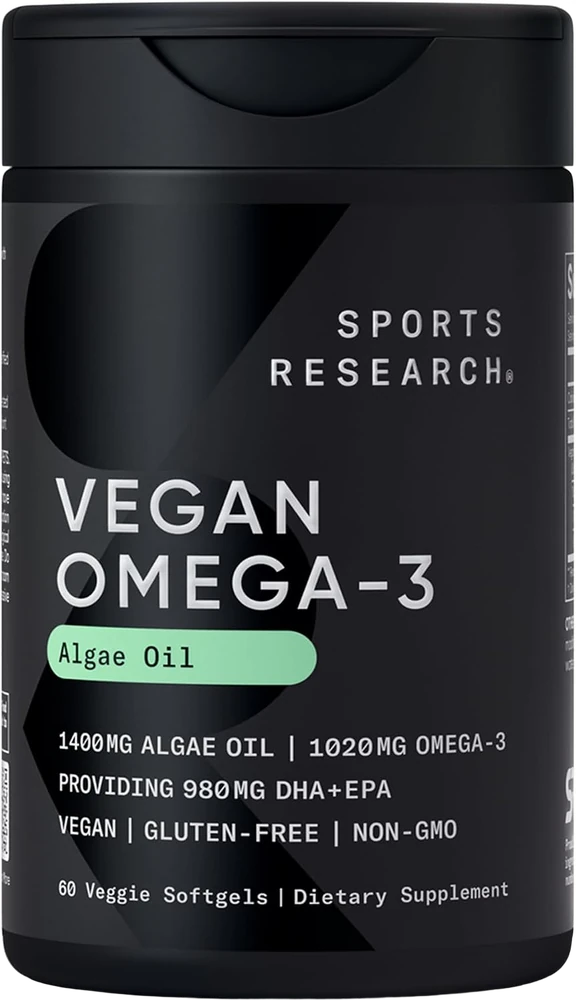
Best overall: Sports Research Vegan Omega-3 from Algae Oil, 60 Veggie Softgels (Carrageenan Free)
The highest printed dose on this list — 700 mg DHA plus 280 mg EPA per 2-softgel serving (980 mg), listed as triglyceride-form omega-3 on the panel, in a tapioca capsule whose ingredient list has no carrageenan.
$26.95$0.90 / serving (about $0.92 per gram of DHA+EPA)
Why it wins: all five scores, pros & cons, full label
- 700 mg DHA and 280 mg EPA per serving, both printed on the panel (980 mg combined)
- Omega-3 listed as triglyceride (TG) on the panel; no carrageenan in the capsule ingredients
- IAOS testing by Nutrasource and AVA vegan certification printed on the label graphics
- Serving is 2 softgels, so a 60-count bottle is a 30-day supply
- Do not confuse with the brand's Vegan Omega-3 + Vitamin D3 SKU — this is the algae-only version
- DHA per serving
- 700 mg DHA per 2 softgels (350 mg per softgel)
- EPA per serving
- 280 mg EPA per 2 softgels (140 mg per softgel)
- Carrageenan-free
- The panel's other-ingredients list has no carrageenan (tapioca starch, glycerin, water, mixed tocopherols); 2 softgels per serving
- Form
- Vegan algae oil concentrate (Schizochytrium sp.), 1,400 mg per serving with 1,020 mg total omega-3 listed as TG (triglyceride), in a Plantgel tapioca capsule
- Testing
- Label graphics print IAOS tested by Nutrasource (09/25/2024) and vegan certified by the American Vegetarian Association (06/17/2024); front says non-GMO — not checked at the certifiers

Our take — Sports Research prints the highest dose on this list: 700 mg DHA plus 280 mg EPA per 2-softgel serving, 980 mg combined, listed as triglyceride-form omega-3 on the panel. The capsule is tapioca with no carrageenan in its ingredient list, and the label graphics print IAOS testing by Nutrasource and AVA vegan certification (we did not check either at the certifier). Cautions: the serving is two softgels, so 60 softgels last 30 days, and the algae-only SKU is not the brand's Vitamin D3 combo. Per gram of DHA+EPA it is the cheapest of the picks with a current Amazon price, at about $0.92.
 02
 03
 04
 05
 06
 07
 08
 09
 10
Who Wins Which Aspect
Sorted by overall SAC Product Score™ — the official ranking.
| # | Pick | Score | DHA + EPA dose per serving30% | Form & absorption25% | Purity & testing20% | Value per mg omega-315% | Sustainability & label honesty10% | Cost Per Dose | Buy |
|---|---|---|---|---|---|---|---|---|---|
| 01 | | 9.4 | 9.51 | 9.61 | 9.03 | 9.21 | 9.51 | $0.90 / serving | Check price |
| 700 mg DHA and 280 mg EPA per serving, both printed on the panel (980 mg combined)Serving is 2 softgels, so a 60-count bottle is a 30-day supply | |||||||||
| 02 | | 8.8 | 9.03 | 9.02 | 9.61 | 6.8 | 9.02 | $0.76 / serving at the last listed price | Check price |
| Eurofins testing of every batch is printed on the label graphicsSmaller specialty brand without the shelf recognition of Nordic Naturals | |||||||||
| 03 | | 8.6 | 9.03 | 8.4 | 8.8 | 8.32 | 8.0 | $0.50 / serving | Check price |
| 300 mg DHA plus 150 mg EPA in one softgel, printed on the box frontNo Supplement Facts panel in the gallery; the listing text (325 mg DHA, 535 mg omega-3) does not match the box | |||||||||
| 04 | | 8.5 | 9.32 | 8.2 | 8.0 | 8.03 | 9.02 | $0.72 / serving | Check price |
| 195 mg EPA alongside 390 mg DHA per serving, both printed on the panelSoftgel shell lists carrageenan and sorbitol | |||||||||
| 05 | | 8.5 | 8.4 | 8.4 | 8.2 | 9.21 | 9.02 | $0.37 / serving at the last listed price | Check price |
| Carries both DHA (270 mg) and EPA (135 mg) — not DHA-only — once dailyLower absolute DHA/EPA per softgel than the premium picks | |||||||||
| 06 | | 7.6 | 6.5 | 9.02 | 8.5 | 5.3 | 9.02 | $1.13 / serving | Check price |
| Standout sustainability story — farm-grown algae, zero fresh water, non-arable landListing leads with bioavailability rather than absolute DHA/EPA mg — harder to compare on raw milligrams | |||||||||
| 07 | | 7.4 | 6.0 | 8.3 | 7.5 | 8.03 | 8.53 | ~$0.50 / 3-softgel serving | Check price |
| 500 mg DHA and 100 mg DPA per serving, every figure printed on the panelThe panel prints no EPA line; this is a DHA source, not a fish-oil replacement | |||||||||
| 08 | | 7.1 | 6.0 | 7.2 | 9.52 | 5.3 | 8.0 | $1.14 / serving | Check price |
| Highest pure DHA per serving here (500 mg) — strong for brain and eye supportDHA-only — provides essentially no EPA, so it is not a complete omega-3 on its own | |||||||||
| 09 | | 7.1 | 5.5 | 8.53 | 8.0 | 5.5 | 9.02 | $0.50 / serving | Check price |
| 150 mg DHA and 75 mg EPA per softgel, both printed on the panel — not DHA-onlyDHA-dominant — EPA is the smaller share, and 225 mg combined per serving is the lowest dose of the EPA-carrying picks | |||||||||
| 10 | | 7.0 | 6.0 | 8.0 | 6.5 | 7.0 | 8.0 | — | Check price |
| True liquid format — no softgels to swallow; orange-flavored and family-friendlyDHA-only — just ~4 mg EPA per serving, so pair it with an EPA-inclusive product if EPA matters | |||||||||
The Other 9, Ranked
- 02
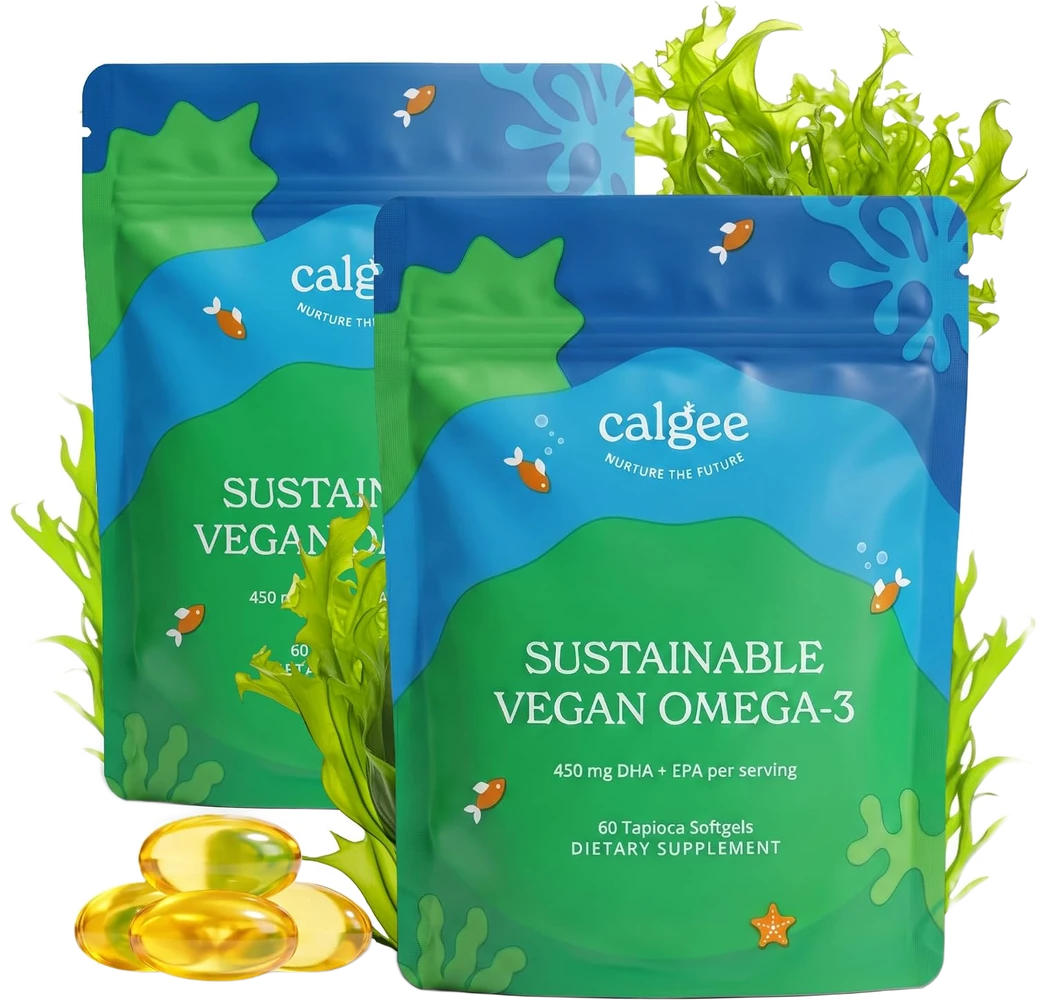
Eurofins-tested every batch: Calgee Vegan Omega 3, 450 mg DHA & EPA, 120 Softgels
8.8SAC Score™Per-batch testing in a clean shell — 300 mg DHA plus 150 mg EPA per 2-softgel serving (450 mg), a carrageenan-free and sorbitol-free shell, and Eurofins testing of every batch stated on the label graphics. Amazon shows it as not currently in stock (2026-10-18).
StrongestPurity & testing9.61WeakestValue per mg omega-36.8- DHA per serving
- 300 mg DHA per 2 softgels (150 mg per softgel)
- EPA per serving
- 150 mg EPA per 2 softgels (75 mg per softgel)
- Carrageenan-free
- Yes — gallery graphics print No Carrageenan and No Sorbitol, and the panel's ingredient list has neither; 2 softgels per serving
Check price on AmazonRead the full review$45.50 (last listed; not currently in stock on Amazon, 2026-10-18)All five scores, pros & cons, full label
What We Like- Eurofins testing of every batch is printed on the label graphics
- Carrageenan-free and sorbitol-free tapioca softgel
- 300 mg DHA plus 150 mg EPA per serving, both printed on the panel
What You Live With- Smaller specialty brand without the shelf recognition of Nordic Naturals
- Serving is 2 softgels; the panel in the gallery is the 60-softgel pouch (30 servings) while the listing title says 120 count — confirm the count you order
- Form
- Algal oil (Schizochytrium sp.), 1,000 mg per serving with 550 mg total omega-3, in a tapioca softgel; the panel prints no triglyceride or ethyl ester wording
- Testing
- Eurofins Scientific tests every batch, per a label graphic; GMP-certified US facility — no certificate of analysis seen
Our take — Calgee puts 300 mg DHA and 150 mg EPA in each 2-softgel serving (450 mg), in a tapioca shell with no carrageenan and no sorbitol, and prints that Eurofins tests every batch. At the last listed price of $45.50 for the 120-count bottle (Amazon shows it as not currently in stock, 2026-10-18) it costs about $0.76 a serving and about $1.69 per gram of DHA+EPA, well above Sports Research, Testa and Nordic Naturals per gram. The catches are brand recognition, a dose well below the highest-dose pick, and a gallery panel that shows the 60-count pouch while the listing title says 120. For per-batch testing in a carrageenan-free shell, it is the pick once it is back in stock.
- 03
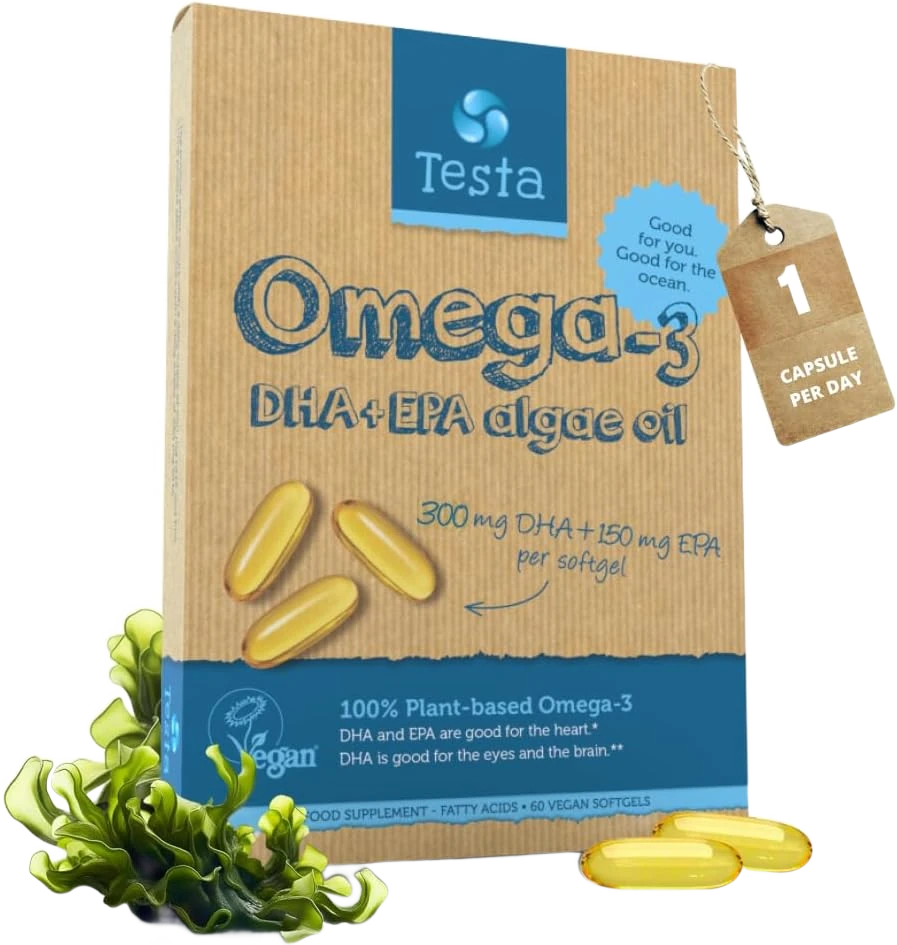
Best one-softgel serving: Testa Omega-3 DHA + EPA, Vegan Algae, 60 Softgels
8.6SAC Score™The largest single-softgel serving here — 300 mg DHA plus 150 mg EPA in one softgel, printed on the box, so a 60-count bottle lasts two months. The gallery has no Supplement Facts panel, and the listing text's 325 mg DHA does not match the box.
StrongestDHA + EPA dose per serving9.03WeakestSustainability & label honesty8.0- DHA per serving
- 300 mg DHA per softgel (printed on the box front and a gallery tile; the listing text says 325 mg)
- EPA per serving
- 150 mg EPA per softgel
- Carrageenan-free
- Not known — the gallery has no ingredient list; 1 softgel per serving
All five scores, pros & cons, full label
What We Like- 300 mg DHA plus 150 mg EPA in one softgel, printed on the box front
- One softgel a day, so a 60-count bottle is a 2-month supply
- Individually blister-packed capsules (per a gallery tile) in a plastic-light cardboard box
What You Live With- No Supplement Facts panel in the gallery; the listing text (325 mg DHA, 535 mg omega-3) does not match the box
- Specialty import brand with lighter US shelf presence; form and testing claims come from the listing
- Form
- Algae oil; the listing title says RTG (re-esterified triglyceride) — no panel in the gallery to confirm the form
- Testing
- Gallery tile says free from ocean toxins; listing says Kosher and sustainably grown US algae — no lab or certificate named
Our take — Testa is for the buyer who wants the dose in one capsule: the box front and a gallery tile print 300 mg DHA plus 150 mg EPA per softgel, and a 60-count bottle is a two-month supply. The honest caveats: the gallery has no Supplement Facts panel, the listing text claims 325 mg DHA and 535 mg omega-3 that the box does not print, and the RTG form and the contaminant-free claim rest on the listing alone. It is a lighter-presence import brand. For a one-softgel serving at 450 mg DHA+EPA, it is the pick.
- 04
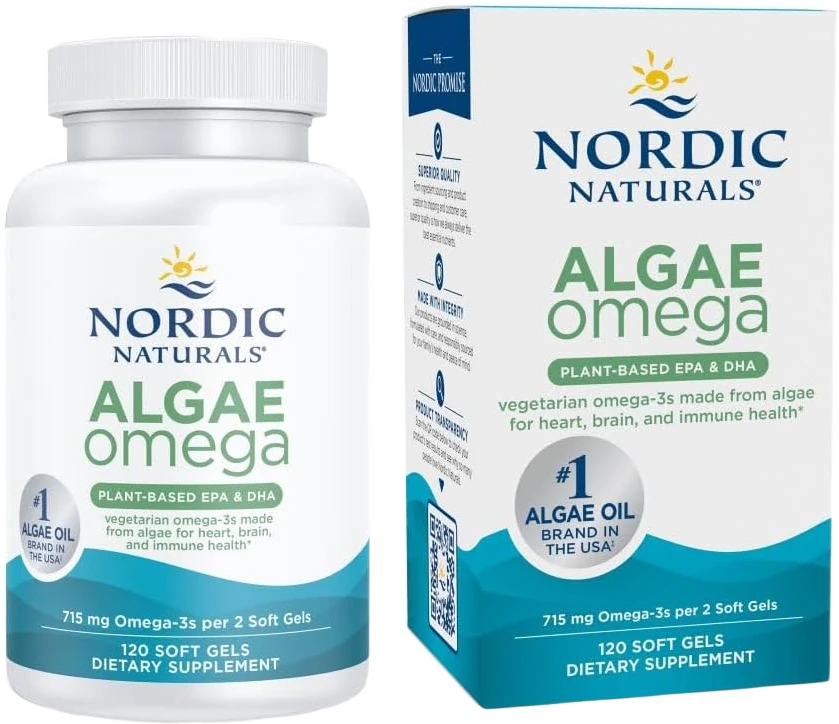
Balanced 2:1 DHA:EPA: Nordic Naturals Algae Omega, 715 mg Omega-3, 120 softgels
8.5SAC Score™A 2:1 DHA:EPA split from a well-known omega-3 brand — 390 mg DHA plus 195 mg EPA per 2-softgel serving, listed as triglyceride-form omega-3 on the panel. The softgel shell lists carrageenan and sorbitol.
StrongestDHA + EPA dose per serving9.32WeakestPurity & testing8.0- DHA per serving
- 390 mg DHA per 2 softgels
- EPA per serving
- 195 mg EPA per 2 softgels (715 mg total omega-3, including other omega-3s)
- Carrageenan-free
- No — the softgel shell lists carrageenan and sorbitol (modified cornstarch, glycerin, carrageenan, sorbitol, water, carob color); 2 softgels per serving
All five scores, pros & cons, full label
What We Like- 195 mg EPA alongside 390 mg DHA per serving, both printed on the panel
- Omega-3 listed as triglyceride form (TG) on the panel
- Box text states every batch is third-party tested for environmental toxins; certified-vegan badge
What You Live With- Softgel shell lists carrageenan and sorbitol
- Full dose is 2 softgels, so a 120-count bottle is a 60-day supply, at about $0.72 a serving
- Form
- Marine algal oil (Schizochytrium sp.); the panel lists the omega-3s in triglyceride form (TG)
- Testing
- Box text says every batch is tested by a third-party certified lab for environmental toxins including heavy metals; badges read 3rd Party Purity Tested, igen Non-GMO Tested and Certified Vegan — no lab or certifier named, not checked at the certifiers
Our take — Algae Omega prints 390 mg DHA and 195 mg EPA per 2-softgel serving (715 mg total omega-3), listed as triglyceride-form omega-3, from a well-known brand — a 2:1 split with real EPA. We read the full panel in the listing gallery on Oct 18, 2026. The trade-offs: the shell lists carrageenan and sorbitol, the serving is two softgels (a 120-count bottle lasts 60 days) and at about $1.23 per gram of DHA+EPA it costs more per gram than Sports Research and Testa. The box states third-party batch testing but names no lab. For a balanced EPA+DHA oil from an established brand, it is a solid pick.
- 05
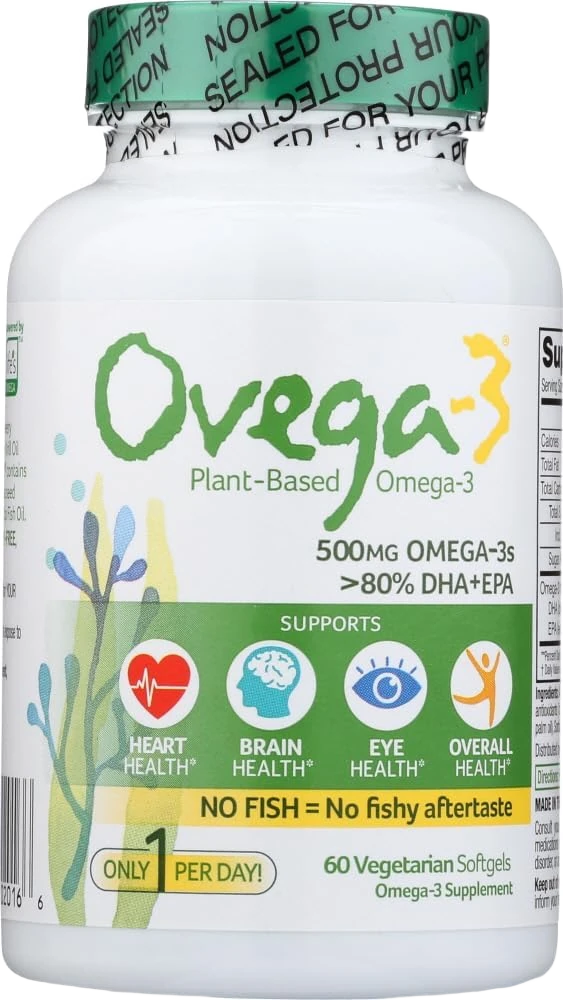
Budget: Ovega-3 Vegan Algae Omega-3, 500 mg, 60 Softgels
8.5SAC Score™The accessible budget gateway — a widely stocked, drugstore-familiar vegan omega-3 with a genuine EPA+DHA pairing (270/135) in one once-daily softgel at a friendly price.
StrongestValue per mg omega-39.21WeakestPurity & testing8.2- DHA per serving
- 270 mg DHA
- EPA per serving
- 135 mg EPA
- Carrageenan-free
- Not stated; 1 softgel per serving; no fishy aftertaste
All five scores, pros & cons, full label
What We Like- Carries both DHA (270 mg) and EPA (135 mg) — not DHA-only — once daily
- Long-standing, widely available mainstream vegan omega-3 brand
- Gluten-free, soy-free, non-GMO; no fishy aftertaste; budget-friendly
What You Live With- Lower absolute DHA/EPA per softgel than the premium picks
- Multiple Ovega-3 SKUs (different counts and a mini-softgel version) — confirm the count before buying
- Form
- Algal oil (life'sOMEGA / Schizochytrium)
- Testing
- Gluten-free, GMO-free, soy-free (no third-party seal stated)
Our take — Ovega-3 is the easy entry point: a long-established, drugstore-familiar vegan omega-3 that still pairs real EPA with DHA (270/135) in one once-daily softgel, at the lowest sticker here when last listed (out of stock on Amazon, 2026-10-18). It's gluten-, soy- and GMO-free with no fishy aftertaste. You give up some absolute dose versus the premium picks, and there are several Ovega-3 SKUs (including a mini-softgel) so confirm the count. No third-party seal is stated. For a budget-friendly, genuinely balanced first algae oil, it's the gateway pick.
- 06
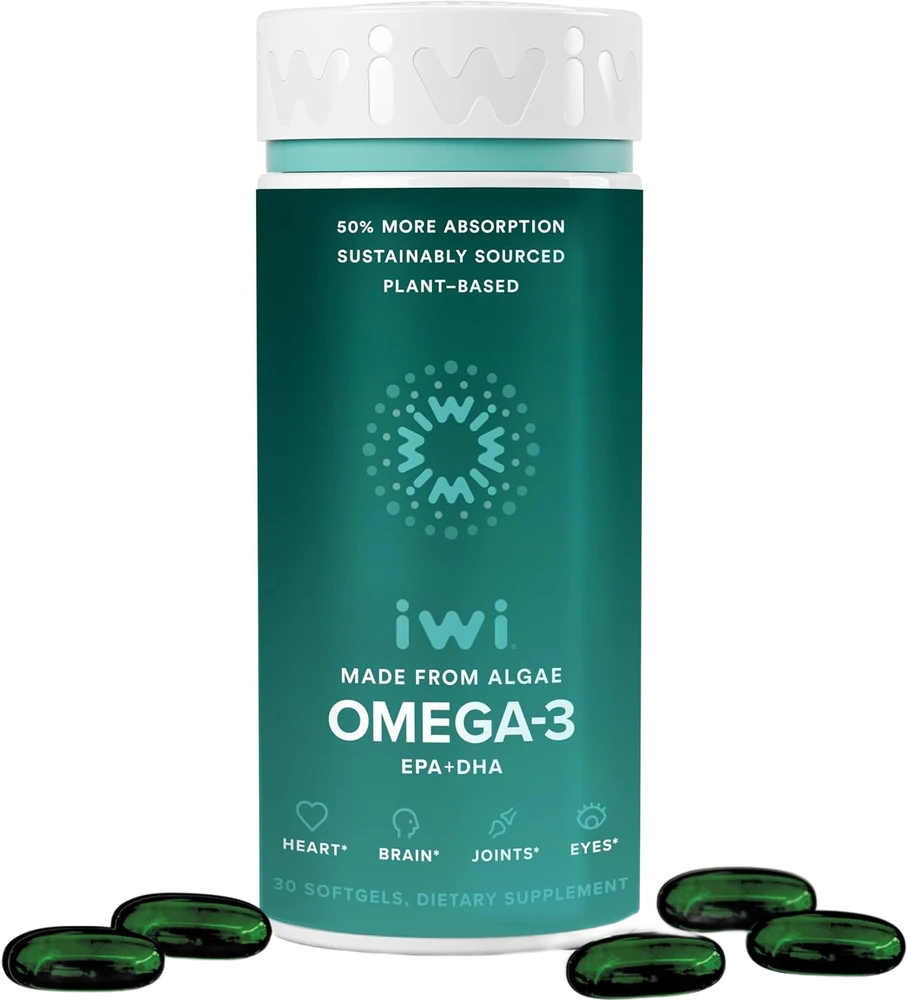
Most sustainable: iwi life Omega-3 Whole-Body, AlmegaPL Algae, 30 Softgels
7.6SAC Score™The most sustainable pick — AlmegaPL algae grown on US farms with zero fresh water and no arable land, in a clinically-studied polar-lipid form the brand says absorbs better gram-for-gram than standard algal oil.
StrongestForm & absorption9.02WeakestValue per mg omega-35.3- DHA per serving
- Contains DHA — mg not prominently stated on the listing
- EPA per serving
- Contains EPA — mg not prominently stated on the listing
- Carrageenan-free
- Not stated; 1 softgel per serving
All five scores, pros & cons, full label
What We Like- Standout sustainability story — farm-grown algae, zero fresh water, non-arable land
- AlmegaPL polar-lipid form with brand-cited superior bioavailability; contains EPA + DHA
- Non-GMO Project Verified; tested for heavy metals and contaminants
What You Live With- Listing leads with bioavailability rather than absolute DHA/EPA mg — harder to compare on raw milligrams
- 30-count is only a one-month supply and priced like larger bottles
- Form
- AlmegaPL algae extract (Nannochloropsis), polar-lipid bound
- Testing
- Non-GMO Project Verified; tested for heavy metals & contaminants
Our take — iwi life is the sustainability pick: AlmegaPL algae grown on US farms using non-arable land and zero fresh water, in a polar-lipid form the brand says is more bioavailable gram-for-gram than standard algal oil, and it's Non-GMO Project Verified and tested for heavy metals. Here's the honest mark-down on our milligram-first methodology: the listing leads with bioavailability and does NOT prominently publish the per-serving DHA/EPA split, so you can't compare it on raw mg the way you can the picks above. If a low-impact supply chain is your priority and you'll trust the bioavailability claim, it's the most ethical option — just know you're buying the story, not a stated dose.
- 07
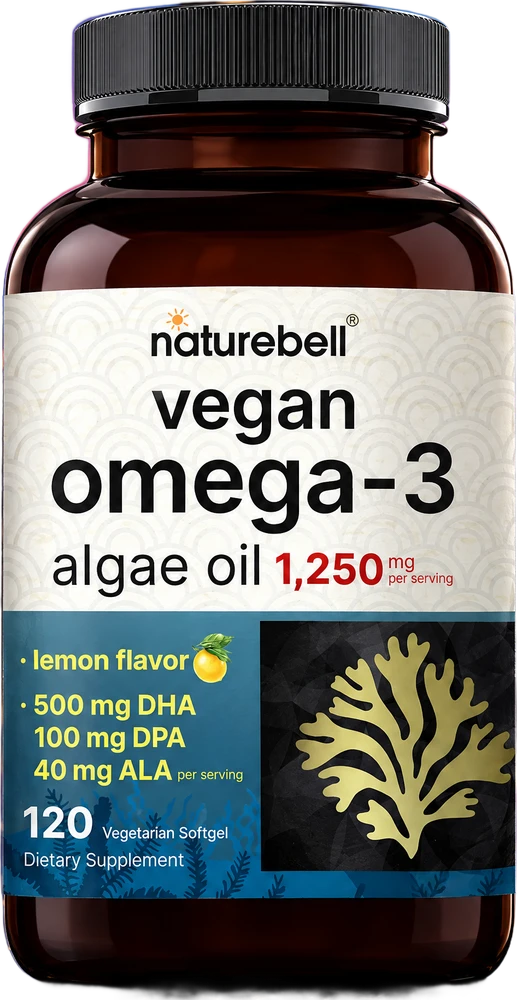
Low-cost DHA: NatureBell Vegan Omega-3 Algae Oil, 120 Veggie Softgels (Lemon)
7.4SAC Score™Inexpensive, carrageenan-free DHA: 500 mg DHA and 100 mg DPA per 3-softgel serving at about $0.50 a serving, but the panel prints no EPA line and the test lab is never named.
StrongestSustainability & label honesty8.53WeakestDHA + EPA dose per serving6.0- DHA per serving
- 500 mg DHA per 3-softgel serving
- EPA per serving
- The panel prints no EPA line (100 mg DPA is printed instead)
- Carrageenan-free
- Yes, printed on the other-ingredients line; 3 softgels per serving
All five scores, pros & cons, full label
What We Like- 500 mg DHA and 100 mg DPA per serving, every figure printed on the panel
- Carrageenan-free printed on the panel, with rosemary extract, ascorbyl palmitate and tocopherols to protect the oil
- About $0.50 per serving; the 120-softgel bottle lasts about 40 days
What You Live With- The panel prints no EPA line; this is a DHA source, not a fish-oil replacement
- Third-Party USA Lab Tested names no lab and the brand is not in the Nutrasource directory
- 3 softgels a day, and the panel prints no triglyceride or ethyl ester form
- Form
- Vegan algal oil (Schizochytrium sp.) with flaxseed oil in a vegetarian softgel; no triglyceride or ethyl ester wording on the panel
- Testing
- Third-Party USA Lab Tested badge, no lab named · not in the Nutrasource directory (checked Oct 18, 2026) · no certificate of analysis found
Our take — The pick for a buyer who wants DHA from algae at a low price and does not need EPA. The panel is honest on the dose: 500 mg DHA and 100 mg DPA per 3-softgel serving, a carrageenan-free shell and about $0.50 a serving on the price we checked. What holds it at 7.4 is what the listing leaves out: no EPA line, no named lab, no certificate of analysis and no NatureBell entry in the Nutrasource directory. Choose Sports Research or Ovega-3 if you want EPA printed on the label.
- 08
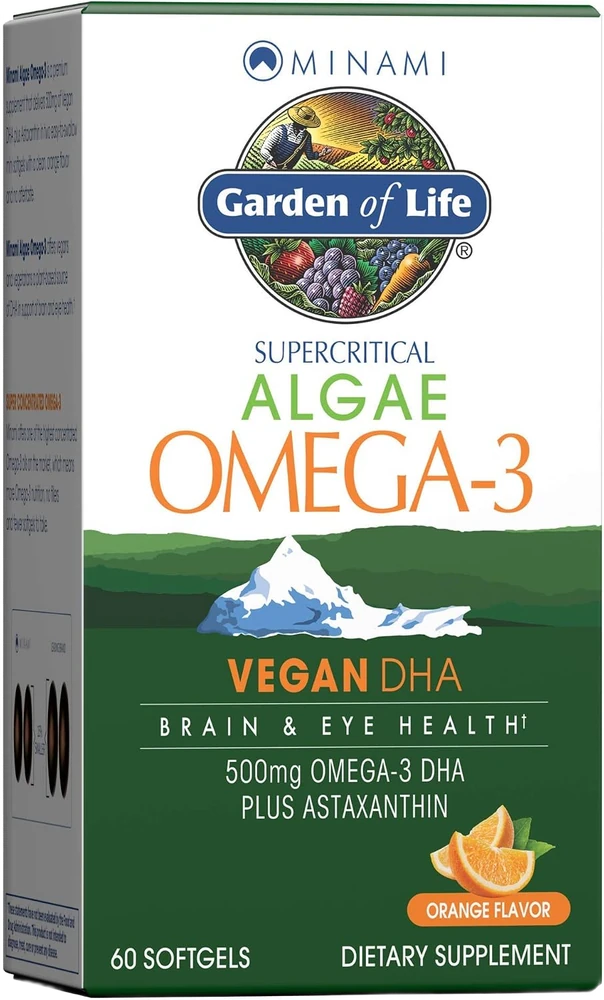
Highest DHA (DHA-only): Garden of Life Minami Algae Omega-3 Vegan DHA, Orange, 60 Mini Softgels
7.1SAC Score™The highest-DHA option for brain and eye support — a concentrated 500 mg DHA per serving with added astaxanthin, processed by hexane-free Supercritical CO2 and verified for low oxidation — but it is DHA-only.
StrongestPurity & testing9.52WeakestValue per mg omega-35.3- DHA per serving
- 500 mg DHA (highest pure DHA here)
- EPA per serving
- DHA-only formula — no meaningful EPA
- Carrageenan-free
- No — the panel's ingredient list prints carrageenan (and Contains: Soy); 2 softgels per serving
All five scores, pros & cons, full label
What We Like- Highest pure DHA per serving here (500 mg) — strong for brain and eye support
- Hexane-free Supercritical CO2 extraction; verified low oxidation; added astaxanthin
- Orange-flavored mini softgels, no aftertaste
What You Live With- DHA-only — provides essentially no EPA, so it is not a complete omega-3 on its own
- Full serving is 2 mini softgels; 60-count is a 30-day supply
- Form
- Marine algae (Schizochytrium); Supercritical CO2 extraction; + astaxanthin
- Testing
- Third-party tested for purity and low oxidation, per the listing (no lab or report named); Supercritical on the box front
Our take — Garden of Life's Minami line is the DHA maximizer: 500 mg of pure DHA per serving — the most here — with added astaxanthin, hexane-free Supercritical CO2 extraction, and verified-low oxidation, which is a genuinely strong purity credential. The decisive caveat is right on the label: it's DHA-ONLY, with essentially no EPA, so it's excellent if DHA (brain, eyes) is exactly what you want but it is not a complete omega-3 on its own — pair it with an EPA source if EPA matters to you. The serving is two mini softgels, so a 60-count bottle lasts 30 days.
- 09
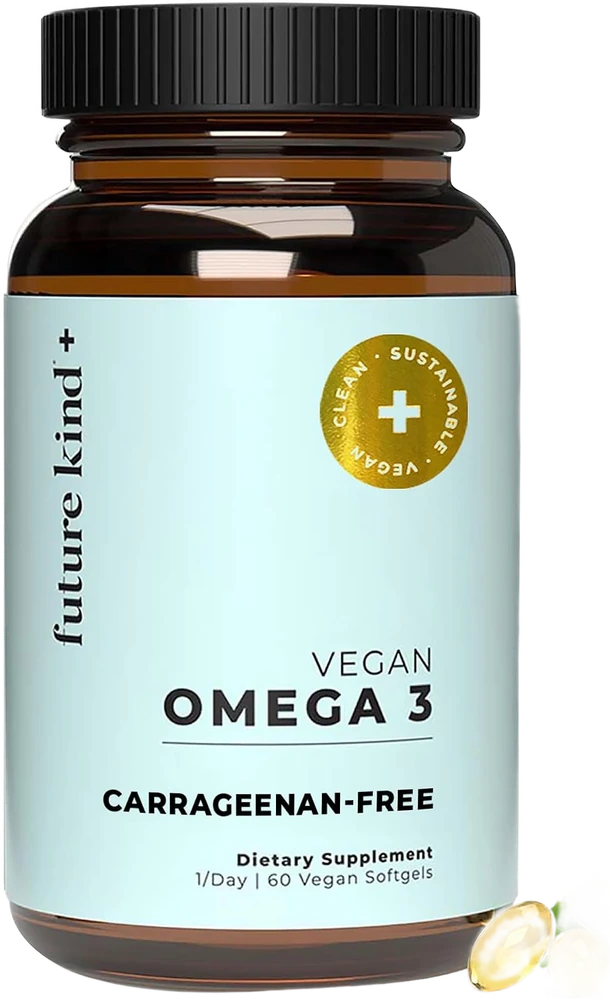
Best clean-label (DHA-dominant): Future Kind Vegan Omega-3 (150 mg DHA + 75 mg EPA), 60 Softgels
7.1SAC Score™Best for clean-label vegan buyers — 150 mg DHA plus 75 mg EPA (225 mg) in one carrageenan-free, citrus-scented tapioca softgel from a vegan-first brand in a glass bottle, third-party tested per the listing. The dose is the lowest of the EPA-carrying picks.
StrongestSustainability & label honesty9.02WeakestDHA + EPA dose per serving5.5- DHA per serving
- 150 mg DHA per 1-softgel serving (DHA-dominant)
- EPA per serving
- 75 mg EPA per 1-softgel serving (225 mg DHA+EPA; 275 mg total omega-3 from 500 mg algal oil)
- Carrageenan-free
- Yes — the front label prints Carrageenan-Free and the panel's ingredient list has none; 1 softgel per serving (the brand says 1-2 a day)
All five scores, pros & cons, full label
What We Like- 150 mg DHA and 75 mg EPA per softgel, both printed on the panel — not DHA-only
- Carrageenan-free tapioca softgel; glass bottle; vegan-first brand ethos
- Citrus-scented to avoid any aftertaste; one softgel is a serving, so 60 softgels last 60 days
What You Live With- DHA-dominant — EPA is the smaller share, and 225 mg combined per serving is the lowest dose of the EPA-carrying picks
- About $2.22 per gram of DHA+EPA at one softgel a day, among the highest costs per milligram of omega-3 on this list
- Form
- Algal oil (Schizochytrium sp.) in a modified-tapioca softgel, citrus-scented
- Testing
- Third-party lab tested and made in USA, per the listing; no lab named
Our take — Future Kind is the clean-label vegan-first pick: 150 mg DHA plus 75 mg EPA per softgel (225 mg), printed on the panel, in a carrageenan-free, citrus-scented tapioca softgel in a glass bottle, third-party lab tested per the listing. The honest flag is the dose: DHA-dominant, with EPA the smaller share, and 225 mg per one-softgel serving is the lowest on the list for an EPA-carrying pick; at about $0.50 a serving it costs about $2.22 per gram of DHA+EPA. The brand suggests 1-2 softgels a day, which would double the dose and the cost. For buyers who care most about a clean, ethical label and lead with DHA, it works.
- 10
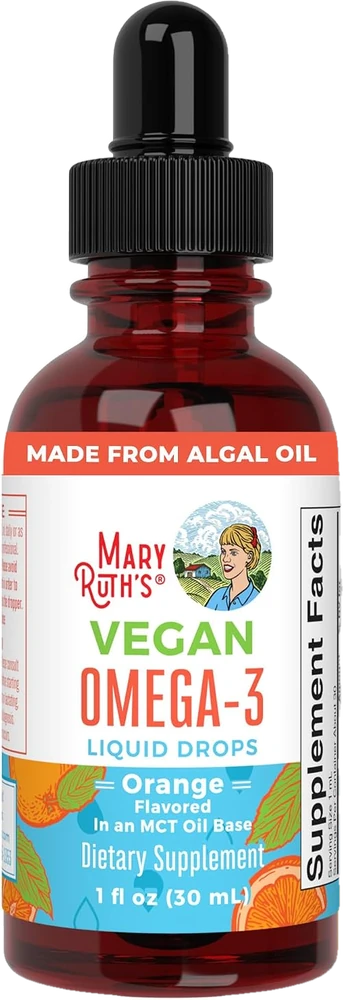
Best liquid (DHA-only): MaryRuth Organics Omega-3 Liquid Drops, 400 mg DHA, Orange, 1 oz
7.0SAC Score™The best liquid / no-pill option — an orange-flavored vegan algae omega-3 in drop form for anyone who can't or won't swallow softgels, including kids and the whole family, at 400 mg DHA per serving.
StrongestForm & absorption8.0WeakestDHA + EPA dose per serving6.0- DHA per serving
- 400 mg DHA
- EPA per serving
- 4 mg EPA (trace — effectively DHA-only)
- Carrageenan-free
- N/A — liquid (no softgel shell); orange-flavored
All five scores, pros & cons, full label
What We Like- True liquid format — no softgels to swallow; orange-flavored and family-friendly
- Solvent-free extraction from sustainably grown, ocean-friendly microalgae
- Flexible dosing straight from the dropper
What You Live With- DHA-only — just ~4 mg EPA per serving, so pair it with an EPA-inclusive product if EPA matters
- Liquid omega-3 oxidizes faster than capsules once opened; refrigerate and use within the stated window
- Form
- Liquid drops; wild-strain microalgae; solvent-free extraction
- Testing
- Vegan, solvent-free, ocean-friendly algae (no third-party seal stated)
Our take — MaryRuth's drops are the no-pill answer: an orange-flavored vegan algae omega-3 in liquid form for anyone — kids included — who can't or won't swallow softgels, at 400 mg DHA per serving with solvent-free, ocean-friendly sourcing and dropper-flexible dosing. Two honest flags: it's effectively DHA-ONLY (just ~4 mg EPA, a trace), so add an EPA-inclusive product if EPA matters to you; and liquid omega-3 oxidizes faster than capsules once opened, so refrigerate it and use it within the stated window. For the best liquid format, it's the pick.
The Guide In Four Short Lessons
Read the DHA and EPA split, not the omega-3 total.
Many algae oils are DHA-dominant and several are DHA-only. A bottle can advertise a big omega-3 number and deliver almost no EPA, and the front label will not tell you.
Decide whether you need EPA.
DHA is the omega-3 most studied for cognition and vision, so a DHA-dominant oil has real value. If you are replacing fish oil for cardiovascular or anti-inflammatory reasons, a DHA-only oil leaves the EPA out.
Check the form and the purity testing.
Re-esterified triglyceride ranks over ethyl ester in our scoring, carrageenan-free over capsules with it, and published oxidation testing over none. Where a brand will not publish its split, treat that as an answer.
Ranked on actual DHA+EPA dose (30%), form & absorption (25%), purity & testing (20%), value per mg (15%) and sustainability/label honesty (10%). Evidence base: Arterburn 2008 (PMID 18589030), Bailey 2025 (PMID 41096614), Maki 2014 (PMID 25123060), Dyerberg 2010 (PMID 20638827), Stonehouse 2013 (PMID 23515006).
Algae oil is unusual because the front of the label can hide the one number that matters, so we weighted the actual DHA + EPA dose the heaviest at 30%: the real milligrams of each per serving, taken from the listing or brand spec. This is also where we apply the category's hardest honesty test — many algae oils are DHA-dominant or DHA-only, so we flag every pick that delivers little or no EPA rather than letting a big "omega-3" number imply balance it doesn't have. Form and absorption is next at 25%: re-esterified triglyceride (rTG) and natural triglyceride forms absorb better than ethyl ester, and a carrageenan-free plant softgel (or a clean liquid) beats a shell with additives. Purity and testing is worth 20% — oxidation/TOTOX control, third-party verification, and freedom from heavy metals, PCBs and microplastics — and we credit it ONLY where the listing actually states it; "None stated" earns nothing, and we never upgrade a missing claim. Value at 15% is judged per milligram of omega-3 across the bottle, not on sticker price, since a 120-count one-a-day can beat a cheaper 30-count. Sustainability and label honesty rounds it out at 10%: how the algae is grown, and crucially whether the brand publishes its real DHA/EPA split — a brand that won't tell you the milligrams is marked down for it. Every figure below is from the real listing; nothing was invented, and where a number isn't published we say so.
DHA + EPA dose per serving · 30%
The decisive axis: the actual milligrams of DHA and of EPA per serving, read from the label, not a combined "omega-3" figure. We reward products that carry meaningful EPA alongside DHA — a true fish-oil replacement — and we explicitly flag DHA-dominant and DHA-only picks, because the algae most brands use makes plenty of DHA but little EPA. If you want balanced omega-3, this number is the whole decision.
Form & absorption · 25%
How well the oil is absorbed and how clean the delivery is. Re-esterified triglyceride (rTG) and natural triglyceride forms are absorbed better than ethyl ester, so they score higher. We also credit a carrageenan-free plant-based (tapioca) softgel, or a clean liquid, over a shell carrying additives — the everyday-tolerability factor that algae brands too often ignore.
Purity & testing · 20%
Independent verification that the oil is what it claims and isn't rancid: oxidation/TOTOX control, third-party or per-batch testing, and freedom from mercury, heavy metals, PCBs and microplastics. Credited ONLY where the listing or brand actually states it — a Eurofins per-batch test or a verified-low-oxidation claim earns the points; "None stated" does not, and we never imply a test a product doesn't carry.
Value per mg omega-3 · 15%
Real cost efficiency, measured on price per milligram of DHA+EPA across the whole bottle rather than the sticker. A 120-count one-a-day at a higher total price can deliver cheaper omega-3 than a small premium jar, and a 2-softgel serving halves a bottle's true life. The tiebreaker between picks of similar dose and form.
Sustainability & label honesty · 10%
Algae oil's core appeal is that it's fish-free and lower-impact, so we credit genuinely sustainable cultivation (farm-grown algae, low water use, solvent-free extraction). Crucially, this axis also rewards label honesty — a brand that publishes its exact DHA/EPA split scores higher than one that hides the milligrams behind a bioavailability story, because you can't make a balanced-omega-3 decision on a number you can't see.

How algae oil works
- 1
Straight to DHA and EPA
The beneficial omega-3s are DHA and EPA. Fish get them by eating algae; algae oil skips the fish and delivers DHA (and increasingly EPA) directly — chemically the same molecules your heart, brain and eyes use, so DHA+EPA dose per serving is our heaviest axis.
- 2
Why not just eat ALA?
Plant omega-3 (ALA, from flax/chia) converts to DHA/EPA at single-digit percentages — unreliable. Algae oil bypasses that broken conversion, which is why it, not flax, is the real vegan omega-3 answer.
- 3
Triglyceride form absorbs better
Omega-3 in triglyceride form absorbs more completely than ethyl-ester; form and absorption is scored second because a big milligram number in a poorly absorbed form under-delivers.
- 4
Purity without the ocean
Grown in controlled tanks, algae oil sidesteps the mercury and ocean-contaminant concerns of fish — a genuine advantage, provided the product still tests clean and prints honest DHA+EPA numbers.
What to expect from algae oil
Nothing to feel
Omega-3 status rebuilds silently in cell membranes; there is no acute effect. A quality product should not cause fishy burps — a plus over fish oil.
Membranes enrich
The omega-3 index rises as DHA/EPA incorporate into cells. Dry eyes or skin may ease if you were deficient; the cardiovascular and cognitive benefits are building beneath the surface.
The real payoff
Omega-3's value is long-term cardiovascular and brain-health margins, reflected in a higher omega-3 index on a blood test — not a feeling. Consistency at an adequate DHA+EPA dose is what matters.
The clean vegan choice
For anyone avoiding fish, algae oil is the evidence-based way to get real DHA+EPA. Take with a fatty meal, choose triglyceride form, and verify the DHA+EPA milligrams rather than the softgel count.
The bottom line
Sports Research Vegan Omega-3 (#1) prints the highest dose here: 700 mg DHA and 280 mg EPA per 2-softgel serving, read straight off the Supplement Facts panel.
Two tapioca softgels deliver 980 mg of DHA+EPA, listed as triglyceride-form omega-3, with no carrageenan in the capsule ingredients, and it is the cheapest pick per gram of DHA+EPA at about $0.88. The label graphics print IAOS testing by Nutrasource and AVA vegan certification; we did not check either at the certifier.
Alternatives by need: Calgee (#2) per-batch testing, Testa (#3) one softgel a day, Nordic Naturals (#4) balanced 2:1 from a well-known brand, Ovega-3 (#5) budget.
Calgee (#2) prints 300 mg DHA and 150 mg EPA per 2-softgel serving and states Eurofins tests every batch; Testa (#3) prints 300/150 per softgel on the box, though its gallery has no Supplement Facts panel; Nordic Naturals (#4) prints 390/195 per 2 softgels in triglyceride form, with carrageenan and sorbitol in the shell; Ovega-3 (#5) is the budget DHA-plus-EPA pick. Read the EPA number before you buy: Minami (#8), Future Kind (#9) and MaryRuth (#10) are DHA-only or DHA-dominant.
The buying rule: read the EPA number — the bottom picks (Minami #8, Future Kind #9, MaryRuth #10) are DHA-only or DHA-dominant.
Garden of Life Minami (#8) is the highest pure DHA at 500 mg per serving but DHA-ONLY, with carrageenan in the shell; Future Kind (#9) is a clean-label blend at 150 mg DHA plus 75 mg EPA per softgel, DHA-dominant; MaryRuth (#10) is the best liquid at 400 mg DHA but effectively DHA-only (~4 mg EPA) and oxidizes faster once opened. Where a product is DHA-only or hides its split, the file said so plainly instead of letting a big number imply balance.
Quick Answers
Which pick is the best overall?
Vegan Omega-3 from Algae Oil, 60 Veggie Softgels (Carrageenan Free) by Sports Research is our #1 pick (SAC score 9.4/10). Sports Research prints the highest dose on this list: 700 mg DHA plus 280 mg EPA per 2-softgel serving, 980 mg combined, listed as triglyceride-form omega-3 on the panel. The capsule is tapioca with no carrageenan in its ingredient list, and the label graphics print IAOS testing by Nutrasource and AVA vegan certification (we did not check either at the certifier). Cautions: the serving is two softgels, so 60 softgels last 30 days, and the algae-only SKU is not the brand's Vitamin D3 combo. Per gram of DHA+EPA it is the cheapest of the picks with a current Amazon price, at about $0.92.
What is the best budget option?
Ovega-3 Vegan Algae Omega-3 — see its pick card above for price and details.
How much do these picks cost?
Across our ranked picks, prices run from about $19.99 to $45.5 — exact price and cost per serving are listed on every pick card above.
How were these picks ranked?
Algae oil is unusual because the front of the label can hide the one number that matters, so we weighted the actual DHA + EPA dose the heaviest at 30%: the real milligrams of each per serving, taken from the listing or brand spec. This is also where we apply the category's hardest honesty test — many algae oils are DHA-dominant or DHA-only, so we flag every pick that delivers little or no EPA rather than letting a big "omega-3" number imply balance it doesn't have. Form and absorption is next at 25%: re-esterified triglyceride (rTG) and natural triglyceride forms absorb better than ethyl ester, and a carrageenan-free plant softgel (or a clean liquid) beats a shell with additives. Purity and testing is worth 20% — oxidation/TOTOX control, third-party verification, and freedom from heavy metals, PCBs and microplastics — and we credit it ONLY where the listing actually states it; "None stated" earns nothing, and we never upgrade a missing claim. Value at 15% is judged per milligram of omega-3 across the bottle, not on sticker price, since a 120-count one-a-day can beat a cheaper 30-count. Sustainability and label honesty rounds it out at 10%: how the algae is grown, and crucially whether the brand publishes its real DHA/EPA split — a brand that won't tell you the milligrams is marked down for it. Every figure below is from the real listing; nothing was invented, and where a number isn't published we say so.
Every Claim Ranked Above Traces Back To One Of These
5 peer-reviewed sources, each linked to PubMed
- [1] Arterburn 2008 PMID 18589030 — Algal-oil capsules and cooked salmon: nutritionally equivalent sources of docosahexaenoic acid. In a randomized study of 32 healthy adults, 600 mg/day of DHA from algal-oil capsules raised plasma phospholipid DHA (~+80%) and erythrocyte DHA (~+25%) to the same extent as DHA from assayed portions of cooked salmon. Direct evidence that algal-oil DHA is nutritionally equivalent to the DHA in fish — the foundation of treating algae oil as a genuine fish-oil alternative for DHA.
- [2] Bailey 2025 PMID 41096614 — Comparative Bioavailability of DHA and EPA from Microalgal and Fish Oil in Adults. A randomized, double-blind, placebo-controlled trial in 74 adults found that the bioavailability of DHA and EPA in plasma phospholipids from microalgal oil was statistically non-inferior to fish oil after 6 and 14 weeks, despite differences in production and composition. Confirms microalgal oil is a reliable, bioavailable source of BOTH DHA and EPA — not just DHA.
- [3] Maki 2014 PMID 25123060 — A new, microalgal DHA- and EPA-containing oil lowers triacylglycerols in adults with mild-to-moderate hypertriglyceridemia. In 93 adults with hypertriglyceridemia, a microalgal oil providing 2.4 g/day DHA+EPA lowered triglycerides to a degree not different from a standard fish oil, and significantly more than a corn/soy oil control over 14 weeks. Evidence that a balanced microalgal DHA+EPA oil delivers a recognized cardiometabolic omega-3 effect comparable to fish oil.
- [4] Dyerberg 2010 PMID 20638827 — Bioavailability of marine n-3 fatty acid formulations. In 72 volunteers taking ~3.3 g/day EPA+DHA for 2 weeks, re-esterified triglyceride (rTG) form gave the highest bioavailability (124% relative to fish-oil triglyceride), while ethyl ester was the lowest (~73%). The basis for ranking triglyceride/rTG algae oils above ethyl-ester forms on the absorption axis.
- [5] Stonehouse 2013 PMID 23515006 — DHA supplementation improved both memory and reaction time in healthy young adults: a randomized controlled trial. In 176 healthy young adults with low dietary DHA, 1.16 g/day DHA for 6 months improved episodic memory (in women) and working-memory reaction time (in men) versus placebo. Randomized evidence that DHA specifically — the omega-3 algae oil supplies best — supports cognition, which is exactly why DHA-dominant algae oils still have real value.
Related Guides
Affiliate disclosure: every Amazon link uses our Associates tag (superachieverclub-20). We earn a small commission at no cost to you; it funds independent reviews. We never accept payment to change a ranking.