
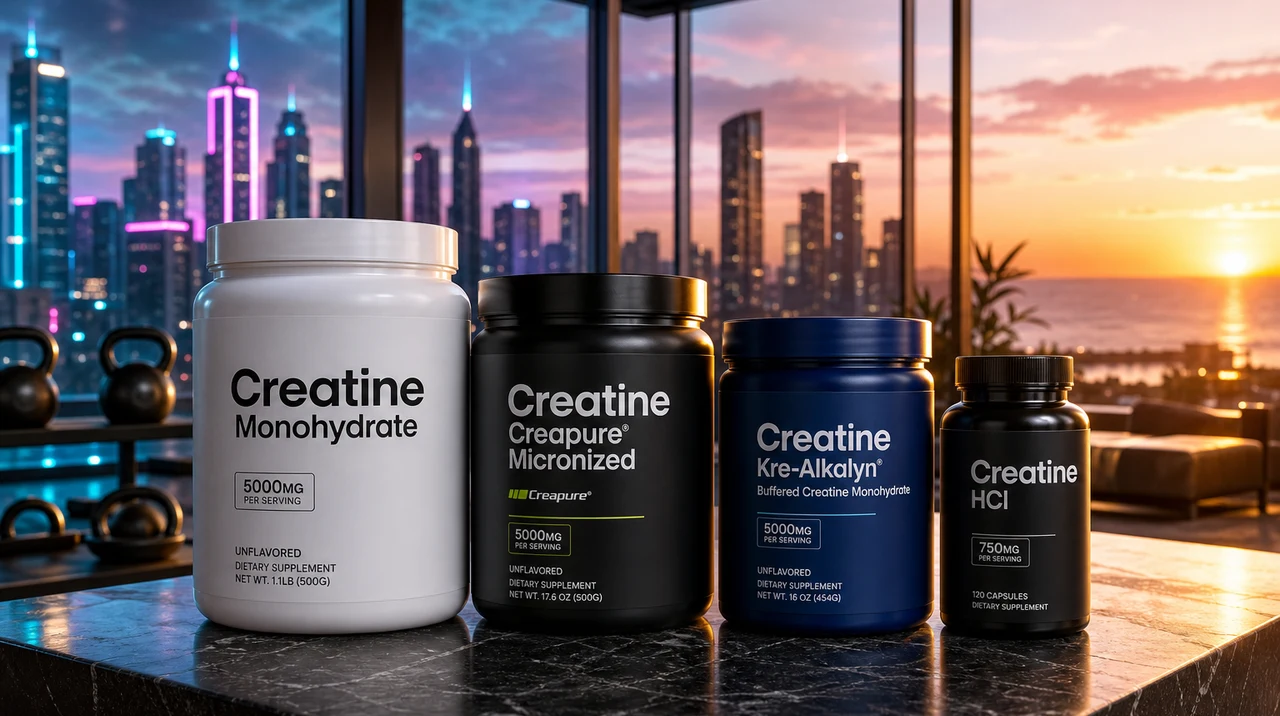
Top 5 Best Form of Creatine: Why Monohydrate Wins (2026)
We make this one. Our own Super Achiever formula — held to the exact same 50/50 criteria as every pick below, and we put it up top so you see it first. Full transparency: it's ours.
- #0100% pure
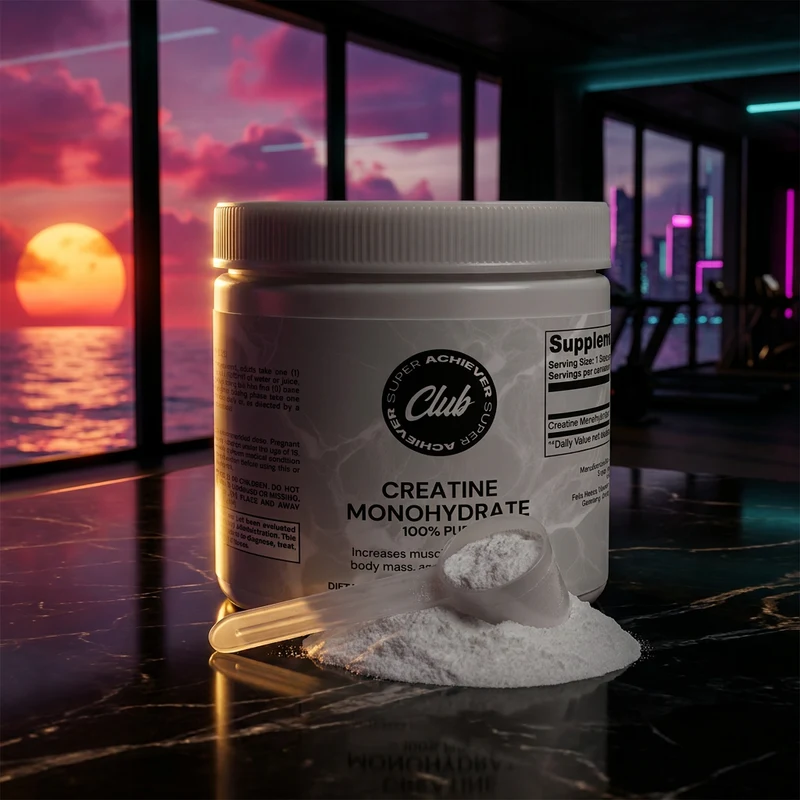
Super Achiever Creatine Monohydrate
Super Achiever Club · ships direct from our store9.3/10SAC Product Score™Our in-house formula: single-ingredient creatine monohydrate, unflavored — the exact form behind 500+ trials. Pinned here because it's ours, held to the same 50/50 criteria.
- Form
- Creatine monohydrate — single ingredient
- Size
- 250 g + scoop (~50 servings)
- Flavor
- Unflavored · zero fillers or sweeteners
- Made in
- USA
Pros- One ingredient — 100% creatine monohydrate, nothing hidden
- The exact form validated by 500+ clinical trials
- Unflavored — stacks into anything, no added sweeteners
- Ships direct from us — no marketplace middleman
Honest trade-offs- Not the cheapest per gram — bulk tubs undercut us on price
- 250 g tub, not a 1 kg bulk size
- Unflavored only — no flavored option yet
Our take — If you want to buy creatine straight from the source that wrote this guide, this is it — trial-grade monohydrate, nothing hidden. Not the cheapest gram on the page, but it's ours and we stand behind every tub.
5 picks — ranked by our 50/50 methodology
- #1Best form (overall)
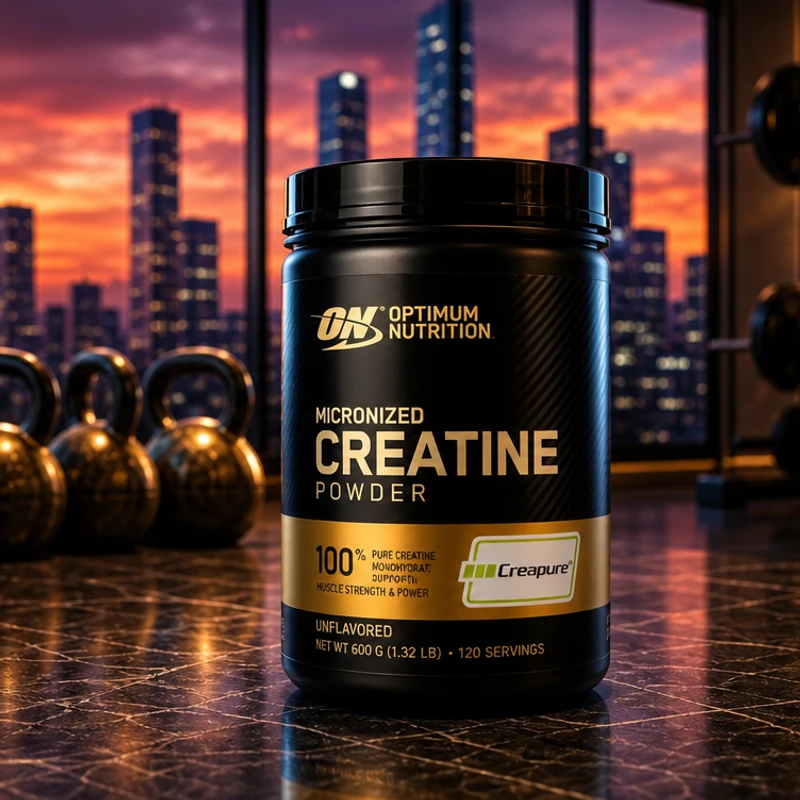
Monohydrate (micronized) — Optimum Nutrition
Creatine monohydrate · the only evidence-backed form · Creapure micronized, 600 g9.6/10SAC Product Score™SAC Product Score™ — how it breaks down- Form purity25%9.5
- Third-party testing25%8.5
- Per-serving creatine20%9.5
- Cost per active gram20%9.0
- Brand QC track record10%9.5
Creatine monohydrate is the best form, full stop — 500+ RCTs and the ISSN gold standard. This is the cleanest, cheapest way to buy it: Creapure micronized monohydrate from the most-trusted brand at $0.23/serving.
- Form
- Creatine monohydrate (Creapure, micronized) — the evidence-backed form
- Evidence
- 500+ RCTs · ISSN-rated most effective form
- Per serving
- 5 g monohydrate, no fillers, no flavoring
- Solubility
- High (micronized — mixes clean)
Pros- The single form with a real evidence base — every other form is judged against it
- Micronized for clean mixing without changing the molecule or efficacy
- Creapure-licensed — 99.95% pure German monohydrate
- Cheapest effective creatine tier — no 'next-gen' markup
Cons- Not NSF Certified for Sport — drug-tested athletes should take the Creapure form from Thorne (#2)
- Modest premium over a pure generic monohydrate (Bulk Supplements) if you want the absolute lowest price
Our take — If you only read one pick, read this one: the best form of creatine is monohydrate, and this is the cleanest, most-trusted way to buy it. Creapure-licensed, micronized for easy mixing, 120 servings for under $30. The 'micronized' and 'Creapure' labels aren't different forms — they're monohydrate optimized for texture and purity. Skip the load, run 5 g/day, and ignore every shelf-talker pushing a fancier form. There is no better-performing form to graduate to.
- #2Best form (purity)
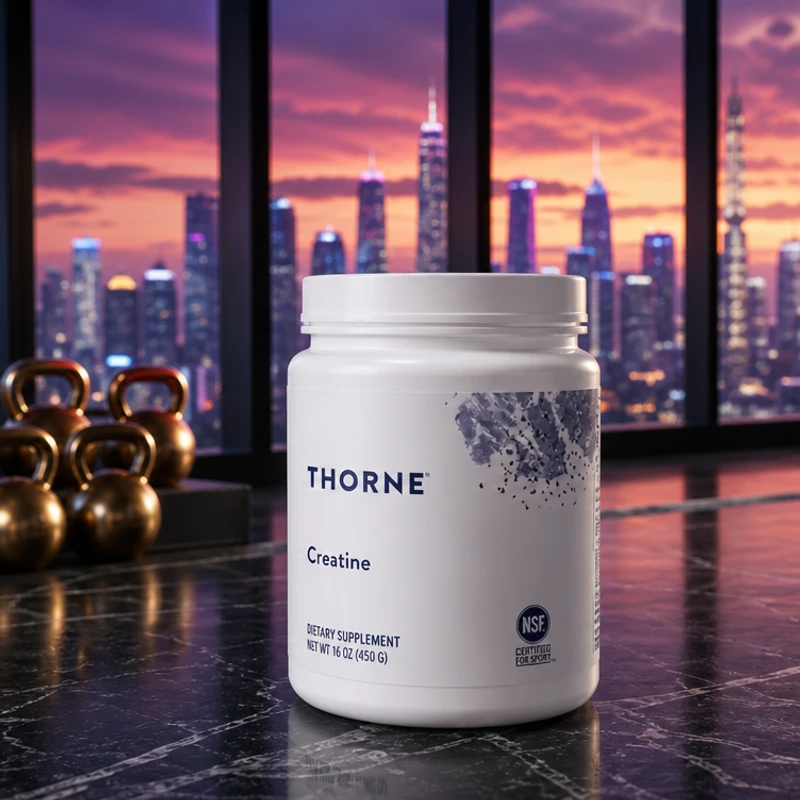
Creapure monohydrate — Thorne
Creatine monohydrate (Creapure, German Alzchem) · NSF Certified for Sport9.3/10SAC Product Score™SAC Product Score™ — how it breaks down- Form purity25%9.5
- Third-party testing25%10.0
- Per-serving creatine20%9.5
- Cost per active gram20%7.5
- Brand QC track record10%10.0
Still monohydrate — Creapure is the patented 99.95%-pure German production of it. The purity-and-testing tier for drug-tested athletes, with NSF Certified for Sport on every batch.
- Form
- Creatine monohydrate (Creapure) — same form as #1, higher QC
- Evidence
- Same 500+ RCTs as all monohydrate
- Testing
- NSF Certified for Sport — 270+ banned substances, every batch
- Purity
- 99.95% (Creapure, German Alzchem)
Pros- Creapure monohydrate — the cleanest tested supply of the evidence-backed form
- NSF Certified for Sport for federation-tested athletes (NCAA, IOC, MLB, NFL)
- Same molecule and same evidence as Pick #1, with banned-substance testing layered on
- Thorne's clinical-grade QC is the industry benchmark
Cons- $0.50/serving — the highest cost per gram here, and you're paying for testing not a better form
- Smaller 450 g tub means more frequent re-orders than ON's 600 g
Our take — The purity tier — and a clean illustration that 'best form' isn't the same as 'most expensive form.' Creapure is monohydrate; NSF Certified for Sport is testing, not a different molecule. If you're drug-tested or simply want the cleanest possible tub, Thorne is the answer and worth the premium. If you train recreationally, you're paying for certification you don't need — Optimum Nutrition (#1) gets you the same Creapure monohydrate for half the per-serving cost.
- #3More soluble, no edge
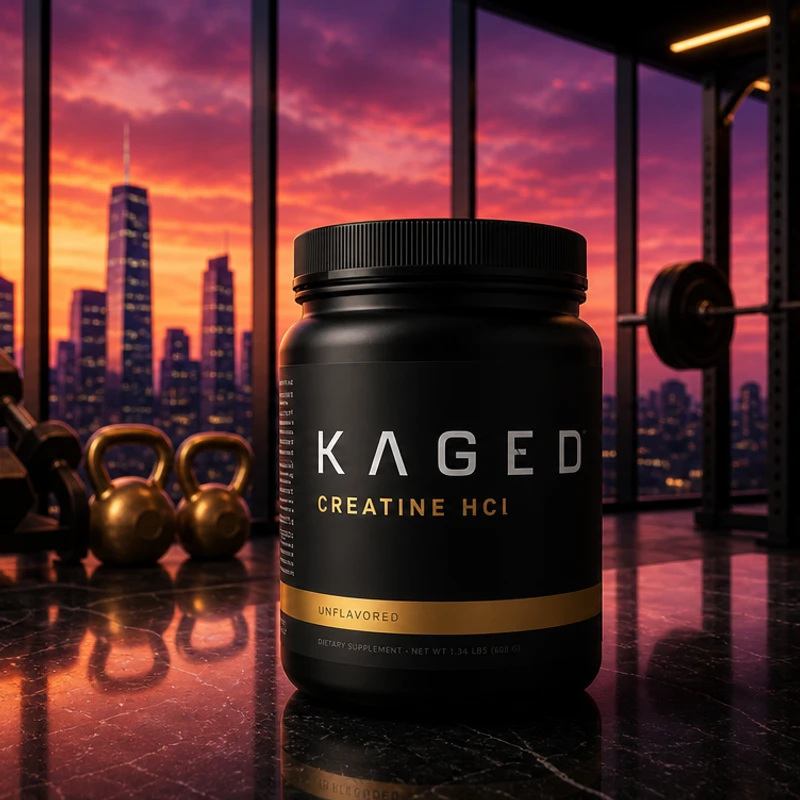
Creatine HCl — Kaged
Creatine hydrochloride · NOT monohydrate · 750 mg per capsuleSAC Product Score™ — how it breaks down- Form purity25%7.0
- Third-party testing25%7.5
- Per-serving creatine20%5.0
- Cost per active gram20%4.0
- Brand QC track record10%8.0
Dissolves better, costs more, no added benefit. HCl is the most credible alternative form — and it still has no head-to-head advantage over monohydrate at equal doses.
- Form
- Creatine hydrochloride (HCl) — a different molecule from monohydrate
- Evidence
- No head-to-head superiority over monohydrate (Antonio 2021)
- Per serving
- 750 mg HCl (~585 mg creatine) — far below a 5 g monohydrate scoop
- Solubility
- Very high — dissolves fully in cold water
Pros- Genuinely more soluble — mixes fully in a small volume of water
- Can be gentler for the rare user who gets GI upset on monohydrate
- Smaller per-dose volume — convenient to capsule
Cons- No clinical advantage over monohydrate at equivalent total creatine doses
- Far less creatine per serving (750 mg HCl vs 5 g monohydrate) — you'd need 4-8 caps to match a scoop
- Costs 2-4× more per gram of actual creatine than any monohydrate pick
- 'Better absorption' and 'no loading' claims don't survive equal-dose comparison
Our take — The most defensible of the alternative forms — and that's faint praise. Creatine HCl is more water-soluble, full stop. That solubility is a real convenience and can help the rare person who reacts to monohydrate, but it is not an efficacy advantage: once both forms hit your gut, they deliver the same creatine. You pay a steep premium per effective gram for a smoother mix. The one honest reason to buy it: monohydrate genuinely upsets your stomach even at 5 g/day with no loading. Otherwise, monohydrate (#1) wins on every axis.
- #4Niche combo
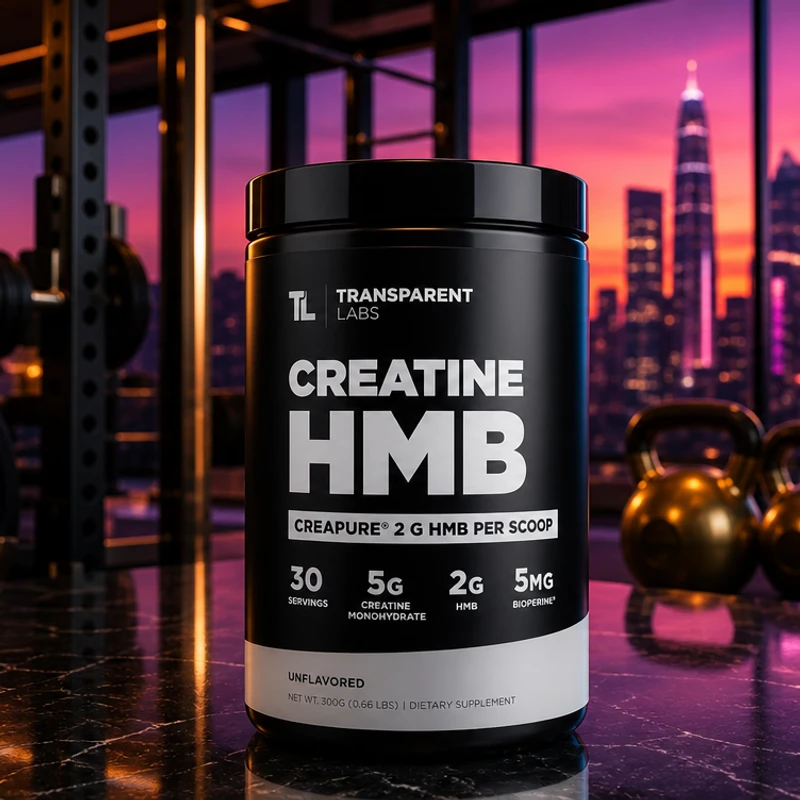
Creatine + HMB — Transparent Labs
Creapure monohydrate + 1.5 g HMB per scoop · HMB is a separate compoundSAC Product Score™ — how it breaks down- Form purity25%9.5
- Third-party testing25%9.0
- Per-serving creatine20%9.0
- Cost per active gram20%3.5
- Brand QC track record10%8.5
The creatine here is still monohydrate — HMB is a separate compound bolted on, not a creatine form. Clean product, but you're paying 7× the pure-monohydrate price for an add-on with weak evidence in trained lifters.
- Form
- Creatine monohydrate (Creapure) + 1.5 g HMB — the creatine is still monohydrate
- Evidence (creatine)
- Full 500+ RCTs — it's monohydrate
- Evidence (HMB)
- Weak in trained athletes (Wilson 2013); modest in beginners
- Per serving
- 5 g monohydrate + 1.5 g HMB
Pros- The creatine half is Creapure monohydrate — the right form
- Transparent Labs publishes per-batch COAs — best QC transparency on the list
- Reasonable single-scoop convenience if you've decided to run HMB anyway
Cons- Not a creatine 'form' — it's monohydrate plus a separate compound at a big markup
- $1.67/serving — roughly 7-10× the cost of standalone monohydrate
- HMB's evidence is minimal-to-absent in trained athletes
- Running monohydrate + protein separately beats this combo for less money
Our take — Included to make a point: this isn't a different form of creatine, it's the best form (monohydrate) with HMB bolted on. The creatine half is exactly right; the HMB add-on is the questionable part, with weak evidence in the trained lifters who'd buy a $50 combo. It's a reasonable buy only if you've independently decided to run HMB (beginner, deep cut) and want one scoop for compliance. Everyone else: buy pure monohydrate (#1) and put the $25/month into protein, which does more for muscle protein breakdown than HMB.
- #5Marketing stack (skip)
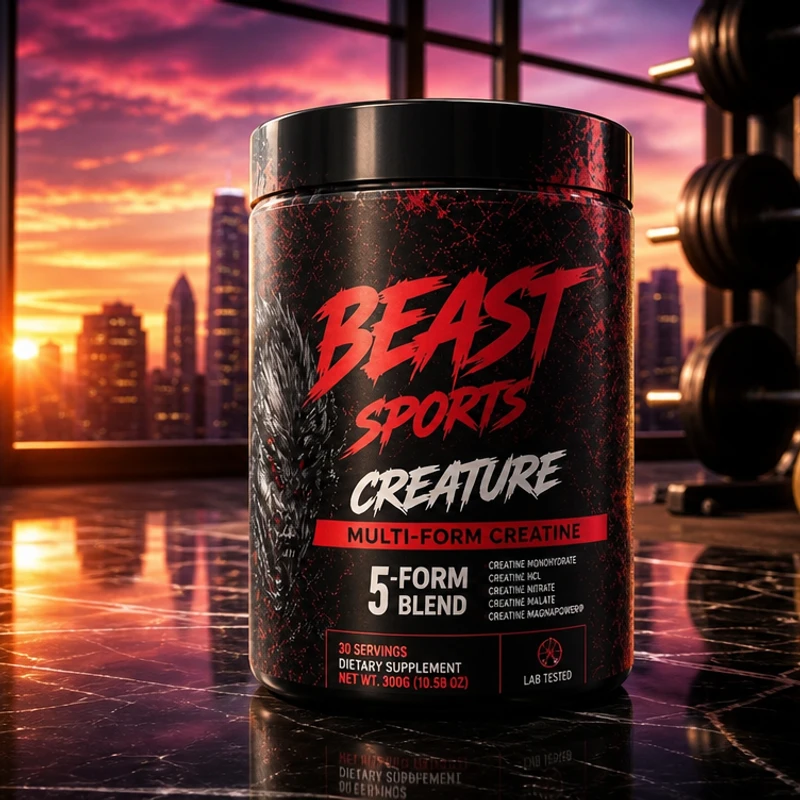
Multi-form blend — Beast Sports Creature
5-form creatine blend (monohydrate + di-creatine malate + anhydrous + buffered Crea-Trona + gluconate)SAC Product Score™ — how it breaks down- Form purity25%5.0
- Third-party testing25%6.0
- Per-serving creatine20%5.5
- Cost per active gram20%4.5
- Brand QC track record10%7.0
Pay more for forms with no monohydrate-beating evidence. Five creatine forms in one scoop sounds premium and means less of each — a sub-therapeutic dose split across forms that don't outperform plain monohydrate.
- Form
- 5-form blend — monohydrate + 4 forms with no head-to-head edge
- Evidence
- No multi-form-vs-monohydrate superiority data (Antonio 2021)
- Per serving
- 4 g blend across 5 forms (~3 g actual creatine) — bottom of the trial range
- Effective dose
- Each form ~800 mg on average — sub-therapeutic individually
Pros- Includes monohydrate as one of the five forms (the only one that matters)
- Flavored options for users who want a pre-workout-style mix
Cons- Splits a smaller total creatine dose across 5 sub-therapeutic forms
- No published evidence any blend outperforms plain monohydrate at equal doses
- Costs 2-3× more per actual gram of creatine than monohydrate (#1)
- The 'multi-form is better' premise is unsupported by the literature
Our take — The textbook marketing stack, and the clearest 'skip' on the list. Five forms of creatine reads as premium and delivers the opposite: less total creatine per scoop, every sub-form below its trial-validated dose, no efficacy advantage, and a 2-3× price premium over pure monohydrate. The blend exists to escape the fact that monohydrate is a cheap commodity — not because more forms work better. Buy 5 g of plain monohydrate (#1) instead, get more actual creatine, and save the money.

▸ Affiliate disclosure: every Amazon link uses our Associates tag (superachieverclub-20). We earn a small commission at no cost to you; it funds independent reviews. We never accept payment to change a ranking.
The best form of creatine is monohydrate — everything else is marketing
- 01
The "best form" question isn't really a contest — one form has the evidence.
Only monohydrate has a serious evidence base. The ISSN position stand (Kreider 2017), after reviewing 500+ studies, states plainly that no alternative form reliably beats it at equal doses.
- 02
The page ranks every form on the shelf on the one axis that settles it: published evidence.
Monohydrate, micronized, Creapure, HCl, buffered (Kre-Alkalyn), ethyl ester, liquid, magnesium chelate, and multi-form blends are all judged on RCTs, not marketing copy. On that axis, monohydrate wins outright.
- 03
Every recommendation tier — value, purity, drug-tested — is still monohydrate.
Best overall is Optimum Nutrition Creapure monohydrate (#1) at $0.23/serving; tightest budget is Bulk Supplements generic micronized monohydrate at $0.15/serving; maximum purity is Creapure from Thorne (NSF) or MyProtein (Informed Sport). The same molecule sits at the top of each.
- 04
If you just want the answer, it fits in one line.
Buy unflavored creatine monohydrate, ideally Creapure-licensed, at the lowest cost per gram. Everything else on the list is marketing markup on the same molecule.
ISSN position stand (Kreider 2017, PMID 28615996) and ISSN common-questions review (Antonio 2021, PMID 33557850), plus the two head-to-head RCTs on alternative forms: Jagim 2012 buffered/Kre-Alkalyn (PMID 22971354) and Spillane 2009 ethyl ester (PMID 19228401).
How we ranked the forms
We're ranking FORMS, not just products, so the criteria are weighted toward what actually distinguishes one form from another. Evidence base carries the most weight by far — a form's RCT count and the ISSN's verdict on it is the single best predictor of whether it works. Effective creatine per dollar is the economic reality check that sinks the premium forms. Solubility/tolerability is the one axis where an alternative form (HCl) can legitimately beat monohydrate, so it earns real weight. Stability separates the genuinely inferior forms (ethyl ester, liquid degrade to inert creatinine) from the merely overpriced ones. Run any form through this and monohydrate wins — which is the honest answer to the question this page is built around.
- Evidence base35%
RCT count and the ISSN position on the form. Monohydrate has 500+ trials and the gold-standard rating; HCl, chelate, and blends have no head-to-head superiority; ethyl ester and buffered have RCTs that they lost or tied; liquid has none. This criterion alone decides the ranking.
- Effective creatine per dollar25%
Total bioavailable creatine delivered divided by cost. Monohydrate wins outright at $0.05-0.20 per 5 g. HCl, combos, and multi-form blends cost 2-4× more per effective gram — sometimes for LESS total creatine per serving.
- Solubility / tolerability20%
The one axis where alternatives can legitimately differ. HCl and chelate dissolve more completely than coarse monohydrate; micronized monohydrate closes most of that gap. Relevant only for the rare user with GI sensitivity — not an efficacy factor.
- Stability20%
Does the molecule survive to muscle, or degrade to inert creatinine first? Monohydrate, micronized, Creapure, HCl, buffered, and chelate are stable. Ethyl ester degrades in the gut; pre-dissolved liquid degrades on the shelf. This is what separates 'overpriced' from 'actively inferior.'

The bottom line: monohydrate wins
- 01
Optimum Nutrition Creapure monohydrate (#1) is the default buy.
After ranking every form, the answer is the one science has given for 30 years: creatine monohydrate — 500+ RCTs, the ISSN's most-effective rating, and the cheapest. "Micronized" and "Creapure" are monohydrate optimized for mixing and purity, so they win too.
- 02
Every alternative ranks below monohydrate for a concrete reason, not a vibe.
HCl (#3) is more soluble but has no efficacy edge at equal doses — buy only if monohydrate upsets your gut. Creatine + HMB (#4) is monohydrate plus a weak-evidence compound at a 7× markup; buffered (Kre-Alkalyn) tied and ethyl ester lost in RCTs; liquid and multi-form blends (#5) are active avoids that degrade or under-dose.
- 03
Stop treating the form choice as a real decision — buy monohydrate and pocket the difference.
Anyone selling a "next-gen" creatine that isn't monohydrate is selling marketing, usually at 2-4× the price. Buy unflavored monohydrate — Creapure-licensed if budget allows, generic micronized if not — and put the savings into protein and training volume.
Every claim ranked above traces back to one of these
Peer-reviewed studies, meta-analyses and clinical trials behind the picks. Click any citation to read the abstract on PubMed.
- [1]Kreider 2017
International Society of Sports Nutrition position stand: safety and efficacy of creatine supplementation in exercise, sport, and medicine
The anchor source for the form question. After reviewing 500+ studies, the ISSN concludes creatine monohydrate is the most effective form for increasing high-intensity exercise capacity and lean mass, and states no other commercially available form has been shown to be more effective. The official scientific basis for 'monohydrate is the best form.'
- [2]Antonio 2021
Common questions and misconceptions about creatine supplementation: what does the scientific evidence really show?
Directly addresses the alternative-form marketing claims. Concludes that no alternative form (HCl, buffered, ethyl ester, magnesium chelate, etc.) has demonstrated superiority over monohydrate at equivalent total creatine doses, and that 'better absorption / less bloating / no loading' claims are not supported by head-to-head data.
- [3]Jagim 2012
A buffered form of creatine does not promote greater changes in muscle creatine content, body composition, or training adaptations than creatine monohydrate
Head-to-head RCT of buffered creatine (Kre-Alkalyn) vs monohydrate. Found no difference in muscle creatine content, body composition, or strength adaptations — directly refuting the 'pH-buffered for less breakdown' marketing claim. The buffered form matched monohydrate at best.
- [4]Spillane 2009
The effects of creatine ethyl ester supplementation combined with heavy resistance training on body composition, muscle performance, and serum and muscle creatine levels
Head-to-head RCT of creatine ethyl ester vs monohydrate. Ethyl ester did not raise muscle creatine more than monohydrate and produced higher serum creatinine — evidence it degrades to inert creatinine before reaching muscle. The form actively underperformed monohydrate.
- [5]Branch 2003
Effect of creatine supplementation on body composition and performance: a meta-analysis
Foundational meta-analysis establishing the +1.2 kg lean-mass and high-intensity performance effect of creatine (monohydrate in the underlying trials) vs placebo. Quantifies the benefit that every alternative form is implicitly claiming to beat — and none do.
More Creatine guides
Every form, format and use-case in the Creatine cluster — each ranked with the same methodology, so you can jump straight to the angle that fits you.
- Best Creatine SupplementsThe definitive creatine buying guide — the single best pick for each kind of buyer across powder, gummies, and HCl. Monohydrate powder wins on raw value; every other form is a situational upgrade for adherence, testing, or tolerance.
- Best Creatine for BrainCreatine raises brain phosphocreatine — biggest cognitive lift for vegetarians + the sleep-deprived (Rae 2003). Monohydrate at 5 g/day; ranked by Creapure purity, dose, and cognitive-trial alignment.
- Best Creatine for MenSame 10-product roster as the general creatine list, reframed for the male-lifter cohort — NSF Sport leads (federation-safe), Creapure form, tub size for bulking macros, per-scoop creatine.
- Best Creatine for Muscle GrowthTen creatine picks ranked for hypertrophy — cell volumization, satellite-cell proliferation, saturation over loading. Monohydrate is the only form with RCT weight.
- Best Creatine for WomenTen creatine picks re-scored for women: lean-mass preservation, postmenopausal bone-density support (Chilibeck 2015), cognition/mood uplift, no-loading-default, kitchen-friendly tub sizes.
- Best Creatine GummiesCreatine gummies ranked by grams-per-gummy and cost-per-real-5g-dose — most gummies under-deliver and a '3-gummy serving' usually isn't 5 g. Honest picks, including when powder still wins.
- Best Creatine MonohydrateThe most-studied supplement in sports nutrition — and 95% of buyers get it wrong by paying for fancier forms or flavored blends. Ranked by purity (Creapure), price-per-gram, and lab transparency.
- Best Supplements for Muscle GrowthThe supplement categories that actually matter for hypertrophy, each represented by our existing #1 pick — evidence-first hierarchy: training + calories + protein beat everything; creatine is the only large-effect legal supplement; the rest are honest margins.