
Glutathione: Benefits, Dosage & Side Effects (2026)
Glutathione is the cysteine-containing tripeptide your cells use as their master antioxidant and detox workhorse; oral absorption of plain reduced GSH is debated.
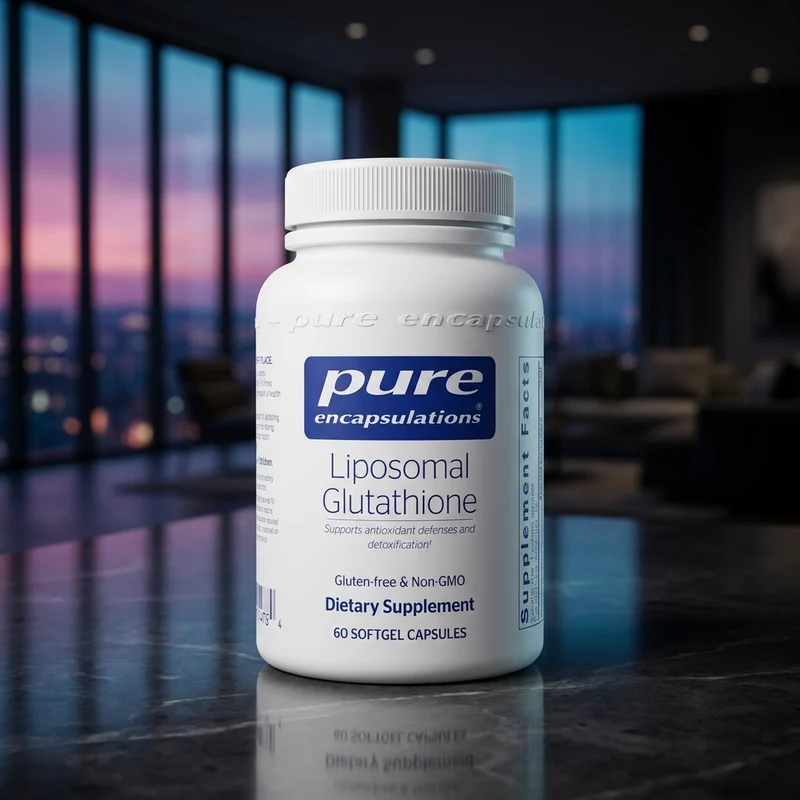
Pure Encapsulations Liposomal Glutathione
What is Glutathione?
Glutathione (GSH) is the body's master antioxidant — a small tripeptide built from three amino acids (glutamate, cysteine, and glycine) that nearly every cell makes for itself. It is the workhorse behind a huge amount of everyday cellular housekeeping: it directly neutralises free radicals and peroxides, it regenerates the 'spent' forms of vitamins C and E back into their active antioxidant states, and it is central to the liver's phase-II detoxification, where it conjugates toxins and drug metabolites so they can be safely excreted. The rate-limiting ingredient for making it is cysteine — which is exactly why the precursor NAC (N-acetylcysteine) is so often discussed alongside glutathione: NAC delivers cysteine and lets the body build its own GSH.
Here is the honest core every buyer needs, stated up front: the oral bioavailability of plain reduced glutathione is genuinely debated. Glutathione is a peptide, and the digestive tract is built to break peptides apart before they reach the bloodstream. In Witschi 1992, a single 3 g oral dose failed to raise plasma glutathione at all, and the authors called systemic availability 'negligible in man.' In Allen 2011, 500 mg a day for four weeks moved no oxidative-stress biomarkers. And yet Richie 2015 found that 250 mg and 1000 mg a day, taken for six full months, did raise the body's glutathione stores — slowly and cumulatively. The reconciling picture is that plain oral GSH can probably replete you over months at a real dose, but it is not the instant antioxidant infusion the marketing implies.
That debate is why supplemental glutathione comes in several forms, and why form matters more than brand. Liposomal glutathione wraps the molecule in a phospholipid shell to shepherd it past digestion; Sinha 2018 showed liposomal GSH raised body stores and immune markers. S-acetyl glutathione carries an acetyl group engineered to survive the gut and be cleaved off inside the cell. And clinically-referenced branded reduced glutathione — Setria, from Kyowa in Japan (its oral-grade sibling is OPITAC) — is the named raw material behind most of the better human work. These delivery strategies are the industry's direct answer to a real scientific objection, not marketing flourishes.
How it works
Inside the cell, glutathione works as a redox buffer. It cycles between a reduced form (GSH) and an oxidised form (GSSG): the reduced form donates electrons to neutralise reactive oxygen species, becomes oxidised in the process, and is then recycled back to the active reduced form by the enzyme glutathione reductase, which is why cofactors that support that recycling — such as alpha lipoic acid — are often stacked with it. This GSH:GSSG ratio is one of the body's core markers of oxidative balance. Glutathione also acts as the substrate for glutathione peroxidase (a selenium-dependent enzyme) to detoxify peroxides, and for glutathione-S-transferases in the liver to conjugate and clear toxins and drug metabolites — the phase-II detox role.
The whole reason the form question dominates is that none of this can happen if the molecule doesn't get into your cells. Oral plain GSH must first survive the gut, and the evidence that it does so meaningfully is mixed (Witschi 1992 and Allen 2011 negative on plasma and biomarkers; Richie 2015 positive on body stores over six months). Liposomal encapsulation aims to physically protect the tripeptide through digestion and improve uptake — the mechanism behind the body-store and immune-marker gains in Sinha 2018. S-acetyl glutathione aims to chemically protect it with an acetyl group cleaved intracellularly, though its human outcome evidence is thinner and largely mechanistic. And the precursor route — supplying cysteine via NAC so the body synthesises its own glutathione — sidesteps the absorption problem entirely, which is why it is the cheaper alternative many clinicians reach for first.
A note on the most-marketed claim: glutathione is widely sold, especially in some regions and via intravenous clinics, as a skin-lightening agent (it can shift melanin synthesis toward lighter pigment). SAC does not endorse or score that use. The oral evidence for skin lightening is limited and short-term, intravenous glutathione for cosmetic whitening has drawn safety warnings from regulators, and it is simply not the use case we rank these products on — we evaluate glutathione as an antioxidant, liver-support, and immune supplement.
At-a-glance facts
- What it is
- Master antioxidant tripeptide (glutamate + cysteine + glycine), made by every cell
- Studied oral dose
- 250-1000 mg/day (Richie 2015 raised body stores over 6 months)
- The honest caveat
- Plain reduced GSH oral absorption is debated (Witschi 1992, Allen 2011 negative)
- Forms, by absorption strategy
- Liposomal · S-acetyl (acetylated) · branded reduced (Setria/OPITAC, Kyowa) · plain reduced
- Time to felt effect
- Months, not days — repletion is slow and cumulative
- Cheaper alternative
- NAC (N-acetylcysteine) — the cysteine precursor your body uses to build GSH
- Recycling cofactors
- Alpha lipoic acid (regenerates GSH), selenium (glutathione peroxidase), riboflavin
- Cost range (US)
- ≈ $0.10-1.80 / serving depending on form (plain capsule cheapest, sublingual liquid priciest)
- Skin-lightening claims
- NOT endorsed or measured by SAC; oral evidence limited, IV cosmetic use carries safety warnings
Evidence: Genuinely mixed human evidence. Plain oral glutathione showed negligible plasma availability after a single dose (Witschi 1992, PMID 1362956) and no oxidative-stress biomarker change over 4 weeks (Allen 2011, PMID 21875351) — yet 250-1000 mg/day over 6 months raised body stores (Richie 2015, PMID 24791752), and liposomal GSH raised body stores plus immune markers (Sinha 2018, PMID 28853742). The takeaway: repletion appears possible but is slow, dose- and form-dependent, and not the instant antioxidant hit the marketing implies. NAC is the cheaper precursor alternative.
Who it's for — and who it isn't
- Antioxidant- and longevity-minded buyers who want to support the body's master redox system — provided they accept months-long, form-dependent expectations
- People focused on liver support and detoxification capacity, where glutathione's phase-II conjugation role is central (often stacked with milk thistle + alpha lipoic acid)
- Those targeting immune resilience — liposomal glutathione raised natural-killer and T-cell markers in Sinha 2018
- Buyers willing to choose by FORM first: liposomal or S-acetyl if they want to hedge the absorption debate, named branded reduced (Setria) if they want a verifiable single-ingredient source
- Anyone weighing glutathione against NAC and wanting the direct-GSH option rather than the cysteine-precursor route
- Anyone expecting a fast, dramatic effect — plain oral GSH raised body stores only over six months in Richie 2015, and moved no biomarkers in 4 weeks in Allen 2011
- Buyers whose only goal is skin lightening — SAC does not endorse or measure that use; oral evidence is limited and IV cosmetic use carries regulatory safety warnings
- Cost-first buyers who mainly want to raise their own glutathione — NAC (a cysteine precursor) is typically the cheaper route and worth comparing first
- People who want a guaranteed plasma 'antioxidant infusion' from a single capsule — the bioavailability of plain reduced GSH is genuinely debated, not settled
Week-by-week, what happens
- Week 1-4No reliable felt change. Allen 2011 found no oxidative-stress biomarker movement from 500 mg/day plain GSH over 4 weeks. Take consistently; choose your form deliberately.
- Month 1-3If using a delivery form (liposomal/S-acetyl) or a real daily dose, body-store repletion is underway but largely subclinical. Immune-marker shifts seen with liposomal GSH (Sinha 2018) build here.
- Month 3-6Body stores of glutathione measurably rose by 6 months at 250-1000 mg/day in Richie 2015, with the high dose lowering an oxidative-stress marker. This is the realistic horizon for plain oral GSH.
- OngoingEffects depend on continued dosing — glutathione is a maintenance supplement, not a one-time fix. Re-evaluate form and cost (vs NAC) periodically.
Safety & contraindications
- Oral glutathione is generally well tolerated in trials at 250-1000 mg/day; the most common complaints are mild and gastrointestinal. It is a naturally occurring compound the body already makes.
- Intravenous glutathione for cosmetic skin whitening is a different matter — it has drawn safety warnings from regulators (e.g. the Philippine FDA) over adverse events. SAC does not endorse cosmetic IV use.
- Liquid sublingual products may contain ethanol (e.g. some nanoliposomal liquids) — check the label if you avoid alcohol. Liposomal softgels often contain soy lecithin and gelatin (not vegan).
- Asthma caution is sometimes raised for inhaled/nebulised glutathione (not the oral capsules here); if you have asthma, discuss any nebulised form with a clinician.
- As with any supplement, talk to your doctor if pregnant, breastfeeding, on chemotherapy, or managing a chronic condition — glutathione interacts with redox and detox pathways relevant to some treatments.
- Pair-and-recycle logic: cofactors like alpha lipoic acid, selenium, and adequate protein (for cysteine) support endogenous glutathione status — sometimes a more cost-effective lever than high-dose GSH itself.
All articles on Glutathione
Best Glutathione Supplements
The 9 best glutathione supplements ranked by absorption strategy (liposomal / S-acetyl / branded Setria vs plain reduced GSH), dose, testing and value — with the genuinely debated oral bioavailability of plain reduced glutathione as the page's honest spine.
Read →Core Med Science Liposomal Glutathione Review
The higher-dose, better-value liposomal — full 500 mg Setria for less per mg.
Read →Designs for Health Liposomal Glutathione Review
A pleasant practitioner-brand liquid liposomal — for buyers who specifically want the liquid format.
Read →Double Wood S-Acetyl L-Glutathione Review
A distinct, sensible acetylated mechanism — but its own human outcome evidence is thin.
Read →Healthy Origins Setria L-Glutathione Review
The best single-ingredient glutathione — named Setria source, full dose, lowest cost-per-day.
Read →Jarrow Formulas Glutathione Reduced Review
The honest cheap entry — full 500 mg of clean reduced GSH at the lowest sticker price.
Read →NatureBell Glutathione 2,000 mg Review
2,000 mg reduced glutathione in four capsules at about $0.42 a day; no certifier listing or COA found. 7.0/10.
Read →NOW Foods Glutathione 500 mg Review
A coherent liver/detox stack — glutathione plus the cofactors that support it.
Read →Nutricost Glutathione 500 mg Review
The bulk-value champion — 240 caps at 500 mg, about a dime a day.
Read →Pure Encapsulations Liposomal Glutathione Review
The cleanest practitioner-grade liposomal — pay the premium to sidestep the absorption debate.
Read →Quicksilver Scientific Liposomal Glutathione Review
The most aggressive delivery route — sublingual liquid nanoliposomal, at the highest cost-per-mg.
Read →FAQ
Does oral glutathione actually get absorbed?
This is the central, genuinely-debated question — and the honest answer is 'partly, slowly, and it depends on the form.' Glutathione is a tripeptide the gut readily breaks down. Witschi 1992 (PMID 1362956) found a single 3 g oral dose did not raise plasma glutathione at all ('negligible' availability), and Allen 2011 (PMID 21875351) found 500 mg/day for 4 weeks moved no oxidative-stress biomarkers. But Richie 2015 (PMID 24791752) found that 250-1000 mg/day taken for six months did raise the body's glutathione stores. So plain oral GSH can probably replete you over months at a real dose — it just isn't the instant plasma spike the label implies. Liposomal forms (Sinha 2018, PMID 28853742) and S-acetyl forms exist specifically to improve on plain absorption.
Liposomal, S-acetyl, or plain reduced — which form should I buy?
Choose by how much you want to hedge the absorption debate. PLAIN REDUCED glutathione (often the named Setria material) is the cheapest and the form behind the repletion data, but carries the most-debated oral absorption — fine if you'll commit to a months-long dose. LIPOSOMAL wraps GSH in a phospholipid shell to protect it through digestion and has the best human delivery evidence (Sinha 2018) — the cleanest answer to the absorption objection, at a premium. S-ACETYL adds an acetyl group engineered for gut stability and intracellular release — a distinct mechanism, but its human outcome evidence is thinner and largely mechanistic. There's no single 'best' form for everyone; it's a price-versus-confidence trade-off.
Is NAC a cheaper alternative to glutathione?
Often, yes — and it's worth weighing before you buy. NAC (N-acetylcysteine) supplies cysteine, the rate-limiting amino acid your body needs to synthesise its own glutathione, and it absorbs well orally. Because it sidesteps the problem of getting an intact glutathione tripeptide past your gut, NAC is the precursor route many clinicians reach for first, and it's typically cheaper. The trade-off is that NAC raises glutathione indirectly (your body still has to build it) rather than supplying GSH directly. If cost is your main constraint and your goal is simply to support glutathione status, NAC belongs in your decision.
Does glutathione lighten skin?
Glutathione is widely marketed for skin lightening — especially in some regions and through intravenous clinics — because it can shift melanin synthesis toward lighter pigment. SAC does not endorse or score that use, and we rank these products as antioxidant, liver-support, and immune supplements, not whitening agents. The honest evidence position: oral skin-lightening data is limited and short-term, and intravenous glutathione for cosmetic whitening has drawn safety warnings from regulators over adverse events. If skin lightening is your goal, this is not a use we measure or recommend.
What does glutathione actually do in the body?
It's the master antioxidant and a detox workhorse. Glutathione directly neutralises free radicals and peroxides, regenerates the spent forms of vitamins C and E back to their active antioxidant states, and is central to the liver's phase-II detoxification — where it conjugates toxins and drug metabolites so they can be cleared. It cycles between a reduced (active) and oxidised (spent) form, and that GSH:GSSG ratio is one of the body's core measures of oxidative balance. The recycling enzyme is supported by cofactors like alpha lipoic acid and the selenium-dependent glutathione peroxidase system.
How long before I notice anything?
Think in months, not days. In the longest controlled trial, body stores of glutathione rose by six months at 250-1000 mg/day (Richie 2015), whereas a four-week trial of 500 mg/day saw no biomarker change (Allen 2011). Glutathione works structurally and cumulatively on your redox status, not as an acute stimulant — so judge it over a sustained period of consistent daily dosing, pick a form you'll actually keep taking, and set expectations from the evidence rather than the marketing.
Sources & further reading
- Richie 2015 (oral GSH, body stores)Randomized controlled trial of oral glutathione supplementation on body stores of glutathione
6-month RCT: oral glutathione at 250 mg/day and 1000 mg/day raised body stores of glutathione (blood, erythrocytes, plasma, lymphocytes) versus placebo, with the high dose lowering an oxidative-stress marker. The key 'repletion is possible — but slow' trial.
- Witschi 1992 (systemic availability)The systemic availability of oral glutathione
7 volunteers, single 3 g oral dose: plasma glutathione, cysteine and glutamate did not rise significantly over 270 minutes — systemic availability of oral glutathione judged 'negligible in man.' The origin of the bioavailability debate.
- Allen 2011 (oxidative-stress biomarkers)Effects of oral glutathione supplementation on systemic oxidative stress biomarkers in human volunteers
Randomized, double-blind, placebo-controlled trial: 500 mg twice daily for 4 weeks produced no significant change in oxidative-stress biomarkers or glutathione status. The short-term counterpoint to Richie 2015.
- Sinha 2018 (liposomal GSH)Oral supplementation with liposomal glutathione elevates body stores of glutathione and markers of immune function
Healthy adults: oral liposomal glutathione raised body stores of glutathione and improved immune-function markers (natural-killer and T-cell activity). The human trial that justifies the liposomal delivery premium.