
Manuka Honey: Benefits, Dosage & Side Effects (2026)
Manuka honey is a monofloral New Zealand honey whose methylglyoxal (MGO) content drives a dose-dependent antibacterial activity, graded by the UMF™ and MGO scales and best-evidenced for topical wound care.
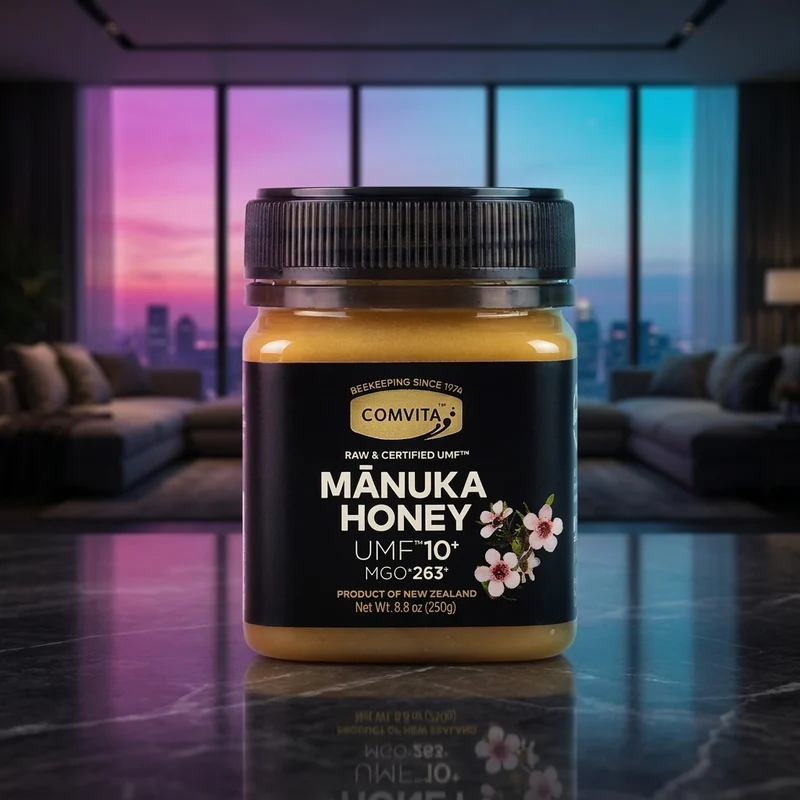
Comvita Manuka Honey UMF 10+ (MGO 263+)
What is Manuka Honey?
Manuka honey is a monofloral honey produced by bees foraging the flowers of the manuka tree (Leptospermum scoparium), which grows wild across New Zealand and parts of Australia. What separates it from ordinary honey is not floral romance but chemistry: manuka nectar is rich in dihydroxyacetone (DHA), which converts to methylglyoxal (MGO) as the honey matures. MGO is the compound responsible for manuka's distinctive non-peroxide antibacterial activity — the property that, in genuine high-grade jars, is present at concentrations 20 to 1,000 times higher than in conventional honey (Mavric 2008, PMID 18210383). That single molecule is the reason manuka commands five to ten times the price of regular raw honey, and the entire reason its grading systems exist.
Because the value lives in the MGO, buyers are sold a graded potency tier, and three labeling systems collide on the shelf. UMF™ (Unique Manuka Factor) is the independent certification run by the UMF Honey Association: it tests three markers — Leptosperin (a manuka authenticity marker), DHA, and MGO — on every batch, so it verifies both potency AND that the honey is genuinely manuka. It is the gold standard precisely because it confirms authenticity, not just strength. MGO labeling states a direct number in milligrams of methylglyoxal per kilogram; it is a precise and useful figure when third-party tested, but a brand can print an MGO number without holding UMF certification, so the number tells you potency, not who verified the honey's identity. K-Factor (KFactor) is a third thing entirely — it is Wedderspoon's OWN in-house standard, and it measures pollen purity and traceability, NOT the UMF potency panel. A 'KFactor 16' jar is not a 'UMF 16' jar; they are different scales measuring different things, and treating them as equivalent is the single most common way buyers overpay for less potency than they believe they're getting.
The practical mapping, taken from the grades printed on real listings, is: UMF 5+ ≈ MGO 83+, UMF 10+ ≈ MGO 263+, UMF 13+ ≈ MGO 400+, UMF 15+ ≈ MGO 514+, and UMF 20+ ≈ MGO 829+. UMF 5-10+ is the everyday-wellness range; 15+ is what most people mean by 'the strong stuff'; 20+ and the equivalent MGO 850+ are premium, potency-maximizing tiers. One honest framing matters above all: if you do not care about the MGO number, manuka is functionally just very expensive honey, and a good raw honey will do the breakfast-table job for a fraction of the cost. You buy manuka for verified MGO, or you don't really need to buy manuka.
How it works
Manuka's mechanism — the part that is genuinely well-evidenced — is antibacterial and largely TOPICAL. Methylglyoxal is a reactive dicarbonyl compound that damages bacterial proteins and DNA, producing a non-peroxide antibacterial activity that, unlike the hydrogen-peroxide activity of ordinary honey, is stable and not broken down by the body's catalase enzyme. Adams 2009 (PMID 18194804) isolated and characterised this bioactive fraction and confirmed that the activity arises from MGO formed out of the nectar's dihydroxyacetone — which is why genuine manuka potency develops from the honey's own chemistry rather than being added, and why UMF certification tests for both DHA and MGO. The effect is dose-dependent: higher MGO means more antibacterial activity, which is the rational basis for grading and for paying more for a higher number.
Where that mechanism is actually proven to matter clinically is wound and burn care. A Cochrane systematic review (Jull 2015, PMID 25742878) of 26 trials and over 3,000 participants found that topical honey may shorten healing time in partial-thickness burns and in some post-operative infected wounds compared with certain conventional dressings, though evidence for other wound types was of low certainty. Medical-grade manuka is used in licensed wound dressings for exactly this reason. This is the science that earns manuka its premium — and notice that it is topical application to broken skin, not a spoonful swallowed.
The oral story — the throat, immune-support, and gut-soothing benefits that most people actually buy a jar for — is where honesty is required. These uses are traditional and supportive rather than clinically established. A spoonful of manuka in warm water or tea is a soothing, time-honoured ritual that coats and comforts an irritated throat, and the in-vitro antibacterial activity of MGO is real in a petri dish; but that does not translate into proven, dose-defined treatment of colds, immune outcomes, or gut conditions when eaten, and digestion may degrade some of the activity. The defensible position: manuka is a premium honey with a real, MGO-driven antibacterial mechanism whose best evidence is topical, plus a long tradition of soothing oral use. Buy it for the verified grade and the ritual; do not buy it as a medicine you eat.
At-a-glance facts
- What makes it special
- Methylglyoxal (MGO) — the antibacterial compound, 20-1000× higher than ordinary honey (Mavric 2008)
- Two real grading systems
- UMF™ (independent, tests Leptosperin+DHA+MGO) · MGO number (direct mg/kg)
- NOT a grade
- K-Factor — Wedderspoon's in-house pollen-purity/traceability standard, NOT the UMF potency panel
- UMF↔MGO mapping
- UMF 5+≈MGO 83+ · 10+≈263+ · 13+≈400+ · 15+≈514+ · 20+≈829+
- Strongest evidence
- TOPICAL wound/burn care (Jull 2015 Cochrane) — not eaten
- Oral use status
- Throat/immune/gut benefits are traditional + supportive, not clinical promises
- Daily use
- ~1 teaspoon by spoon or in tea/yogurt; ~35 servings per 250 g jar
- Cost range (US)
- ~$2.20/oz (entry UMF 5+) to ~$9/oz (MGO 850+) — buy by cost-per-oz at grade
- Origin
- New Zealand (Leptospermum scoparium); imports into NZ are illegal, so true NZ traceability is verifiable
Evidence: The antibacterial MECHANISM is well-established: Mavric 2008 (PMID 18210383) identified MGO as manuka's dominant antibacterial constituent and Adams 2009 (PMID 18194804) traced it to the nectar's DHA, with a dose-dependent effect that justifies grading. The TOPICAL wound-care use has genuine (if mixed-certainty) trial support — Jull 2015 Cochrane (PMID 25742878) found honey may speed healing of burns and some infected wounds. But the ORAL immune/throat/gut claims that drive most retail purchases are traditional and supportive, not clinically proven — hence an honest evidenceLevel of 2 for the way buyers actually use it.
Who it's for — and who it isn't
- Anyone who wants a premium honey with a real, measurable antibacterial story — and is willing to pay for verified MGO/UMF grade
- People who use honey topically for minor wounds, irritation, or as part of skincare — manuka's best-evidenced use is topical (Jull 2015 Cochrane)
- Those who want a soothing throat-and-comfort ritual during cold season — a traditional, supportive use, not a clinical cure
- Buyers who value third-party certification and full New Zealand traceability and will read a UMF/MGO label correctly
- Anyone trading up from ordinary honey specifically because they care about the methylglyoxal potency tier
- Anyone who doesn't care about MGO — at that point manuka is just very expensive honey, and a great raw honey does the same job for far less
- People expecting an eaten jar to treat colds, immune conditions, or gut disease — oral health claims are traditional/supportive, not clinically proven
- Diabetics and anyone managing blood sugar — manuka is still ~80% sugar; the grade doesn't change its glycemic load
- Infants under 12 months — like all honey, manuka carries a botulism-spore risk and must never be given to babies
- Bargain hunters confusing K-Factor with UMF — KFactor 16 is not UMF 16, and an MGO number alone is not UMF certification
Week-by-week, what happens
- Topical (wounds/burns)Where the real evidence sits — applied to partial-thickness burns or infected wounds under appropriate care, honey may shorten healing time versus some conventional dressings (Jull 2015). This is application to skin, not a spoonful.
- Throat / immediateEaten by the spoon or in warm water, manuka coats and soothes an irritated throat right away — a traditional comfort effect, real as a ritual rather than a proven antimicrobial treatment.
- Daily / ongoingAs a premium honey in tea, yogurt, or on toast, it's a pleasant high-MGO upgrade over ordinary honey. There is no defined 'course' that produces a measured immune outcome — treat ongoing oral use as supportive, not therapeutic.
- If you don't care about MGONo timeline applies — at that point you're paying a large premium for honey, and an ordinary raw honey delivers the same culinary and sweetening result.
Safety & contraindications
- NEVER give honey of any kind — including manuka — to infants under 12 months. Honey can contain Clostridium botulinum spores that cause infant botulism. This is the single most important safety rule.
- Manuka is still honey: roughly 80% sugar. It raises blood glucose like other honeys and the UMF/MGO grade does not change that — diabetics and anyone managing blood sugar should treat it as sugar, not medicine.
- Oral health claims (immune, throat, gut) are traditional and supportive, not clinically proven. Do not substitute manuka for medical treatment of an infection, illness, or wound that needs professional care.
- For topical wound use, the evidence base is specifically for medical-grade / sterilised manuka products; using table honey on a serious wound is not the same as a licensed manuka dressing. See a clinician for anything beyond a minor graze.
- Genuine manuka is one of the most adulterated and counterfeited honeys in the world. Buy UMF-certified or third-party MGO-tested jars with New Zealand traceability; an MGO number alone, or a K-Factor label, is not UMF certification.
- People with a known honey or bee-product allergy should avoid it. Rarely, high consumption can cause digestive upset; moderate intake (a teaspoon or two daily) is well tolerated by most adults.
All articles on Manuka Honey
Best Manuka Honey
The 7 best manuka honeys ranked by certified UMF/MGO grade, New Zealand origin & licensing, labeling honesty (K-Factor is NOT UMF) and value per ounce at grade — with the honest note that manuka's strongest evidence is topical/antibacterial, not oral immune claims.
Read →Comvita Manuka Honey UMF 10+ (MGO 263+) Review
The certified daily default — genuine UMF 10+ at the best per-ounce price.
Read →Comvita Manuka Honey UMF 5+ (MGO 83+) Review
The cheapest genuinely UMF-certified jar — the honest, rational entry into real manuka.
Read →Kiva Raw Manuka Honey UMF 15+ / MGO 514+ Review
The certified 15+ to grab on its deal — same grade as pricier rivals, cheapest when promoted.
Read →Manuka Health UMF 13+ / MGO 400+ Manuka Honey Review
An exact MGO number ON a UMF-certified jar — the cleanest of both worlds.
Read →Manukora Raw Mānuka Honey MGO 850+ Review
The potency splurge — the strongest jar here, for buyers who want the MGO number.
Read →New Zealand Honey Co. Raw Manuka Honey UMF 15+ / MGO 514+ Review
The certified UMF 15+ to buy at list — concentrated potency, best 15+ value, real traceability.
Read →Wedderspoon Raw Monofloral Mānuka Honey KFactor 16 (150+ MGO) Review
A genuine affordable everyday manuka — but K-Factor isn't UMF, and 150+ MGO is below UMF 10+.
Read →FAQ
UMF vs MGO vs K-Factor — what's the difference?
They are three different things and the distinction is the whole game. UMF™ (Unique Manuka Factor) is an INDEPENDENT certification from the UMF Honey Association that tests three markers — Leptosperin, DHA, and MGO — on every batch, so it verifies both potency AND authenticity. It's the gold standard. MGO is a direct number (milligrams of methylglyoxal per kilogram) printed on the jar; it's a precise, useful potency figure when third-party tested, but a brand can state an MGO number WITHOUT holding UMF certification — so it tells you strength, not who verified the honey's identity. K-Factor (KFactor) is Wedderspoon's OWN in-house standard that measures pollen purity and traceability, NOT the UMF potency panel — it is NOT a UMF grade. The mapping between UMF and MGO (from real labels) is UMF 5+≈MGO 83+, 10+≈263+, 13+≈400+, 15+≈514+, 20+≈829+. Bottom line: UMF certification is the strongest signal; a tested MGO number is fine; KFactor 16 is not UMF 16.
Is UMF worth paying for?
If you're buying manuka for its antibacterial potency at all, yes — UMF is the certification that makes the number trustworthy. Because UMF tests Leptosperin, DHA, and MGO on every batch through an independent association, it confirms the honey is genuinely manuka AND that the grade is real, in a category that is heavily adulterated and counterfeited. A third-party-tested MGO number is also legitimate and can be a good buy (Manukora's MGO 850+, for example, is independently verified). What you should NOT do is pay UMF-level prices for a label that only implies certification — an MGO number without UMF, or a K-Factor jar, is not the same assurance. And if you don't care about the potency number, no grade is 'worth it,' because then you're just buying expensive honey.
Does eating manuka honey actually boost immunity or cure a cold?
Be skeptical of strong oral claims. Manuka's well-evidenced benefit is TOPICAL: methylglyoxal gives it a real, dose-dependent antibacterial activity (Mavric 2008, Adams 2008), and a Cochrane review (Jull 2015) found topical honey may speed healing of burns and some infected wounds. The throat, immune, and gut benefits people buy a jar for are TRADITIONAL and supportive, not clinically proven — a spoonful in warm water genuinely soothes an irritated throat as a comfort ritual, but that's not the same as a proven cure for colds or a measured immune boost when swallowed. Buy manuka for the verified grade and the soothing ritual; don't treat the jar as medicine you eat in place of real care.
What UMF or MGO grade should I actually buy?
Match the grade to the goal, then buy on cost-per-ounce at that grade. For everyday wellness and a soothing daily spoonful, UMF 5-10+ (MGO 83-263+) is plenty — Comvita UMF 10+ is the sweet-spot daily jar, and UMF 5+ is the honest, cheapest way into real certification. For concentrated 'I feel something coming on' use, step up to certified UMF 15+ (MGO 514+). UMF 20+ / MGO 850+ is a premium potency-maximizer tier that most people don't need for daily use. Higher grades cost dramatically more per ounce, so don't buy a 20+ to sweeten tea — that's wasted potency. The grade ladder is about how much antibacterial strength you're paying for, not about quality per se.
If I don't care about the antibacterial grade, is manuka worth buying?
Honestly, no — at that point manuka is just very expensive honey. The entire premium over ordinary raw honey is justified by methylglyoxal content and the antibacterial activity it drives. If you're not buying for MGO — if you just want something nice on toast or in tea — a high-quality raw honey delivers the same culinary result for a fraction of the price (manuka runs 2-10× more per ounce). Manuka does have a pleasant, complex, herbaceous flavour some people prefer, so a taste preference is a legitimate reason. But 'it's healthier honey' only holds up if you actually care about, and verify, the MGO grade you're paying for.
Sources & further reading
- Mavric 2008 (MGO is the active)Identification and quantification of methylglyoxal as the dominant antibacterial constituent of Manuka (Leptospermum scoparium) honeys from New Zealand
Identified methylglyoxal (MGO) as the dominant antibacterial constituent of NZ manuka honey, present at concentrations 20-1000× higher than in conventional honeys, with a direct correlation between MGO content and non-peroxide antibacterial activity. The foundational paper behind MGO grading and the reason the MGO number is the meaningful potency metric.
- Adams 2008 (DHA→MGO mechanism)Isolation by HPLC and characterisation of the bioactive fraction of New Zealand manuka (Leptospermum scoparium) honey
Showed manuka's non-peroxide antibacterial activity arises from methylglyoxal, which forms from dihydroxyacetone (DHA) present in manuka nectar as the honey matures. Explains the DHA→MGO conversion that underpins UMF certification testing both markers — genuine potency develops from the nectar's own chemistry.
- Jull 2015 (Cochrane, topical wounds)Honey as a topical treatment for wounds
Systematic review of 26 trials (3,011 participants): topical honey may shorten healing time in partial-thickness burns and some post-operative infected wounds versus certain conventional dressings, with low-certainty evidence for other wound types. The basis for manuka's best-supported (TOPICAL) use — distinct from the traditional, unproven oral immune claims.