
Kiva Raw Manuka Honey UMF 15+ / MGO 514+ Review
 #4 of 7 · Best certified-15+ deal
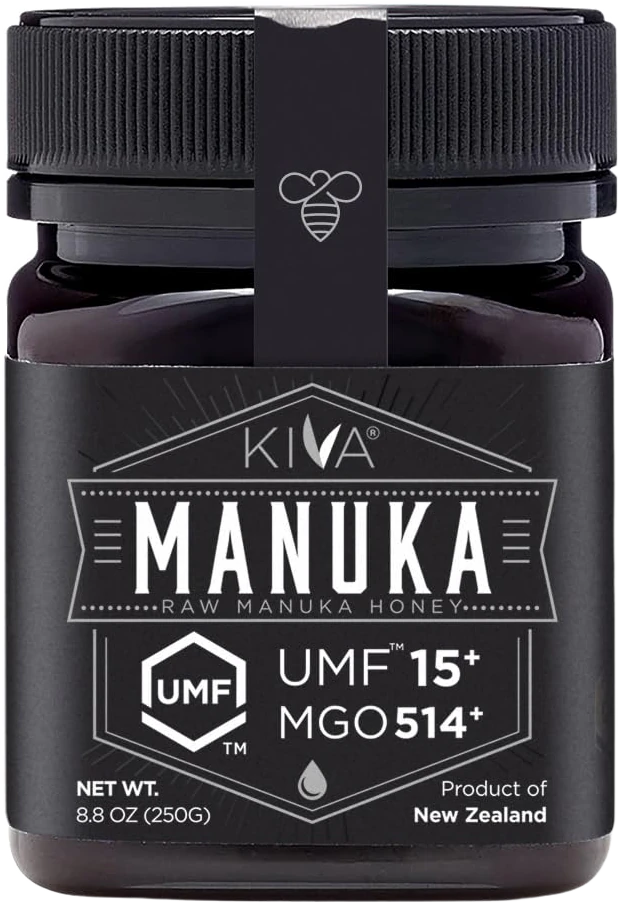
Real retailer photo, cut out. Label unedited.
Buy it. The certified 15+ to grab on its deal — same grade as pricier rivals, cheapest when promoted. Kiva is a genuine certified UMF 15+ / MGO 514+ — full UMFHA quality mark, batch-tested for MGO, Leptosperin, DHA and HMF, QR-verified per jar — from a smaller brand that discounts aggressively.
$40 / 8.8 oz jar (frequently discounted to ~$32)~$3.65/oz at UMF 15+ when on sale (~$4.55/oz at list)
Why It Scores 8.9 — And The Label Line Behind Each Number
UMF/MGO grade verification
30% of scoreFull UMF Honey Association quality mark at certified UMF 15+ / MGO 514+, with every batch independently tested for the signature compounds (MGO, Leptosperin, DHA, HMF) and QR verification per jar. Genuine, thorough verification of the concentrated potency tier — the same certified 15+ grade as pricier rivals. Just shy of perfect because, like #2, the listing leads with the UMF/MGO grade rather than itemising each marker result, but the certification is unquestionably real.
- Grade
- Certified UMF 15+ / MGO 514+
Origin & licensing (NZ, traceability)
25% of scoreGenuine New Zealand origin (imports into NZ are illegal, so it's verifiable), monofloral, with a QR code per jar for origin and authenticity. Solid provenance and traceability. Held below the top tier because Kiva is a smaller brand with thin physical-retail presence and less of a documented multi-decade supply-chain story than the pioneer names — the chain is real and QR-verifiable, just less established and famous.
- Origin
- New Zealand · monofloral · QR code per jar
Independent testing & labeling honesty
20% of scoreAmong the most thorough testing in the lineup: every batch independently tested for MGO, Leptosperin, DHA, AND HMF (a freshness/overheating marker most listings don't mention), earning the UMFHA quality mark, with clean UMF 15+ / MGO 514+ labeling and per-jar QR verification. No K-Factor confusion, no implied-but-absent certification. The buyer knows exactly what's verified — transparent and comprehensive.
- Certification
- UMFHA quality mark · every batch tested for MGO, Leptosperin, DHA, HMF
Value per ounce at grade
15% of scoreThe defining swing axis. On its frequent ~$32 promotion, Kiva works out to ~$3.65/oz — the cheapest certified 15+ on the entire list, beating every same-grade rival. At its ~$42 list price, though, it's ~$4.55/oz, above New Zealand Honey Co.'s 15+ (~$4.40/oz, #2). Scored as a strong-but-conditional value: outstanding on deal, merely fair at list, so the per-ounce verdict depends entirely on whether the promo is live.
- Jar
- 250 g (8.8 oz) · ~35 teaspoon servings
- Price
- ~$40 list (often ~$32 on deal) = ~$3.65/oz on deal, ~$4.55/oz at list — certified UMF 15+
Taste & daily use
10% of scoreGenuine UMF 15+ intensity — thick and herbaceous as concentrated manuka is, a touch polarizing for newcomers but characteristic of the real grade. Versatility is a plus: the listing positions it for spoonfuls, smoothies, or topical use, the last of which aligns with manuka's strongest (topical) evidence. A solid daily-use experience, marked slightly below the milder daily-grade jars purely on the concentrated flavour's accessibility.
- More Specs
- Type
- Raw
- Best for
- Concentrated certified-15+ potency at the lowest price — when the promo is live
- Evidence note
- MGO antibacterial mechanism (Mavric 2008); topical wound care (Jull 2015). Oral immune use = traditional/supportive
Marketing Claims Vs. Reality
Certified UMF 15+ / MGO 514+ with the UMFHA quality mark.
Kiva carries the full UMF Honey Association quality mark at UMF 15+ / MGO 514+, with every batch independently tested for MGO, Leptosperin, DHA, and HMF and QR verification per jar. UMF 15+ maps to MGO 514+ per these listings. This is genuine, thorough certification of the concentrated potency tier — the same certified 15+ grade as pricier rivals.
Cheapest certified UMF 15+ per ounce.
True specifically on its frequent ~$32 promotion, where it works out to ~$3.65/oz — the lowest certified 15+ per ounce on the list. At its ~$42 list price it's ~$4.55/oz, above New Zealand Honey Co.'s 15+ (#2). So the claim holds on deal but not at list; framed honestly, Kiva is the cheapest 15+ when promoted, which is often.
Every batch independently tested for signature compounds.
The listing states batch-level independent testing for MGO, Leptosperin, DHA, and HMF — a thorough panel that verifies potency, authenticity, precursor chemistry, and freshness. Combined with the UMFHA quality mark and per-jar QR code, the independent-testing claim is accurate and among the most comprehensive in the lineup.
Supports immune health; suitable for topical use.
Honest framing required. The topical positioning actually aligns with manuka's strongest evidence — MGO-driven antibacterial activity is best documented for wound/burn care (Jull 2015 Cochrane). The oral immune claim is the weaker half: supportive and traditional, not clinically proven. Accurate for topical antibacterial use (with the caveat that wound-care evidence is for medical-grade products) and as a soothing oral ritual; overstated if read as proven immune therapy you eat.
Genuine raw, monofloral New Zealand manuka.
The listing states raw, monofloral, New Zealand origin with QR verification per jar. As genuine NZ provenance (honey imports into NZ are illegal) backed by the UMFHA quality mark, these are accurate product descriptors — the honey is the real article at a certified concentrated grade.
What Our Test Actually Found
Same certified 15+ grade as the pricier jars — just from a discounting brand
The core value proposition: Kiva's UMF 15+ / MGO 514+ is the identical certified potency tier as New Zealand Honey Co. (#2), with arguably more thorough batch testing (it adds HMF freshness testing to the usual MGO/Leptosperin/DHA panel). You're not trading down on grade to save money — you're buying the same certified 15+ from a smaller brand whose business model is aggressive discounting. The honey is genuine concentrated manuka; the only difference from the famous names is the price tag and the shelf presence.
The buying rule is purely about the promo
Kiva's score and value hinge on one thing: is the deal live? At its frequent ~$32 promotion it's ~$3.65/oz, the cheapest certified 15+ on the entire list. At its ~$42 list price it's ~$4.55/oz, which is more than New Zealand Honey Co.'s 15+ (#2). So there's no ambiguity in the buying decision — if Kiva is on its deal, buy Kiva; if it's at full list, buy #2. Both are genuinely certified 15+, so you just take whichever is cheaper at the moment, and Kiva's deal price is often the lowest going.
The testing panel is unusually thorough
Kiva tests every batch for four markers — MGO, Leptosperin, DHA, and HMF — which is more comprehensive than most listings disclose. The HMF addition matters: it's a freshness and overheating indicator, so testing it confirms the honey wasn't degraded by heat or age. Together with the UMFHA quality mark and per-jar QR code, that's a genuinely well-verified certified 15+. For a smaller brand, the verification rigor is a real reassurance that you're getting authentic, fresh, concentrated manuka.
Smaller brand, but trust comes from certification not shelf space
Kiva's main downside is brand footprint: it's mostly an online purchase with thin physical-retail presence, so you won't grab it off a supermarket shelf like Comvita or Wedderspoon. But in manuka, trust is built on certification and testing, not ubiquity — and Kiva's UMFHA quality mark, four-marker batch testing, and QR verification cover exactly that. The smaller-brand note is about convenience and recognition, not quality. You're buying a genuinely certified 15+; you're just doing it online from a less famous name.
Topical use is the honest sweet spot for manuka's evidence
Notably, Kiva's listing positions the honey for topical use alongside eating it — and topical is where manuka's evidence is actually strongest. The MGO-driven antibacterial activity is best documented for wound and burn care (Jull 2015 Cochrane), so applying it to minor skin irritation is more aligned with the real science than the oral immune claims. The caveat: that evidence is for medical-grade/sterilised products, so table honey isn't a substitute for a licensed dressing on a serious wound — see a clinician for anything beyond a minor graze.
Full analysis: all pros & cons (8), buy if / skip if
- Genuine certified UMF 15+ / MGO 514+ — full UMFHA quality mark, the same concentrated grade as pricier rivals
- Cheapest certified 15+ on the list when its frequent ~$32 promotion is live (~$3.65/oz)
- Unusually thorough batch testing — MGO, Leptosperin, DHA, AND HMF (freshness) — with QR verification per jar
- Versatile positioning including topical use, which aligns with manuka's strongest (topical) evidence
- Clean UMF/MGO labeling with no K-Factor or implied-certification confusion
- At its ~$42 list price the per-ounce cost rises above New Zealand Honey Co.'s 15+ (#2) — only a deal-time winner
- Smaller brand with thin physical-retail presence — mostly an online purchase
- Oral immune benefit is traditional and supportive, not clinically proven — buy it for concentrated potency and topical use
- Kiva is currently on its ~$32 promo — at that price it's the cheapest certified 15+ on the list (~$3.65/oz)
- You want concentrated, genuinely certified potency — full UMFHA quality mark at UMF 15+ / MGO 514+
- You value thorough batch testing (MGO, Leptosperin, DHA, HMF) and QR verification per jar
- You're comfortable buying online from a smaller brand to get the best 15+ price
- Kiva is at its ~$42 list price — New Zealand Honey Co.'s 15+ (#2) is cheaper per ounce at list
- You only want an everyday daily jar — a certified UMF 10+ (Comvita, #1) is plenty and cheaper
- You want a famous shelf brand — Kiva is mostly an online purchase with thin retail presence
Kiva is a genuine certified UMF 15+ / MGO 514+ — full UMFHA quality mark, batch-tested for MGO, Leptosperin, DHA and HMF, QR-verified per jar — from a smaller brand that discounts aggressively. At its frequent ~$32 promo it's the cheapest certified 15+ here (~$3.65/oz); at ~$42 list it costs more per ounce than New Zealand Honey Co. (#2). The rule: buy Kiva on its deal, buy #2 at list. Buy it for concentrated, verified MGO potency; oral immune use is a traditional ritual, not clinical.
Kiva UMF 15+ is the certified 15+ you buy on a deal. The grade and certification are the real thing — full UMF Honey Association quality mark at UMF 15+ / MGO 514+, every batch independently tested for the signature compounds (MGO, Leptosperin, DHA, HMF), with a QR code per jar for verification. So you're getting genuine concentrated potency, the same tier as pricier rivals, not a number on a label. The catch is the price swing. At its ~$42 list price, Kiva costs more per ounce than New Zealand Honey Co.'s 15+ (#2); but at its frequent ~$32 promotion it drops to ~$3.65/oz — the cheapest certified 15+ on the list. The play is simple: buy Kiva when its deal is live, buy #2 at list. As always, hold honest expectations: manuka's antibacterial evidence is topical (Mavric 2008, Adams 2008; Jull 2015 Cochrane), so the oral throat-and-immune use is a traditional, soothing ritual, not a clinical promise. Here's the full breakdown.
The certified 15+ to grab on its deal — best 15+ value when the promo is live.

Kiva UMF 15+ is the deal-hunter's certified 15+, and a genuinely smart buy at the right moment. The grade and certification are the real thing — full UMFHA quality mark at UMF 15+ / MGO 514+, with unusually thorough batch testing (MGO, Leptosperin, DHA, and HMF) and QR verification per jar — so you're getting authentic concentrated potency, the same tier as pricier rivals, from a smaller brand that discounts hard. The whole decision comes down to timing. On its frequent ~$32 promotion, Kiva is the cheapest certified 15+ on the entire list (~$3.65/oz) and the clear buy. At its ~$42 list price, it's ~$4.55/oz — above New Zealand Honey Co.'s 15+ (#2) — so at full price you should buy #2 instead. There's no downside to the brand being smaller; trust in manuka comes from certification, not shelf space, and Kiva's verification is comprehensive. So: grab Kiva when its deal is live, buy #2 at list, and for everyday use buy a certified 10+ (#1). Buy it for concentrated, verified potency and topical use, and keep oral immune expectations honest — manuka's real antibacterial evidence is topical, and a spoonful is a soothing ritual.
If This Doesn’t Fit — Try These
 02
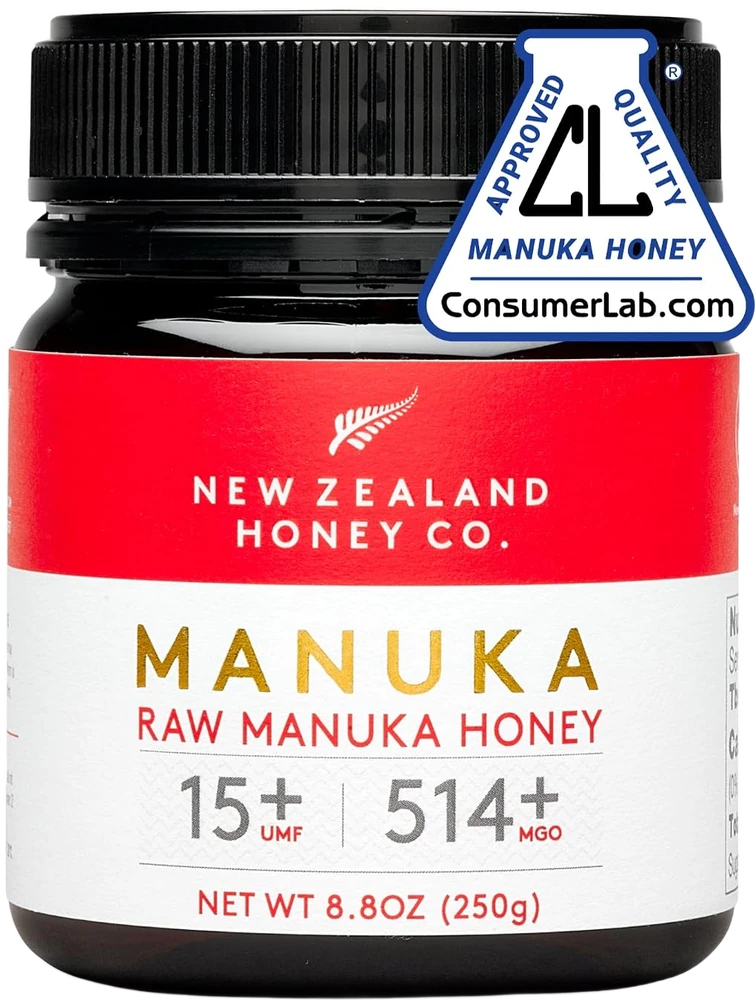
02New Zealand Honey Co. UMF 15+
This is the pick when you want real, concentrated potency without overpaying for it.
 01
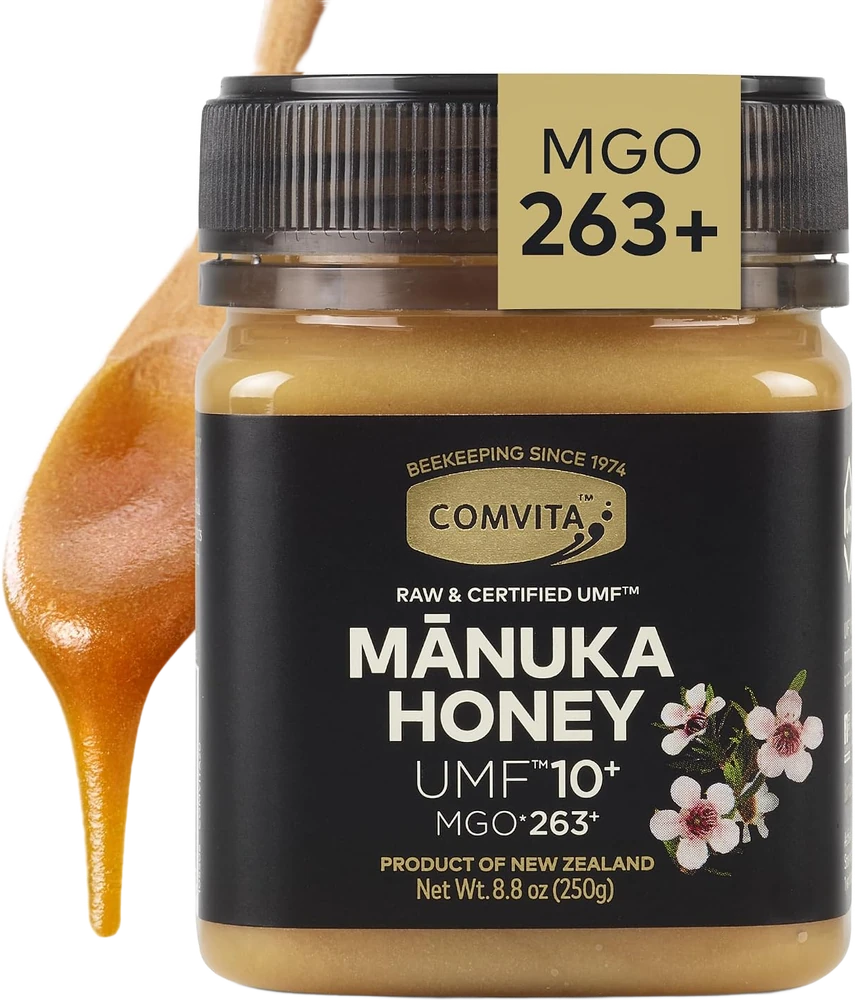
01Comvita Manuka Honey UMF 10+
If you want one jar of genuine, independently certified manuka and you don't want to study the category, this is it.
04Kiva Manuka Honey UMF 15+
Kiva is the certified 15+ you buy on a deal.
Quick Answers
Is Kiva's UMF 15+ the same grade as the pricier 15+ jars?
Yes — identical certified grade. Kiva's jar carries the full UMF Honey Association quality mark at UMF 15+ / MGO 514+, with every batch independently tested for the signature compounds (MGO, Leptosperin, DHA, and HMF) and a QR code per jar for verification. That's the same certified potency tier as New Zealand Honey Co. (#2) and the same MGO 514+ figure. You are not buying a lesser grade to get a lower price; you're buying the same certified 15+ from a smaller brand that discounts aggressively. The honey itself is genuine concentrated manuka either way.
When is Kiva actually the cheapest 15+, and when isn't it?
It's the cheapest certified 15+ when its frequent ~$32 promotion is live — at that price it works out to roughly $3.65/oz, undercutting every certified 15+ on the list. At its ~$42 list price, though, the per-ounce cost (~$4.55/oz) rises above New Zealand Honey Co.'s 15+ (~$4.40/oz, #2). So the rule is clean: if Kiva is on its deal right now, buy Kiva; if it's at full list, buy #2 instead. Both are genuinely certified 15+ jars, so you're simply taking whichever is cheaper at the moment — and Kiva's whole appeal is that its deal price is often the lowest available.
What are the 'signature compounds' Kiva tests for?
Kiva states each batch is independently tested for MGO, Leptosperin, DHA, and HMF. MGO (methylglyoxal) is the antibacterial potency marker; Leptosperin is a manuka-authenticity marker that's hard to fake; DHA (dihydroxyacetone) is the nectar precursor that converts to MGO; and HMF (hydroxymethylfurfural) is a freshness/overheating indicator — high HMF suggests the honey was overheated or old. Testing all four is thorough: it verifies potency, authenticity, the precursor chemistry, and freshness. Combined with the UMFHA quality mark and per-jar QR code, that's a genuinely well-verified certified 15+.
Is Kiva a trustworthy brand if it's smaller and mostly online?
On the verification that matters, yes. Kiva is a smaller brand with thin physical-retail presence — it's mostly an online purchase, and you won't find it on every supermarket shelf like Comvita or Wedderspoon. But trust in manuka comes from certification and testing, not shelf ubiquity, and Kiva carries the full UMFHA quality mark with batch-level independent testing and QR verification per jar. So the smaller footprint is a convenience and brand-recognition note, not a quality concern. You're getting a genuinely certified 15+; you're just buying it online from a less famous name.
Can I use Kiva manuka topically, or just eat it?
The listing positions it for spoonfuls, smoothies, OR topical use — and topical is actually where manuka's evidence is strongest. The MGO-driven antibacterial activity is best documented for wound and burn care (Jull 2015 Cochrane), so applying manuka to minor skin irritation is consistent with the real science, more so than the oral immune claims. That said, the wound-care evidence is specifically for medical-grade/sterilised manuka products — table honey on a serious wound is not the same as a licensed dressing, so see a clinician for anything beyond a minor graze. For eating, treat it as a soothing traditional ritual and a premium honey.
Sources & Further Reading
3 peer-reviewed sources, each linked to PubMed
- [1] Mavric 2008 PMID 18210383 — Identification and quantification of methylglyoxal as the dominant antibacterial constituent of Manuka (Leptospermum scoparium) honeys from New Zealand. Identified methylglyoxal (MGO) as manuka's dominant antibacterial constituent, 20-1000× higher than ordinary honey, correlating directly with antibacterial activity. The basis for grading — and why Kiva's certified UMF 15+ (MGO 514+) is a real concentrated potency tier.
- [2] Adams 2008 PMID 18194804 — Isolation by HPLC and characterisation of the bioactive fraction of New Zealand manuka (Leptospermum scoparium) honey. Showed manuka's non-peroxide antibacterial activity arises from MGO formed from the nectar's dihydroxyacetone (DHA) — among the markers Kiva tests on every batch, underpinning its verified UMF 15+ grade.
- [3] Jull 2015 (Cochrane) PMID 25742878 — Honey as a topical treatment for wounds. 26 trials (3,011 participants): topical honey may shorten healing of burns and some infected wounds. Supports Kiva's topical positioning as manuka's best-evidenced use — distinct from the traditional oral immune claims, and noting the evidence is for medical-grade products.
Affiliate disclosure: every Amazon link uses our Associates tag (superachieverclub-20). We earn a small commission at no cost to you; it funds independent reviews. We never accept payment to change a ranking.