
Wedderspoon Raw Monofloral Mānuka Honey KFactor 16 (150+ MGO) Review
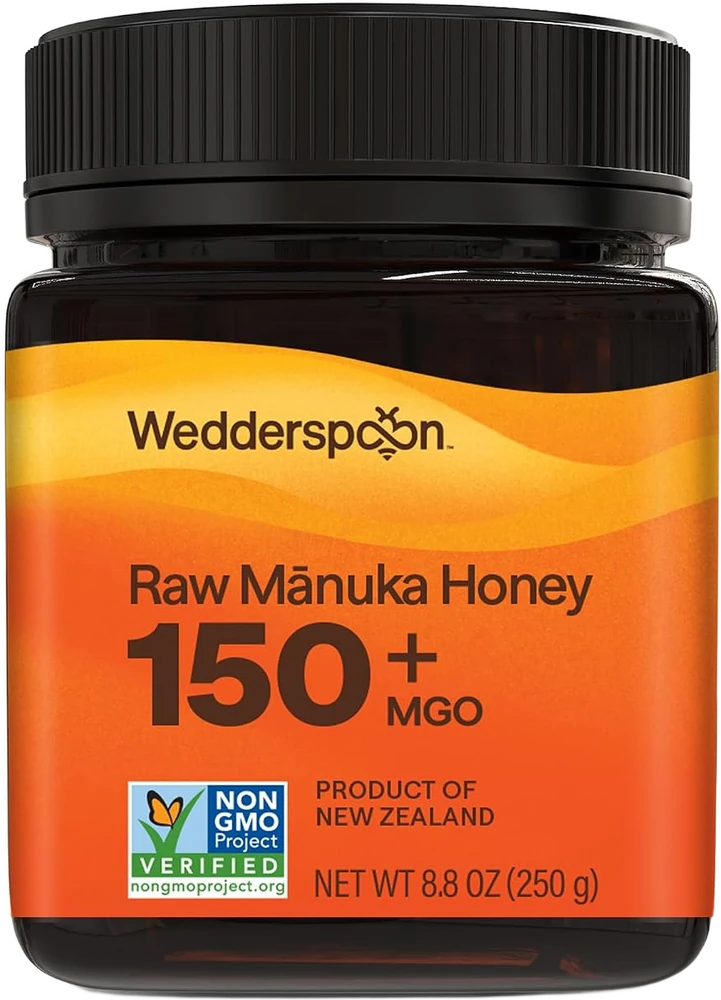 #7 of 7 · Best grocery-store pick
Real retailer photo, cut out. Label unedited.
Consider it. A genuine affordable everyday manuka — but K-Factor isn't UMF, and 150+ MGO is below UMF 10+. Wedderspoon is a real raw, monofloral NZ manuka at a friendly ~$3.20/oz, widely available, now honestly disclosing 150+ MGO.
$28 / 8.8 oz jar (~35 servings)~$3.20 / oz (potency below UMF 10+)
Why It Scores 7.4 — And The Label Line Behind Each Number
UMF/MGO grade verification
30% of scoreThe honest weak axis, and the reason this jar ranks below the certified picks. KFactor 16 is Wedderspoon's in-house standard for pollen purity and traceability — it is NOT a UMF potency certification and not an independent potency grade. The newly-disclosed 150+ MGO is a real, comparable potency figure (a genuine improvement), but it sits below the everyday UMF 10+ threshold (MGO 263+) and there's no UMFHA certification behind it. Genuine manuka, but the lowest verified-potency standing in the lineup.
- Grade
- KFactor 16 / 150+ MGO — between UMF 5+ (83) and UMF 10+ (263)
Origin & licensing (NZ, traceability)
25% of scoreGenuinely strong here: raw, monofloral manuka sourced from New Zealand's South Island, and KFactor's whole purpose is in fact pollen-purity and traceability verification — so on provenance and authenticity (as opposed to potency) Wedderspoon is solid. Widely available through mainstream retail. Held below the top tier because it lacks a UMFHA license chain, but NZ origin and traceability are real and well-documented.
- Origin
- New Zealand (South Island) · monofloral · raw · unpasteurized
Independent testing & labeling honesty
20% of scoreMixed, and improving. The big positive: the listing now transparently discloses 150+ MGO (Wedderspoon's site is retiring KFactor in favor of the MGO number), so potency is finally comparable — that's genuine honesty. The drag: 'KFactor 16' still reads like a potency grade to most buyers and is easily mistaken for UMF, which it isn't. So the label is more honest than it used to be but still carries a number (KFactor 16) that implies more than the in-house pollen standard delivers.
- Labeling
- KFactor = Wedderspoon's OWN pollen-purity + traceability standard, NOT the UMF potency panel
Value per ounce at grade
15% of score~$3.20/oz is strong everyday value for a genuine raw, monofloral NZ manuka — cheaper per ounce than several certified picks. The honest asterisk: you're paying that lower price for a sub-UMF-10+ potency (150+ MGO) and no UMF certification, so it's good value for what it is (an affordable everyday manuka) rather than a bargain on verified potency. Scored well because, judged as an everyday jar, the price is genuinely friendly.
- Jar
- 250 g (8.8 oz) · ~35 teaspoon servings
- Price
- ~$28 / 8.8 oz jar = ~$3.20/oz (potency below UMF 10+)
Taste & daily use
10% of scoreThe strongest axis. At 150+ MGO the flavour is more approachable than the intense high-grade jars, making it an easy everyday honey in tea, coffee, smoothies, yogurt, or baking (as the listing positions it). Widely available so easy to restock, with Non-GMO, BPA-free packaging. For pleasant, low-friction daily use this is among the best in the lineup — which is precisely why it's a grocery-store favorite.
- More Specs
- Type
- Non-GMO · BPA-free jar · widely available
- Best for
- An affordable, genuine everyday NZ manuka — bought with eyes open on grade
- Evidence note
- MGO antibacterial mechanism (Mavric 2008); topical wound care (Jull 2015). Oral immune use = traditional/supportive
Marketing Claims Vs. Reality
KFactor 16 certified manuka honey.
KFactor 16 is real, but it's Wedderspoon's OWN in-house standard verifying pollen purity and traceability — NOT a UMF potency certification and NOT an independent potency grade. So it's a genuine authenticity/pollen mark, but any reading of 'KFactor 16' as an independent potency certification (or as equivalent to UMF 16) is not accurate. Honest as a pollen/traceability standard; misleading if taken as a UMF-style potency grade.
150+ MGO potency.
The listing now discloses 150+ MGO, a genuine and newly-transparent potency figure. Using the mapping on these listings, 150+ MGO sits between UMF 5+ (MGO 83+) and UMF 10+ (MGO 263+) — i.e. below the everyday UMF 10+ grade. The number itself is accurate and is a real improvement in transparency; it simply confirms an entry-level potency.
Equivalent to a UMF 16 grade.
Flatly incorrect, and the key thing to debunk. KFactor 16 is NOT UMF 16 — they're different scales, and KFactor isn't a potency certification at all. The disclosed 150+ MGO maps to BELOW UMF 10+, nowhere near UMF 16 (which would be ~MGO 550+). Any implication that KFactor 16 equals or approximates UMF 16 is false; the honest potency is sub-UMF-10+.
Supports immune health and wellness.
Honest framing required. It is genuine manuka with real (if modest, 150+ MGO) methylglyoxal, and a spoonful is a traditional soothing ritual. But oral immune benefit is supportive and traditional, not clinically proven — and at this entry potency it's the weakest antibacterial jar in the lineup. The best antibacterial evidence is topical (Jull 2015 Cochrane). Accurate as an everyday manuka and soothing ritual; overstated as proven immune support you eat.
Genuine raw, monofloral New Zealand manuka, Non-GMO and BPA-free.
Accurate. It's a raw, monofloral manuka sourced from New Zealand's South Island, Non-GMO, in BPA-free packaging, and KFactor's pollen-purity testing supports the monofloral/authenticity claim specifically. These are honest provenance and product descriptors — the authenticity of the honey isn't in question, only its potency grade and the KFactor-vs-UMF distinction.
What Our Test Actually Found
KFactor is NOT UMF — the one thing every buyer must understand
This is the headline. KFactor 16 is Wedderspoon's OWN in-house grading system, and it verifies pollen purity and traceability — not the UMF potency panel. 'KFactor 16' is not 'UMF 16'; they're different scales measuring different things, and there's no independent UMFHA potency certification behind a KFactor number. The figure looks like a potency grade and is easily mistaken for UMF, which is exactly how buyers overpay for less potency than they think. Judge this jar by its disclosed MGO number, not its KFactor number.
150+ MGO is genuine — but it's below the everyday UMF 10+ grade
Now that Wedderspoon discloses 150+ MGO, we can place its potency honestly: between UMF 5+ (MGO 83+) and UMF 10+ (MGO 263+), using the mapping on these listings. So it's real manuka with modest methylglyoxal — more than an entry UMF 5+, less than an everyday UMF 10+. That's a perfectly fine potency for casual daily use, but it's weaker than every certified pick ranked above it in our list, all of which are UMF 10+ or higher. If concentrated antibacterial strength is your goal, this isn't the jar.
Credit where due: the MGO disclosure is a real honesty upgrade
Wedderspoon used to sell this as 'KFactor 16' with no MGO number, making its potency impossible to compare. The listing now discloses 150+ MGO, and the brand's own site is retiring KFactor in favor of the MGO figure. That's a genuine transparency improvement — it lets buyers finally compare Wedderspoon's potency directly against UMF/MGO jars, which is why we can frame it honestly rather than guessing. The product didn't change; the disclosure did, and it's to the buyer's benefit.
As an everyday jar it's genuinely good — and genuinely affordable
Strip away the grade confusion and Wedderspoon is a real, raw, monofloral New Zealand manuka at ~$3.20/oz with an approachable flavour, Non-GMO and BPA-free packaging, and grocery-store availability that makes restocking trivial. For someone who wants an affordable everyday manuka and isn't chasing certified high potency, it's a reasonable, pleasant buy. The honest framing isn't a knock on the honey's authenticity — it's about setting the right expectation on its grade and potency.
Want verified potency? Step up to UMF
The clean recommendation: if you value grocery availability and price and you're buying an everyday manuka, Wedderspoon is fine with eyes open. But if you want certified, independently-verified potency for manuka's antibacterial story, step up to a UMF jar — Comvita UMF 10+ (#1) for everyday, New Zealand Honey Co. (#2) or Kiva (#4) for a concentrated 15+. Those give you a real, tested potency tier behind an independent certification, which is the whole point of paying manuka prices in the first place.
Full analysis: all pros & cons (8), buy if / skip if
- Genuine raw, monofloral New Zealand (South Island) manuka at a friendly ~$3.20/oz
- Now transparently MGO-labeled (150+ MGO), so its potency can finally be compared against UMF jars
- Widely available through mainstream retail — easy to find and restock
- Non-GMO, BPA-free packaging; approachable everyday flavour
- KFactor genuinely verifies pollen purity and traceability (authenticity), even though it's not a potency grade
- NOT UMF-certified — KFactor is Wedderspoon's in-house pollen/traceability standard, not the UMF potency panel; KFactor 16 ≠ UMF 16
- 150+ MGO is below the UMF 10+ threshold (263) — weaker than every certified pick ranked above it
- Oral immune benefit is traditional and supportive, not clinically proven — and this is the lowest-potency jar in the lineup
- You want an affordable, genuine everyday NZ manuka and value grocery-store availability (~$3.20/oz)
- You appreciate that it now honestly discloses its potency (150+ MGO) so you can compare it
- You want Non-GMO, BPA-free packaging and a raw, monofloral South Island manuka
- You understand you're buying a pollen/traceability-graded jar, not a UMF-certified potency tier
- You want certified, verified potency — KFactor is NOT UMF, and there's no independent UMFHA grade behind it
- You're buying for concentrated antibacterial strength — 150+ MGO is below UMF 10+ (263) and weaker than every certified pick above it
- You assumed KFactor 16 equals UMF 16 — it doesn't; step up to a genuine UMF jar (#1, #2, #5)
Wedderspoon is a real raw, monofloral NZ manuka at a friendly ~$3.20/oz, widely available, now honestly disclosing 150+ MGO. The crucial caveat: KFactor 16 is Wedderspoon's OWN pollen-purity/traceability standard, NOT a UMF potency certification — KFactor 16 is not UMF 16 — and 150+ MGO sits below even the everyday UMF 10+ grade. Buy it as an affordable everyday jar with eyes open; if you want certified, verified potency for the antibacterial story, step up to a UMF jar (#1, #2, #5).
Wedderspoon is the jar most people meet first on a grocery shelf, and it deserves an honest framing rather than a dismissal. The good: it's a genuine raw, monofloral New Zealand manuka from the South Island at a friendly ~$3.20/oz, widely available, with Non-GMO and BPA-free packaging — and it now discloses 150+ MGO, so you can finally compare its potency directly. The thing you must understand: KFactor 16 is Wedderspoon's OWN in-house grading system. It verifies pollen purity and traceability, but it is NOT the UMF potency panel — 'KFactor 16' is not 'UMF 16,' and there's no independent UMFHA potency certification behind it. And that newly-disclosed 150+ MGO sits BETWEEN UMF 5+ (MGO 83+) and UMF 10+ (MGO 263+) — i.e. below even the everyday UMF 10+ grade. As always, manuka's antibacterial evidence is topical (Mavric 2008, Adams 2008; Jull 2015 Cochrane), so oral use is a traditional, soothing ritual. Buy this as an affordable everyday manuka with eyes open; step up to a UMF jar for verified potency. Here's the full breakdown.
A genuine, affordable everyday manuka — buy it with eyes open on the grade, not as UMF.

Wedderspoon KFactor 16 is the grocery-store favorite, and it earns an honest framing rather than a dismissal. The honey is the real thing: raw, monofloral New Zealand manuka from the South Island, Non-GMO, BPA-free, widely available, at a friendly ~$3.20/oz — and it now discloses 150+ MGO so you can finally compare its potency. For an affordable everyday manuka and a soothing daily spoonful, it's a perfectly reasonable buy. What keeps it at #6, fairly, are two honest facts. First, KFactor 16 is Wedderspoon's OWN in-house standard — it verifies pollen purity and traceability, NOT the UMF potency panel, so it is not a UMF grade and 'KFactor 16' is not 'UMF 16.' Second, the disclosed 150+ MGO sits below even the everyday UMF 10+ grade, making this the lowest-potency jar in the lineup. So buy it as an affordable everyday manuka with clear eyes — and if you want certified, independently-verified potency for the antibacterial story manuka is actually known for, step up to a UMF jar (#1, #2, #5). Either way, keep oral immune expectations honest: manuka's real antibacterial evidence is topical, and a spoonful is a traditional ritual.
If This Doesn’t Fit — Try These
 01
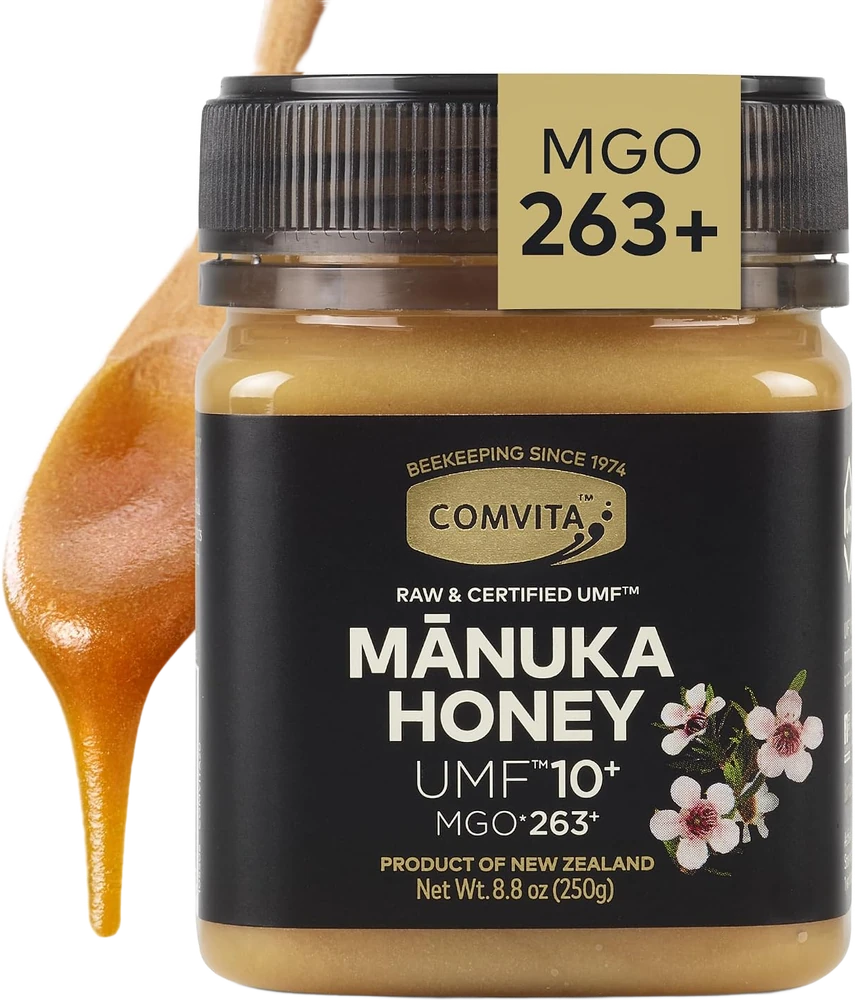
01Comvita Manuka Honey UMF 10+
If you want one jar of genuine, independently certified manuka and you don't want to study the category, this is it.
07Wedderspoon KFactor 16
Wedderspoon is the jar most people meet first on a grocery shelf, and it deserves an honest framing rather than a dismissal.
 02
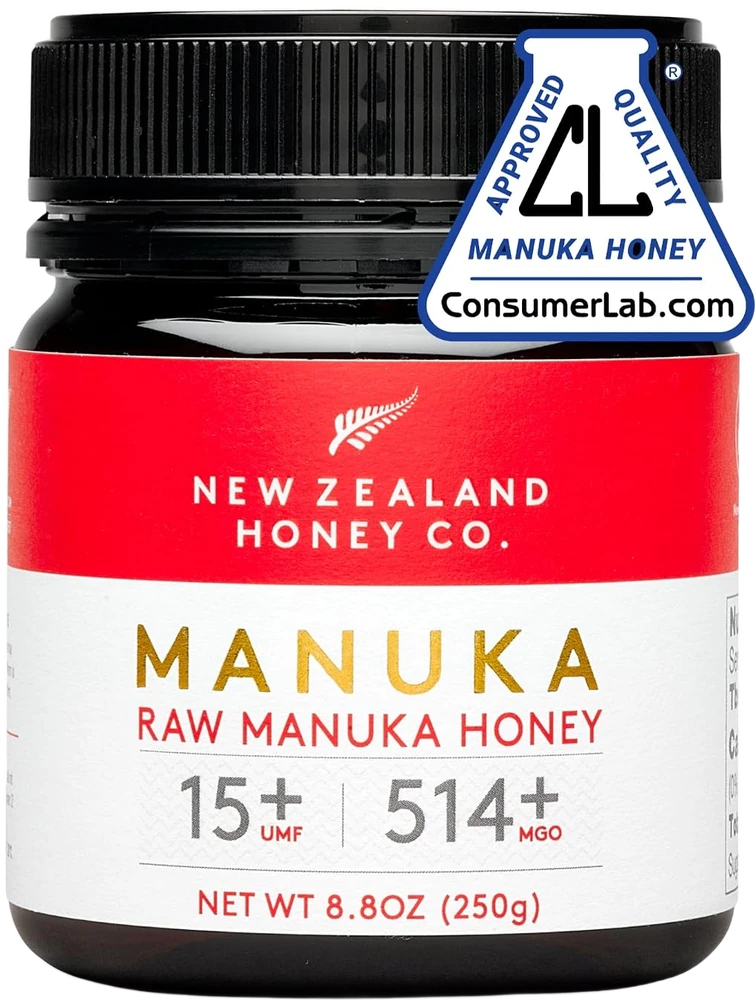
02New Zealand Honey Co. UMF 15+
This is the pick when you want real, concentrated potency without overpaying for it.
Quick Answers
Is KFactor 16 the same as UMF 16?
No — and this is the single most important thing to understand about this jar. KFactor is Wedderspoon's OWN in-house grading system; it verifies pollen purity and traceability, NOT the UMF potency panel. It is NOT a UMF grade, and 'KFactor 16' is not 'UMF 16' — they're different scales measuring different things. KFactor doesn't tell you the methylglyoxal potency the way UMF does; it's primarily an authenticity/pollen measure. The honest comparison comes from the separately-disclosed MGO number: this jar is now labeled 150+ MGO, which sits BETWEEN UMF 5+ (MGO 83+) and UMF 10+ (MGO 263+) — i.e. below even the everyday UMF 10+ grade. So treat KFactor 16 as a pollen/traceability mark on an affordable manuka, not as a high potency grade.
How strong is 150+ MGO, really?
It's entry-level potency — below the everyday UMF 10+ grade. Using the mapping printed on these listings (UMF 5+ ≈ MGO 83+, UMF 10+ ≈ MGO 263+), a 150+ MGO honey falls between UMF 5+ and UMF 10+. So it's genuine manuka with real, if modest, methylglyoxal content — more than a UMF 5+ but less than a UMF 10+. For everyday use and a soothing spoonful, that's a perfectly reasonable potency at a friendly price. But if you're buying manuka specifically for concentrated antibacterial strength, 150+ MGO is weaker than every certified pick ranked above it in our list, all of which are UMF 10+ or higher.
Did Wedderspoon change how this honey is labeled?
Yes, and the change is to your benefit. The jar was historically sold as 'KFactor 16' with no MGO number, which made its potency impossible to compare against UMF/MGO jars. Wedderspoon has since retitled the Amazon listing to disclose '150+ MGO' (and its own site now sells it as 'MGO 150+' with KFactor being retired). The underlying product is the same — the page's model number still references KFactor 16 — but now that the MGO number is disclosed, you can finally compare its potency directly. That's a genuine transparency improvement, and it's why we can frame this jar honestly rather than guessing at its strength.
Is it still worth buying if it's not UMF-certified?
As an affordable everyday manuka, yes — with eyes open. It's a genuine raw, monofloral New Zealand manuka from the South Island at ~$3.20/oz, widely available, with Non-GMO, BPA-free packaging, and it now discloses 150+ MGO. For casual daily use and a soothing spoonful, it's a reasonable buy and the grocery-store convenience is real. What you're NOT getting is independent UMF certification of potency, and the disclosed potency (150+ MGO) is below UMF 10+. So if you just want an everyday manuka and value availability and price, it's fine; if you want certified, verified potency for the antibacterial story, step up to a UMF jar (#1, #2, #5). The honest framing is the whole point.
Why does it rank below the UMF-certified jars if it's cheaper?
Because manuka's whole premise is verified MGO potency, and this jar offers neither UMF certification nor a potency that reaches even the everyday UMF 10+ grade. Our top axis is grade verification: a certified jar with an independently-tested potency tier beats a cheaper jar whose 'grade' (KFactor) isn't a potency certification and whose disclosed MGO (150+) is sub-10+. So the lower price can't lift it above genuinely certified picks — you'd be paying less for less verified potency. It ranks where it does, fairly, as the honest grocery-store pick: a real, affordable manuka that's simply not in the same verified-potency league as the UMF jars above it.
Sources & Further Reading
3 peer-reviewed sources, each linked to PubMed
- [1] Mavric 2008 PMID 18210383 — Identification and quantification of methylglyoxal as the dominant antibacterial constituent of Manuka (Leptospermum scoparium) honeys from New Zealand. Identified methylglyoxal (MGO) as manuka's dominant antibacterial constituent, with potency scaling on MGO content. The basis for comparing jars by MGO — and the reason Wedderspoon's disclosed 150+ MGO (below UMF 10+'s 263+) places it honestly as an entry-potency manuka.
- [2] Adams 2008 PMID 18194804 — Isolation by HPLC and characterisation of the bioactive fraction of New Zealand manuka (Leptospermum scoparium) honey. Showed manuka's antibacterial activity arises from MGO formed from the nectar's DHA — the potency chemistry the MGO number reflects, and which KFactor (a pollen/traceability standard) does not measure.
- [3] Jull 2015 (Cochrane) PMID 25742878 — Honey as a topical treatment for wounds. 26 trials (3,011 participants): topical honey may shorten healing of burns and some infected wounds. Cited for honesty — manuka's best-supported use is TOPICAL; at 150+ MGO this jar is the lowest-potency option here, so oral immune claims are weakest of all.
Affiliate disclosure: every Amazon link uses our Associates tag (superachieverclub-20). We earn a small commission at no cost to you; it funds independent reviews. We never accept payment to change a ranking.