

Cordyceps: Benefits, Dosage & Side Effects (2026)
Cordyceps is a medicinal fungus taken for natural energy, endurance, and immune support; Cordyceps militaris fruiting body (cordycepin-rich) is the meaningful form, though human performance evidence is mixed and modest.
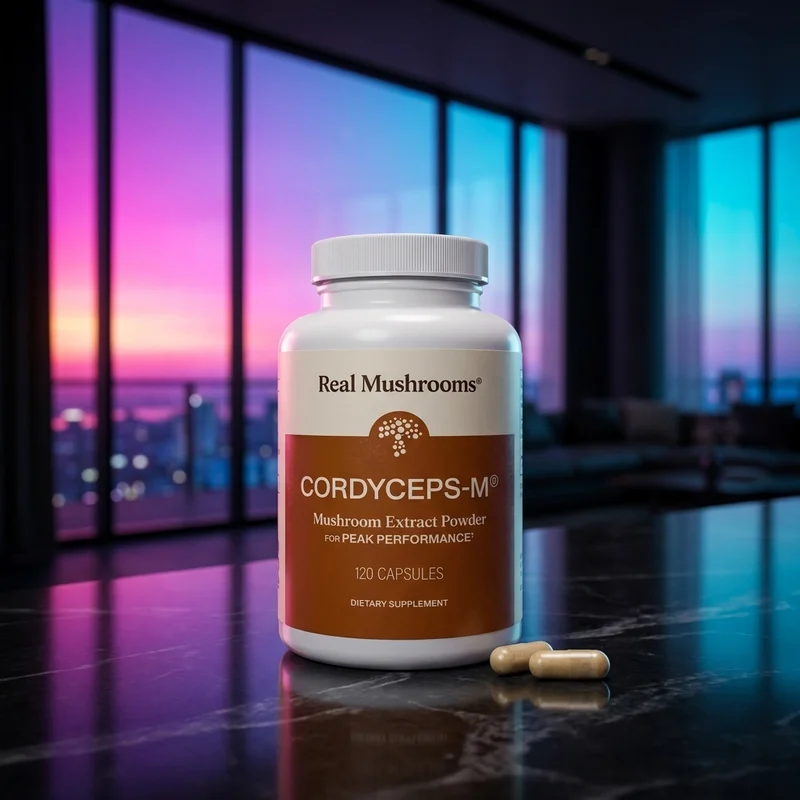
Real Mushrooms Cordyceps-M
What is Cordyceps?
Cordyceps is a genus of parasitic fungi traditionally prized in Tibetan and Chinese medicine for stamina, vitality, and lung and kidney support. As a modern supplement it is taken mainly for natural energy, endurance and aerobic capacity, and immune support. But the single most important thing to understand is that two genuinely different fungi are sold under the one word, and which one you buy decides whether the product means anything.
The first is CORDYCEPS MILITARIS — a bright-orange species that can be cultivated in a lab and that actually accumulates cordycepin (3'-deoxyadenosine), the marker compound behind cordyceps' energy reputation. Almost every modern, potency-disclosing extract is militaris. The second is CORDYCEPS SINENSIS — the Tibetan 'caterpillar fungus' (Dong Chong Xia Cao), which grows on insect larvae high on the plateau. Genuine wild sinensis is one of the most expensive biological materials on earth, so commercial 'sinensis' is in practice always CS-4: a fermented MYCELIUM strain (Paecilomyces hepiali / Hirsutella sinensis) grown in liquid culture. CS-4 is the form behind the older human exercise trials, but it carries little to no cordycepin.
The second axis is FRUITING BODY vs MYCELIUM-ON-GRAIN. A fruiting-body extract is the actual mushroom, hot-water-extracted and ideally standardised to beta-glucans (the well-characterised active polysaccharides). A mycelium product is the fungal root system grown ON a grain substrate (oats or brown rice) and dried together WITH it — so a real fraction of the powder is starch, not mushroom, and the beta-glucan content is usually low and undisclosed. This is why a publicly stated beta-glucan percentage on a militaris fruiting-body extract is the single spec a knowledgeable cordyceps buyer is actually paying for — and why 'Cordyceps 1000 mg' on a label tells you almost nothing on its own.
How it works
The proposed mechanism is coherent and centres on cellular energy. Cordycepin, the principal bioactive of Cordyceps militaris, is a close structural analogue of adenosine and is implicated in pathways governing cellular ATP production and the AMPK energy-sensing system (Tuli 2014, PMID 28324458). In an animal model, Choi 2020 (PMID 33312018) found that Cordyceps militaris extract improved exercise performance in a way associated with increased cellular ATP generation rather than a reduction in muscle-fatigue markers — i.e. the engine makes more energy, rather than the muscle simply fatiguing less. Beta-glucans, the other major fraction, are the component behind cordyceps' immune-modulating reputation, interacting with innate-immune receptors.
The human exercise evidence is where honesty matters most, because it is limited and mixed. Hirsch 2017 (PMID 27408987) randomised 28 healthy young adults to a Cordyceps militaris–containing mushroom blend (4 g/day) or placebo: after one week there was no effect, but after three weeks VO2max improved (+4.8 mL·kg⁻¹·min⁻¹) and time-to-exhaustion improved at both one and three weeks. That is the strongest human signal — but it is a small study, it used a multi-mushroom blend rather than cordyceps alone, and the benefit required chronic dosing. Chen 2010 (PMID 20804368) gave 20 healthy older adults CS-4 (Cordyceps sinensis) for 12 weeks and found improved sub-maximal metabolic and ventilatory thresholds — markers of exercise economy — but NO change in VO2max in either group.
So the honest synthesis: the mechanism is plausible, two small human trials are directionally encouraging (one on militaris showing a VO2max gain, one on CS-4 showing sub-maximal-only gains), and the effect — where present — builds over weeks, not acutely. What does not yet exist is a large, replicated human RCT establishing a reliable performance benefit. Cordyceps is best understood as a promising endurance and energy support to pair with actual training, not a proven ergogenic.
At-a-glance facts
- Two species, one word
- C. militaris (cordycepin-rich, the meaningful form) vs C. sinensis / CS-4 (mycelium, low cordycepin)
- The spec that matters
- Militaris FRUITING BODY + a disclosed beta-glucan % — not 'mycelium on grain', not just 'Cordyceps 1000 mg'
- Typical dose
- ~1,000-2,000 mg/day of extract (label-dependent); CS-4 trial used ~1,000 mg/day
- Time to effect
- Builds over weeks — Hirsch 2017's VO2max gain appeared at 3 weeks, not acutely
- Active compounds
- Cordycepin (energy/cellular-ATP rationale) + beta-glucans (immune fraction)
- Human evidence
- Promising but limited and mixed — 1 militaris trial (VO2max ↑ at 3 wk), 1 CS-4 trial (sub-maximal only, no VO2max change)
- Cost range (US)
- ~$13-32 / bottle; fruiting-body extracts cost more per gram than mycelium-on-grain
- Stack synergy
- Pair with actual endurance training; beetroot/nitrate (blood flow) and a broader mushroom blend are common companions
Evidence: Promising but limited and mixed human evidence. Hirsch 2017 (PMID 27408987) found a Cordyceps militaris blend improved VO2max and time-to-exhaustion after 3 weeks in 28 adults; Chen 2010 (PMID 20804368) found CS-4 improved sub-maximal exercise thresholds but NOT VO2max in 20 older adults. The cordycepin → cellular-ATP/AMPK mechanism is coherent (Tuli 2014, PMID 28324458; Choi 2020, PMID 33312018, animal) — but no large, replicated human performance RCT exists yet. Treat cordyceps as a plausible endurance/energy support, not a proven ergogenic.
Who it's for — and who it isn't
- Endurance and aerobic-fitness seekers willing to run it for weeks — a militaris blend improved VO2max and time-to-exhaustion after 3 weeks (Hirsch 2017)
- People chasing natural, non-stimulant 'cellular energy' — the cordycepin → ATP/AMPK mechanism is the rationale (Tuli 2014, Hsu 2020)
- Older or recreational exercisers wanting better exercise economy — CS-4 improved sub-maximal thresholds in older adults (Chen 2010)
- Buyers who want immune support from a beta-glucan-bearing medicinal mushroom alongside the energy angle
- Knowledgeable supplement buyers who will choose a Cordyceps militaris fruiting-body extract with a disclosed beta-glucan number over a cheap mycelium powder
- Anyone expecting a fast or guaranteed performance boost — the human evidence is mixed and effects build over weeks, if at all
- People who won't check the species and form — a 'Cordyceps 1000 mg' mycelium-on-grain bottle may be mostly starch with little active content
- Those wanting a stimulant 'pre-workout' kick — cordyceps is not caffeine; any effect is subtle and cumulative, not acute
- Anyone on immunosuppressants or with an autoimmune condition without clinician input — an immune-modulating mushroom warrants caution
Week-by-week, what happens
- Week 1No reliable change expected — in Hirsch 2017 one week of a militaris blend did not move VO2max (though time-to-exhaustion edged up). Take it consistently and don't judge it yet.
- Week 2-3The window where the militaris signal appeared — Hirsch 2017 saw VO2max and time-to-exhaustion improve by ~3 weeks of chronic dosing. Some users report steadier energy here.
- Week 4-8Sub-maximal exercise economy may improve with continued use; CS-4's threshold gains in older adults built over a 12-week course (Chen 2010).
- Week 8-12+Maintenance phase — any benefit is cumulative and depends on consistent dosing plus real training. Reassess honestly; if you've felt nothing by ~12 weeks, it may not be a responder effect for you.
Safety & contraindications
- Cordyceps is generally well tolerated; the most common complaints are mild and digestive (nausea, stomach upset, dry mouth). Take with food if sensitive.
- It is immune-modulating (via beta-glucans), so use caution and seek clinician input if you have an autoimmune condition or take immunosuppressant medication.
- Cordycepin can theoretically affect platelet/clotting pathways — be cautious if you take anticoagulants/antiplatelet drugs or are approaching surgery, and discuss with a clinician.
- May have mild blood-sugar-lowering effects in some contexts; people on diabetes medication should monitor and consult a clinician.
- Quality and identity matter most here: 'Cordyceps' on a label can be low-cordycepin CS-4 mycelium grown on grain. Choose a Cordyceps militaris fruiting-body extract with a disclosed (ideally third-party-verified) beta-glucan percentage so you know what you're taking.
- Pregnancy/breastfeeding: evidence is insufficient — avoid unless cleared by a clinician. Not a substitute for training, sleep, or medical care for fatigue.
All articles on Cordyceps
Best Cordyceps Supplements
The 10 best cordyceps supplements ranked by species and extract quality (premium Cordyceps militaris fruiting body vs cheap mycelium-on-grain), beta-glucan content, testing and value — with honest 'promising-not-proven' framing on the endurance evidence.
Read →Double Wood Cordyceps Review
The cheapest per capsule — and unlike most value bottles, it discloses a potency figure.
Read →FreshCap Cordyceps Review
The highest disclosed potency on the list — a 10:1 fruiting-body extract at 32% beta-glucans.
Read →Host Defense Cordyceps Review
The most trusted brand — but mycelium-on-grain, not a fruiting-body extract.
Read →Nature's Way Premium Herbal Cordyceps Review
A trusted legacy name — but the least concentrated cordyceps on the list.
Read →Nootropics Depot Cordyceps Militaris Review
The lab-forward militaris fruiting body — buy it if you trust published COAs most.
Read →NOW Foods Cordyceps 750 mg Review
Reliable, cheap CS-4 from a trusted brand — but not the cordycepin-rich militaris form.
Read →Nutricost Cordyceps 1,100 mg Review
The most servings per dollar — but CS-4 sinensis mycelium, not a militaris extract.
Read →Om Mushroom Superfood Cordyceps Review
A trustworthy full-spectrum organic cordyceps — but not a concentrated extract.
Read →Real Mushrooms Cordyceps-M Review
The cleanest, most honest cordyceps — right species, right form, disclosed potency.
Read →Super Achiever Organic Cordyceps Review
Our own cordyceps, scored like every other pick: organic sinensis mycelium powder with a polysaccharide figure, not a fruiting-body extract.
Read →FAQ
Cordyceps militaris vs sinensis (CS-4) — which should I buy?
For a supplement, Cordyceps militaris fruiting body is the meaningful form. Militaris is the species that actually accumulates cordycepin (3'-deoxyadenosine), the marker compound behind the energy story (Tuli 2014). Cordyceps sinensis is the Tibetan caterpillar fungus, and because real wild sinensis is astronomically expensive, every commercial 'sinensis' product is in practice CS-4 — a fermented mycelium strain grown in a tank that carries little cordycepin. CS-4 isn't useless (it's the form the older human exercise trial used; Chen 2010), but it's the lower-cordycepin lineage. If you want the chemically meaningful product, buy a militaris fruiting-body extract with a disclosed beta-glucan number.
Does cordyceps actually improve endurance and VO2max, or is it hype?
Be honest and measured: it's promising, not proven. The best human evidence, Hirsch 2017 (PMID 27408987), randomised 28 adults to a Cordyceps militaris blend and found VO2max and time-to-exhaustion improved after 3 weeks — but it was a small study using a multi-mushroom blend, and nothing happened after just 1 week. Chen 2010 (PMID 20804368) found CS-4 improved sub-maximal exercise thresholds in older adults but did NOT change VO2max. The mechanism (cordycepin → cellular ATP) is coherent (Hsu 2020), but there's no large, replicated human RCT yet. So: a plausible endurance support that builds over weeks and pairs with training — not a guaranteed performance boost.
Why is 'fruiting body' better than 'mycelium'?
Because a mycelium product is grown on grain and dried with it, so part of the powder is starch rather than mushroom. The fruiting body is the actual mushroom, where the beta-glucan active fraction concentrates. A 'mycelium on brown rice/oats' product (often labelled 'full-spectrum') typically has lower, undisclosed beta-glucans because of that grain carryover, whereas a fruiting-body extract can be standardised to a stated beta-glucan percentage. That disclosed beta-glucan number from a fruiting-body extract is the single clearest signal you're buying concentrated mushroom rather than diluted filler. It's the spec the best products on our list publish and the cheap ones don't.
What's cordycepin, and does the amount matter?
Cordycepin (3'-deoxyadenosine) is the signature bioactive of Cordyceps militaris and the compound most associated with its energy and cellular-ATP rationale (Tuli 2014, Hsu 2020). In principle more cordycepin is better, but here's the honest reality: most consumer listings — including the best ones — do NOT publish a cordycepin percentage, so you usually can't buy on that number directly. What you can use as a proxy is species (militaris, not sinensis) plus a disclosed beta-glucan figure from a fruiting-body extract. We never quote a cordycepin percentage a product doesn't state.
How long until cordyceps works, and how should I take it?
Give it weeks, not days. The militaris VO2max signal in Hirsch 2017 appeared at 3 weeks of daily dosing (not at 1 week), and the CS-4 threshold gains in Chen 2010 built over a 12-week course. So take it consistently — typically ~1,000-2,000 mg of extract per day depending on the label — ideally alongside real endurance training, and reassess at 8-12 weeks. Because any effect is cumulative rather than a stimulant kick, timing (morning vs pre-workout) matters less than consistency. If you've felt nothing by ~12 weeks on a genuine militaris fruiting-body extract, it may simply not be a responder effect for you.
Is cordyceps safe, and who should avoid it?
For most healthy adults it's well tolerated, with mild digestive upset the main complaint. But because it's immune-modulating (via beta-glucans), use caution with autoimmune conditions or immunosuppressant drugs; because cordycepin may affect clotting, be cautious on anticoagulants or before surgery; and because it may mildly lower blood sugar, monitor if you're on diabetes medication. Pregnancy and breastfeeding: insufficient evidence, so avoid unless a clinician clears it. As always, the biggest practical 'safety' issue is buying a mislabelled, low-quality mycelium-on-grain product — choose a militaris fruiting-body extract with disclosed, ideally third-party-verified, beta-glucans.
Sources & further reading
- Hirsch 2017 (militaris, VO2max/endurance)Cordyceps militaris Improves Tolerance to High-Intensity Exercise After Acute and Chronic Supplementation
28 healthy adults, randomized double-blind placebo-controlled: a Cordyceps militaris–containing mushroom blend (4 g/day) showed NO effect at 1 week, but after 3 weeks VO2max improved (+4.8 mL·kg⁻¹·min⁻¹) and time-to-exhaustion improved at both 1 and 3 weeks. The strongest human signal for militaris and endurance — but small, in a blend, and dependent on chronic dosing.
- Chen 2010 (CS-4 sinensis, exercise)Effect of Cs-4 (Cordyceps sinensis) on exercise performance in healthy older subjects: a double-blind, placebo-controlled trial
20 healthy older adults (50-75 y), 12 weeks: CS-4 (Cordyceps sinensis) at 333 mg ×3/day raised the metabolic threshold by 10.5% and ventilatory threshold by 8.5% versus no change on placebo — but VO2max did NOT change in either group. The honest counterpoint: CS-4 improved sub-maximal exercise economy, not peak aerobic power, and the gains were modest.
- Tuli 2014 (cordycepin mechanism)Pharmacological and therapeutic potential of Cordyceps with special reference to Cordycepin
Review of cordycepin (3'-deoxyadenosine), the principal bioactive of Cordyceps militaris, detailing its anti-inflammatory, antioxidant, and metabolic actions. The mechanistic basis for why species matters — militaris accumulates cordycepin, sinensis/CS-4 largely does not — and why a militaris fruiting-body extract is the chemically meaningful form.
- Choi 2020Beneficial Effect of Cordyceps militaris on Exercise Performance via Promoting Cellular Energy Production
Animal model: Cordyceps militaris extract improved exercise performance in a manner associated with increased cellular ATP production (AMPK energy-sensing pathway) rather than reduced muscle-fatigue markers. Supports the coherent 'cordyceps → cellular energy' mechanism — but is preclinical, which is why endurance benefit is framed as promising rather than proven.