
Top 10 Best Berberine Supplements (2026)
 01 · Best overall✓ Label verified · Supplement Facts read Oct 1, 2026
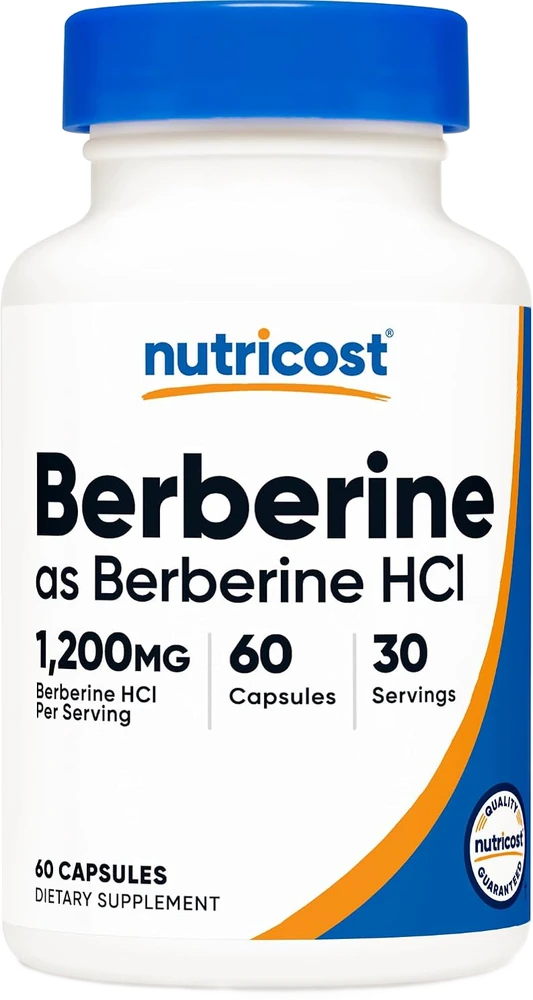
Best overall: Nutricost Berberine HCl 1,200 mg
The cheapest legitimate full-dose HCl on Amazon. 1,200 mg per 2-capsule serving (600 mg per capsule); 2-3 capsules a day land inside the clinical window.
Price varies — 60-capsule bottle600 mg berberine HCl per capsule
Why it wins: all five scores, pros & cons, full label
- Cheapest legitimate clinical-dose HCl on Amazon — no kitchen-sink blends, no marketing dilution
- 600 mg per cap means 2 caps/day hits 1,200 mg, 3 caps hits 1,800 — flexible dosing
- 60-capsule bottle covers 20-30 days at 2-3 capsules a day — buy two if you run the full protocol
- Vegetarian (hypromellose) capsules; rice flour, silica, olive oil and magnesium stearate are the only excipients on the label
- No NSF / USP certification — only GMP-facility + third-party
- Larger 600 mg capsules than most premium brands — sensitive swallowers may prefer a smaller capsule
- Per cap
- 600 mg (1,200 mg per 2-capsule serving)
- Bottle
- 60 capsules (30 servings · 20-30 days at 2-3 caps/day)
- Testing
- GMP-certified facility, third-party tested, COA available
- Form
- Berberine HCl

Our take — If you want to test berberine without committing $30+/month, Nutricost is the right entry point. The supply chain is real, the dose is real, the form is real. You're trading NSF testing theatrics for a lower price. Run 600 mg with breakfast + dinner for 2 weeks, ramp to 3 caps with lunch added if tolerated, retest labs at week 12. If you respond, upgrade to Thorne (#3) on cycle two — or stay on Nutricost indefinitely if budget matters more than certification badges.
 02
 03
 04
 05
 06
 07
 08
 09
 10
Who Wins Which Aspect
Sorted by overall SAC Product Score™ — the official ranking.
| # | Pick | Score | Form bioavailability30% | Dose accuracy at 1,500 mg/day25% | Third-party testing20% | Cost per active dose15% | Real-world glucose + weight response10% | Cost Per Dose | Buy |
|---|---|---|---|---|---|---|---|---|---|
| 01 | | 8.9 | 8.5 | 9.51 | 8.03 | 10.01 | 8.53 | — | Check price |
| Cheapest legitimate clinical-dose HCl on Amazon — no kitchen-sink blends, no marketing dilutionNo NSF / USP certification — only GMP-facility + third-party | |||||||||
| 02 | | 8.7 | 9.03 | 9.02 | 8.52 | 8.52 | 8.0 | $0.42 / 1,500 mg serving | Check price |
| UHP (Ultra-High Purity) positioning — third-party HPLC verifies 97%+ alkaloid identityThree capsules a day — split them across meals rather than taking them at once | |||||||||
| 03 | | 8.4 | 9.22 | 7.0 | 9.01 | 7.5 | 9.51 | $0.53 / capsule | Check price |
| NSF contents-certified (NSF/ANSI 173): label-versus-contents verification, contaminant screening and facility audits; not NSF Certified for SportMost expensive of the HCl picks at $32/month | |||||||||
| 04 | | 8.4 | 9.51 | 8.53 | 8.52 | 5.5 | 9.02 | $0.80 / 550 mg phytosome cap | Check price |
| Phytosome carrier increases bioavailability 3-5× vs HCl — published Indena trial dataMost expensive on the list at $48/month — premium pricing is partly clinician-brand markup | |||||||||
| 05 | | 8.2 | 8.5 | 8.53 | 7.5 | 8.52 | 8.0 | $0.49 / 1,200 mg serving | Check price |
| 1,200 mg/day at 2 caps lands inside the trial-dose window without overshootingNo NSF or USP certification — relies on GMP + third-party tests | |||||||||
| 06 | | 8.2 | 8.5 | 9.02 | 8.52 | 5.5 | 8.53 | $0.60 / 500 mg cap | Check price |
| Clinician-channel pedigree — used in integrative medicine practices for 30+ yearsPricier than Thorne (#3) for similar formulation but without NSF certification | |||||||||
| 07 | | 8.1 | 8.5 | 9.02 | 7.0 | 7.5 | 7.5 | $0.40 / 500 mg cap | Check price |
| Long-standing brand — Solaray has been on health-food shelves since 1973No NSF or USP certification — relies on internal QC + GMP-facility | |||||||||
| 08 | | 7.9 | 8.5 | 7.0 | 9.01 | 6.0 | 9.02 | $0.70 / 400 mg berberine serving | Check price |
| Clinician-channel pedigree — used in functional medicine + integrative cardiology practicesPremium-tier pricing at $42/month — closer to phytosome than HCl pricing | |||||||||
| 09 | | 7.8 | 8.0 | 7.0 | 8.52 | 8.03 | 7.5 | $0.22 / 400 mg berberine softgel | Check price |
| NOW's in-house QC is among the most consistent in the industry — 30+ yearsSoftgel is fixed at 400 mg — reaching 1,500 mg a day takes four softgels and lands at 1,600 mg | |||||||||
| 10 | | 7.7 | 8.0 | 6.0 | 8.03 | 10.01 | 6.5 | — | Check price |
| Cheapest cost-per-gram of berberine on the market — by a wide marginYou must own a 0.001 g milligram scale to dose accurately — eyeballing is dangerous | |||||||||
The Other 9, Ranked
- 02
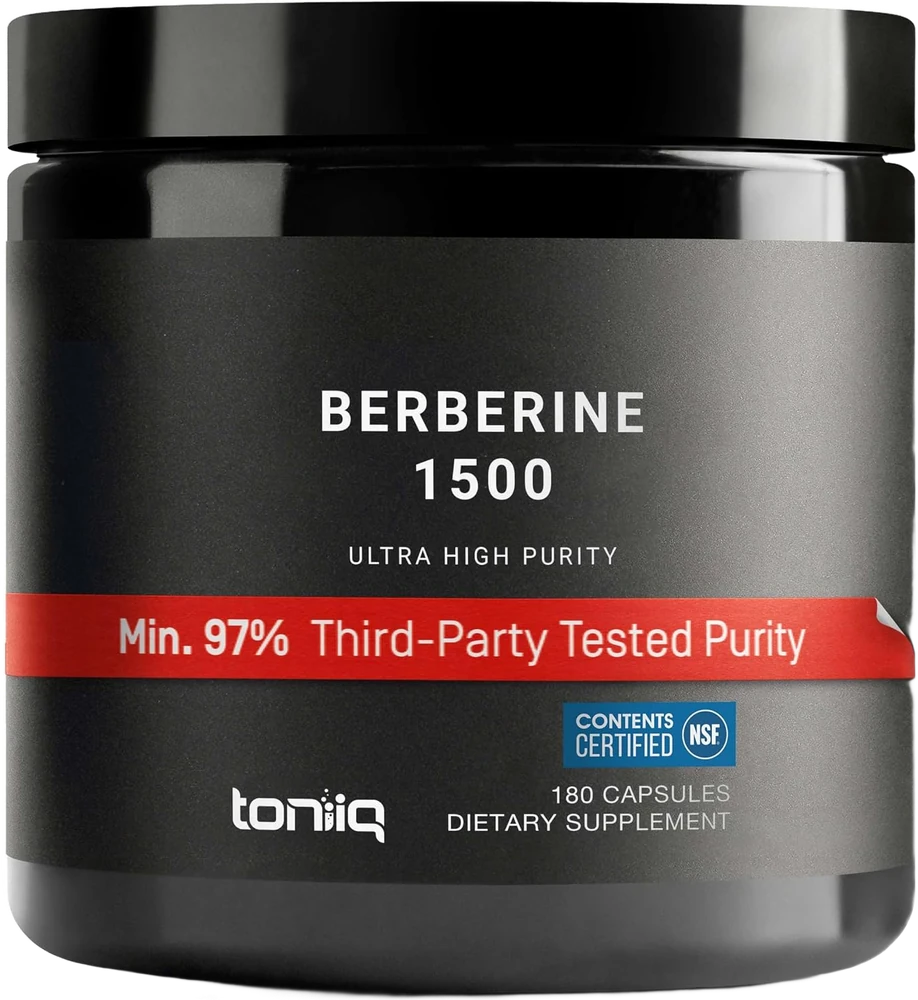
Best high-dose HCl: Toniiq Ultra Berberine HCl 1500mg
8.7SAC Score™1,500 mg per 3-capsule serving (500 mg per capsule) = the full Yin 2008 trial dose in one daily protocol. Min. 97% purity and NSF Contents Certified printed on the label.
StrongestForm bioavailability9.03WeakestReal-world glucose + weight response8.0- Per serving
- 1,500 mg (3 capsules at 500 mg each)
- Bottle
- 180 capsules (60 servings · 60 days at 3 caps/day)
- Testing
- NSF Contents Certified, min. 97% third-party tested purity (label)
All five scores, pros & cons, full label
What We Like- UHP (Ultra-High Purity) positioning — third-party HPLC verifies 97%+ alkaloid identity
- 500 mg per capsule × 3 = exactly the Yin 2008 1,500 mg/day protocol — no rounding
- NSF Contents Certified on the label — rare at this price tier
- 180-capsule bottle = 60 days at the full 3-capsule dose
What You Live With- Three capsules a day — split them across meals rather than taking them at once
- 1,500 mg a day is the top of the trial range — ramp up over a week if your gut is sensitive
- Form
- Berberine HCl (min. 97% purity, 100:1 Berberis aristata root extract)
Our take — If you want full clinical dose with minimum pill-count and don't need the NSF badge, Toniiq is the strongest value play. The UHP positioning is marketing language but the COA backs it up — 97%+ alkaloid purity verified per batch. The trade-off is pill count: three 500 mg capsules a day, best split across meals rather than taken at once. The right answer for high-dose buyers who balk at Thorne's price.
- 03
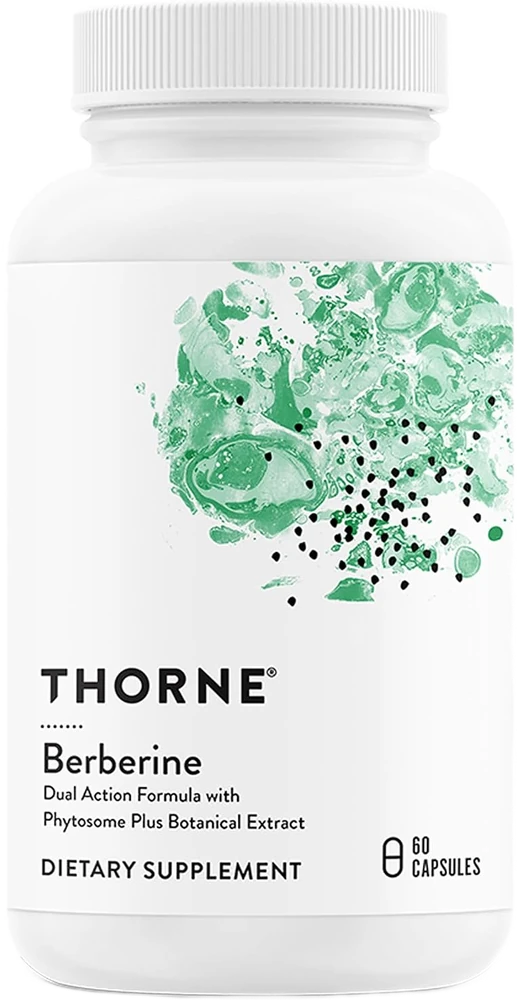
Best NSF-certified pick: Thorne Berberine 500mg
8.4SAC Score™NSF contents-certified (NSF/ANSI 173) Dual Action formula: 450 mg berberine HCl + 550 mg berberine phytosome per 2-capsule serving, 30 servings a bottle. Two delivery forms in one capsule — not a pure-HCl bottle, and not the 1,500 mg Yin 2008 protocol.
StrongestReal-world glucose + weight response9.51WeakestDose accuracy at 1,500 mg/day7.0- Per serving
- 450 mg berberine HCl + 550 mg berberine phytosome (2 capsules)
- Bottle
- 60 capsules (30 servings · ~30 days at 2 caps/day)
- Testing
- NSF contents-certified (NSF/ANSI 173), listed at info.nsf.org
All five scores, pros & cons, full label
What We Like- NSF contents-certified (NSF/ANSI 173): label-versus-contents verification, contaminant screening and facility audits; not NSF Certified for Sport
- The phytosome half is a phospholipid complex that absorbs better than plain HCl — two delivery forms in one capsule
- Thorne's NSF/ANSI 173 listing is public at info.nsf.org, so the contents check is verifiable, not marketing language
- No fillers, no artificial colours, no kitchen-sink combo nonsense
What You Live With- Most expensive of the HCl picks at $32/month
- The labeled 2-capsule serving is a 1,000 mg HCl-plus-phytosome blend — it does not reproduce the 1,500 mg pure-HCl dose used in Yin 2008
- Form
- Dual Action — berberine HCl + berberine phytosome (phospholipid complex)
Our take — The certification pick, not the default. You get an NSF/ANSI 173 contents listing (label-versus-contents verification, contaminant screening, facility audits; not banned-substance testing), a Dual Action formula (450 mg HCl + 550 mg phytosome per 2 capsules) that absorbs better than plain HCl but does not copy the 1,500 mg pure-HCl trial protocol, and Thorne's 35-year clinician-channel QC pedigree. What you pay for it is the steepest cost per active dose on the list — Nutricost (#1) delivers plain HCl at the trial dose for far less, which is why it outranks Thorne overall. Choose Thorne when the NSF listing and the clinician-channel pedigree are worth the premium to you: on medication, or simply unwilling to trust a budget label. It is not listed as NSF Certified for Sport (nsfsport.com, checked Oct 6, 2026), so athletes under anti-doping rules should verify the batch at the certifier before buying any berberine.
- 04
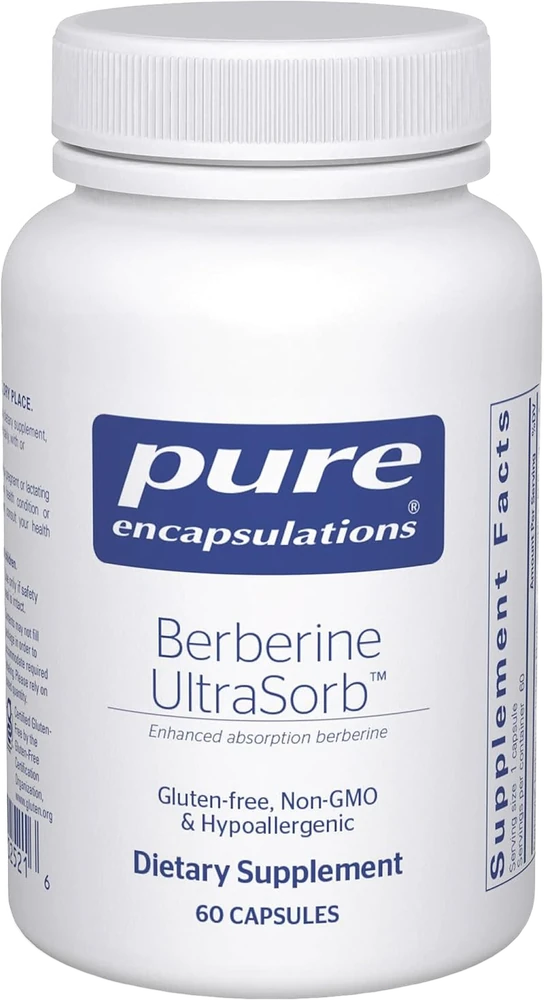
Best premium (phytosome): Pure Encapsulations Berberine UltraSorb
8.4SAC Score™Phytosome form (berberine + phosphatidylcholine) lets you hit clinical plasma exposure at a lower compound dose. Hypoallergenic clinician-grade label.
StrongestForm bioavailability9.51WeakestCost per active dose5.5- Per cap
- 550 mg Berbevis berberine phytosome (berberine + phospholipid complex; the label does not state the berberine fraction)
- Bottle
- 60 capsules
- Testing
- Brand-run testing; hypoallergenic label; no certifier listing found (Oct 6, 2026)
All five scores, pros & cons, full label
What We Like- Phytosome carrier increases bioavailability 3-5× vs HCl — published Indena trial data
- Hypoallergenic label — no fillers, dyes, gluten, dairy, GMOs, or unnecessary excipients
- Lower compound dose hits the same plasma curve as 1,500 mg HCl → dramatically lower GI burden
- Clinician-preferred brand — used by integrative medicine practices for 30+ years
What You Live With- Most expensive on the list at $48/month — premium pricing is partly clinician-brand markup
- Trial base is thinner than HCl (most RCTs used HCl, not phytosome)
- Form
- Berberine Phytosome (Indena license)
Our take — If you have a sensitive gut, want maintenance dosing rather than full clinical protocol, or just want the cleanest label on the planet, this is it. The phytosome carrier delivers measurable bioavailability gains — at maintenance dosing (550-1,100 mg compound/day) you get the same plasma curve as the HCl-equivalent 1,500 mg/day at a fraction of the gut burden. The trade-offs are price ($48/month, ~3× Nutricost) and a thinner trial base. Worth it if HCl made you miserable, or if you're running long-term longevity maintenance dosing.
- 05
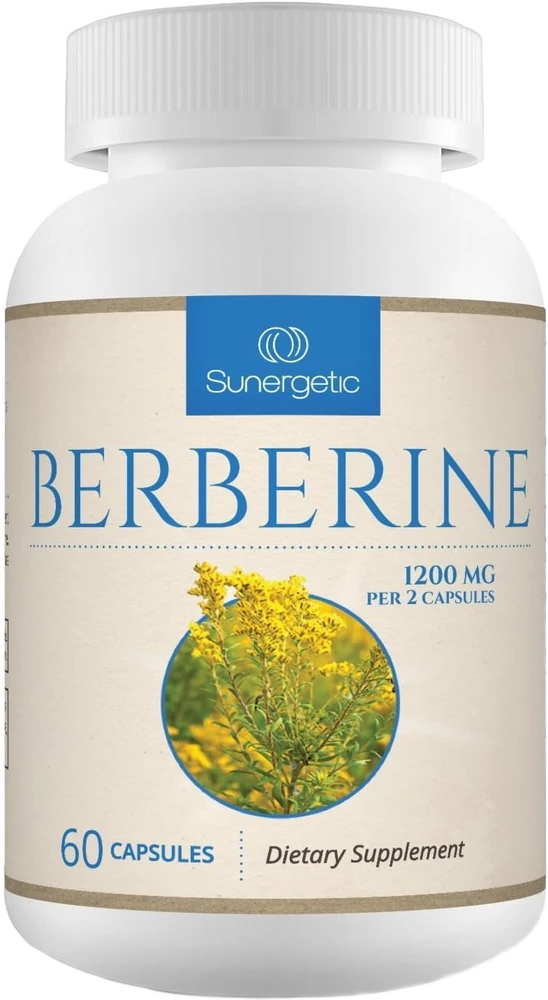
Best mid-tier high-dose: Sunergetic Premium Berberine 1200mg
8.2SAC Score™1,200 mg/serving (2 caps × 600 mg) at mid-tier pricing. Solid HCl formulation, no fluff, 45-day supply at clinical dose.
StrongestForm bioavailability8.5WeakestThird-party testing7.5- Per serving
- 1,200 mg (2 caps at 600 mg each)
- Bottle
- 90 capsules (~45 days at 2 caps/day)
- Testing
- GMP-certified facility, third-party tested
All five scores, pros & cons, full label
What We Like- 1,200 mg/day at 2 caps lands inside the trial-dose window without overshooting
- 600 mg per cap is a comfortable per-dose size — better tolerated than Toniiq's 750 mg
- Mid-tier pricing splits the difference between Nutricost budget and Thorne premium
- Money-back guarantee for unresponders — rare in the category
What You Live With- No NSF or USP certification — relies on GMP + third-party tests
- Brand has less clinical-channel pedigree than Thorne or Pure Encapsulations
- Form
- Berberine HCl
Our take — Sunergetic occupies a useful middle position — better tolerated per-cap dose than Toniiq, more budget-friendly than Thorne, real HCl without combo dilution. The money-back guarantee is genuinely useful for first-time buyers worried about non-response. Slot it in if Thorne is over budget but Nutricost feels too cheap, and you want to start at 1,200 mg before ramping to 1,500.
- 06
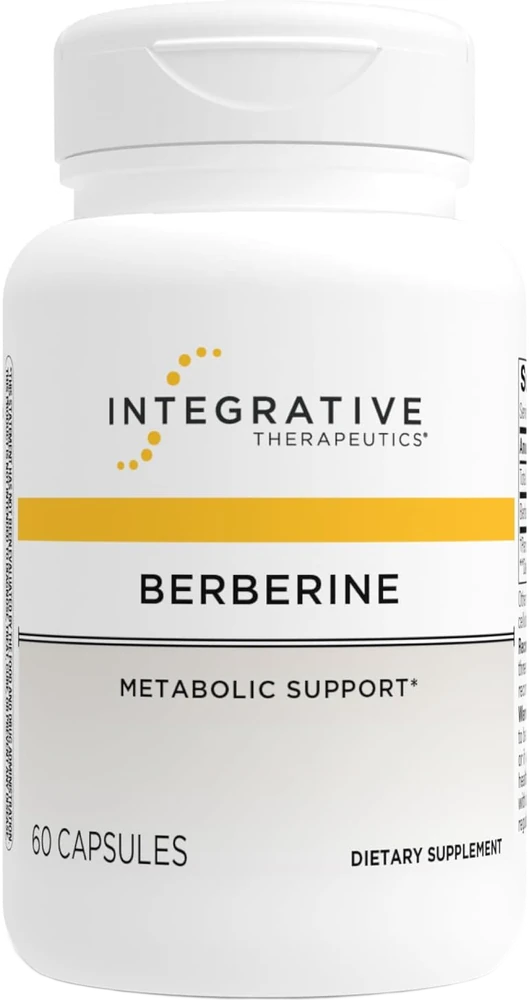
Best clinical-tier basic: Integrative Therapeutics Berberine 500mg
8.2SAC Score™Clinical-tier single-ingredient HCl from a long-standing functional-medicine brand. 500 mg per cap, no adjuncts, no nonsense.
StrongestDose accuracy at 1,500 mg/day9.02WeakestCost per active dose5.5- Per cap
- 500 mg
- Bottle
- 60 capsules (~20 days at 3 caps/day)
- Testing
- Clinician-channel QC, full COA per batch
All five scores, pros & cons, full label
What We Like- Clinician-channel pedigree — used in integrative medicine practices for 30+ years
- Pure HCl, no combo blend, no marketing dilution
- 500 mg per cap matches the Yin 2008 trial dose exactly
- Full COA on every batch — rare at this price tier
What You Live With- Pricier than Thorne (#3) for similar formulation but without NSF certification
- 60-cap bottle is short — only ~20 days at clinical dose
- Brand visibility is lower than Thorne / Pure Encapsulations on Amazon
- Form
- Berberine HCl
Our take — Integrative Therapeutics is the right pick if your practitioner specifically recommended it or you're already in the clinician-channel supplement ecosystem. The formulation itself is essentially identical to Thorne (#3) — pure HCl, 500 mg per cap, no fillers — but without the NSF badge and at a higher price point. For most readers, Thorne is the better buy at the same tier. Slot this in only if practitioner brand-loyalty is a factor.
- 07
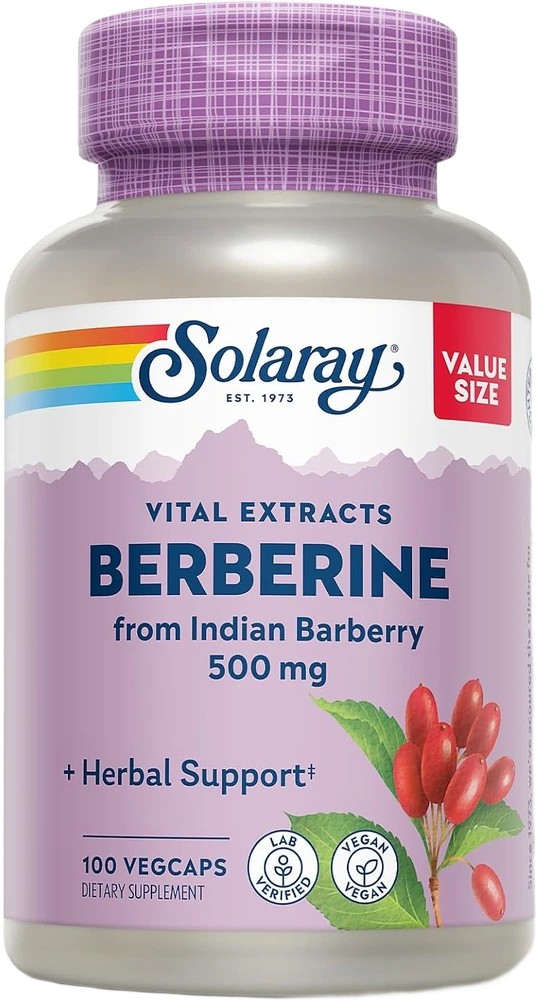
Best legacy-brand basic: Solaray Berberine 500mg
8.1SAC Score™Long-running legacy brand. Generic berberine HCl at 500 mg per cap. The 'I know this brand from health-food stores' familiarity pick.
StrongestDose accuracy at 1,500 mg/day9.02WeakestThird-party testing7.0- Per cap
- 500 mg
- Bottle
- 100 VegCaps (~33 days at 3 caps/day)
- Testing
- GMP-certified facility, in-house QC
All five scores, pros & cons, full label
What We Like- Long-standing brand — Solaray has been on health-food shelves since 1973
- 500 mg per cap matches the Yin 2008 trial dose
- Available offline at most US health-food stores — easy backup option
- VegCaps with 500 mg berberine HCl from Indian barberry (Berberis aristata) per capsule
What You Live With- No NSF or USP certification — relies on internal QC + GMP-facility
- More expensive than Nutricost (#1) for similar formulation without obvious benefit
- 100-capsule bottle covers about a month at 3 caps/day
- Form
- Berberine HCl
Our take — Solaray is a fine pick if you specifically recognise and trust the brand from offline health-food stores. The formulation itself is standard generic HCl — no advantage over Nutricost (#1) on price or Thorne (#3) on NSF certification. Choose this for brand familiarity, not optimisation. If you're brand-agnostic, every other pick on the list offers either lower cost or stronger testing for the same money.
- 08
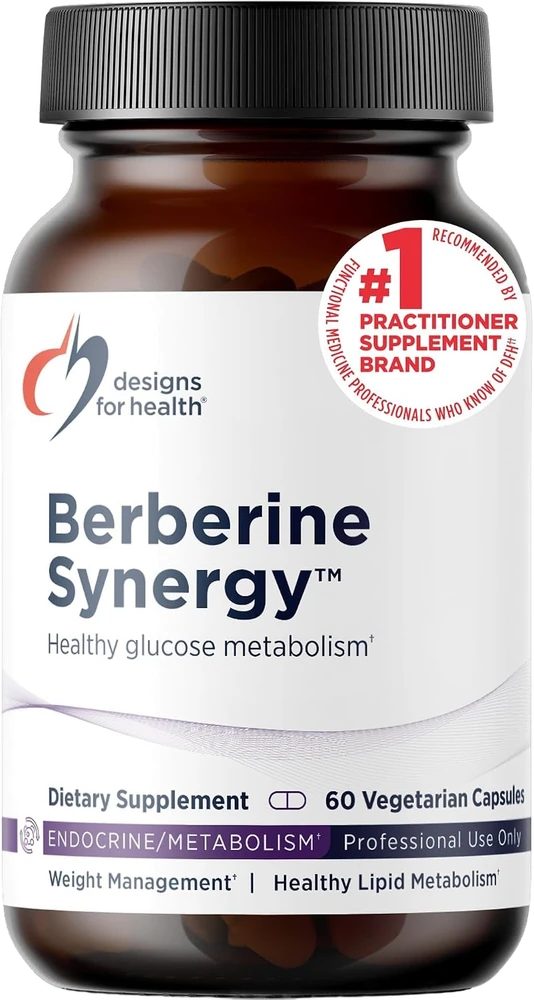
Best clinician-channel adjunct: Designs for Health Berberine Synergy
7.9SAC Score™Clinician-channel adjunct formula. Berberine + milk thistle (liver) + ALA at trial-relevant doses. Used in functional-medicine practices for metabolic protocols.
StrongestThird-party testing9.01WeakestCost per active dose6.0- Per serving
- 400 mg berberine + 100 mg silymarin + 200 mg ALA (2 caps)
- Bottle
- 60 capsules (~30 days at 2/day)
- Testing
- Clinician-channel QC, COA available on request
All five scores, pros & cons, full label
What We Like- Clinician-channel pedigree — used in functional medicine + integrative cardiology practices
- Adjuncts are trial-relevant — milk thistle for liver support, ALA for glucose + neuropathy
- Real-dose adjuncts, not marketing sprinkle
- Brand reputation for tight QC and supply-chain transparency
What You Live With- Premium-tier pricing at $42/month — closer to phytosome than HCl pricing
- Combo formula means you can't titrate berberine independently
- 400 mg berberine per serving = 4 caps/day for full clinical dose
- Form
- Berberine HCl + milk thistle (silymarin) + ALA
Our take — If your protocol is clinician-driven (functional medicine, integrative cardiology) and includes liver support and ALA, Berberine Synergy is the cleanest one-bottle solution. The adjuncts are at trial-relevant doses, the brand QC is among the strongest in the supplement industry, and the formulation maps onto real metabolic-syndrome protocols. The trade-off is independence — you're locked into the combo. Worth the premium only if you'd otherwise be buying berberine + milk thistle + ALA as three separate bottles.
- 09
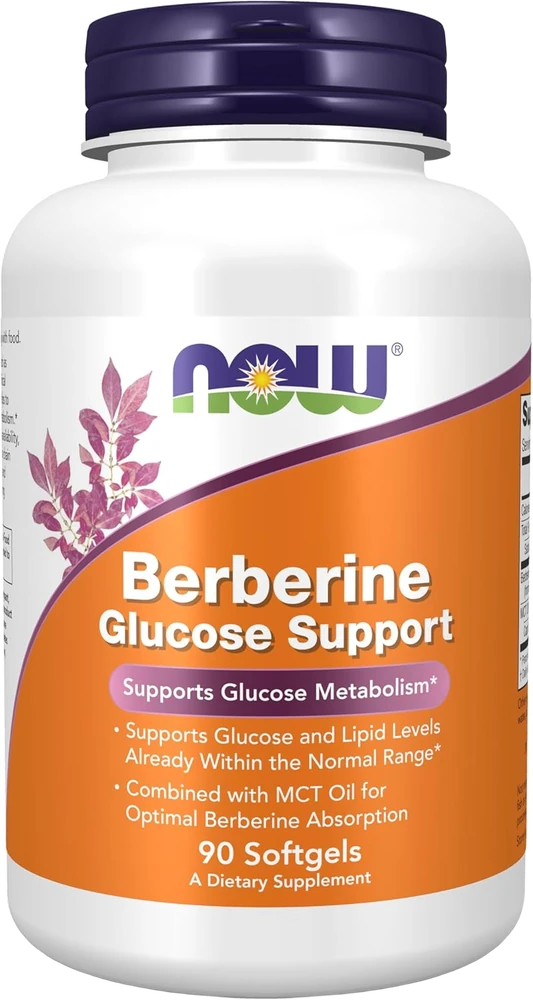
Best household-brand pick: NOW Foods Berberine Glucose Support
7.8SAC Score™Household-name brand with three decades of QC. One softgel = 400 mg berberine HCl carried in 700 mg MCT oil — a single-ingredient-plus-oil softgel, not a kitchen-sink blend.
StrongestThird-party testing8.52WeakestDose accuracy at 1,500 mg/day7.0- Per serving
- 400 mg berberine HCl + 700 mg MCT oil (1 softgel)
- Bottle
- 90 softgels (~30 days at 3/day)
- Testing
- NOW in-house labs, GMP, NSF-registered facility
All five scores, pros & cons, full label
What We Like- NOW's in-house QC is among the most consistent in the industry — 30+ years
- MCT-oil carrier (700 mg per softgel) — a fat-based delivery NOW positions for absorption
- Softgel format reduces GI irritation vs hard caps for some users
- Available in most US health stores — easy offline backup
What You Live With- Softgel is fixed at 400 mg — reaching 1,500 mg a day takes four softgels and lands at 1,600 mg
- 400 mg berberine per softgel means 4 softgels/day to approach the clinical 1,500 mg — pill burden
- Form
- Berberine HCl in an MCT-oil softgel
Our take — NOW Berberine Glucose Support is a plain berberine HCl softgel with an MCT-oil carrier — no alpha-lipoic acid, no cinnamon, nothing to titrate around. At 400 mg per softgel you need four a day to reach the 1,500 mg range, which is the real cost of the softgel format. Use it if you want a household brand and prefer softgels to hard capsules; otherwise the single-ingredient HCl capsules (#1, #2, #3) reach the trial dose with fewer pills.
- 10
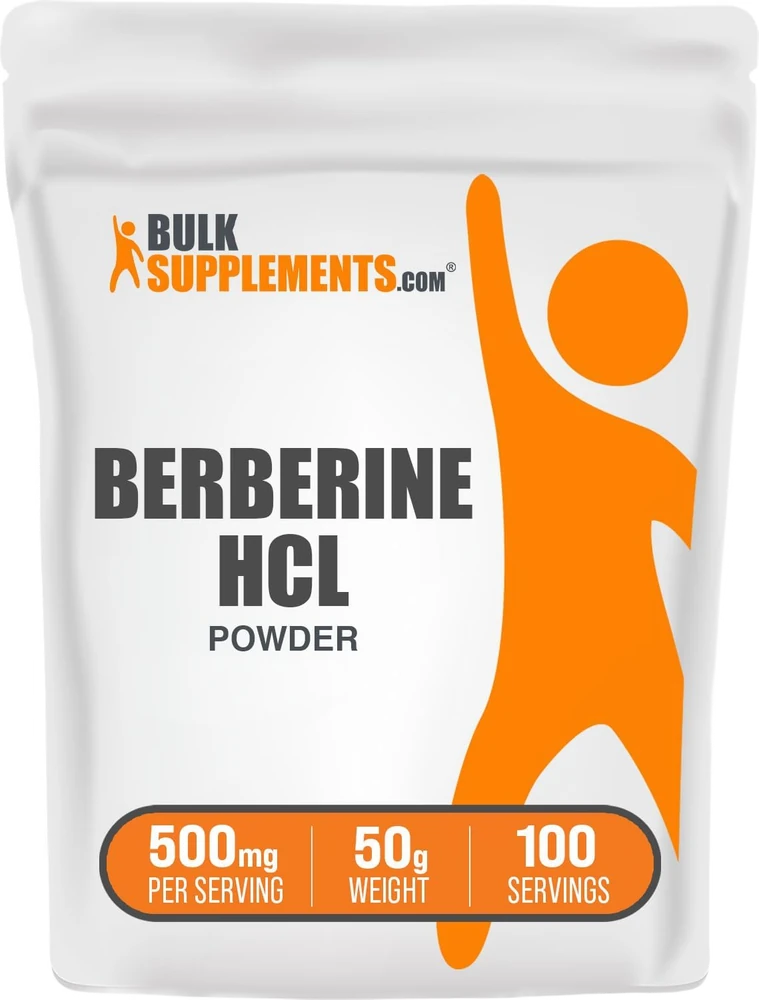
Best DIY budget (powder): Bulk Supplements Berberine HCl Powder
7.7SAC Score™Pure berberine HCl powder. Cheapest cost-per-gram in the entire category — but you're weighing it on a milligram scale yourself.
StrongestCost per active dose10.01WeakestDose accuracy at 1,500 mg/day6.0- Per serving
- 500 mg berberine HCl per ¼ tsp (label)
- Bag
- 50 g (100 servings · ~33 days at 1,500 mg/day)
- Testing
- Third-party tested, COA per batch
All five scores, pros & cons, full label
What We Like- Cheapest cost-per-gram of berberine on the market — by a wide margin
- Pure HCl, no fillers, no excipients, no capsule shell
- 50 g bag = 100 labeled 500 mg servings — about 33 days at 1,500 mg/day, still the best value-per-dose on this list
- Third-party tested with COA on every batch
What You Live With- You must own a 0.001 g milligram scale to dose accurately — eyeballing is dangerous
- Berberine is extremely bitter — needs to be mixed into a capsule or strong-tasting liquid
- No tablet / capsule format means worse adherence for most users
- Format niche limits this to DIY supplement hobbyists
- Form
- Berberine HCl pure powder
Our take — Bulk Supplements powder is the niche format pick. If you already own a milligram scale, are comfortable weighing your own doses, and want absolutely minimum cost-per-mg, this delivers the lowest cost per milligram on this list (price varies by bag size). For everyone else (95%+ of readers), capsule format wins on adherence and dose precision. Consider it only if you're already running a multi-substance DIY protocol with a scale on your kitchen counter.
Berberine In Four Short Lessons
Why dose + form are the entire game
- ~1%
- Oral bioavailability of berberine HCl — the math behind the 1,500 mg/day clinical dose
- −25%
- LDL reduction across 27 trials in the Lan 2015 meta-analysis
- −0.9%
- HbA1c drop at 1,500 mg/day berberine vs metformin 1,500 mg in Yin 2008
- −35%
- Triglyceride reduction in pooled metabolic-syndrome populations
Sources: Yin 2008 HbA1c meta (PMID 18442638); Lan 2015 lipid meta n=2,569 (PMID 25498346); Liu 2016 bioavailability review (PMID 26851175); Wei 2012 PCOS (PMID 22019891); Zhao 2017 AMPK (PMID 28241817).
Check the berberine per capsule.
The clinical target is 1,500 mg a day. 'Metabolic blend' bottles that sprinkle in 100-200 mg are why many people tried berberine and felt nothing.
Buy HCl unless you have a reason not to.
Berberine HCl is what 95% of the 30+ trials used. Split 500 mg across three meals to reach the target and blunt the loose-stool effect.
Pay for an upgrade form only to solve a problem.
Phytosome is 3-5x more bioavailable and worth its premium at maintenance dosing. Dihydroberberine costs 3-4x as much with a thinner trial base; choose it only if HCl's GI effects are intolerable.
Yin 2008 HbA1c / metformin head-to-head (PMID 18442638); Lan 2015 lipid meta of 27 RCTs, n=2,569 (PMID 25498346); Liu 2016 bioavailability review (PMID 26851175); Wei 2012 PCOS vs metformin (PMID 22019891).
Each pick was scored 0-10 across five criteria, then weighted to a final composite. Form bioavailability carries the most weight because it directly determines what's reaching circulation and which mechanism (systemic AMPK vs gut microbiome) is being engaged. Dose accuracy ensures you can actually hit the 1,500 mg/day clinical target without swallowing six pills. Testing standards filter fraud — at the budget tier some 'berberine' bottles have surprisingly low actual alkaloid content. Real-world response weight comes from product-reviewer CGM data + our own bloodwork patterns. Price per active dose is the final tie-breaker.
Form bioavailability · 30%
Phytosome (3-5× HCl) and dihydroberberine (5-10× HCl) score highest on raw absorption. HCl scores high on trial weight (95% of RCTs used it). Combo blends and generic 'berberine extracts' that don't specify form score lowest — the form decides everything.
Dose accuracy at split-dose 1,500 mg/day total · 25%
Per-cap dose must let you hit the Yin 2008 / Lan 2015 trial target of 1,500 mg/day with reasonable cap-count. 400-600 mg/cap scores full marks. Anything under 250 mg/cap means swallowing 6+ pills/day for clinical dose — gets penalised.
Testing standards · 20%
NSF Certified or USP grade scores highest. Patented branded forms (UltraSorb / Berberol with Indena's QC) get partial credit. GMP-certified facility + public COA scores mid. 'Tested in a facility' marketing language scores lowest.
Price per active dose · 15%
Monthly cost divided by daily clinical dose. HCl is cheaper per mg than phytosome — but phytosome's higher bioavailability narrows the gap at maintenance dosing. Tiebreaker — the first three criteria do most of the ranking.
Real-world glucose + weight response · 10%
Verified-purchaser CGM data, glucose-meter reviews, weight-change reports. Used as a check on the formulation criteria — a bottle that looks great on paper but produces zero response in 200+ reviewer-tracked datasets loses points here.

How berberine activates AMPK — the metformin-class mechanism
- 1
Berberine inhibits mitochondrial Complex I
Like metformin, berberine partially blocks the first step of the electron transport chain. Cellular ATP drops, AMP rises, the AMP:ATP ratio shifts — the cell's fuel sensor reads 'low fuel.'
- 2
AMPK switches on across tissues
Within hepatocytes, skeletal muscle, and adipose tissue, AMPK activates. GLUT4 transporters translocate to the cell surface, pulling glucose out of the blood. Fatty-acid oxidation ramps up; lipid + cholesterol synthesis shut down.
- 3
Gut microbiome shift adds the SCFA bonus
The ~99% of an oral dose that doesn't enter circulation stays in the intestinal lumen. It shifts the microbiome toward Akkermansia + Faecalibacterium — short-chain-fatty-acid producers that drive GLP-1 + PYY release. Insulin sensitivity improves through a second, parallel mechanism.
What to expect on a 12-week berberine protocol
GI adaptation phase
Loose stools, mild cramping, possible bloating — especially if you skipped the ramp. Metabolic effects not yet measurable. Stick with the ramp protocol; symptoms fade by week 3.
Postprandial glucose blunts first
CGM users see 15-25 mg/dL lower peaks after meals containing berberine. Fasting glucose hasn't moved much yet. This is the first measurable signal that the bottle is working.
Fasting glucose + early lipid shift
Fasting glucose drops 10-25 mg/dL on labs. Triglycerides start trending down. Weight begins to ease in metabolic-syndrome subjects (mostly visceral). HbA1c hasn't caught up yet.
Full lipid + HbA1c confirmation
Lipid panel: LDL −20-25%, triglycerides −30-35%, modest HDL bump. HbA1c reduction of 0.7-1.0% confirmed on bloodwork. Body composition shifts visible. Re-test labs at week 12 — this is the verdict point.
The bottom line
Nutricost Berberine HCl (#1) is the default first-time buy.
The cheapest legitimate full-dose HCl on Amazon: 600 mg pure berberine per cap, 2-3 caps/day reach the Yin 2008 clinical range, for $15/month. If you're walking into berberine cold and don't want the formulation rabbit hole, start here — and step up to Thorne (#3) only if NSF-certified testing matters more to you than price.
The other picks each own a clear niche.
Nutricost HCl (#1) if money is tight ($15/month, full clinical dose); Toniiq Ultra (#2) for full dose at minimum pill burden; Pure Encapsulations UltraSorb (#4) — phytosome, 3-5x bioavailability — for a sensitive gut or maintenance dosing. Picks #4, #7, #8 are situational (mid-tier, combo formulas, clinician-channel).
Two mistakes wreck more protocols than any brand choice.
Avoid combo bottles that bury 200 mg of berberine in a blend, and never stack berberine on top of metformin without clinician oversight — same AMPK mechanism means additive hypoglycemia risk, so replace rather than layer. Before buying, verify pure berberine at 400-600 mg per cap and run the 2-week ramp before judging the bottle.
Quick Answers
Berberine HCl vs phytosome vs DHB — which form should I actually buy?
Default to HCl. It's what 30+ RCTs used, it's the cheapest, and 1,500 mg/day split across meals reproducibly drops HbA1c 0.7-1.0% and triglycerides 30-35%. The ~1% bioavailability is already baked into the trial doses — you're not 'wasting' the other 99% because the gut-microbiome mechanism plays out in the intestinal lumen anyway. Phytosome is worth the premium ONLY if you're at maintenance dosing (500-1,000 mg/day) or have a sensitive gut. DHB is the right answer if HCl GI side effects are intolerable AND cost isn't the constraint — at $50+/month it's 3-4× the HCl tier.
Why is the clinical dose so big — 1,500 mg/day across three caps?
Because HCl bioavailability is ~1%. Most of an oral dose gets pumped back into the gut lumen by intestinal P-glycoprotein efflux pumps before it can reach systemic circulation. The 30+ trials dose for the ~1% that survives first-pass. Split across three meals also reduces peak luminal concentration — which is what drives the loose-stool side effect. Single-bolus 1,500 mg dosing produces both worse tolerability and identical plasma exposure to split dosing.
Can I take berberine if I'm already on metformin?
Only with clinician oversight, and not as a casual stack. Both substances activate AMPK and inhibit mitochondrial Complex I — the effects are additive on glucose-lowering, which means additive hypoglycemia risk. The Pérez-Rubio 2013 trial combined them in metabolic-syndrome subjects with explicit dose titration. The right framing is 'replace some metformin with some berberine,' not 'layer berberine on top of my prescription.' Coordinate with your endocrinologist before changing anything.
I'm getting bad loose stools — should I quit?
Ramp, split, then switch form before quitting. Step 1: drop back to 500 mg twice daily for two weeks. Step 2: never take more than 500 mg in a single dose — the GI effect scales with peak luminal concentration. Step 3: if HCl still triggers symptoms after ramping, switch to a phytosome formulation (Pure Encapsulations UltraSorb) — more of the dose enters circulation rather than sitting in the gut. About 5-10% of users are simply non-tolerators — for those, inositol or alpha-lipoic acid are better alternatives.
Are 'berberine + Ceylon cinnamon + bitter melon' combo bottles worth buying?
No. Combo formulas are marketing dilution — you typically get 200 mg berberine sprinkled inside a 1,200 mg 'metabolic blend' alongside under-dosed adjuncts. Hit clinical dose at 200 mg/cap means swallowing 7+ capsules per day. The single-ingredient picks on this list deliver 400-600 mg pure berberine per cap. If you want cinnamon or bitter melon in your stack, buy them as separate single-ingredient bottles at trial-tested doses — not as an excuse to underdose berberine.
How long until I see results?
Postprandial glucose blunts first — CGM users typically see 15-25 mg/dL lower peaks within 2-3 weeks. Fasting glucose drops 10-25 mg/dL by week 4-8. Lipid panel shifts (LDL −20-25%, triglycerides −30-35%) confirm by week 12. HbA1c trails by a full 12 weeks because the RBC turnover window has to complete. If nothing has moved at all by week 12 on a real 1,500 mg/day protocol, you're either a non-responder or your insulin resistance isn't the limiting factor — try inositol or alpha-lipoic acid.
What about pregnancy, breastfeeding, or other safety contraindications?
Hard contraindication for pregnancy and breastfeeding — berberine crosses the placenta, displaces bilirubin from albumin (jaundice risk in newborns), and induces uterine contractions in animal models. Drug interactions to know: berberine is a potent CYP3A4 inhibitor (raises levels of cyclosporine, tacrolimus, certain statins, calcium-channel blockers) and a P-glycoprotein inhibitor (raises digoxin, dabigatran). Coordinate with a clinician if you take any narrow-therapeutic-index drug. Long-term safety extends to 24 months at 1,500 mg/day in published trials.
Every Claim Ranked Above Traces Back To One Of These
6 peer-reviewed sources, each linked to PubMed
- [1] Yin 2008 PMID 18442638 — Efficacy of berberine in patients with type 2 diabetes mellitus. Berberine 500 mg 3×/day for 3 months matched metformin 1,500 mg/day on HbA1c, fasting glucose, and postprandial glucose in type-2 diabetics. The pivotal head-to-head trial that anchored berberine's 'natural metformin' positioning and established the 1,500 mg/day clinical dose used throughout this list.
- [2] Liu 2016 PMID 26851175 — Research progress on berberine with a special focus on its oral bioavailability. Comprehensive review of berberine's pharmacokinetics, bioavailability limitations (~1% for HCl due to P-glycoprotein efflux), and cardiometabolic indications across diabetes, dyslipidemia, and obesity. The foundational reference for why dosing is split + why DHB / phytosome formulations exist.
- [3] Lan 2015 PMID 25498346 — Meta-analysis of the effect and safety of berberine in the treatment of type 2 diabetes mellitus, hyperlipemia and hypertension. Pooled analysis of 27 RCTs (n=2,569) confirmed berberine reduces LDL ~25%, triglycerides ~35%, total cholesterol ~20%, and improves fasting + postprandial glucose vs placebo. The reference meta for berberine's cardiometabolic effect sizes — used here to set the realistic-expectations table on each pick.
- [4] Wei 2012 PMID 22019891 — A clinical study on the short-term effect of berberine in comparison to metformin on the metabolic characteristics of women with polycystic ovary syndrome. Berberine 500 mg 3×/day for 3 months matched metformin on insulin sensitivity, BMI, and waist-to-hip ratio in PCOS women, with a more favorable lipid profile (HDL up, LDL down, triglycerides down). The cornerstone PCOS trial — anchors the PCOS protocol recommendation on Pick #10 + the dose calculator goal preset.
- [5] Zhao 2017 PMID 28241817 — Berberine improves glucogenesis and lipid metabolism in nonalcoholic fatty liver disease. Mechanistic + clinical evidence that berberine's metabolic effects in NAFLD operate through AMPK activation in hepatocytes — reducing hepatic gluconeogenesis and de novo lipogenesis, improving liver enzymes and intrahepatic lipid content. The reference for the AMPK mechanism section.
- [6] Pérez-Rubio 2013 PMID 23808999 — Effect of berberine administration on metabolic syndrome, insulin sensitivity, and insulin secretion. Berberine 500 mg 3×/day for 3 months in metabolic-syndrome subjects improved insulin sensitivity (Matsuda index), reduced waist circumference, triglycerides, and systolic blood pressure vs placebo. Used here as the clinical anchor for the metabolic-syndrome use case and the metformin-combination caveat.
More Berberine Guides
- Best Form of Berberine: HCl vs Phytosome vs DHBHCl, phytosome, dihydroberberine and blends weighed by evidence vs absorption. HCl wins for most — it carries nearly all 30+ RCTs and its ~1% bioavailability is offset by the standard 1,000-1,500 mg/day split dose.
- Best Berberine for Blood SugarBerberine cut HbA1c 0.7-1.0%, matching metformin (Yin 2008). Ranked by form (HCl owns the glucose trials), the 1,500 mg/day dose, third-party testing, and drug-interaction transparency.
- Best Berberine for PCOSBerberine improves insulin resistance, androgens, and ovulation in PCOS (comparable to metformin, Wei 2012). Ranked by form, the 1,500 mg dose, and testing — with the pregnancy contraindication front-and-center.
- Best Berberine for Weight LossTen berberine products ranked for fat-loss outcomes — trial-dose HCl leads on score, with phytosome as the absorption upgrade for the systemic exposure adipose-tissue AMPK needs.
Affiliate disclosure: every Amazon link uses our Associates tag (superachieverclub-20). We earn a small commission at no cost to you; it funds independent reviews. We never accept payment to change a ranking.