
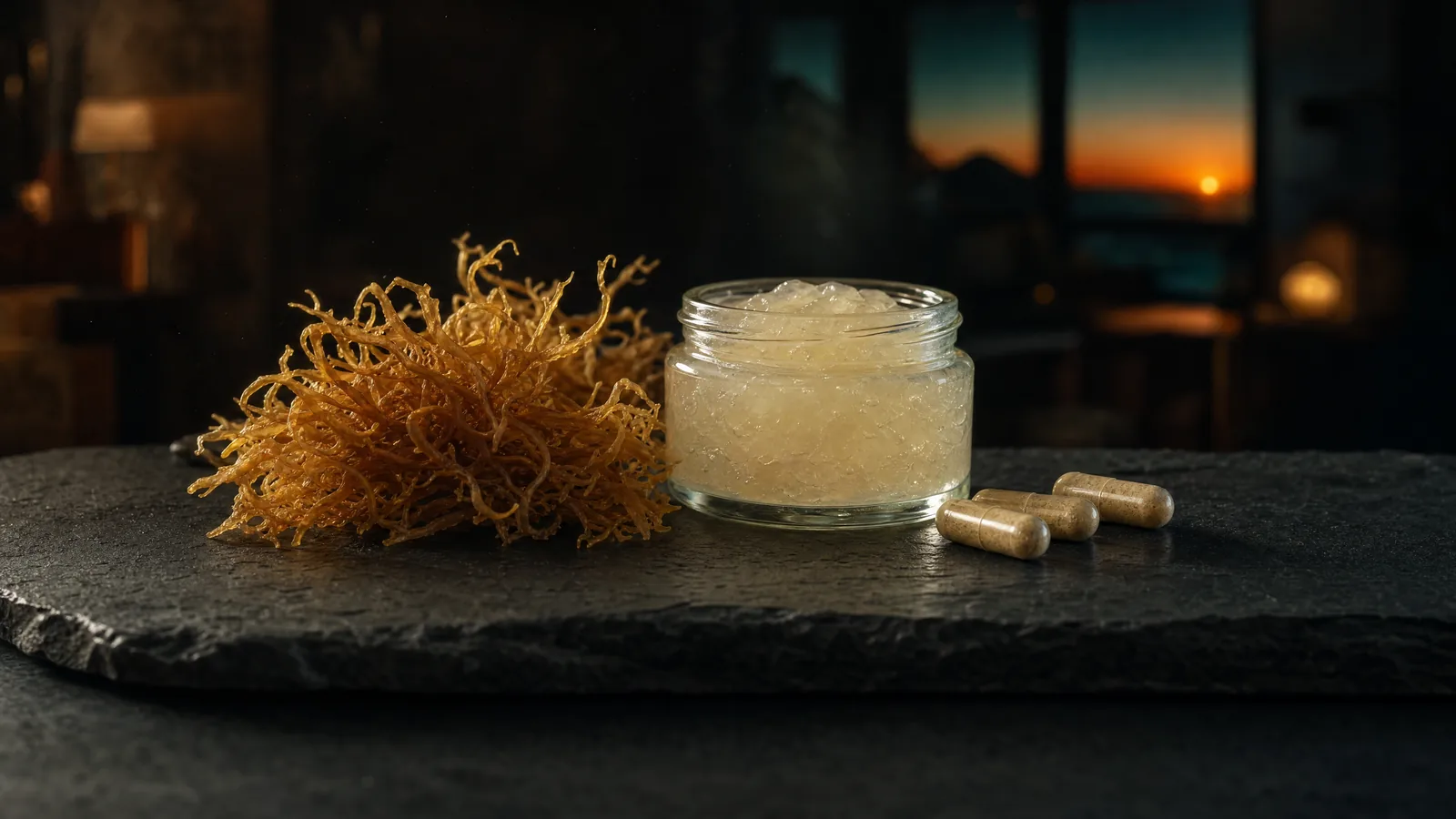
Sea Moss: Benefits, Dosage & Side Effects (2026)
Sea moss is a traditional Caribbean red seaweed (Chondrus crispus / Gracilaria) taken for its trace minerals and prebiotic fiber — a nutrient-bearing whole food, not a clinically proven cure, with a real, variable-iodine thyroid caveat.
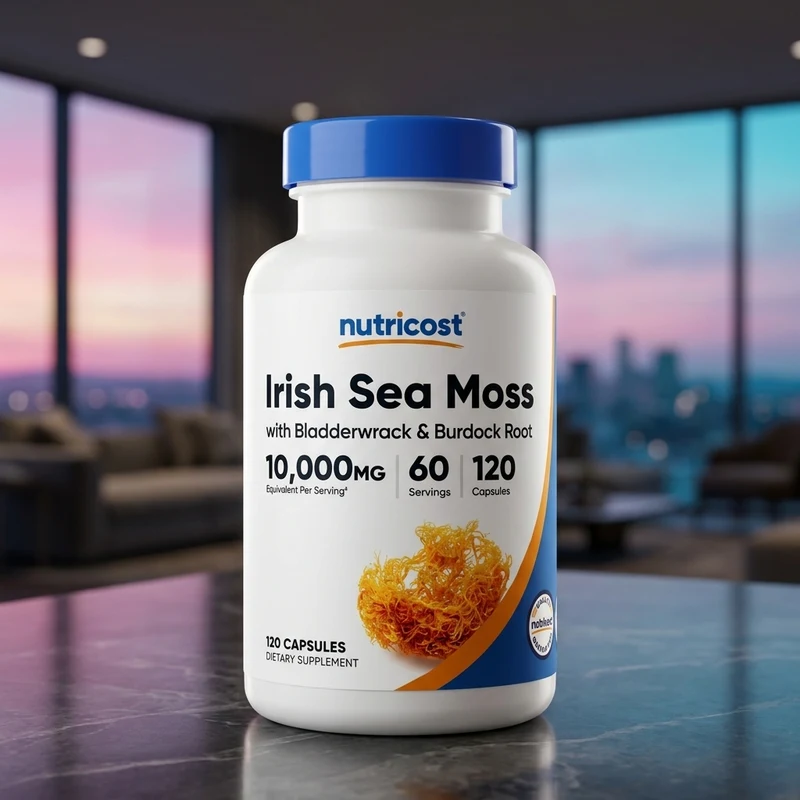
Nutricost Irish Sea Moss Extract (with Bladderwrack & Burdock Root)
What is Sea Moss?
Sea moss is a red seaweed — most often Chondrus crispus (the original "Irish moss" of the North Atlantic) or Gracilaria species (the warm-water seaweed sold as much of today's "sea moss") — that has been eaten and used as a folk remedy for generations, especially across Ireland and the Caribbean. Traditionally it's soaked and blended into a gel and stirred into smoothies, teas, soups and sauces; today it's also sold as capsules, powders and gummies. Its appeal is its nutrient profile: sea moss genuinely contains a range of trace minerals (iron, calcium, magnesium, iodine) plus the gel-forming sulfated polysaccharides — carrageenans — that give it its texture and its prebiotic-fiber reputation.
The single most important thing to understand before buying one is what sea moss is NOT: it is not the "92 minerals" miracle the marketing implies. The famous "92 minerals" line is a marketing figure, not a verified nutrition label, and the headline claims — that sea moss supercharges your thyroid, heals your gut and clears your skin — come from tradition and anecdote, not from human clinical trials. That doesn't make it worthless. It's a real whole food, and the lab work on Chondrus crispus is legitimately interesting (mineral content, sulfated polysaccharides, antioxidant and cytotoxic activity in test tubes). But that is compositional and bench science; the leap from "contains interesting compounds" to "does these things in your body" simply hasn't been made in good human studies yet. The right mental model is a nutrient-bearing traditional food you might enjoy — not a proven supplement that fixes a specific problem.
The category is also unusually variable in form and honesty. Sea moss comes as raw gel (the traditional whole-food form, but perishable and the most variable in dose), capsules (the most measurable, often disclosing real milligrams), and gummies (the easiest to take but usually the lowest and least-disclosed dose). It's sold as single-herb sea moss or as the popular sea moss + bladderwrack + burdock "trio." And sourcing ranges from explicitly wildcrafted to unspecified pool-grown. Because a seaweed concentrates whatever was in the water it grew in — minerals, but also iodine and potential heavy metals — sourcing transparency and testing matter more than any mineral-count claim on the front of the jar. The defining buyer decisions are therefore form, honest dosing, wildcrafted-vs-pool-grown sourcing, and heavy-metal/iodine testing — not the headline number of minerals.
How it works
Sea moss doesn't have one proven mechanism — it's a nutrient-bearing food whose popular "benefits" rest on three different kinds of reasoning, and the honest picture separates what's plausible from what's marketed.
FIRST, the COMPOSITIONAL case is the real one: sea moss is a genuine source of trace minerals and bioactive compounds. A compositional study found Chondrus crispus was the richest of three seaweeds in calcium, iron, manganese and zinc, with polyunsaturated fatty acids and in-vitro anticancer activity (Čmiková 2024, PMID 39598320), and a review of the Chondrus genus catalogued antioxidant, anti-inflammatory, immunomodulatory and anti-tumor activities — reported largely in vitro and in animal models (Park 2024, PMID 38248672). This establishes that sea moss contains genuinely bioactive constituents. The catch, stated plainly: this is bench and cell science, not human efficacy. "Contains compounds with activity in a dish" is not the same as "improves your thyroid, gut or skin when you eat it," and the popular health claims live in that gap.
SECOND, the GUT story is the most mechanistically plausible but cuts both ways. Sea moss is largely carrageenan — sulfated polysaccharides that act as gel-forming soluble fiber, the basis of its "prebiotic" and "gut-soothing" reputation. But the same compound is debated: a review summarized evidence that carrageenan can promote intestinal inflammation in animal and cell models, while noting it's unlikely to be a sole cause of inflammatory bowel disease in humans (Komisarska 2024, PMID 38732613). So the honest read is that the headline gut-healing claim is unproven, and the very compound credited with the benefit also carries a debated irritation concern — a reason for moderation, not mega-dosing.
THIRD, the THYROID claim is where mechanism becomes a SAFETY issue, and it's the most decision-relevant part of this whole page. Sea moss carries iodine, and iodine is essential for thyroid hormone — which is the kernel of truth behind "sea moss supports your thyroid." But the relationship between iodine and thyroid function is U-shaped: too much disrupts the thyroid just as too little does (Smyth 2021, PMID 33981614), and a meta-analysis of 50 studies found excess iodine intake was associated with markedly higher odds of hypothyroidism (Katagiri 2017, PMID 28282437). Sea moss's iodine content is naturally variable batch-to-batch, and real human data on seaweed consumers show iodine exposure can run above tolerable limits depending on the product (Aakre 2020, PMID 33202773). The sea moss + bladderwrack + burdock trio stacks even more iodine, because bladderwrack is itself iodine-rich. The honest bottom line on mechanism: sea moss is a real mineral-bearing food with interesting bench science, but its marketed benefits are unproven in humans, and the one mechanism that's well established — iodine's effect on the thyroid — is as much a risk as a benefit when the dose is high and unpredictable.
At-a-glance facts
- What it actually is
- A traditional mineral-bearing red seaweed (Chondrus crispus / Gracilaria) — a whole food, NOT a clinically proven cure
- The "92 minerals" claim
- A marketing figure, not a verified nutrition label — judge on disclosed dose, not mineral count
- Typical use
- Gel ~1–2 tbsp daily; capsules often ~1,200mg/serving; gummies usually undisclosed
- Forms
- Raw gel (traditional, perishable) · capsule (most measurable) · gummy (easiest, lowest dose)
- Single vs trio
- Single-herb sea moss, or the sea moss + bladderwrack + burdock "trio" — the trio adds MORE iodine
- Evidence picture
- Compositional + in-vitro/animal bench science (Park 2024, Čmiková 2024); no human efficacy trials
- The real caveat — iodine
- Variable and rarely declared (90% of labels state none); measured Chondrus crispus is modest at ~3.86–16 µg/g
- Iodine reference points
- RDA 150 µg/day (NIH ODS) · US upper limit 1,100 µg/day (Institute of Medicine / NASEM, adults 19+); EFSA sets 600
- Where the iodine really is
- Bladderwrack ~120 µg/g vs Irish moss ~16 µg/g — in a trio, the bladderwrack drives the dose (PMID 33889064)
- Biggest buyer decision
- Form & honest dosing + wildcrafted-vs-pool-grown sourcing + heavy-metal/iodine testing
- Safety note
- Thyroid condition / on thyroid meds / pregnant → talk to a clinician before supplementing
- Cost range (US)
- ~$0.22 to $0.50 per capsule serving; raw gels ~$30 per jar
Evidence: The thinnest human-efficacy base on this site. The real science on Chondrus crispus is COMPOSITIONAL and BENCH work — sea moss is a genuine source of minerals and bioactive sulfated polysaccharides with antioxidant/anti-tumor activity in vitro and in animals (Park 2024 PMID 38248672; Čmiková 2024 PMID 39598320) — not proof those effects occur in people. The popular "92 minerals," thyroid, gut and skin claims are traditional and anecdotal. The strongest, most decision-relevant evidence here is on the IODINE/THYROID RISK the marketing ignores: iodine's effect on the thyroid is U-shaped and excess is harmful (Smyth 2021 PMID 33981614; Katagiri 2017 PMID 28282437; Aakre 2020 PMID 33202773), and carrageenan — the bulk of sea moss — carries a debated gut-irritation concern (Komisarska 2024 PMID 38732613). Treat sea moss as a traditional food, not a proven cure.
Who it's for — and who it isn't
- People who want to add a traditional, mineral-bearing whole food (iron, calcium, magnesium, iodine) to a varied diet — as food, not as a proven cure
- Buyers who'll choose on what's verifiable — disclosed milligrams, wildcrafted sourcing, heavy-metal/iodine testing — rather than on "92 minerals" marketing
- Smoothie and whole-food enthusiasts who like the raw-gel form blended into drinks, teas, soups or sauces
- People drawn to the prebiotic-fiber angle who understand the evidence is preliminary and will use it in moderation, not mega-dose
- Anyone who wants to try the popular sea moss habit but with eyes open about the iodine caveat and a single-herb or fully-disclosed product
- Anyone with a thyroid condition, on thyroid medication, or pregnant/breastfeeding — variable, sometimes-high iodine makes this a talk-to-your-clinician-first supplement
- People expecting a proven thyroid, gut, skin or immune treatment — those claims are traditional and anecdotal, not demonstrated in human trials
- Buyers who would mega-dose the sea moss + bladderwrack + burdock trio on faith — bladderwrack stacks even more variable iodine on top
- Anyone who wants a precisely-dosed, verified supplement — raw gels and many gummies don't disclose milligrams, and iodine content is inherently variable
- People with a known carrageenan/seaweed sensitivity, or active inflammatory bowel concerns who want to avoid a debated gut irritant
Week-by-week, what happens
- Day 1No felt change should be expected. Sea moss is a mineral-bearing food, not an acute-acting supplement — early 'energy' or 'clarity' impressions are easily placebo or just the hydration from a smoothie.
- Week 1-2The most plausible early, real effect is digestive: as a gel-forming soluble fiber (carrageenan), sea moss may shift bowel regularity, and some people notice mild gas or bloating. This is a fiber effect, not proof of 'gut healing.'
- Week 3-4No human trials map this window, so there's nothing established to expect — no verified thyroid, skin or immune change. If anything, this is the point to re-check the iodine question, especially on a bladderwrack trio.
- Month 2+Sustained use functions as a minor dietary addition of trace minerals and fiber. There's no evidence of accumulating, transformative benefits — and with daily high-iodine products, the relevant long-term signal is thyroid load, not a building 'cure,' so moderation and (if relevant) clinician input matter more than persistence.
Safety & contraindications
- Iodine is the caveat that actually matters, and it deserves precision rather than alarm. Sea moss's iodine content is VARIABLE and RARELY DECLARED — but on published measurements it is not inherently high: Chondrus crispus runs about 3.86 µg per gram (PMID 32803579) to 16 µg/g (PMID 33889064), against an adult RDA of 150 µg/day (NIH Office of Dietary Supplements) and a US tolerable upper limit of 1,100 µg/day (Institute of Medicine / NASEM, adults 19+). One analysis calculates you would need roughly 286 g of dried Irish moss a day to breach that limit. Always check which body a stated upper limit comes from: EFSA's adult figure is 600 µg/day, and the WHO publishes no adult µg/day limit at all. Excess iodine is still not harmless — the iodine–thyroid relationship is U-shaped, and excess intake has been linked to higher odds of hypothyroidism — so the risk here is dosing blind, not the seaweed being potent.
- The sea moss + bladderwrack + burdock "trio" deserves a specific warning, because the iodine is mostly not coming from the sea moss. Measured in the same analysis, bladderwrack averaged 120 µg of iodine per gram against Irish moss's 16 µg/g — about seven times more (PMID 33889064). Since most trio labels quantify the sea moss and leave the bladderwrack blank, the ingredient driving your iodine dose is usually the one with no number attached. Single-herb sea moss keeps the picture simpler (though still variable).
- Anyone with a thyroid condition, on thyroid medication, or who is pregnant should talk to a clinician before supplementing sea moss. Breastfeeding warrants a stronger line than caution: the NIH's Drugs and Lactation Database notes that sea moss carries iodine plus heavy metals — arsenic, lead, cadmium and mercury — absorbed from the water it grew in, that maternal excess iodine from seaweed has caused thyroid suppression in breastfed infants, and that sea moss should be avoided while breastfeeding unless iodine and heavy-metal levels have been shown to be low enough to be safe (LactMed, PMID 41730053). This is not a supplement to mega-dose on faith.
- Sourcing drives both the mineral profile AND the contaminant load. A seaweed takes up whatever was in its water, including heavy metals — so prefer products that are explicitly wildcrafted and state heavy-metal, microbial or iodine testing, and treat listings that won't say whether they're wildcrafted or pool-grown with caution.
- Sea moss is largely carrageenan, a sulfated polysaccharide credited with its prebiotic/gut-soothing reputation — but the same compound can promote intestinal inflammation in animal and cell models (while being unlikely to be a sole cause of IBD in humans). It's a reason for moderation rather than mega-dosing, and a consideration for anyone with sensitive digestion.
- Raw gels are perishable: refrigerate after opening and use within roughly 3–4 weeks (or freeze). And remember the overarching honesty — sea moss is a traditional food, not a proven treatment, so don't replace medical care or a balanced diet with it.
All articles on Sea Moss
Best Sea Moss
The 9 best sea moss supplements ranked on form and honest dosing (capsule vs gel vs gummy), sourcing and purity (wildcrafted vs pool-grown, iodine & heavy-metal testing), formula transparency, value and taste — with the honest caveat that the health claims are largely traditional and variable iodine content is a real thyroid consideration.
Read →American Standard Organic Sea Moss, Bladderwrack & Burdock Root Capsules Review
The only trio that itemizes every milligram — transparency that also exposes the iodine load.
Read →Carlyle Irish Sea Moss Capsules (Complex with Bladderwrack & Burdock Root) Review
The cheapest trio on-ramp — a recognizable brand at the lowest entry price, with the trade-offs you'd expect.
Read →Double Wood Irish Sea Moss Capsules, 1,200mg per Serving Review
The cleanest single-herb capsule — disclosed 1,200mg, explicitly wildcrafted, simpler iodine picture.
Read →EverSmith Organics Wildcrafted Irish Sea Moss Gel (Mango Pineapple) Review
The traditional whole-food form — raw, wildcrafted, and the best-tasting way to take sea moss.
Read →MaryRuth Organics Sugar Free Sea Moss Gummies (Irish Sea Moss) Review
The easiest format from a trusted clean-label name — gated only by an undisclosed dose.
Read →NatureBell 3-in-1 Sea Moss Complex (with Organic Bladderwrack & Burdock Root) Review
The cheapest-per-serving trio — 240 capsules of the classic stack, if you accept the sourcing gap.
Read →Nutricost Irish Sea Moss Extract (with Bladderwrack & Burdock Root) Review
The low-risk default — the full trio from an NSF-certified facility at the best per-serving price.
Read →Peak Performance Wild Harvested Organic Sea Moss Capsules, 1,200mg Review
Wild-harvested single-herb sea moss with the dose you can actually see — at a slight premium.
Read →TrueSeaMoss Sea Moss Gummies with Bladderwrack & Burdock Root Review
The full trio in the easiest format — but the least-verifiable dose and iodine load in the lineup.
Read →FAQ
Does sea moss actually do what the marketing claims — or is it hype?
Mostly hype, with a kernel of truth. Sea moss is a real, nutrient-bearing traditional food, and the lab work on Chondrus crispus is genuinely interesting — it's a legitimate source of minerals like iron, calcium and iodine, plus sulfated polysaccharides with antioxidant and other activity in test-tube studies. But the viral selling points — the "92 minerals" figure, supercharged thyroid, healed gut, glowing skin — are tradition and anecdote, not human clinical evidence. The real science is compositional and bench work; the leap from "contains interesting compounds" to "does these things in your body" hasn't been made in good human studies. Buy it as a mineral-bearing food you enjoy, not as a proven cure.
Is the "92 minerals" claim true?
No — "92 minerals" (sometimes "102") is a marketing figure, not a verified nutrition label, and you should treat it as a red flag rather than a selling point. Sea moss genuinely contains a range of trace minerals, but no standard nutrition panel certifies 92 of them, and a high mineral count tells you nothing about how much of any useful nutrient you actually get per serving. That's exactly why this site judges sea moss on what's checkable — the disclosed milligrams of sea moss, the form, the sourcing and the testing — instead of mineral-count theatre. A product that tells you it delivers 1,200mg beats one that shouts "92 minerals" and hides the dose.
Is sea moss safe for your thyroid?
This is the most important safety question, and the honest answer is: it depends on the dose, and the dose is unpredictable. Sea moss carries iodine, which the thyroid needs — but the iodine–thyroid relationship is U-shaped, so too much disrupts thyroid function just as too little does, and excess iodine is linked to higher odds of hypothyroidism. Sea moss's iodine content is naturally variable batch-to-batch, and the popular sea moss + bladderwrack + burdock trio stacks even more iodine because bladderwrack is itself iodine-rich. If you have a thyroid condition, take thyroid medication, or are pregnant or breastfeeding, talk to a clinician before you start — this is not a supplement to mega-dose on faith.
Gel, capsule, or gummy — which form should I choose?
It's a trade-off between tradition, dose-honesty and convenience. Raw GEL is the most traditional, whole-food form — blendable into smoothies, teas and sauces — but it's perishable and its per-serving mineral and iodine content is the most variable and least quantified. CAPSULES are the most measurable: the best ones disclose real milligrams of sea moss per serving (around 1,200mg is common), which is the form to choose if you want to know what you're getting. GUMMIES are the easiest to take and the most palatable, but usually deliver the lowest and least-disclosed dose. If verifiable dosing matters most, choose a capsule; if you want the traditional experience, choose a wildcrafted gel and use it in moderation.
Single-herb sea moss or the bladderwrack + burdock "trio"?
Neither is automatically better, and the trio is not the upgrade it's often sold as. Single-herb sea moss keeps the iodine picture simpler (though still variable) and is the cleaner choice if your thyroid is a concern or you just want sea moss and nothing else. The sea moss + bladderwrack + burdock trio is the popular traditional stack, but bladderwrack is itself iodine-rich, so a trio adds more — and more variable — iodine on top. If you do want the trio, favor one that discloses the exact milligrams of each botanical rather than hiding them in a proprietary blend, so you can at least see what you're taking. And whichever you choose, the iodine caution applies more, not less, to the trio.
Will sea moss heal my gut or improve my skin?
There's no good human evidence that it does either, despite being two of its most popular claims. The gut angle has the most mechanistic plausibility because sea moss is largely carrageenan, a gel-forming soluble fiber — but that's also the catch: the same carrageenan can promote intestinal inflammation in animal and cell models, so the headline "gut-healing" story is both unproven and double-edged, a reason for moderation rather than mega-dosing. The skin claim rests on the idea that its minerals support skin, but that hasn't been demonstrated in trials. Treat any digestive change as a normal fiber effect and any skin benefit as unproven — sea moss is a traditional food worth enjoying on its own terms, not a clinically proven gut or skin treatment.
Sources & further reading
- Smyth 2021Iodine, Seaweed, and the Thyroid
A review of the rising profile of seaweed in Western diets and its thyroid implications: seaweeds can be both a useful iodine source and a source of excessive, highly variable iodine intake, and individuals with underlying thyroid disease are most susceptible to iodine-induced dysfunction. This is the core, decision-relevant honesty of this page — the safety axis the '92 minerals' marketing ignores.
- Katagiri 2017Effect of excess iodine intake on thyroid diseases in different populations: A systematic review and meta-analyses including observational studies
Pooling 50 studies, excess iodine intake was associated with markedly higher odds of overt and subclinical hypothyroidism versus adequate intake (odds ratios ~2.78 and ~2.03 in adults). Direct evidence that too much iodine — exactly what an unpredictably high-iodine sea moss or bladderwrack batch can deliver — is a real thyroid risk, not a theoretical one.
- Aakre 2020Iodine Status and Thyroid Function in a Group of Seaweed Consumers in Norway
In habitual seaweed consumers, urinary iodine and thyroid markers varied widely, with some participants reaching iodine intakes above tolerable limits depending on the seaweed product consumed. Real human data showing that seaweed-derived iodine exposure is inconsistent and can run high — the practical basis for treating variable-iodine sea moss with caution.
- Park 2024An Update on the Chemical Constituents and Biological Properties of Selected Species of an Underpinned Genus of Red Algae: Chondrus
A review cataloguing the chemical constituents of Chondrus (the genus of Irish sea moss) and a range of biological activities — antioxidant, anti-inflammatory, immunomodulatory and anti-tumor — reported largely in vitro and in animal models. Establishes that sea moss contains genuinely bioactive compounds, while being explicit that this is bench and compositional science rather than human efficacy proof.
- Čmiková 2024Seaweed Nutritional Value and Bioactive Properties: Insights from Ascophyllum nodosum, Palmaria palmata, and Chondrus crispus
A compositional study finding Chondrus crispus (sea moss) was the richest of the three seaweeds in calcium, iron, manganese and zinc, with polyunsaturated fatty acids and in-vitro anticancer activity. Confirms sea moss is a real mineral-bearing food — but the data are nutritional and cell-based, underscoring that the popular health claims remain unproven in humans.
- Komisarska 2024Carrageenan as a Potential Factor of Inflammatory Bowel Diseases
A review summarizing evidence that carrageenan — the sulfated polysaccharide that makes up much of sea moss and its gels — can promote intestinal inflammation in animal and cell models, while noting it is unlikely to be a sole cause of IBD in humans. A measured counterpoint to the 'gut-healing' marketing: the same compound credited with benefits also carries debated gut-irritation concerns.