
Milk Thistle: Benefits, Dosage & Side Effects (2026)
Milk thistle (silymarin) is the traditional liver-support herb, standardized to a complex of flavonolignans led by silibinin; it has genuine antioxidant and membrane-stabilizing biology, but rigorous trials — a Cochrane review and a NASH RCT among them — found no clear benefit on hard outcomes, leaving it a low-to-moderate-evidence support agent whose most consistent signal is a modest drop in liver enzymes.
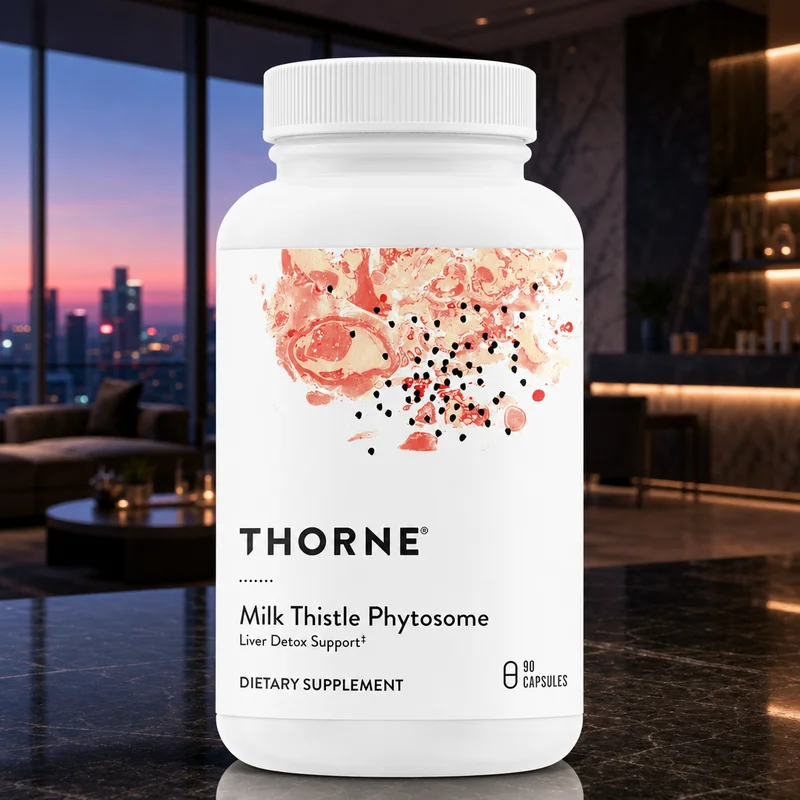
Thorne Milk Thistle Phytosome (Formerly Siliphos), 90 Capsules
What is Milk Thistle?
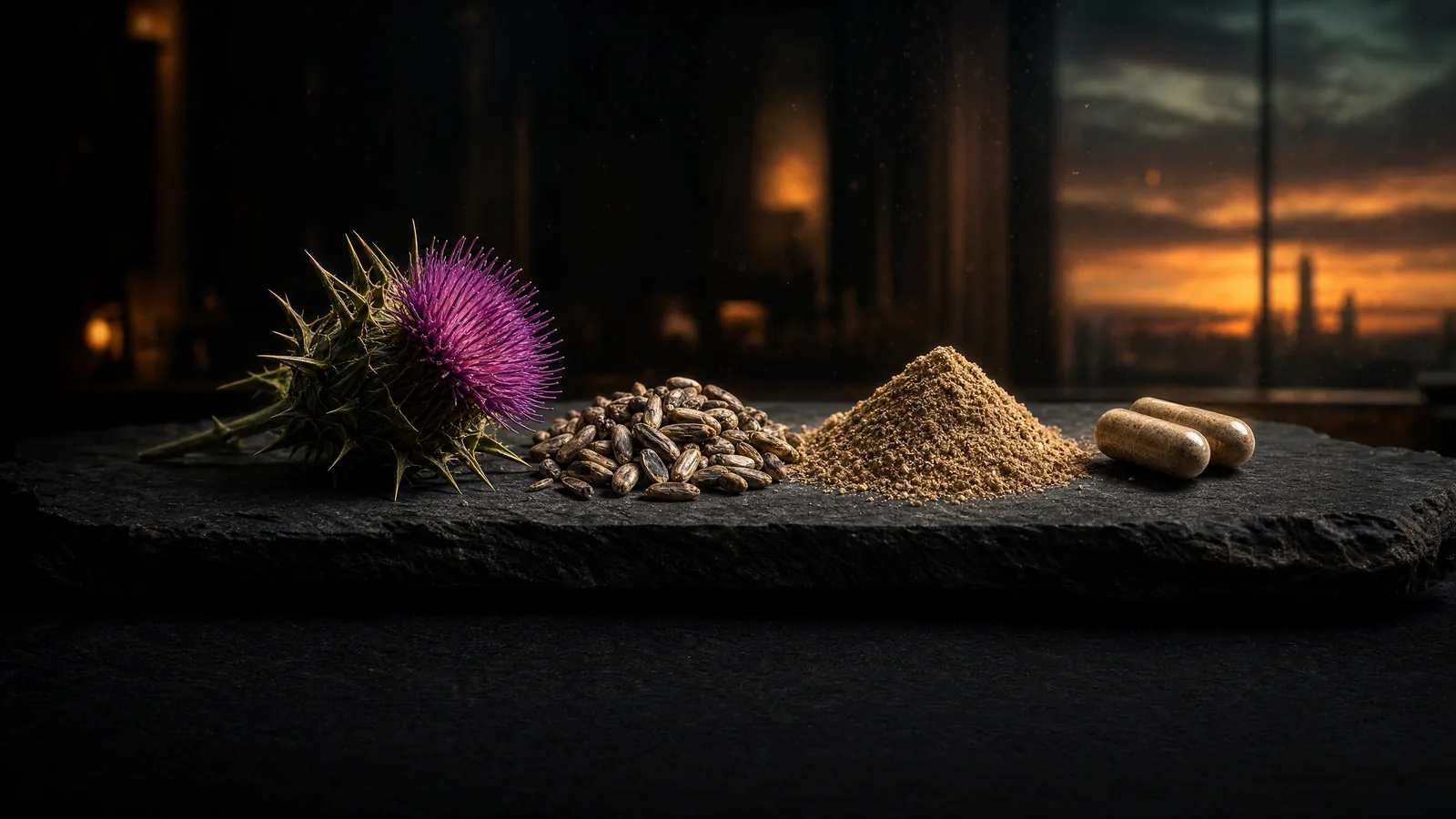
Milk thistle is an extract of the seeds of Silybum marianum, a spiny Mediterranean plant in the daisy (Asteraceae) family used as a liver remedy for two millennia. Its active fraction is silymarin — not a single molecule but a complex of flavonolignans (silibinin, also spelled silybin, plus silychristin and silydianin) together with the flavonoid taxifolin. Silibinin is the most biologically active of these, so a product's real strength depends on two numbers: how much silymarin it contains and how much of that silymarin is silibinin. Quality extracts are standardized to roughly 70-80% silymarin; a raw "milk thistle seed" capsule with no percentage on the label can contain a small and unpredictable fraction of the active compounds.
The second axis — the one most buyers miss — is absorption. Silymarin is poorly water-soluble and poorly absorbed from the gut, so a large share of an ordinary capsule never reaches the bloodstream. This is why the more serious formulations use a phospholipid complex, binding silibinin to phosphatidylcholine (the branded silybin-phosphatidylcholine complex Siliphos / IdB1016) to raise absorption several-fold over plain extract. Milk thistle therefore has the same practical problem as curcumin: standardized silymarin percentage plus a bioavailability-enhanced form are what separate a product that delivers a meaningful dose from a cheap powder that mostly passes through you.
It is also worth separating the supplement from milk thistle's one genuinely strong clinical use. Intravenous silibinin (Legalon SIL) is a recognized hospital antidote for Amanita phalloides ("death cap") mushroom poisoning, where it helps block toxin uptake into liver cells. That is a purified drug given by infusion under medical supervision — not the same thing as an oral capsule for everyday liver health, and its success does not transfer to the supplement's much weaker case for treating chronic liver disease.
How it works
On paper, milk thistle's biology is attractive. Silibinin is a direct free-radical scavenger that also raises intracellular glutathione, the liver's main antioxidant defense. It stabilizes the hepatocyte cell membrane, which is thought to reduce uptake of toxins (the mechanism behind the intravenous Amanita antidote), and in preclinical models it damps NF-κB-driven inflammation, inhibits stellate-cell activation (the driver of fibrosis), and stimulates ribosomal RNA polymerase I to support hepatocyte protein synthesis and regeneration. That is a plausible, multi-target hepatoprotective profile — which is exactly why the herb has such a strong reputation.
The problem is that this mechanistic promise has not translated cleanly into hard clinical outcomes. The Cochrane review by Rambaldi and colleagues (PMID 17943794) pooled randomized trials of milk thistle in alcoholic and hepatitis B/C liver disease and found no significant effect on all-cause mortality or liver-related complications; when the analysis was restricted to high-quality, low-bias trials, the apparent benefits disappeared. The earlier Rambaldi 2005 systematic review in the American Journal of Gastroenterology (PMID 16279916) reached the same null conclusion. Most tellingly, the modern NASH RCT by Wah Kheong and colleagues (PMID 28419855) gave non-alcoholic steatohepatitis patients silymarin at 2,100 mg/day and missed its primary histologic endpoint — the reduction in NAFLD activity score was numerically larger than placebo but not statistically significant.
So how should a reader weigh this? The most defensible read is that milk thistle is a low-risk antioxidant support agent with a modest, fairly consistent ability to nudge liver enzymes (ALT/AST) down, but without demonstrated benefit on the outcomes that matter most — mortality, cirrhosis progression, or liver histology. A more favorable narrative review by Gillessen and Schmidt (PMID 32065376) emphasizes enzyme, symptom, and quality-of-life improvements, but a narrative review sits at a lower evidence tier than the Cochrane meta-analysis and does not overturn the null findings on hard endpoints. Milk thistle is best understood as an adjunct, judged on bloodwork over months, not as a treatment that reverses liver disease.
At-a-glance facts
- Active compound
- Silymarin — a complex of flavonolignans led by silibinin (silybin); extracts standardized to ~70-80% silymarin
- Trial dose
- ~420 mg/day silymarin is common (140 mg x3); the NASH RCT pushed to 2,100 mg/day (Wah Kheong 2017)
- Form matters
- Silymarin is poorly water-soluble; phospholipid complexes (silybin-phosphatidylcholine, Siliphos/IdB1016) raise absorption several-fold
- Evidence reality
- Cochrane found no clear mortality/complication benefit; a modest ALT/AST enzyme drop is the most consistent finding
- Mechanism
- Antioxidant + glutathione support, hepatocyte membrane stabilization, anti-inflammatory and antifibrotic in preclinical models
- Established pharma use
- IV silibinin (Legalon SIL) is a recognized antidote for Amanita death-cap mushroom poisoning — a hospital drug, not the oral supplement
- Time to felt effect
- No acute effect; enzyme changes are measured over 8-24 weeks of bloodwork, not felt symptoms
- Safety
- Very well tolerated; mild GI/laxative effect at high doses; caution with ragweed-family allergy
Evidence: Evidence is genuinely mixed and, for hard outcomes, largely null. The Cochrane review (Rambaldi 2007, PMID 17943794) and the earlier Rambaldi 2005 systematic review (PMID 16279916) found no significant effect on mortality or complications in alcoholic and hepatitis B/C liver disease, with benefits vanishing in high-quality trials. The modern NASH RCT (Wah Kheong 2017, PMID 28419855) missed its primary histologic endpoint even at 2,100 mg/day. A more favorable narrative review (Gillessen 2020, PMID 32065376) reports enzyme and symptom improvements but sits at a lower evidence tier. The one consistent thread is a modest reduction in liver enzymes (ALT/AST); the real axes for a useful product are standardized silymarin percentage and phospholipid-enhanced absorption.
Who it's for — and who it isn't
- People with fatty liver or mildly elevated liver enzymes who want a low-risk antioxidant adjunct — with realistic expectations, since the signal is a modest ALT/AST nudge, not a cure
- Anyone who values traditional hepatoprotective support and is willing to buy a properly standardized (70-80% silymarin), absorbable form rather than cheap seed powder
- People in an alcohol-reduction or general liver-health push who want a well-tolerated add-on layered on top of the real drivers (abstinence, weight loss)
- Supplement stackers pairing it with metabolic and anti-inflammatory agents for a NAFLD-focused protocol
- Buyers who understand the herb is an adjunct and treat lifestyle and medical care as the actual levers
- Anyone expecting it to reverse cirrhosis, cure hepatitis, or reduce mortality — the Cochrane review found no clear benefit on those hard outcomes
- People treating serious liver disease as a substitute for antivirals, abstinence, weight loss, or medical care — milk thistle is an adjunct at best
- Anyone allergic to the Asteraceae/ragweed family (ragweed, daisies, marigolds, chrysanthemums) — cross-reactivity is possible
- Buyers of cheap 'milk thistle' capsules with no silymarin percentage and no absorption enhancer — that's the form neither the good extracts nor the trials resembled
Week-by-week, what happens
- Week 1-2No felt change — milk thistle has no acute or perceptible effect. It is a slow biochemical support agent judged on lab values, not on how you feel.
- Week 4-8Any liver-enzyme (ALT/AST) movement begins to appear on bloodwork in responders. The effect is modest and not universal; many people see little change.
- Week 8-24The window trials used to measure enzyme and steatosis changes. Expect small shifts at best — the NASH RCT still missed its histologic endpoint over 48 weeks (Wah Kheong 2017).
- OngoingSupport agent only. Any benefit depends on continued dosing plus the real drivers — alcohol reduction, weight loss, and treating the underlying cause. It does not fix the liver on its own.
Safety & contraindications
- Very well tolerated at supplement doses; the most common complaint is mild GI upset or a laxative/loose-stool effect, usually at higher doses.
- Milk thistle is in the Asteraceae (ragweed/daisy) family — people allergic to ragweed, chrysanthemums, marigolds, or daisies can cross-react, so avoid it if you have that allergy.
- It can mildly affect drug-metabolizing (CYP) enzymes in lab studies; clinically important interactions are uncommon, but check with a pharmacist if you take narrow-therapeutic-index medications.
- It may have mild blood-glucose-lowering effects — people with diabetes on medication should monitor for lows.
- It is an adjunct, not a treatment. Do not use it to replace antivirals, abstinence, weight loss, or medical care for diagnosed liver disease.
- Buy standardized (70-80% silymarin) extracts, ideally phospholipid-complexed, from brands that publish third-party testing — cheap seed powders vary widely in actual silymarin content.
All articles on Milk Thistle
Best Choline Supplements
9 choline supplements ranked on form and bioavailability, dose against the clinical range, third-party testing, tolerability and value.
Read →Best Milk Thistle (Silymarin) Supplements
9 milk thistle supplements ranked on form and bioavailability, silymarin dose against the clinical range, third-party testing, value per effective serving and tolerability.
Read →Best NAC (N-Acetylcysteine) Supplements
9 NAC supplements ranked on form and bioavailability, third-party testing, dose against the clinical range, tolerability and cost per effective dose.
Read →Best TUDCA Supplements
9 TUDCA supplements ranked on third-party testing and purity, form, dose against the functional range, tolerability and value.
Read →Gaia Herbs Milk Thistle Seed, 120 Vegan Liquid Phyto-Caps Review
USDA-organic whole-fruit extract with lot-level traceability — but no disclosed silymarin dose.
Read →Jarrow Formulas Milk Thistle 150 mg, 30:1 Extract, 80% Total Flavonoids, 200 Veggie Capsules Review
A concentrated 30:1 extract at about $0.15 per capsule — clean and vegan, but only 120 mg total flavonoids per cap, with silymarin not declared.
Read →Life Extension Advanced Milk Thistle, 120 Softgels Review
The most loaded formula here — clinical-range silymarin plus a Siliphos phytosome fraction in two softgels.
Read →NOW Foods Silymarin Milk Thistle Extract 300 mg, Double Strength, with Artichoke & Dandelion, 200 Veg Capsules Review
240 mg of 80% silymarin bundled with artichoke and dandelion, in a 200-count bottle for around $22.
Read →Nutricost Milk Thistle 300 mg (80% Silymarin), 120 Capsules Review
A genuine 80% extract — ~240 mg silymarin per capsule — for around $16, the best cost-per-milligram here.
Read →Pure Encapsulations Silymarin (Milk Thistle) 250 mg, 120 Capsules Review
The hypoallergenic clinic staple — 250 mg of 80% extract in a capsule whose only other ingredient is cellulose.
Read →Solaray Milk Thistle Seed Extract 350 mg, One Daily, Guaranteed 80% Silymarin, 60 VegCaps Review
The highest silymarin per single capsule of the plain extracts — 280 mg, guaranteed potency, one a day.
Read →Swanson Siliphos Milk Thistle Phytosome (Standardized) 300 mg, 60 Capsules Review
The cheapest way into real phytosome absorption — the same patented Siliphos tech, at around $16.
Read →Thorne Milk Thistle Phytosome (Formerly Siliphos), 90 Capsules Review
The absorption-first phytosome from the brand clinicians trust most — soy-free and third-party certified.
Read →FAQ
Does milk thistle actually protect or repair the liver?
The honest answer is: partly, and less than its reputation suggests. Its antioxidant and membrane-stabilizing biology is real, and it tends to produce a modest drop in liver enzymes (ALT/AST). But the rigorous trials are underwhelming — the Cochrane review (PMID 17943794) found no significant effect on mortality or complications in alcoholic and hepatitis B/C liver disease, and the biggest modern NASH trial (PMID 28419855) missed its primary endpoint even at 2,100 mg/day. Treat it as a low-risk adjunct that nudges enzymes, not as something that reverses liver disease.
Milk thistle vs silymarin vs silibinin — what am I actually buying?
Milk thistle is the plant; silymarin is the active extract from its seeds, a complex of flavonolignans; and silibinin (silybin) is the single most active compound within silymarin. A useful product states its silymarin standardization — quality extracts are 70-80% silymarin. A capsule that just says 'milk thistle seed 1000 mg' with no percentage tells you nothing about how much active compound you're getting, and is often far weaker than a standardized extract.
Why does the 'form' matter — isn't seed powder fine?
Because silymarin is poorly water-soluble and poorly absorbed, so much of a plain capsule never reaches your blood. The better-absorbed products bind silibinin to a phospholipid (silybin-phosphatidylcholine, sold as Siliphos/IdB1016), which raises blood levels several-fold over ordinary extract. If you're going to bother taking it, a standardized, phospholipid-complexed form gives you a real shot at a therapeutic dose; cheap seed powder mostly passes through you.
How much should I take, and when?
Most studies cluster around 420 mg/day of silymarin, usually split as 140 mg three times daily, taken with food. The NASH trial pushed much higher (700 mg silymarin three times daily, 2,100 mg/day) and still missed its endpoint, so more is not obviously better. Follow the standardized silymarin number on the label, not the raw 'milk thistle' milligrams, and give it 8-24 weeks measured on bloodwork rather than expecting anything you can feel.
Is milk thistle good for a hangover or a 'detox'?
There's no good evidence it prevents or cures a hangover, and 'detox' isn't a real physiological target for it — your liver detoxifies on its own. Milk thistle has no acute effect; it works slowly on antioxidant and enzyme pathways, if at all. The single most effective thing for alcohol-related liver stress is drinking less. A capsule the morning after is not doing what the marketing implies.
Is it safe to take long-term, and does it interact with anything?
For most people it's one of the better-tolerated supplements, with mild GI or laxative effects at high doses being the usual complaint. The specific cautions: it's in the ragweed/daisy family so ragweed-allergic people can react; it can mildly influence CYP drug-metabolizing enzymes in lab studies (uncommon in practice, but check narrow-therapeutic-index drugs with a pharmacist); and it may lower blood glucose slightly, which matters if you're on diabetes medication. Most importantly, don't let it replace real treatment for diagnosed liver disease.
Sources & further reading
- Rambaldi 2007 (Cochrane review)Milk thistle for alcoholic and/or hepatitis B or C virus liver diseases
Cochrane meta-analysis of randomized trials in alcoholic and hepatitis B/C liver disease found no statistically significant effect of milk thistle on all-cause mortality or liver-related complications; apparent benefits disappeared when the analysis was limited to high-quality, low-bias trials. The cornerstone null result behind the honest framing of milk thistle's evidence.
- Rambaldi 2005 (systematic review)Milk thistle for alcoholic and/or hepatitis B or C liver diseases — a systematic Cochrane hepato-biliary group review with meta-analyses of randomized clinical trials
Earlier systematic review reaching the same conclusion: milk thistle did not significantly reduce mortality or complications of liver disease, and the highest-quality trials showed no clear benefit. Reinforces that the null finding is consistent across analyses, not a one-off.
- Wah Kheong 2017 (NASH RCT)A Randomized Trial of Silymarin for the Treatment of Nonalcoholic Steatohepatitis
Randomized, placebo-controlled trial giving NASH patients silymarin 700 mg three times daily (2,100 mg/day) for 48 weeks. The primary histologic endpoint (a reduction in NAFLD activity score without worsening fibrosis) was numerically greater than placebo but did not reach statistical significance — the modern trial most often cited for milk thistle's failure to move hard liver endpoints.
- Gillessen 2020 (narrative review)Silymarin as Supportive Treatment in Liver Diseases: A Narrative Review
Narrative review presenting a more favorable case — reporting improvements in liver enzymes, symptoms, and quality of life across various liver conditions. Included as the optimistic counterpoint, but flagged as a lower evidence tier than the Cochrane meta-analysis and not a substitute for controlled outcome data.