
Jarrow Formulas Milk Thistle 150 mg, 30:1 Extract, 80% Total Flavonoids, 200 Veggie Capsules Review
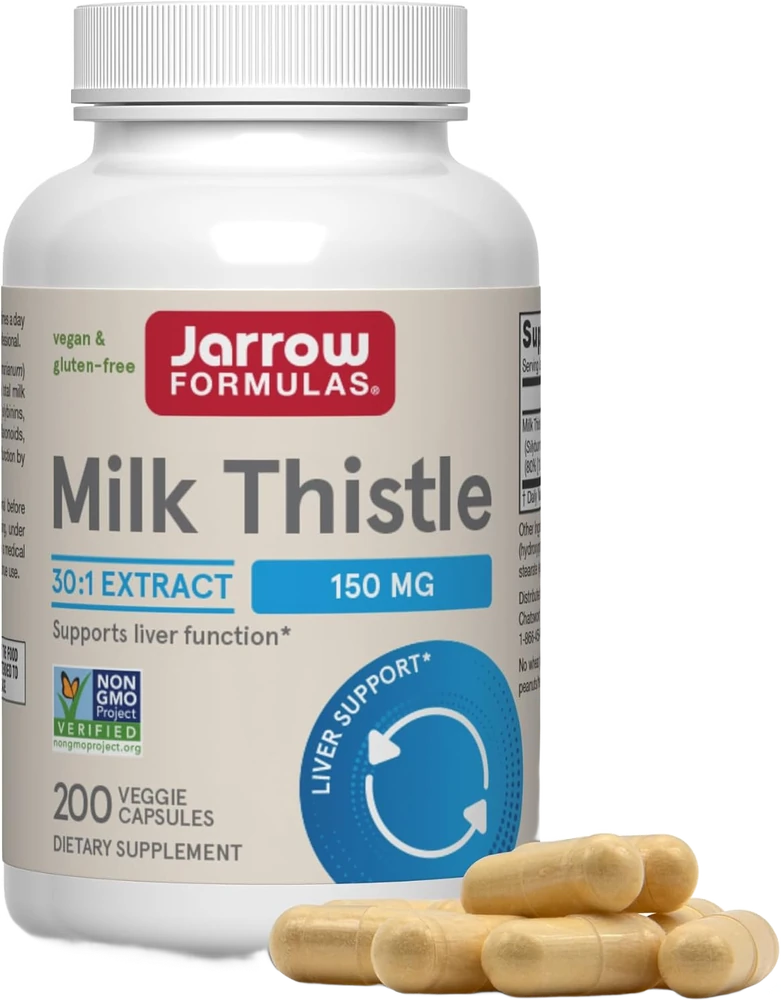 #9 of 9 · Best Vegan Staple✓ Label verified · Supplement Facts read Aug 27, 2026
Real retailer photo, cut out. Label unedited.
Consider it. Clean, fairly priced, and underpowered per cap. A vegan, Non-GMO Project Verified, allergen-free staple at about $0.15 per capsule.
~$29~$0.15/cap
Why It Scores 6.4 — And The Label Line Behind Each Number
Form & Bioavailability
30% of scoreA 30:1 concentrated seed extract standardized to 80% total flavonoids on the panel — a legitimate, concentrated plain extract, but still non-phytosome, so the usual low oral bioavailability applies.
- Form
- Milk thistle fruit/seed 30:1 extract, 80% total flavonoids (veggie cap)
Silymarin/Silybin Dose vs Clinical Range
25% of scoreThe panel declares 120 mg total flavonoids per capsule and no silymarin figure, so the dose against the ~420 mg silymarin trial range cannot be confirmed from the label; the '80% silymarin' wording appears only in the listing title. Even counting all 120 mg as silymarin it is the lowest per-cap dose in the set, and matching ~420 mg/day takes 3–4 capsules. This is the main drag on its score.
Third-Party Testing & Quality Assurance
20% of scoreThe front label carries the Non-GMO Project Verified seal (checked in the Non-GMO Project's own product finder), which certifies GMO status only, not potency or purity. The panel shows no independent NSF or USP seal, which is comparable to the other value plain extracts.
- Testing
- Non-GMO Project Verified; no NSF/USP seal on the panel
Value per Effective Serving
15% of score200 caps for ~$29 is about $0.15 per capsule at the 2026-10-18 US price. Nutricost and NOW milk thistle now cost about $0.12–0.13 per capsule and each carries a declared 240 mg silymarin per cap, so Jarrow is no longer the cheapest per capsule and is clearly dearer per declared milligram. Counting the 3–4 caps needed for a full dose widens the gap.
- Supply
- 200 veggie capsules (label: 1 cap 1–3× daily)
- Price
- ~$29 (US price read 2026-10-18)
- Cost per serving
- ~$0.15/cap
Formulation Suitability & Tolerability
10% of scoreVegan, Non-GMO Project Verified and gluten-free, with no wheat, gluten, soybeans, dairy, egg, fish/shellfish, peanuts/tree nuts or sesame on the panel — one of the cleanest suitability profiles in the set and its strongest axis.
- Suitability
- Vegan, Non-GMO Project Verified, gluten-free
- More Specs
- Flavonoid load
- 120 mg total flavonoids per capsule (150 mg extract); silymarin not declared
Label verified. Every figure read from the Supplement Facts photo, Aug 27, 2026.
Marketing Claims Vs. Reality
30:1 extract standardized to 80% total flavonoids
The panel prints Milk Thistle 30:1 Extract 150 mg, 80% [120 mg] Total Flavonoids. It does not print a silymarin figure; the listing title says 80% silymarin, which the panel does not state.
Vegan, non-GMO and allergen-free
The label says vegan and gluten-free, the front carries the Non-GMO Project Verified seal (listed as verified in the Non-GMO Project's product finder), and the panel lists no wheat, gluten, soybeans, dairy, egg, fish/shellfish, peanuts/tree nuts or sesame.
Supports glutathione and liver function
Silymarin is associated with antioxidant/glutathione support mechanistically, but clinical outcome evidence is mixed (Rambaldi 2007), so the functional claim is only partially supported.
One capsule daily is an effective dose
The panel declares 120 mg total flavonoids per capsule. Even counting all of it as silymarin, a single daily capsule is well below the ~420 mg used in several trials; reaching it takes 3–4 capsules.
What Our Test Actually Found
Do the label math
The panel declares 120 mg total flavonoids per cap and no silymarin figure. Even on the most generous reading, 'one a day' delivers far less than the ~420 mg used in liver studies. To reach that you need 3–4 capsules — which is the single most important thing to understand before buying it as a one-a-day.
Fair per cap, dear per dose
At about $0.15 a capsule it is no longer the lowest sticker in the set, and once you account for the 3–4 caps needed for a full dose, with no silymarin figure printed on the panel, the per-milligram value trails the budget extracts.
Best-in-class suitability
Vegan, Non-GMO Project Verified, gluten-free and free of the major allergens the panel lists — on the 10%-weighted suitability axis it's among the cleanest here, which is why it earns the vegan-staple badge despite the low dose.
A maintenance product, not a treatment dose
It works as a low-dose everyday staple. Just don't mistake the single-cap habit for a clinical dose — and remember even a full silymarin dose has mixed trial support.
Full analysis: all pros & cons (7), buy if / skip if
- 30:1 concentrated extract standardized to 80% total flavonoids
- Reasonable price per capsule — 200 caps for ~$29 (about $0.15 per cap)
- Vegan, Non-GMO Project Verified, allergen-free formulation
- Marketed around glutathione support for liver function
- Only 120 mg total flavonoids per cap, with silymarin not declared — the lowest per-capsule dose here
- Reaching a trial-level ~420 mg/day means 3–4 capsules, not one
- Plain extract with the usual low oral bioavailability; no NSF/USP seal
- You want a clean, vegan, allergen-free everyday option
- You want a low per-capsule price and don't mind taking several
- You're using it for low-dose maintenance
- You want a full dose in one or two capsules
- You want a declared silymarin figure on the panel
- You want a phytosome or an independent NSF/USP seal
A vegan, Non-GMO Project Verified, allergen-free staple at about $0.15 per capsule. But the panel guarantees 120 mg total flavonoids per cap and prints no silymarin figure, and that is the lowest per-cap dose in the set. Reaching a trial-level ~420 mg/day takes 3–4 capsules even on the most generous reading, which erodes the price edge. Fine as low-dose maintenance, underpowered as a single-cap solution.
A dependable, allergen-friendly vegan staple that's reasonably priced per capsule — but the label math matters. Jarrow's 30:1 concentrated extract is standardized to 80% total flavonoids (120 mg per capsule on the panel) and comes 200 caps to a bottle for around $29 (about $0.15 per capsule at the 2026-10-18 US price). The catch: the panel prints total flavonoids, not silymarin, and even counting all 120 mg as silymarin the 'one a day' habit lands well under the doses used in studies.
A clean vegan staple — read the dose math

A dependable, allergen-friendly vegan staple that's reasonably priced per capsule — but read the label math. The panel guarantees 120 mg total flavonoids per cap and prints no silymarin figure; even counting all of it, the 'one a day' habit lands well under the doses used in studies and you'll want three or four caps, which erodes the price edge. Fine as a low-dose maintenance option, underpowered as a single-cap solution.
If This Doesn’t Fit — Try These
 04
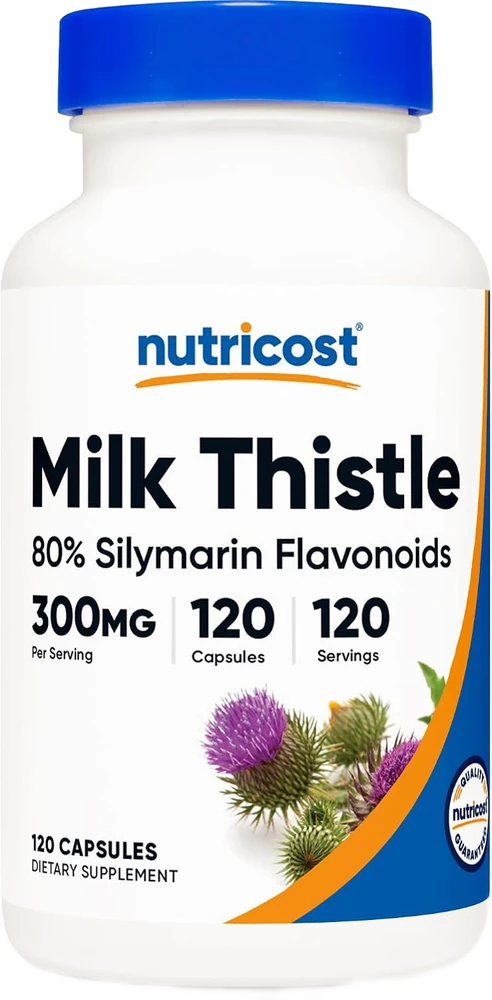
Nutricost Milk Thistle 300 mg
This is the value winner and the sane default for most people — a legitimate 80% extract at a price that makes daily use painless.
 03
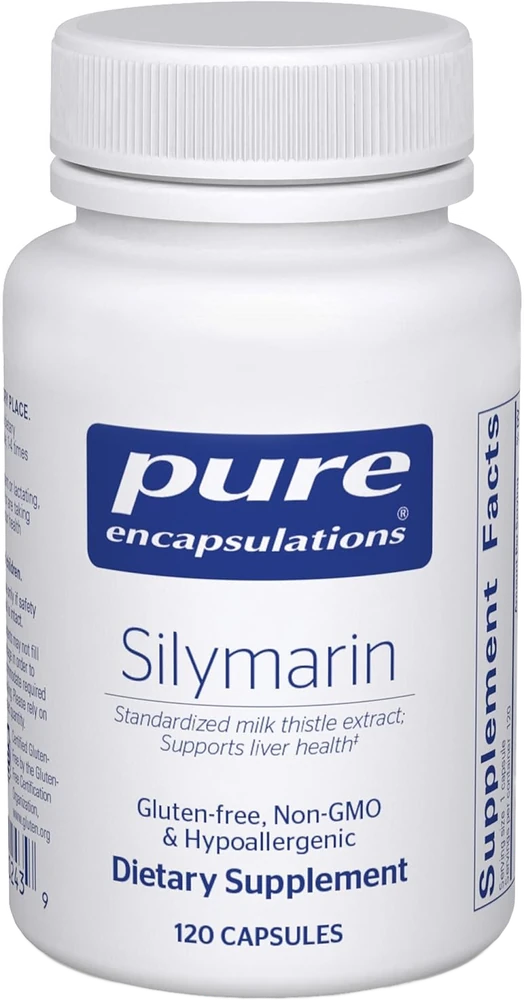
Pure Encapsulations Silymarin
If you react to fillers or just want the cleanest possible silymarin, this is the one — a bare-bones, hypoallergenic capsule from a brand clinicians reach for by reflex.
 06
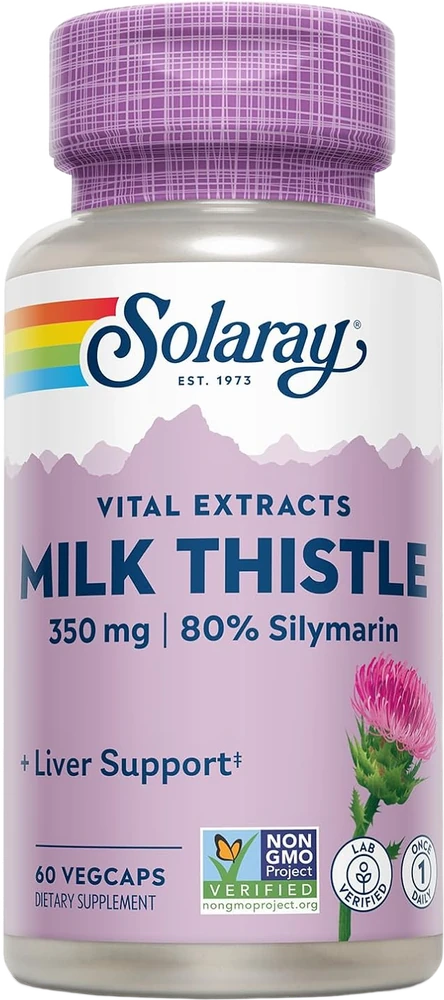
Solaray Milk Thistle 350 mg
The easiest one-and-done pick — a single vegan capsule delivers the most silymarin per cap of any plain extract here, with a guaranteed-potency label.
Quick Answers
Is one capsule a day enough?
No. The panel declares 120 mg total flavonoids per capsule and does not print a silymarin figure. Even if you count every flavonoid as silymarin, one a day is well below the ~420 mg used in trials, so plan on 3–4 capsules daily, which narrows its price advantage.
Is it vegan?
Yes. The label says vegan and gluten-free, the capsule is hydroxypropylmethylcellulose, and the front carries the Non-GMO Project Verified butterfly. The panel also lists no wheat, gluten, soy, dairy, egg, fish/shellfish, peanuts/tree nuts or sesame, which makes it one of the cleanest suitability profiles in the lineup.
Why is it ranked near the bottom if it's clean and reasonably priced?
The low per-capsule dose is the issue, and the panel guarantees total flavonoids rather than silymarin. On a list that weights silymarin dose at 25%, needing 3–4 capsules for a full dose, with no declared silymarin figure, drops it below higher-dose, similarly priced options.
Sources & Further Reading
2 peer-reviewed sources, each linked to PubMed
- [1] Rambaldi A, Jacobs BP, Gluud C. Milk thistle for alcoholic and/or hepatitis B or C virus liver diseases. Cochrane Database Syst Rev. 2007;(4):CD003620. PMID 17943794 — Milk thistle for alcoholic and/or hepatitis B or C virus liver diseases. No significant mortality benefit was demonstrated for milk thistle versus placebo in liver disease.
- [2] Gillessen A, Schmidt HH. Silymarin as Supportive Treatment in Liver Diseases: A Narrative Review. Adv Ther. 2020;37(4):1279-1301. PMID 32065376 — Silymarin as Supportive Treatment in Liver Diseases: A Narrative Review. Notes dose and bioavailability as key determinants of any supportive effect.
Affiliate disclosure: every Amazon link uses our Associates tag (superachieverclub-20). We earn a small commission at no cost to you; it funds independent reviews. We never accept payment to change a ranking.