
Elderberry: Benefits, Dosage & Side Effects (2026)
Black elderberry (Sambucus nigra) is an anthocyanin-rich berry extract taken to shorten cold and flu symptoms; small trials suggest a modest benefit, but the best-designed study found none — and raw berries must never be eaten unprepared.
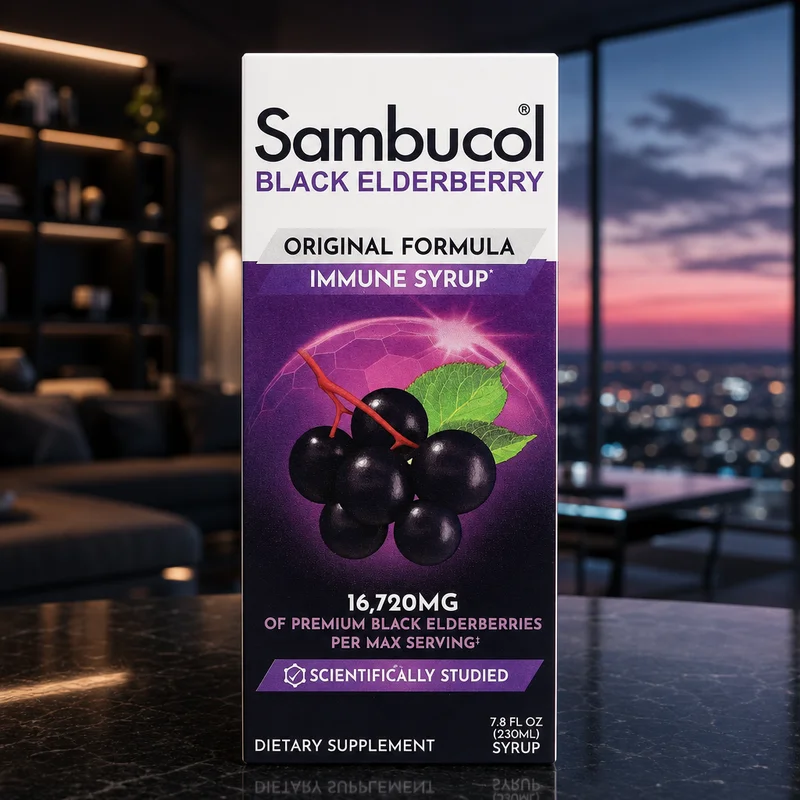
Sambucol Black Elderberry Syrup, Original Formula
What is Elderberry?
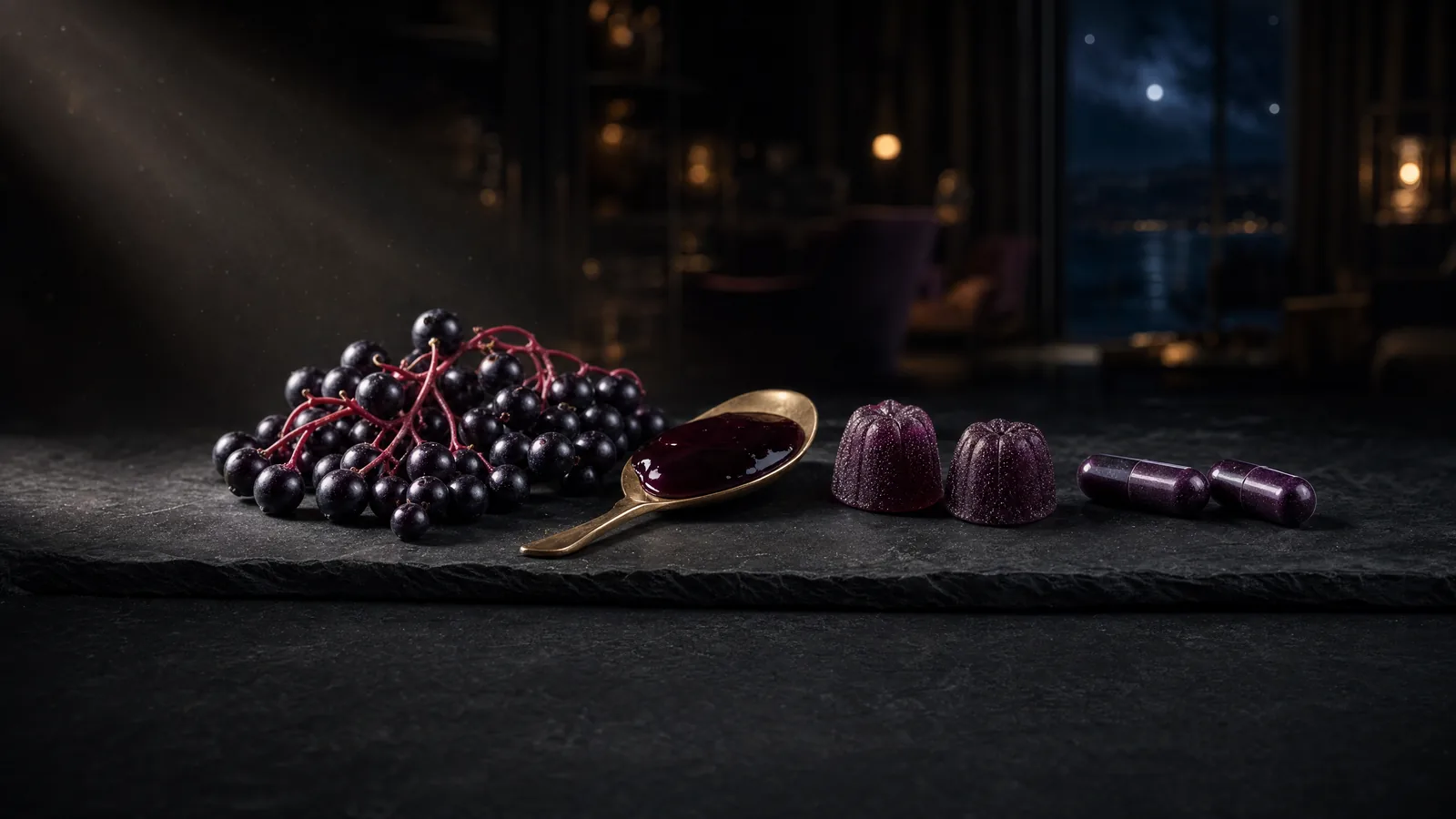
Elderberry is the dark-purple fruit of the European elder tree, Sambucus nigra, sold as a standardized extract in syrups, capsules, and gummies. Its actives are anthocyanins — the same pigment class that colors blueberries — which give the berry its deep color and most of its lab-measured antiviral and antioxidant activity. The best-known commercial form is Sambucol, whose specific extract was used in the original influenza trials, which is why syrups still dominate the category. Critically, elderberry is only safe once properly cooked or extracted: raw or unripe berries, plus the seeds, leaves, bark, and stems, contain cyanogenic glycosides (sambunigrin) that can cause nausea, vomiting, and diarrhea. Every product on this page is a prepared extract for exactly this reason.
How it works
In test-tube and animal studies, elderberry anthocyanins appear to bind to influenza virus particles and blunt their ability to enter and replicate in cells, while also nudging cytokine and antibody activity. That mechanism is plausible and well-documented in vitro. The leap from a petri dish to a shorter cold in a real person is where the evidence thins out. A handful of small randomized trials (Zakay-Rones, Tiralongo) reported that starting an elderberry syrup within 24-48 hours of symptom onset trimmed flu or cold duration by roughly one to two days versus placebo. But those studies were small, several were funded or supplied by the product makers, and a larger, independent 2020 emergency-department trial (Macknin) found no benefit at all — if anything a slight trend toward longer symptoms. So the honest read is: a real but modest, inconsistent effect on symptom duration, most credible when taken early and at the doses used in the syrup trials, not a proven cure or a preventive shield.
At-a-glance facts
- Botanical name
- Sambucus nigra (black / European elder)
- Active compounds
- Anthocyanins (cyanidin glycosides), flavonoids
- Best-studied form
- Standardized syrup (Sambucol extract)
- Studied dose
- ~15 mL syrup 4x/day at symptom onset (flu trials)
- Reported effect
- ~1-2 days shorter symptoms in small trials; null in the largest independent RCT
- Onset window
- Start within 24-48 hours of first symptoms
- Key safety flag
- Raw berries, seeds, leaves & bark are toxic — use prepared extract only
- Primary goal
- Immune system / cold & flu duration
Evidence: Several small, often industry-linked RCTs and a positive meta-analysis suggest a modest reduction in cold/flu symptom duration, but the largest independent trial found no benefit, so the human evidence is genuinely mixed and limited.
Who it's for — and who it isn't
- People who want a low-risk, evidence-adjacent option to try at the very first sign of a cold or flu, and who understand the effect is modest at best
- Anyone who prefers a syrup they can dose to match the amounts used in the published trials, rather than a low-dose gummy
- Supplement users who want an anthocyanin-rich botanical and value third-party testing and clear standardization
- Travelers who want something to take prophylactically on long-haul flights, where the Tiralongo trial showed the most encouraging (though still small) signal
- Anyone expecting a cure or a reliable way to prevent infection — the evidence does not support that, and the strongest independent trial found no benefit
- Pregnant or breastfeeding people, and children under the age tested in trials, where safety data are insufficient — check with a clinician first
- People on immunosuppressant drugs or with autoimmune conditions, since elderberry's immune-stimulating claims are theoretical and could interact
- Anyone tempted to make their own preparation from raw berries, seeds, leaves, or bark — these are toxic uncooked and should never be self-processed
Week-by-week, what happens
- Within hours (at symptom onset)No felt effect yet; the trials that worked required starting dosing within 24-48 hours of the first symptoms — timing appears to matter more than dose
- Days 2-4 of a cold/fluIn the positive trials this is where the gap opened up, with elderberry groups reporting symptoms easing roughly 1-2 days sooner than placebo; in the null trial no difference appeared
- By end of illness (~day 5-7)Any benefit is a modestly shorter or milder episode, not prevention of the infection itself; elderberry has not been shown to stop you catching a cold
- Ongoing/preventive useEvidence for daily prophylaxis is weak; the one travel study hinted at shorter colds when taken before and during flights, but this is not well replicated
Safety & contraindications
- Raw or unripe elderberries and the seeds, leaves, bark, and stems contain cyanogenic glycosides (sambunigrin) and can cause nausea, vomiting, and diarrhea — only ever use commercially prepared, cooked extracts
- Do not attempt to make your own syrup from foraged raw berries or plant parts; proper heating/processing is what removes the toxic compounds
- Safety in pregnancy, breastfeeding, and young children is not established — consult a clinician before use
- A theoretical concern exists for people with autoimmune conditions or on immunosuppressant medication, because elderberry is marketed as immune-stimulating; discuss with a doctor first
- Syrups and gummies contain added sugar (glucose-fructose or cane sugar), which matters for diabetics and for children's dental health
- Elderberry is a supplement, not a treatment for influenza — seek medical care for high fever, difficulty breathing, or symptoms in high-risk individuals rather than relying on it
All articles on Elderberry
Best Elderberry Supplements
9 elderberry supplements ranked on form and bioavailability, standardization and dose, third-party testing, tolerability and value.
Read →Gaia Herbs Black Elderberry (with Acerola) Review
The transparency pick — certified organic with per-lot traceability — but no numeric anthocyanin standardization to back the premium.
Read →Gaia Herbs Black Elderberry Extra Strength Gummies Review
The cleanest gummy you can buy — organic, elderberry-only — but gummy processing, added sugar, and equivalence dosing make it the priciest way to take elderberry.
Read →Gaia Herbs Black Elderberry Syrup Review
Gaia Herbs Black Elderberry Syrup is the certified-organic, traceable liquid on this list - a clean, well-tolerated whole-berry glycerite whose honest weakness is that its headline
Read →Nature's Way Sambucus Elderberry Gummies (with Vitamin C, D3 & Zinc) Review
A pleasant multivitamin-style gummy with only 200 mg of elderberry — any benefit is more likely the zinc and vitamin C than the berry.
Read →Nature's Way Sambucus Original Traditional Elderberry Syrup Review
An anthocyanin-standardized syrup in a bigger bottle — the best-value liquid if you don't need the exact trial extract.
Read →NOW Foods Elderberry (Sambucus nigra) 500 mg, 10:1 Concentrate Review
A sugar-free, GMP-tested capsule from a lab-transparent brand — the honest budget capsule, just not standardized or trial-aligned.
Read →Nutricost Elderberry 575 mg (10:1 Extract) Review
The cheapest cost-per-capsule extract here — a real value play, but you're trusting the label with no published COA.
Read →Sambucol Advanced Black Elderberry Syrup (with Zinc & Vitamin C) Review
The trusted Sambucol extract, but bundled with zinc and vitamin C so you can never tell what's actually working — in a small, pricey bottle.
Read →Sambucol Black Elderberry Syrup, Original Formula Review
The one elderberry product whose actual extract was tested in published flu trials — modest effect, but it's the closest thing to evidence in this category.
Read →FAQ
Does elderberry actually shorten a cold or the flu?
Maybe, modestly. Small randomized trials reported that starting an elderberry syrup early cut flu or cold symptoms by about one to two days versus placebo. But those studies were small and several were linked to the product makers, and a larger independent 2020 emergency-room trial found no benefit at all. The honest answer is a possible, modest effect — not a reliable one, and not a cure.
Is it safe to eat raw elderberries?
No. Raw and unripe elderberries, along with the seeds, leaves, bark, and stems, contain cyanogenic compounds that can cause nausea, vomiting, and diarrhea. They must be cooked or properly extracted first. That is exactly why you buy a prepared syrup, capsule, or gummy rather than foraging your own.
Syrup, capsule, or gummy — which is best?
Syrup is the form with actual human trial data and lets you reach the doses used in the studies, so it is the most defensible choice. Capsules avoid the sugar and are convenient but were not used in the cold/flu trials and usually aren't standardized to a stated anthocyanin percentage. Gummies are the weakest for elderberry specifically — the elderberry dose is often tiny, and combo gummies with added zinc and vitamin C make it impossible to credit elderberry for any benefit.
What does '12,000 mg' or '6,400 mg equivalent' on the label mean?
Almost always a fresh-berry or concentrate-equivalence figure, not the actual weight of extract you swallow and not a standardized dose of the active anthocyanins. A big number looks impressive but tells you little about potency. Standardization to anthocyanins and third-party testing are far more meaningful than the headline milligram claim.
When should I take it for it to have any chance of working?
As early as possible — the trials that showed a benefit had people start within 24 to 48 hours of the first symptoms and dose several times a day. Waiting until you're several days into an illness is unlikely to help. Timing appears to matter as much as the product you pick.
Can I take elderberry every day to avoid getting sick?
The evidence for daily preventive use is weak. One study suggested shorter colds in air travelers who took it before and during flights, but this hasn't been well replicated, and elderberry has not been shown to stop you catching an infection in the first place. It's better thought of as a possible symptom-shortener than a shield.
Sources & further reading
- Zakay-Rones Z, Thom E, Wollan T, Wadstein J. Randomized study of the efficacy and safety of oral elderberry extract in the treatment of influenza A and B virus infections. J Int Med Res. 2004;32(2):132-40.Randomized study of the efficacy and safety of oral elderberry extract in the treatment of influenza A and B virus infections
Small RCT reporting flu symptoms resolved on average about 4 days earlier with the Sambucol elderberry extract than placebo — a key positive but industry-linked trial.
- Tiralongo E, Wee SS, Lea RA. Elderberry Supplementation Reduces Cold Duration and Symptoms in Air-Travellers: A Randomized, Double-Blind Placebo-Controlled Clinical Trial. Nutrients. 2016;8(4):182.Elderberry Supplementation Reduces Cold Duration and Symptoms in Air-Travellers: A Randomized, Double-Blind Placebo-Controlled Clinical Trial
In 312 air travelers, elderberry extract was associated with a shorter cold duration and less severe symptoms versus placebo, the main signal for preventive/travel use.
- Macknin M, Wolski K, Negrey J, Mace S. Elderberry Extract Outpatient Influenza Treatment for Emergency Room Patients Ages 5 and Older: a Randomized, Double-Blind, Placebo-Controlled Trial. J Gen Intern Med. 2020;35(11):3271-3277.Elderberry Extract Outpatient Influenza Treatment for Emergency Room Patients Ages 5 and Older: a Randomized, Double-Blind, Placebo-Controlled Trial
The largest independent RCT found NO reduction in influenza duration or severity from elderberry, with a slight trend toward longer symptoms — the key counter-evidence.
- Hawkins J, Baker C, Cherry L, Dunne E. Black elderberry (Sambucus nigra) supplementation effectively treats upper respiratory symptoms: A meta-analysis of randomized, controlled clinical trials. Complement Ther Med. 2019;42:361-365.Black elderberry (Sambucus nigra) supplementation effectively treats upper respiratory symptoms: A meta-analysis of randomized, controlled clinical trials
Pooled analysis of four RCTs concluded elderberry substantially reduced upper-respiratory symptoms, but the small pool and reliance on the positive trials limit confidence.
- Wieland LS, Piechotta V, Feinberg T, et al. Elderberry for prevention and treatment of viral respiratory illnesses: a systematic review. BMC Complement Med Ther. 2021;21(1):112.Elderberry for prevention and treatment of viral respiratory illnesses: a systematic review
A cautious systematic review judging the evidence as low certainty and at high risk of bias, and flagging a theoretical immune-overstimulation concern — the most balanced appraisal.
- Zakay-Rones Z, Varsano N, Zlotnik M, et al. Inhibition of several strains of influenza virus in vitro and reduction of symptoms by an elderberry extract during an outbreak of influenza B Panama. J Altern Complement Med. 1995;1(4):361-9.Inhibition of several strains of influenza virus in vitro and reduction of symptoms by an elderberry extract (Sambucus nigra L.) during an outbreak of influenza B Panama
The original elderberry flu study, reporting both in-vitro influenza inhibition and faster symptom relief, which launched the category's reputation.