
Gaia Herbs Black Elderberry Syrup Review
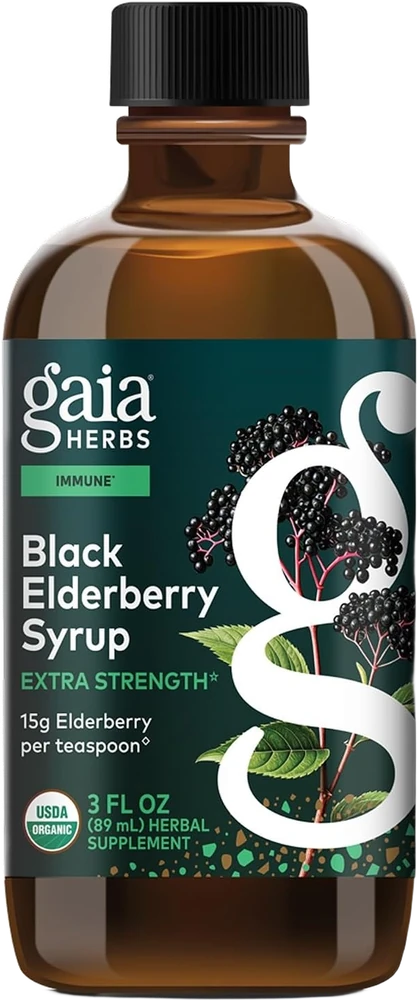 #6 of 9 · Best USDA-organic syrup✓ Label verified · Supplement Facts read Sep 7, 2026
Real retailer photo, cut out. Label unedited.
Consider it. Certified-organic, traceable elderberry syrup - clean and well-tolerated, but sold on a fresh-berry-equivalence number, not a standardized dose. An alcohol-free, USDA-organic whole-berry glycerite with a published Meet Your Herbs traceability ID and excellent tolerability.
$16-22~$0.90-$1.20 per 1 tsp (5 mL) serving
Why It Scores 6.2 — And The Label Line Behind Each Number
Form & Bioavailability
25% of scoreLiquid whole-berry juice concentrate in a vegetable-glycerin base - the polyphenols are delivered in a palatable food matrix and absorb readily, and teaspoon dosing is easy. But a syrup carries no documented bioavailability advantage over capsules or gummies for elderberry, and 'liquid' is not the same as 'standardized.' A solid, neutral delivery form rather than a differentiator.
- Active form
- Organic black elderberry (Sambucus nigra) juice concentrate in a vegetable-glycerin syrup base (alcohol-free)
Standardization & Dose vs Clinical Range
25% of scoreThe weak axis. Gaia declares no anthocyanin or polyphenol content. The Supplement Facts panel lists 2,145 mg of Organic Black Elderberry (Sambucus nigra) fruit juice concentrate per 1 tsp serving - a real, disclosed weight, but a concentrate amount, not an active-compound dose - and the front label's '15 g elderberry per teaspoon◊' claim is a separate fresh-berry equivalence, not an anthocyanin figure either. The trials that anchor elderberry used standardized preparations - Zakay-Rones 2004 dosed a standardized syrup 15 mL four times daily, and Tiralongo 2016 used a standardized 300 mg extract - so you cannot map a Gaia teaspoon onto any trial dose. Apply the same label-inflation scrutiny to the front label's '15 g' claim that you would to any oversized milligram claim.
- Per serving
- 1 tsp (5 mL) = 2,145 mg Organic Black Elderberry (Sambucus nigra) fruit juice concentrate + 90 mg Organic Acerola fruit juice, per the Supplement Facts panel. The front label separately claims '15 g elderberry per teaspoon◊' (a fresh-berry equivalence, not an anthocyanin dose)
- Standardization
- None stated - no declared anthocyanin or polyphenol content
- Trial-dose alignment
- Not mappable - trials (Zakay-Rones 2004, Tiralongo 2016) used standardized extracts; Gaia does not declare an active-compound level
Third-Party Testing & Purity
20% of scoreGaia's genuine edge. USDA Certified Organic is an accredited third-party certification, and the Meet Your Herbs batch-traceability ID lets buyers look up the specific lot - above-average transparency that few elderberry competitors match. It stops short of federation-grade product testing (no NSF or USP certification), and organic sourcing is a purity/provenance signal, not proof of superior potency or a verified anthocyanin level.
- Certifications
- USDA Certified Organic, Non-GMO, vegan, gluten-free, dairy-free
- Lab transparency
- Gaia Meet Your Herbs batch-traceability ID printed on the bottle; no NSF/USP certification
Tolerability & Safety
15% of scoreExcellent. This is a cooked/prepared syrup, so the raw-elderberry toxicity concern does not apply. The alcohol-free glycerin base makes it vegan, gluten-free, dairy-free and kid-friendly, and elderberry syrup is very well tolerated - occasional mild GI upset is the main reported issue. As with any elderberry product, theoretical immune-stimulation cautions apply for autoimmune conditions or immunosuppressant use; check with a clinician.
Value
15% of scoreA real weakness. The 3 fl oz bottle is only ~18 servings, so at $16-22 you are paying roughly $0.90-$1.20 per teaspoon - and it empties fast at 1 tsp/day. That is materially pricier per serving than the capsule picks, including Gaia's own Black Elderberry Capsules at #3. Certified-organic sourcing justifies some premium, but on cost-per-serving this syrup is one of the more expensive ways to take elderberry.
- Bottle
- 3 fl oz syrup - ~18 servings - ~2-3 weeks at 1 tsp/day
- Price
- $16-22 / 3 fl oz = ~$0.90-$1.20 per 1 tsp serving
Label verified. Every figure read from the Supplement Facts photo, Sep 7, 2026.
Marketing Claims Vs. Reality
15 g elderberry per teaspoon (front-label claim, footnoted as a fresh-berry equivalence).
This is Gaia's own front-label claim - accurate as printed, but it is a fresh-berry equivalence, not the Supplement Facts panel's declared amount. The panel itself lists 2,145 mg of Organic Black Elderberry (Sambucus nigra) fruit juice concentrate per 1 tsp (5 mL) serving - a real, disclosed weight of concentrate. Neither figure is a standardized anthocyanin or polyphenol dose, and neither can be mapped to the standardized preparations used in the clinical trials (Zakay-Rones 2004, Tiralongo 2016). Read both numbers as sourcing, not as potency.
Supports immune health and helps with colds and flu.
The evidence is modest and mixed. Small RCTs (Zakay-Rones 2004; Tiralongo 2016 in air travellers) and a 2019 meta-analysis (Hawkins) reported reduced cold/upper-respiratory symptom duration, but the larger, better-controlled 2020 ER trial (Macknin, PMID 32929634) found no benefit for laboratory-confirmed influenza. A plausible but unproven immune-support signal - not a validated cold or flu treatment.
USDA Certified Organic with full batch traceability.
USDA Certified Organic is an accredited third-party certification, and Gaia's Meet Your Herbs program prints a batch ID on every bottle that buyers can look up to trace the specific lot. Both claims are real and independently checkable - this is the product's strongest, most defensible attribute.
What Our Test Actually Found
Correction: the label declares 2,145 mg of elderberry juice concentrate, not '14,500 mg'
An earlier version of this review said Gaia's teaspoon serving was concentrated from '14.5 g (14,500 mg)' of fresh organic elderberries. The Supplement Facts panel reads differently: it lists 2,145 mg of Organic Black Elderberry (Sambucus nigra) fruit juice concentrate per 1 tsp (5 mL) serving, plus 90 mg of Organic Acerola fruit juice. Separately, the bottle's front label carries its own claim - '15 g elderberry per teaspoon◊' - a fresh-berry equivalence that is not the same figure as the Supplement Facts entry. We re-read the label on Sep 7, 2026 and corrected the per-serving elderberry figures throughout this review.
The '15 g per teaspoon◊' claim is a fresh-berry equivalence, not a standardized dose
Gaia's front-label claim tells you how much fresh berry went into making the juice concentrate in one teaspoon - it is a sourcing figure, not a declared amount of the active anthocyanins that elderberry research is built around. The Supplement Facts panel itself lists 2,145 mg of Organic Black Elderberry (Sambucus nigra) fruit juice concentrate per serving - a real, disclosed weight, but still not a standardized anthocyanin or polyphenol content. So you cannot line a Gaia teaspoon up against any published trial dose. Treat both numbers with the same label-inflation scrutiny you would apply to any oversized milligram claim: they signal whole-berry concentration and organic sourcing, not verified potency.
Elderberry's cold/flu evidence is modest and mixed - the strongest recent trial was null
The optimistic picture rests on small studies: Zakay-Rones 2004 (60 patients) and Tiralongo 2016 (air travellers) reported shorter, milder colds, and Hawkins 2019 pooled a favorable meta-analysis of just ~180 participants. Against that sits Macknin 2020 (PMID 32929634), a larger, better-controlled emergency-room RCT that found elderberry did NOT reduce influenza symptom duration, with a trend toward longer illness in the elderberry arm. The honest read: a plausible mild-cold-support signal, not a proven flu remedy.
Sourcing transparency is the real reason to buy this over a cheaper syrup
Where Gaia genuinely leads is provenance. USDA Certified Organic plus the Meet Your Herbs batch-traceability ID gives you an accredited organic guarantee and a lookup for the exact lot in your hand - a level of transparency most elderberry syrups do not offer. That is a legitimate value-add for buyers who care about clean, traceable sourcing. It is not, however, evidence that the product is more potent or more effective than a standardized syrup like Sambucol.
It is a liquid, so it empties fast and costs more per serving
A 3 fl oz bottle is only about 18 teaspoons - roughly two to three weeks at 1 tsp/day - which puts the per-serving cost around $0.90-$1.20, materially higher than capsules. If you want ongoing elderberry at the lowest cost, a capsule (including Gaia's own Black Elderberry Capsules at #3) or a larger standardized syrup like Nature's Way Sambucus (#2) will stretch much further per dollar.
Full analysis: all pros & cons (7), buy if / skip if
- USDA Certified Organic whole-berry syrup with a published Meet Your Herbs batch-traceability ID - sourcing transparency few competitors match
- Alcohol-free vegetable-glycerin base; vegan, gluten-free, dairy-free and kid-friendly
- Palatable teaspoon dosing in a whole-food matrix; very well tolerated
- Cooked/prepared syrup, so no raw-elderberry toxicity concern
- No standardized anthocyanin content - the label's 2,145 mg juice-concentrate figure and '15 g per teaspoon◊' claim are sourcing numbers, not an active-compound dose
- Small 3 fl oz bottle (~18 servings) empties fast and costs more per serving than the capsule picks
- Elderberry's cold/flu evidence is modest and mixed - the strongest recent trial (Macknin 2020) was null for influenza
- You want a USDA-organic, alcohol-free liquid elderberry with published batch traceability
- You or your kids prefer a palatable teaspoon syrup over capsules or gummies
- Sourcing transparency and clean-label certifications matter more to you than cost-per-serving
- You want the lowest cost per serving - the capsule picks (including Gaia's own #3) are far cheaper
- You expect a standardized, trial-matched anthocyanin dose - the label's 2,145 mg juice-concentrate figure and '15 g per teaspoon◊' claim are sourcing numbers, not an anthocyanin dose
An alcohol-free, USDA-organic whole-berry glycerite with a published Meet Your Herbs traceability ID and excellent tolerability. The catch: no standardized anthocyanin content - the label's 2,145 mg juice-concentrate figure and its '15 g per teaspoon◊' front-label claim are sourcing numbers, not an anthocyanin dose - modest and mixed cold/flu evidence, and a small 3 fl oz bottle that costs more per serving than capsules. Buy it for organic sourcing and an easy liquid format; skip it for value or a trial-matched dose.
Gaia Herbs Black Elderberry Syrup is the organic-sourcing pick on this list, and it earns that spot honestly rather than on potency. Each 1 tsp (5 mL) serving supplies 2,145 mg of Organic Black Elderberry (Sambucus nigra) fruit juice concentrate per the Supplement Facts panel (plus 90 mg of Organic Acerola fruit juice), delivered in an alcohol-free vegetable-glycerin base that is vegan, gluten-free and dairy-free. Gaia's genuine edge is transparency: the product is USDA Certified Organic and every bottle carries a Meet Your Herbs ID you can look up to trace the batch. What it is NOT is a standardized, trial-matched dose. The front label's '15 g elderberry per teaspoon◊' claim is a fresh-berry equivalence - a sourcing/concentration figure, not a declared anthocyanin content - so it deserves the same label-inflation scrutiny you would apply to any oversized milligram claim. The underlying evidence is modest and mixed: small positive trials (Zakay-Rones 2004, Tiralongo 2016) and a supportive meta-analysis (Hawkins 2019) sit against the larger, better-controlled 2020 ER trial (Macknin), which found no benefit for influenza. It is also a liquid: a 3 fl oz bottle is only ~18 servings, so it empties fast and costs more per serving than the capsule picks - including Gaia's own capsules at #3.
A clean, certified-organic elderberry syrup - buy it for sourcing, not for a proven or standardized dose.

Gaia Herbs Black Elderberry Syrup is the right bottle for a specific buyer: someone who wants a USDA-organic, alcohol-free, fully traceable liquid elderberry and values clean sourcing over cost-per-serving. On those terms the product delivers honestly - the Meet Your Herbs traceability and organic certification are real, checkable strengths, and tolerability is excellent. Where it falls down is standardization and value. The label's 2,145 mg juice-concentrate figure and its front-panel '15 g per teaspoon◊' claim are sourcing numbers rather than a declared anthocyanin dose, so neither can be matched to the standardized preparations used in the elderberry trials - and those trials are themselves modest and mixed, with the strongest recent one (Macknin 2020) showing no flu benefit. As a liquid it also empties fast and runs pricier per serving than capsules. If you want the best-studied elderberry syrup, Sambucol (#1) leads; if you want the most syrup per dollar, Nature's Way Sambucus (#2) wins; and if you simply want Gaia's organic sourcing at a lower cost per serving, the Gaia capsules at #3 are the more economical way to get it. This syrup earns its #6 spot as the transparent, certified-organic liquid - just not as the potency or value leader.
If This Doesn’t Fit — Try These
 01
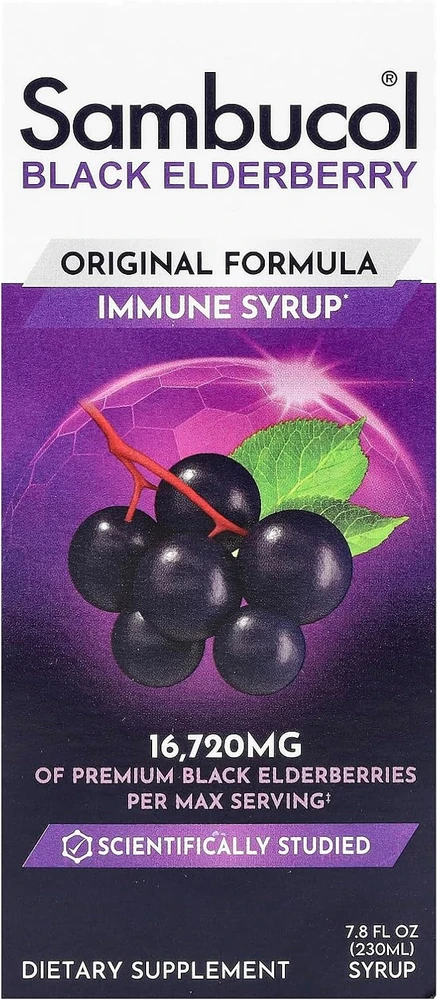
01Sambucol Original Syrup
If you want the one elderberry product whose actual extract has been through published human flu trials, this is it, and the liquid form reaches the studied dose.
 02
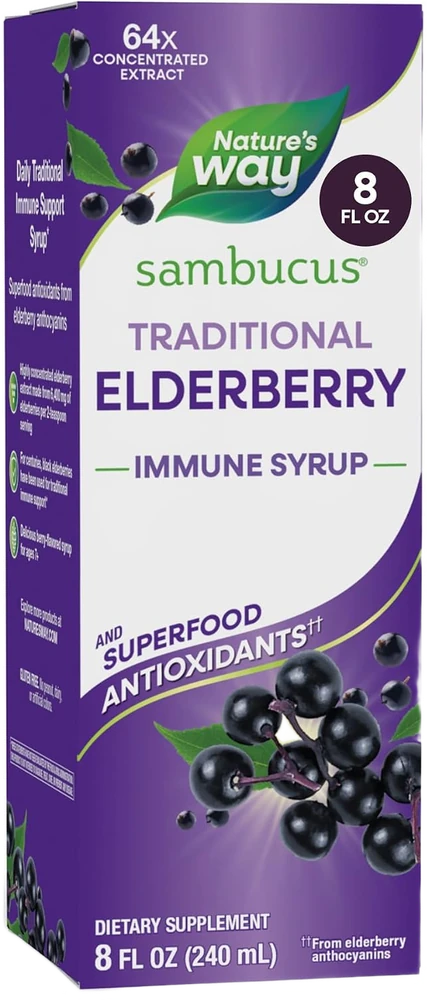
02Nature's Way Sambucus Syrup
A genuinely strong runner-up that does the one thing most elderberry products avoid: it names anthocyanins as the standardized active.
 03
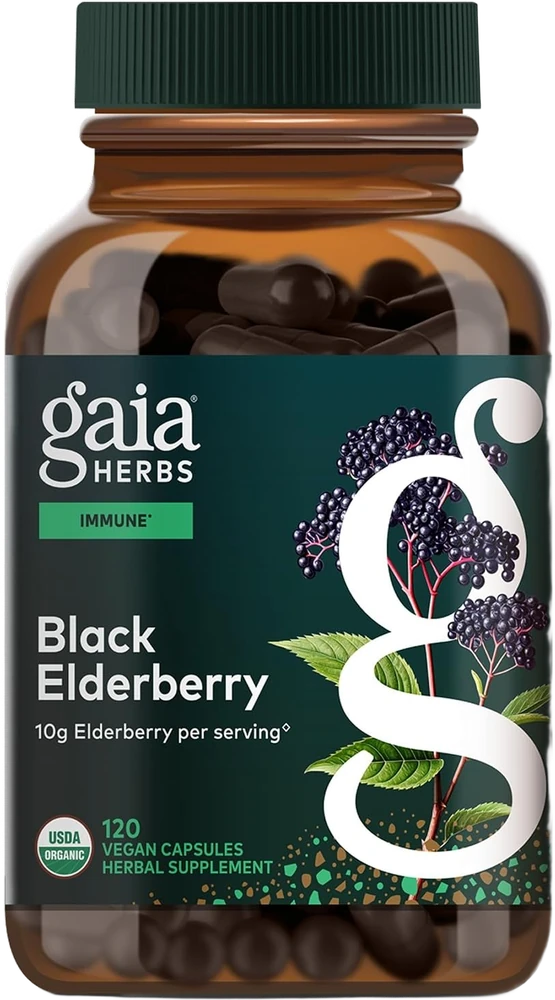
03Gaia Black Elderberry Capsules
The best-sourced product on the list and the top capsule, with organic certification and traceability almost no competitor matches.
Quick Answers
Is the '2,145 mg' Supplement Facts figure the same as the dose used in elderberry studies?
No. The Supplement Facts panel lists 2,145 mg of Organic Black Elderberry (Sambucus nigra) fruit juice concentrate per 1 tsp (5 mL) serving - a real, disclosed weight of concentrate, not a declared amount of the active anthocyanins. The front label separately claims '15 g elderberry per teaspoon◊,' a fresh-berry equivalence footnoted on the bottle that tells you how much fresh fruit the concentrate was made from, not how much of the active anthocyanins it contains. The clinical trials used standardized preparations (for example Zakay-Rones 2004 dosed a standardized syrup 15 mL four times daily, and Tiralongo 2016 used a standardized 300 mg extract), and Gaia does not declare a standardized anthocyanin level, so neither of its label numbers can be mapped onto any trial dose. Treat both figures as sourcing/concentration claims, not potency guarantees.
Does elderberry actually shorten colds and flu?
The evidence is modest and mixed. Small randomized trials (Zakay-Rones 2004; Tiralongo 2016 in air travellers) and a 2019 meta-analysis (Hawkins) reported shorter, milder colds, but those studies are small. The larger, better-controlled 2020 emergency-room trial (Macknin, PMID 32929634) found no benefit for laboratory-confirmed influenza and even hinted at slightly longer illness. Reasonable to try for mild cold support; not a proven flu treatment, and no substitute for a flu vaccine or medical care when needed.
How is this different from the other two Gaia elderberry products on the list?
This #6 is the liquid syrup - an alcohol-free, glycerin-based whole-berry concentrate you dose by the teaspoon. Gaia's #3 pick is the Black Elderberry Capsules with Acerola (a swallowed capsule with added vitamin C, cheaper per serving), and #7 is the Black Elderberry Extra Strength gummies (a chewable format). Same brand and organic sourcing; three different delivery formats at different price-per-serving points.
Is it alcohol-free and safe for kids?
Yes to alcohol-free - it uses a vegetable-glycerin base rather than an alcohol tincture, and it is vegan, gluten-free and dairy-free. Because it is a cooked/prepared syrup, the raw-elderberry toxicity concern does not apply, and it is generally very well tolerated. For young children, or if anyone has an autoimmune condition or takes immunosuppressant medication, check the label age guidance and consult a pediatrician or clinician first.
Sources & Further Reading
4 peer-reviewed sources, each linked to PubMed
- [1] Zakay-Rones 2004 PMID 15080016 — Randomized study of the efficacy and safety of oral elderberry extract in the treatment of influenza A and B virus infections. Small (n=60) RCT of a standardized elderberry syrup dosed 15 mL four times daily; the elderberry group recovered from influenza-like symptoms about 4 days sooner than placebo. Positive but small, and the trial used a standardized extract rather than a fresh-berry-equivalence figure like Gaia's.
- [2] Tiralongo 2016 PMID 27023596 — Elderberry supplementation reduces cold duration and symptoms in air-travellers: a randomized, double-blind placebo-controlled clinical trial. Air-travel RCT using a standardized elderberry extract reported shorter cold duration and reduced symptom scores in travellers who fell ill. Supports a mild-cold benefit signal - again from a standardized preparation, not a syrup measured by fresh-berry equivalence.
- [3] Hawkins 2019 PMID 30670267 — Black elderberry (Sambucus nigra) supplementation effectively treats upper respiratory symptoms: a meta-analysis of randomized, controlled clinical trials. Meta-analysis of ~180 participants concluded elderberry substantially reduced upper-respiratory symptoms. Favorable, but built on a small pooled sample dominated by the early positive trials - context for elderberry's modest, not definitive, evidence base.
- [4] Macknin 2020 PMID 32929634 — Elderberry Extract Outpatient Influenza Treatment for Emergency Room Patients Ages 5 and Above: a Randomized, Double-Blind, Placebo-Controlled Trial. The largest and best-controlled recent trial: standardized elderberry extract did NOT shorten laboratory-confirmed influenza in ER patients, with a trend toward longer illness in the elderberry arm. The key counterweight to the older positive studies and the reason elderberry's flu evidence is rated modest and mixed.
Affiliate disclosure: every Amazon link uses our Associates tag (superachieverclub-20). We earn a small commission at no cost to you; it funds independent reviews. We never accept payment to change a ranking.