
TUDCA: Benefits, Dosage & Side Effects (2026)
TUDCA is a taurine-bound bile acid used clinically for cholestasis, sold OTC for liver and bile-flow support, where the mechanism is strong but human supplement-outcome data is genuinely thin.
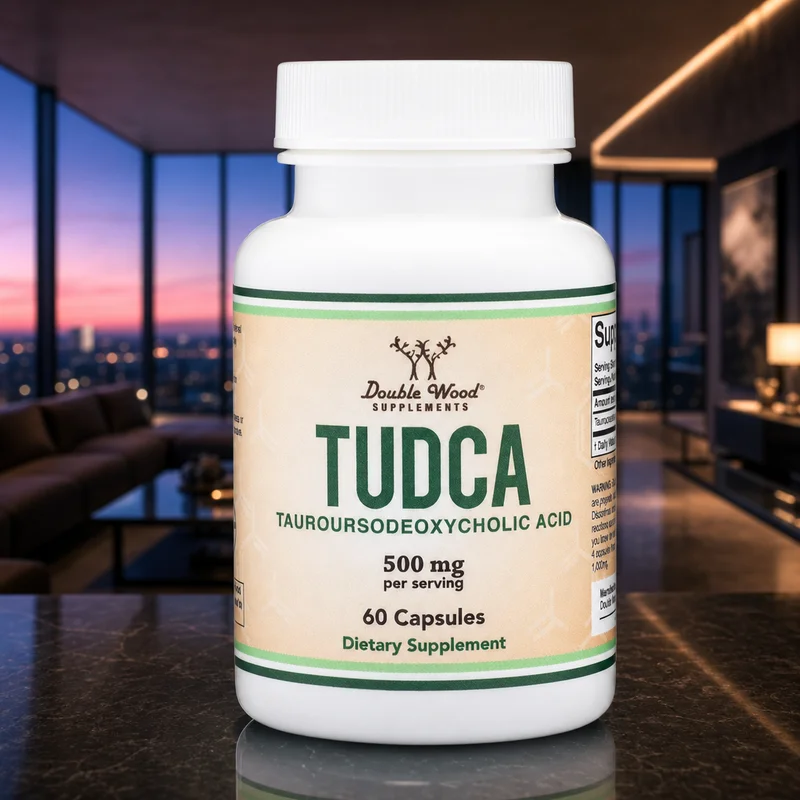
Double Wood TUDCA Bile Salts, 60 Capsules (500mg per 2-cap serving)
What is TUDCA?
TUDCA (tauroursodeoxycholic acid) is the taurine-conjugated form of ursodeoxycholic acid (UDCA), a naturally occurring bile acid found in trace amounts in human bile and, historically, in bear bile. Today's supplements are synthesized, not animal-derived. UDCA itself is an approved prescription drug for cholestatic liver disease and gallstone dissolution, which gives TUDCA a credible biological rationale. As an over-the-counter supplement it is marketed for liver support, bile flow, and gallbladder health, typically dosed at 250-500mg per day. Purity is the axis that matters most here: because it is a bile acid, third-party HPLC verification against a USP standard is the single best signal that you are getting genuine, unadulterated TUDCA.
How it works
TUDCA works through two main mechanisms. First, as a hydrophilic ("water-loving") bile acid, it dilutes the pool of toxic hydrophobic bile acids that build up in cholestasis, reduces their detergent damage to liver cell membranes, and helps restore bile flow, the same logic behind prescription UDCA. Second, and more speculatively for supplement users, TUDCA acts as a chemical chaperone that eases endoplasmic-reticulum (ER) stress and blunts the unfolded-protein response inside cells, which is the basis for research interest in metabolic and neurodegenerative conditions. The important honesty here: these mechanisms are well documented in cell and animal models and in pharmaceutical UDCA trials, but they do not automatically translate into measurable liver-health benefits for a healthy person taking an OTC capsule.
At-a-glance facts
- Typical dose
- 250-500mg per day
- Form
- Capsule (synthesized bile acid)
- Best-tested pick
- Double Wood (HPLC vs USP standard)
- Evidence for OTC liver benefit
- Thin / preliminary in humans
- Pharma cousin
- UDCA, an approved cholestasis drug
- Common stack
- Milk thistle, NAC
- Purity signal to look for
- Third-party HPLC + heavy-metal panel
- Not for
- Pregnancy, bile-duct obstruction
Evidence: The mechanism and the prescription track record of its cousin UDCA are strong, but direct human trials of TUDCA as an OTC liver supplement are small, few, and mostly outside general liver-health, so claims should stay modest.
Who it's for — and who it isn't
- People whose clinician has raised bile-flow or mild cholestasis concerns and who want the researched bile-acid family (ideally under medical guidance)
- Users on liver-taxing regimens (e.g. oral anabolics, aggressive fat-loss protocols) looking for bile-acid support, understanding the evidence is preliminary
- Supplement stackers who already run milk thistle or NAC and want to add a mechanistically distinct bile acid
- People with sluggish fat digestion or post-gallbladder-removal symptoms exploring bile-flow options
- Buyers who prioritize third-party HPLC-verified purity over price
- Pregnant or breastfeeding people, where TUDCA is not established as safe (prescription UDCA is used in pregnancy only under specialist supervision)
- Anyone with a complete bile-duct obstruction, where increasing bile flow can be harmful
- People expecting a proven cure or a substitute for prescription treatment of diagnosed liver disease
- Bargain hunters buying proprietary blends where the true TUDCA milligram dose is hidden
- Vegans buying ox-bile stacked products, which contain animal-derived bile
Week-by-week, what happens
- Days 1-7Possible bile-flow effects such as looser stools or easier fat digestion; some users report nothing at all
- Weeks 2-4In clinical cholestasis settings, bile-acid therapy can begin shifting liver enzyme markers, but this is not established for healthy OTC users
- Weeks 4-8+Any liver-support benefit, if present, would be gradual and best judged through clinician-ordered bloodwork rather than by feel
Safety & contraindications
- Generally well tolerated at 250-500mg/day; the most common complaint is loose stools or GI upset from the bile-acid load
- Do not use with a complete bile-duct obstruction, where raising bile flow can cause harm
- Not established as safe in pregnancy or breastfeeding; prescription UDCA is used in pregnancy only under specialist care, so treat OTC TUDCA as off-limits without medical advice
- It can theoretically interact with bile-acid-binding drugs (e.g. cholestyramine) and other medications; clear it with a pharmacist if you take prescriptions
- Purity is the real safety axis: because it is a bile acid, buy only products with third-party HPLC identity/potency testing and a heavy-metal panel
- OTC supplement claims outrun the human evidence, so do not use TUDCA to self-treat diagnosed liver disease in place of prescribed therapy
All articles on TUDCA
Best Choline Supplements
9 choline supplements ranked on form and bioavailability, dose against the clinical range, third-party testing, tolerability and value.
Read →Best Milk Thistle (Silymarin) Supplements
9 milk thistle supplements ranked on form and bioavailability, silymarin dose against the clinical range, third-party testing, value per effective serving and tolerability.
Read →Best NAC (N-Acetylcysteine) Supplements
9 NAC supplements ranked on form and bioavailability, third-party testing, dose against the clinical range, tolerability and cost per effective dose.
Read →Best TUDCA Supplements
9 TUDCA supplements ranked on third-party testing and purity, form, dose against the functional range, tolerability and value.
Read →Best Naturals TUDCA 250mg, 60 Veg Capsules Review
The cheapest TUDCA here at ~$0.28/cap — but the savings come with the thinnest third-party transparency, which matters a lot for a bile acid.
Read →BodyBio TUDCA, 60 Capsules Review
The most thoroughly tested TUDCA here — in-house plus external cGMP batch testing — but you pay a steep premium for a standard 250mg dose.
Read →BulkSupplements.com TUDCA 250mg, 60 Capsules Review
A plain, per-batch-tested 250mg TUDCA from a bulk manufacturer — reliable and unremarkable, with a powder option for dose tinkerers.
Read →Canarata TUDCA with Milk Thistle Liver Supplements 1000mg - 120 Capsules Review
Canarata pairs a disclosed 900mg of TUDCA with six liver botanicals at 10-20mg each, but names no third-party testing. A strong dose, an unverified product.
Read →Double Wood TUDCA Bile Salts, 60 Capsules (500mg per 2-cap serving) Review
An HPLC-verified TUDCA that lets you hit the full 500mg/day research dose cheaply — the honest pick if you accept the thin OTC outcome evidence.
Read →Dr. Berg TUDCA Supplement, 30 Capsules Review
A practitioner-branded 250mg TUDCA that's the priciest per dose here — you're paying largely for the name, not for extra verification or dose.
Read →Huge Supplements TUDCA 300mg, 60 Servings Review
A slightly higher 300mg dose with QR-scannable batch lab results — transparency is the sell, sports-supplement pricing is the cost.
Read →NatureBell TUDCA 500mg + OX Bile 125mg, 120 Capsules Review
A 500mg TUDCA plus ox-bile stack aimed squarely at fat digestion and bile flow — potent and cheap per serving, but animal-derived and lightly tested.
Read →Nutricost TUDCA 250mg, 60 Capsules (Tauroursodeoxycholic Acid) Review
A clean, third-party-tested 250mg TUDCA at the best mainstream price — the sensible default for a first trial.
Read →Nutricost TUDCA 500 mg Review
500 mg TUDCA in one capsule at about $0.87 a day; testing claim names no lab. 7.6/10.
Read →PrimaForce TUDCA 500 mg Review
500 mg TUDCA in one capsule at about $0.82 a day; no certifier listing or COA found. 7.5/10.
Read →FAQ
Does TUDCA actually protect your liver?
The rationale is strong: TUDCA is a hydrophilic bile acid and its cousin UDCA is an approved cholestasis drug. But direct human trials of TUDCA as an OTC liver supplement in otherwise healthy people are small and sparse, so honest framing is 'promising mechanism, thin outcome evidence,' not 'proven liver protection.'
What dose of TUDCA should I take?
Most supplements and the available research cluster around 250-500mg per day. Higher is not clearly better for general use, and there is no strong basis for megadosing. If you have a diagnosed liver condition, dosing should come from a clinician.
Is TUDCA made from bear bile?
Historically bile acids came from bear bile, but modern reputable TUDCA supplements are chemically synthesized. Look for products that state this and back it with third-party HPLC testing against a USP standard for identity and potency.
Should I stack TUDCA with milk thistle or NAC?
Those are the two most common partners. Milk thistle (silymarin) and NAC act through different liver-relevant pathways than a bile acid, so stacking is reasonable. Just be wary of proprietary blends that hide the true TUDCA milligram dose behind a big headline number.
Why does my TUDCA taste or smell so bitter?
A strong bitter taste is characteristic of genuine bile acid and is sometimes cited as an informal authenticity marker. It is not a substitute for a lab COA, though, which is the only reliable way to confirm purity.
Can I take TUDCA if I'm pregnant?
No, not on your own. TUDCA is not established as safe in pregnancy or breastfeeding. Prescription UDCA is sometimes used for cholestasis of pregnancy, but only under specialist supervision, so OTC TUDCA should be avoided without medical advice.
Sources & further reading
- Kars M, Yang L, Gregor MF, et al. Tauroursodeoxycholic acid may improve liver and muscle but not adipose tissue insulin sensitivity in obese men and women. Diabetes. 2010;59(8):1899-1905.Tauroursodeoxycholic acid may improve liver and muscle but not adipose tissue insulin sensitivity in obese men and women
A small human proof-of-concept trial: 4 weeks of TUDCA improved hepatic and muscle insulin sensitivity in obese subjects, illustrating both the mechanistic promise and the limited scale of human TUDCA data.
- Elia AE, Lalli S, Monsurro MR, et al. Tauroursodeoxycholic acid in the treatment of patients with amyotrophic lateral sclerosis. Eur J Neurol. 2016;23(1):45-52.Tauroursodeoxycholic acid in the treatment of patients with amyotrophic lateral sclerosis
A randomized human trial of TUDCA in ALS showed a signal of slowed functional decline, demonstrating TUDCA's chaperone/ER-stress rationale is being tested in people, though outside liver-health endpoints.
- Kusaczuk M. Tauroursodeoxycholate-Bile Acid with Chaperoning Activity: Molecular and Cellular Effects and Therapeutic Perspectives. Cells. 2019;8(12):1471.Tauroursodeoxycholate-Bile Acid with Chaperoning Activity: Molecular and Cellular Effects and Therapeutic Perspectives
A detailed review of TUDCA's mechanisms as a chemical chaperone that reduces ER stress and apoptosis, documenting strong preclinical rationale alongside the current shortage of definitive human outcome trials.
- Vang S, Longley K, Steer CJ, Low WC. The Unexpected Uses of Urso- and Tauroursodeoxycholic Acid in the Treatment of Non-liver Diseases. Glob Adv Health Med. 2014;3(3):58-69.The Unexpected Uses of Urso- and Tauroursodeoxycholic Acid in the Treatment of Non-liver Diseases
A review outlining the cytoprotective and anti-apoptotic actions of UDCA and TUDCA across multiple organ systems, contextualizing why the bile-acid family draws research interest well beyond its established cholestasis use.
- Rudic JS, Poropat G, Krstic MN, et al. Ursodeoxycholic acid for primary biliary cirrhosis. Cochrane Database Syst Rev. 2012;12:CD000551.Ursodeoxycholic acid for primary biliary cirrhosis
This Cochrane review of TUDCA's parent bile acid UDCA in primary biliary cholangitis anchors the pharmacological pedigree of the family, while its cautious conclusions on hard clinical outcomes underscore why OTC TUDCA claims should stay modest.