
Pre-Workout: Benefits, Dosage & Side Effects (2026)
A pre-workout is a pre-training supplement whose value comes from clinically-dosed, disclosed actives — citrulline, beta-alanine, betaine and caffeine — not its stimulant hit.
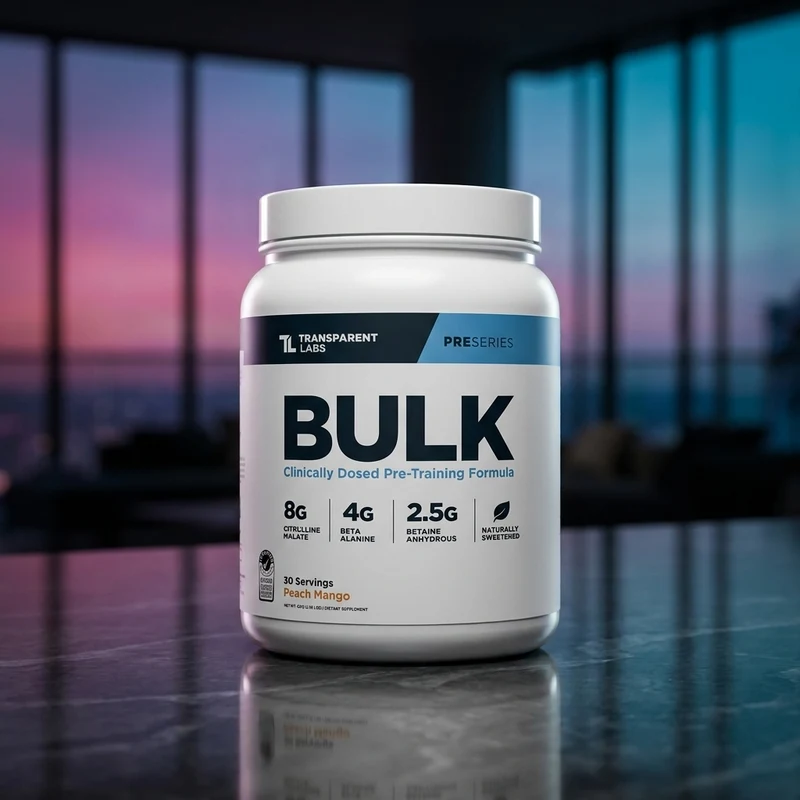
Transparent Labs BULK Pre-Workout, Peach Mango
What is Pre-Workout?
A pre-workout is a powdered (occasionally capsule or ready-to-drink) supplement mixed into water and taken 20-40 minutes before training to support energy, focus, blood flow (the "pump") and muscular endurance. The category is huge and loud, and the marketing is built almost entirely around one sensation: the caffeine hit and the skin-tingling that makes a scoop "feel" like it's working. That framing is exactly backwards. A good pre-workout is judged on its clinically-dosed, fully-disclosed actives — not on how hard the stimulant lands.
The ingredients with real ergogenic evidence are well known and well dosed: L-citrulline at about 6-8 g (or ~8 g of citrulline malate) for the nitric-oxide-driven blood flow people feel as the pump; beta-alanine at 3.2 g for muscular endurance in efforts lasting one to four minutes — and for the harmless skin-tingling (paresthesia); betaine at around 2.5 g; and creatine at ~3-5 g where it's included. Caffeine earns its place too, but for a specific job: acute focus, alertness and a measurable bump in strength and power output. A great pre-workout hits those doses and tells you exactly how much of each it contains. A mediocre one hides behind a wall of stimulant energy and hopes you don't read the panel.
That panel is where the category's dirty secret lives: the proprietary blend. Instead of disclosing each ingredient's dose, a blend lists a long, impressive-looking string of actives under one combined number — which conveniently lets a brand under-dose the expensive pump and endurance ingredients while leaning on a big, cheap hit of caffeine to make the product feel like it's working. The buzz is real; the citrulline behind it often isn't. So the defining buyer decisions are transparency (can you see the dose of every active?) and clinical dosing (are citrulline and beta-alanine actually at research levels?), far more than the milligram count on the front of the tub. There are also two honest sub-types: stimulant formulas built around caffeine for energy and focus, and stim-free / pump formulas (citrulline, glycerol, nitrates) that deliver blood flow with zero caffeine — ideal for evening training or for stacking your own stimulant.
How it works
A pre-workout doesn't have one mechanism — it's a bundle of actives, each with its own evidence, and the honest picture is that the evidence is per-INGREDIENT, not for any single blended product. Understanding the three workhorse actives is what lets you read past the caffeine.
FIRST, the PUMP comes from L-citrulline. Citrulline raises plasma arginine and nitric-oxide availability, widening blood vessels and increasing blood flow to working muscle. The foundational human trial dosed 8 g of citrulline malate and found significantly more bench-press repetitions across a session plus less muscle soreness at 24-48 hours (Pérez-Guisado 2010, PMID 20386132). That 8 g figure is exactly why this hub credits citrulline only at 6-8 g — and why a sprinkle of citrulline hidden inside a proprietary blend scores poorly: under that dose, the mechanism barely engages.
SECOND, the ENDURANCE BUFFER and the tingle come from beta-alanine — and this is the most misunderstood ingredient in the category. Beta-alanine works by saturating muscle carnosine over WEEKS of consistent daily dosing (around 3.2-6.4 g/day), which buffers the acid build-up that limits high-intensity efforts. Meta-analyses put the benefit squarely in efforts lasting 60-240 seconds (Hobson 2012, PMID 22270875), with a larger, more conservative review confirming a small-but-real effect (Saunders 2017, PMID 27797728). Crucially, a single pre-workout scoop is NOT acutely ergogenic — the skin-tingling you feel from it is cosmetic, a sign the ingredient is present, not a sign it's working that session. The benefit is built over weeks, not felt before one workout.
THIRD, the ENERGY and FOCUS come from caffeine, and this is the part you actually feel acutely. Caffeine reliably improves muscle strength and power (Grgic 2018, PMID 29527137) and is ergogenic for endurance, strength and sprinting while sharpening alertness and focus, with an effective range of roughly 3-6 mg/kg of body mass taken ~60 minutes pre-exercise (Guest 2021 ISSN position stand, PMID 33388079). But caffeine's role is specific — acute output and focus — not a substitute for the dosed pump and endurance ingredients, and tolerance builds with daily use, so the jolt fades. Betaine (~2.5 g) and creatine (~3-5 g) add further support where they're dosed. The bottom line on mechanism: a pre-workout genuinely supports a training session when its actives are dosed at trial levels and disclosed — but it's acute performance support layered on sleep, food and progressive overload, not a transformation in a scoop.
At-a-glance facts
- What it actually is
- Acute pre-training performance support — judged on disclosed, clinically-dosed actives, NOT the caffeine buzz
- Typical use
- 1 scoop in water, 20-40 min before training
- The pump dose
- L-citrulline 6-8 g (or ~8 g citrulline malate) for nitric-oxide blood flow (Pérez-Guisado 2010)
- The endurance dose
- Beta-alanine 3.2 g/day — saturates muscle carnosine over WEEKS, not acutely; source of the harmless tingle
- Caffeine range
- ~3-6 mg/kg for focus & output (Guest 2021); tolerance builds, and 300-400 mg sits near the 400 mg daily ceiling
- Biggest buyer decision
- Label transparency (per-ingredient doses) vs proprietary blends that hide under-dosed actives behind cheap caffeine
- Two honest sub-types
- Stim (caffeine-led energy/focus) vs stim-free / pump (citrulline, glycerol, nitrates — zero caffeine)
- Cost range (US)
- ~$0.42 to nearly $3.00 per serving
- Stack synergy
- Creatine daily (the proven muscle/strength lever) + electrolytes; a stim-free pump can stack on your own caffeine dose
Evidence: The evidence is strong but per-INGREDIENT, not for any one blended product. L-citrulline (8 g) increased bench-press reps and cut soreness (Pérez-Guisado 2010 PMID 20386132); beta-alanine improves 1-4 min muscular endurance via muscle-carnosine saturation over WEEKS, not from a single scoop (Hobson 2012 PMID 22270875; Saunders 2017 PMID 27797728, effect modest); caffeine reliably improves strength, power and focus at ~3-6 mg/kg (Grgic 2018 PMID 29527137; Guest 2021 PMID 33388079). So a pre-workout works when its actives are dosed at trial levels AND disclosed — but it's acute performance support, the acute 'feel' is mostly caffeine, tolerance builds, and proprietary blends that under-dose the pump ingredients behind big caffeine are the category's defining failure mode.
Who it's for — and who it isn't
- Lifters and athletes who want a real edge in energy, focus, pump and muscular endurance before training — and will judge a formula on its disclosed doses, not its caffeine number
- People who read the label and want citrulline at 6-8 g and beta-alanine at ~3.2 g actually disclosed, not buried in a proprietary 'energy matrix'
- Anyone training in the morning or early afternoon who tolerates caffeine and wants acute focus and output support (roughly 3-6 mg/kg)
- Evening trainers and the caffeine-sensitive who want a stim-free / pump formula (citrulline, glycerol, nitrates) for blood flow with zero stimulant
- Experienced lifters happy to take beta-alanine consistently for weeks to saturate muscle carnosine, understanding the endurance benefit is built, not felt from one scoop
- Anyone expecting a transformation in a scoop — it's acute performance support, not a substitute for sleep, adequate protein and progressive overload
- Caffeine-sensitive people, anyone with high blood pressure or a heart condition, and those training late who don't want disrupted sleep (choose a stim-free pump formula or skip it)
- Bargain-hunters who only consider proprietary-blend products — you can't verify the citrulline/beta-alanine dose you're paying for behind a single combined number
- Pregnant or breastfeeding people and anyone advised to limit caffeine — many formulas push 300-400 mg, near the FDA's 400 mg daily ceiling
- People chasing the tingle as proof of potency — beta-alanine paresthesia is harmless and cosmetic, not a sign the scoop is working that session
Week-by-week, what happens
- First scoop (20-40 min)Caffeine kicks in — acute focus, alertness and a measurable bump in strength/power output (Grgic 2018). Citrulline raises blood flow, so the 'pump' shows during the session. The beta-alanine tingle may appear; it's harmless and cosmetic, NOT a sign of potency or that the endurance benefit is active.
- Week 1-2Beta-alanine begins saturating muscle carnosine with consistent daily dosing. No felt endurance change yet — this ingredient builds over weeks, so don't judge it on a single workout. Caffeine response is still strong if you don't take it daily.
- Week 3-4Muscle carnosine approaches useful saturation, so beta-alanine's muscular-endurance benefit in 1-4 min efforts starts to materialize (Hobson 2012; Saunders 2017). Meanwhile, daily caffeine users will notice the acute jolt fading as tolerance builds — the actives keep working, the buzz dampens.
- OngoingTreat it as acute performance support layered on the fundamentals. Cycling caffeine (or using a stim-free pump formula on some days) keeps the stimulant effective. None of it substitutes for sleep, adequate protein and progressive overload — judge the product by its disclosed doses, not the buzz.
Safety & contraindications
- Caffeine is the main safety axis. Many pre-workouts carry 300-400 mg per scoop — close to the FDA's 400 mg daily ceiling — so account for all your other caffeine, and don't take it late in the day if you value your sleep. The caffeine-sensitive should choose a low-stim or stim-free / pump formula.
- If you have high blood pressure, a heart condition, anxiety, or are pregnant or breastfeeding, talk to a clinician before using a stimulant pre-workout; the caffeine dose alone can be a problem, and some formulas add other stimulants on top.
- The beta-alanine tingle (paresthesia) is harmless and expected at clinical doses — it's a skin sensation, not an allergic reaction or a sign of potency. If it's uncomfortable, split the dose or choose a lower-beta-alanine product.
- Proprietary-blend labels hide individual doses, so you cannot verify how much citrulline, beta-alanine or other active you're getting — only the combined number and (separately) caffeine. If knowing the dose matters to you, choose a fully-disclosed label.
- Read the full ingredient panel for added stimulants, high niacin (can cause a flush), artificial dyes, and actives you may react to. 'More milligrams on the front' is not the same as 'better' — it's often just more caffeine.
- It is acute performance support, not magic and not a foundation. Tolerance to caffeine builds, the beta-alanine benefit takes weeks to accrue, and none of it replaces sleep, adequate protein and progressive overload.
All articles on Pre-Workout
Best Beta-Alanine Supplements
The best beta-alanine supplements ranked on form (patented CarnoSyn vs generic), effective dose and third-party testing - with the honest framing that the benefit is real but niche: it buffers acid in high-intensity 1-4 minute efforts, a mid-tier add-on, not a top lever.
Read →Best Caffeine + L-Theanine Supplements
8 caffeine + L-theanine combo capsules ranked on the 1:2 ratio the trials used, ingredient sourcing, testing and dosing flexibility — every Supplement Facts panel read by us.
Read →Best Pre-Workout
The 8 best pre-workouts ranked on clinically-dosed actives (L-citrulline 6-8g, beta-alanine 3.2g, betaine), label transparency over proprietary blends, stimulant profile, value and taste — with the honest frame that a great pre-workout is judged on its dosed performance ingredients, not its caffeine buzz.
Read →Beta-Alanine (CarnoSyn), Unflavored Review
The cleanest quality pick — 100% patented CarnoSyn, the exact form used in most of the research, as a pure unflavored powder from a transparent-label, NSF-registered brand. A ~3 g
Read →Beta-Alanine Extreme 3,200 mg (CarnoSyn), 240 Capsules Review
The studied form, pre-measured: 3,200 mg of CarnoSyn per serving in capsules — exactly the research dose, no powder grit, no scoop guesswork, and easy to split through the day to s
Read →Beta-Alanine Powder (400 g) Review
A dependable mid-size alternative: pure unflavored beta-alanine in a 400 g tub from a long-established sports-nutrition brand — a perfectly good option if the higher picks are out
Read →Beta-Alanine Powder (500 g) Review
The budget value leader: pure non-GMO beta-alanine powder in a 500 g tub, third-party tested in an ISO-accredited lab, at one of the lowest prices per gram in the lineup.
Read →Beta-Alanine Powder, Unflavored (200 g) Review
A clean, no-frills powder from an established sports-nutrition brand: pure unflavored beta-alanine, non-GMO and gluten-free, made in an NSF-certified GMP facility — a sensible smal
Read →Beta-Alanine Powder, Unflavored (500 g) Review
The no-nonsense workhorse: pure unflavored beta-alanine, 3 g per serving, lab-tested in a cGMP facility, at a rock-bottom cost per gram — exactly what a commodity amino acid should
Read →Beta-Alanine Powder, Unflavored Review
The recognizable mainstream pick: pure unflavored beta-alanine from the maker of Gold Standard Whey — a trusted, widely-stocked name for buyers who want a familiar brand behind a s
Read →C4 Original Pre-Workout Review
The popular beginner gateway — gentle, cheap and everywhere, but a partly-hidden, under-dosed label.
Read →Gorilla Mode Nitric (Stimulant-Free) Review
The best stim-free pump — a fully-disclosed 32 g nitric-oxide stack, judged on its own terms.
Read →Kaged Pre-Workout Elite Review
The fully-loaded premium scoop — everything disclosed, including 5 g creatine; high stim, high price.
Read →Legion Pulse Pre-Workout Review
The all-natural, fully-disclosed clinical-dose formula — with smoother, theanine-buffered energy.
Read →Nutricost Pre-Workout Complex Review
The lowest cost per serving in the lineup — transparent and third-party tested.
Read →Optimum Nutrition Gold Standard Pre-Workout Review
A trusted, fully-disclosed label with 3 g creatine — but sub-clinical pump doses.
Read →PrimaForce Beta-Alanine Capsules Review
3.4 g beta-alanine per 4 capsules, inside the studied range, about $0.33 a serving; not CarnoSyn. 7.7/10.
Read →RYSE Loaded Pre-Workout Review
Disclosed and delicious with a smooth dual-release stim — but citrulline-light and near the caffeine ceiling.
Read →Sports Beta-Alanine Pure Powder, 2,000 mg Review
The trusted household pick: NOW's pure beta-alanine powder, 2 g per level scoop from a big 500 g tub, backed by NOW's long-standing in-house GMP testing — just dose up to ~3.2 g wi
Read →Transparent Labs BULK Pre-Workout Review
The clinically-dosed, fully-disclosed benchmark — dosed to the milligram, no proprietary blends.
Read →FAQ
Do pre-workouts actually work — or is it just the caffeine?
Both are true, and that's the honest answer. The acute 'feel' — energy, focus, a strength/power bump — is mostly the caffeine, which is reliably ergogenic at roughly 3-6 mg/kg (Guest 2021). But the other actives do real work when they're properly dosed: citrulline at 6-8 g drives the nitric-oxide pump and improved bench-press volume in trials (Pérez-Guisado 2010), and beta-alanine at 3.2 g/day improves muscular endurance in 1-4 minute efforts — though that one builds over weeks of consistent use, not from a single scoop. So a well-formulated pre-workout works on several fronts; a poorly-formulated one is mostly caffeine with a sprinkle of under-dosed pump ingredients for show.
What doses should I actually look for on the label?
The benchmarks are well established: L-citrulline at 6-8 g (or about 8 g of citrulline malate) for the pump, beta-alanine at 3.2 g for muscular endurance and the tingle, betaine at around 2.5 g, and creatine at ~3-5 g where it's included. Caffeine is a personal call — roughly 3-6 mg/kg of body mass for focus and output, which for most people lands around 150-300 mg. The single most important thing is that these doses are actually disclosed on the label, not hidden inside a proprietary blend. A formula that prints every gram and hits those numbers is doing something most of its competitors won't.
What's a proprietary blend, and why is it the category's dirty secret?
A proprietary blend lists several ingredients under one combined number instead of disclosing each ingredient's dose. It looks impressive — a long string of actives — but it conveniently lets a brand under-dose the expensive pump and endurance ingredients (citrulline, beta-alanine) while leaning on a big, cheap hit of caffeine to make the product feel like it's working. You can see the total and usually the caffeine, but not how much of anything else you're getting. That's why this hub is transparency-and-dose-first: a fully-disclosed label beats a proprietary 'energy matrix' every time, no matter how high the milligram count on the front of the tub.
Why does my pre-workout make me tingle?
That's beta-alanine, and the sensation is called paresthesia — a harmless skin-tingling that's expected at clinical doses (around 3.2 g). It is NOT an allergic reaction, and it is NOT a sign of potency or that your workout is about to be supercharged. In fact, beta-alanine doesn't work acutely at all: it improves muscular endurance only after weeks of consistent daily dosing saturate your muscle carnosine. So enjoy the tingle if you like it, but don't read it as the product 'kicking in' — that feeling is the caffeine's job, not the beta-alanine's.
Stim or non-stim — which should I pick?
It depends on when you train and how you handle caffeine. Stimulant formulas are built around caffeine for energy and focus — great for morning or early-afternoon training if you tolerate it. Stim-free / pump formulas (citrulline, glycerol, nitrates) deliver blood flow and a strong pump with zero caffeine, which makes them ideal for evening training, for the caffeine-sensitive, or for stacking on top of your own measured caffeine dose. Neither is 'better' in the abstract — a good non-stim pump product is excellent on its own terms. Judge each on its disclosed doses; just match the stimulant level to your schedule and tolerance.
Can I take pre-workout every day, and does it stop working?
You can take the non-caffeine actives daily — in fact beta-alanine needs consistent daily dosing to build its benefit. The caffeine is the part that fades: tolerance builds with daily use, so the acute jolt gets weaker over time. If you rely on the buzz, consider cycling caffeine (lower-stim or stim-free days) to keep it effective, and watch your total daily intake since many scoops sit near the 400 mg ceiling. And keep the honesty in view: it's acute performance support, not a foundation — sleep, protein and progressive overload do far more for your results than any scoop.
Sources & further reading
- Pérez-Guisado 2010Citrulline malate enhances athletic anaerobic performance and relieves muscle soreness
In a randomized, double-blind crossover trial, a single 8 g dose of citrulline malate significantly increased the number of repetitions performed across a barbell bench-press session (by up to ~52% in later sets) and reduced muscle soreness at 24 and 48 hours versus placebo. The foundational human trial behind the 6-8 g citrulline dose this hub credits for the pump and performance — and the reason an under-dosed proprietary-blend citrulline is not worth paying for.
- Hobson 2012Effects of β-alanine supplementation on exercise performance: a meta-analysis
Pooling 15 studies (360 participants), beta-alanine improved exercise outcomes versus placebo, with the benefit concentrated in efforts lasting 60-240 seconds — the classic 'muscular endurance' window. The core meta-analytic support for beta-alanine, dosed in trials around 3.2-6.4 g/day to saturate muscle carnosine, which is why this hub credits 3.2 g and notes the effect builds over weeks rather than from a single pre-workout scoop.
- Saunders 2017β-alanine supplementation to improve exercise capacity and performance: a systematic review and meta-analysis
An updated systematic review and meta-analysis of 40 studies (1,461 participants) found a small but significant ergogenic effect of beta-alanine, again greatest in capacity-based exercise lasting roughly 30 seconds to 10 minutes. A more conservative, larger-sample confirmation of Hobson 2012 — honest about the effect size being modest, and the basis for treating beta-alanine as a real but non-magical endurance buffer.
- Grgic 2018Effects of caffeine intake on muscle strength and power: a systematic review and meta-analysis
A meta-analysis concluding that acute caffeine ingestion significantly improves muscle strength (SMD 0.20) and muscle power (SMD 0.17), with the strength effect clearest for the upper body. Direct evidence that caffeine's role in a pre-workout is real and specific — acute output and power, not a substitute for the dosed pump and endurance ingredients.
- Guest 2021International society of sports nutrition position stand: caffeine and exercise performance
The ISSN position stand concludes caffeine is reliably ergogenic for muscular endurance, strength, sprinting and aerobic performance and improves alertness and focus, with the effective range commonly 3-6 mg/kg of body mass taken ~60 minutes pre-exercise. The evidence basis for judging a pre-workout's caffeine dose as appropriate (roughly 3-6 mg/kg) rather than simply 'more is better' — and a reminder that tolerance and individual response vary.