

Glucomannan: Benefits, Dosage & Side Effects (2026)
Glucomannan is the viscous soluble fiber from konjac root; trials dosed 1 g to 1.33 g in capsules with a full glass of water before meals, with a supported cholesterol effect and an unproven weight effect.
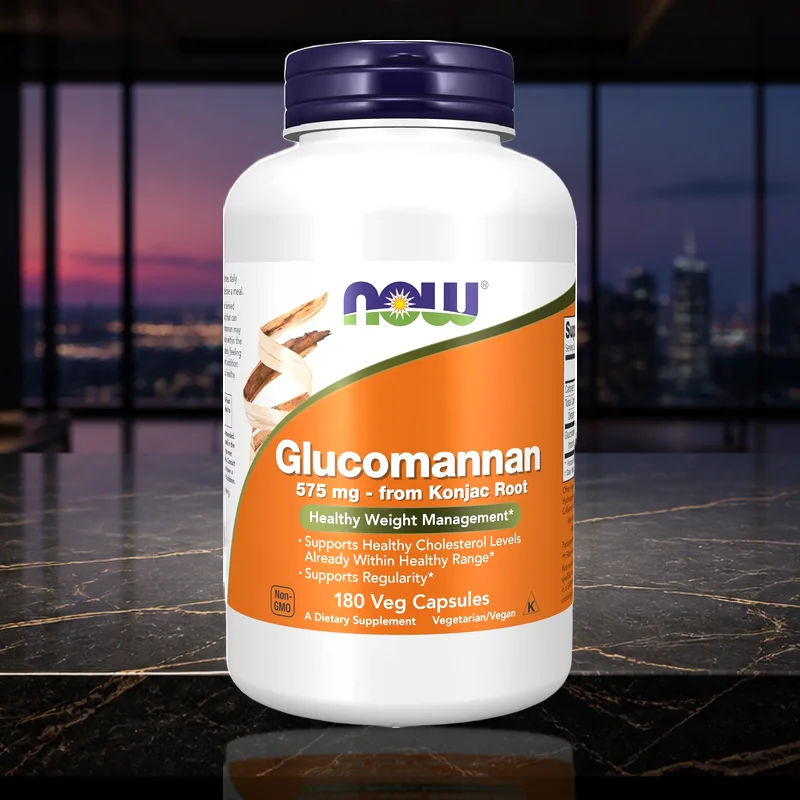
NOW Foods Glucomannan 575 mg
What is Glucomannan?
Glucomannan is a soluble dietary fiber, the main polysaccharide in the tuber of Amorphophallus konjac, a plant eaten in East Asia for centuries as konjac jelly and shirataki noodles. As a supplement it is sold in capsules and as loose powder, and it is the active ingredient in the diet brand Lipozene.
What sets it apart from other fibers is how much water it holds. It is strongly hygroscopic, forms a highly viscous solution and expands to many times its original size. That property is the reason it is marketed for weight loss, and it is also the reason every sensible label tells you to take it with a full glass of water.
How it works
The mechanism is physical. Taken with water before a meal, glucomannan forms a thick gel in the stomach that takes up room; reviews attribute its effects to satiety and to a small loss of energy in the stool (Keithley 2005).
THE LIPID EFFECT is the better-supported one. A meta-analysis of 14 randomized trials found glucomannan lowered total cholesterol, LDL cholesterol, triglycerides and fasting glucose, with a small drop in body weight (Sood 2008).
THE WEIGHT EFFECT is where the evidence splits. A small 1984 trial reported a 5.5 lb loss over eight weeks at 1 g before each meal (Walsh 1984). The better-controlled 2013 trial at 1.33 g before each meal found no more weight loss than placebo and no change in hunger or fullness ratings (Keithley 2013), and a 2014 meta-analysis of eight trials found no statistically significant weight loss (Onakpoya 2014). A 2015 systematic review found some short-term effects in individual trials and none on BMI (Zalewski 2015).
At-a-glance facts
- What it is
- Viscous soluble fiber from konjac root (Amorphophallus konjac)
- Studied dose
- 1 g (Walsh 1984) to 1.33 g (Keithley 2013) before each of three meals; 2-4 g a day in the Keithley 2005 review
- How it was taken
- In capsules with 8 oz of water, about an hour before meals
- Best-evidenced effect
- Lower total and LDL cholesterol across 14 trials (Sood 2008)
- Weight loss
- Mixed: one early positive trial, a negative 2013 trial and a 2014 meta-analysis with no significant effect
- Main risk
- Swelling in the throat or esophagus if taken without enough water (Henry 1986, Vanderbeek 2007)
- Side effects
- Abdominal discomfort, diarrhea, constipation (Onakpoya 2014)
- Label check
- Declared glucomannan amount, a full glass of water, pre-meal timing and a choking warning
- Evidence level
- 3 of 5 — real mechanism and lipid effect, weight effect not confirmed in the pooled trials
- Cost range (US)
- ~$0.14 to $0.55 per label serving
Evidence: A 14-trial meta-analysis supports lower cholesterol and a small weight effect; the best-controlled weight-loss trial and the 2014 meta-analysis of eight trials found no significant weight loss versus placebo. The mechanism is real, the lipid effect is supported, the weight effect is unproven.
Who it's for — and who it isn't
- People in a calorie deficit who want help feeling full before meals and will follow the water rule
- Adults adding a viscous soluble fiber for cholesterol support
- Dieters who want a non-stimulant aid with a known mechanism
- Anyone who prefers a fiber capsule to a bulky fiber drink
- Anyone with swallowing difficulty or a history of esophageal narrowing; obstruction cases are documented
- People who expect weight loss from the capsule alone; the pooled trials did not find it
- People on medication who cannot leave a gap; viscous fiber can slow the absorption of drugs taken with it
- Anyone who will take it dry, lying down or just before sleep; the labels are for adults only
Week-by-week, what happens
- Day 1Fullness before the first meal for some users; in the 2013 trial fullness ratings did not differ from placebo.
- Week 1-2The gut adjusts. Abdominal discomfort, diarrhea and constipation were the adverse events recorded; start with one serving a day and plenty of water.
- Week 8Where the trials measured. One early trial reported a 5.5 lb loss, the 2013 trial no difference from placebo.
- OngoingA fiber habit with rules: before meals, with a full glass of water, away from bedtime and from medications.
Safety & contraindications
- Choking and obstruction are the real risk. Glucomannan expands rapidly on contact with fluid, and esophageal obstruction has been reported (Henry 1986, Vanderbeek 2007). Always swallow it with at least a full glass of water, never dry, and not lying down or just before sleep.
- Do not use it if you have difficulty swallowing or a history of esophageal narrowing. Seek medical attention for chest pain, vomiting or difficulty swallowing or breathing after a dose; several labels print exactly this.
- Medications: viscous fiber can slow the absorption of drugs taken at the same time. One label on our list advises leaving 1.5 hours between glucomannan and medications; ask a pharmacist about anything with a narrow dosing window.
- Gastrointestinal effects are common and usually mild: abdominal discomfort, diarrhea and constipation were the adverse events in the pooled trials.
- Blood sugar: trials found lower fasting glucose. People on glucose-lowering medication should monitor and speak to a clinician.
- Pregnancy and breastfeeding: no safety data at supplement doses; one label on our list says not to use it. The labels are written for adults only.
All articles on Glucomannan
Best Appetite Suppressant Supplements
The best appetite suppressant supplements, ranked evidence-first - fiber (glucomannan, psyllium) and protein lead because they actually curb hunger; weak herbal pills are flagged honestly.
Read →Best Glucomannan Supplements
8 glucomannan products ranked on dose against the trials, label directions and choking warning, testing, formulation and value — every Supplement Facts panel read by us.
Read →Best Naturals Konjac Root Glucomannan 2,000 mg (2-Pack) Review
A two-bottle pack of vegetarian glucomannan capsules, 2,000 mg per serving, labelled third-party lab tested, at roughly half the capsule price per gram.
Read →BulkSupplements Glucomannan Capsules 2,000 mg Review
A 240-count veg capsule with one filler and a testing badge, whose panel lists konjac root extract instead of stating how much glucomannan it contains.
Read →Carlyle Glucomannan 2,400 mg Review
A 200-count gelatin capsule delivering 2,400 mg of glucomannan per serving, with the most complete directions and medication notice of any bottle here.
Read →Lipozene Maximum Strength 1,500 mg Review
Glucomannan under a diet-pill brand: a sound pre-meal dosing schedule and warning, a 'clinically proven' claim the pooled trials do not support, and the highest price per gram on the list.
Read →Nature's Way Glucomannan 1,995 mg Review
A two-ingredient vegan capsule delivering 1.995 g of glucomannan per serving, Non-GMO Project Verified, with a complete safety warning and only 33 servings a bottle.
Read →NOW Foods Glucomannan 575 mg Review
The reference glucomannan capsule: 575 mg per veg capsule, 1.725 g per serving, directions that match how the trials dosed it, about twenty-eight cents a serving.
Read →NOW Foods Glucomannan Pure Powder 8 oz Review
Pure konjac glucomannan powder with no other ingredients, 2 g per half-teaspoon serving, the cheapest gram on the list and the least convenient to take.
Read →Nutricost Glucomannan 1,800 mg Review
A third-party-tested 1,800 mg glucomannan capsule at a fair price whose label leaves out the pre-meal timing and the choking warning.
Read →FAQ
Does glucomannan work for weight loss?
The evidence is mixed. A small 1984 trial reported a 5.5 lb loss over eight weeks at 1 g before each meal (Walsh 1984), and a 2008 meta-analysis found a small pooled effect of 0.79 kg (Sood 2008). The best-controlled trial since found no more weight loss than placebo (Keithley 2013), and a 2014 meta-analysis of eight trials found no statistically significant effect (Onakpoya 2014). Treat it as a fullness aid inside a calorie deficit, not as a fat burner.
How much glucomannan should I take, and when?
The trials used 1 g to 1.33 g in capsules with 8 oz of water about an hour before each of three meals, and a review described 2 to 4 g a day as well tolerated. Most labels suggest a serving of about 2 g once or twice a day, 30 to 45 minutes before a meal.
Is glucomannan dangerous?
Taken correctly it was well tolerated in the trials. The specific danger is mechanical: the fiber swells, and cases of esophageal obstruction are on record. Take it with a full glass of water, never dry, never lying down, and not at all if you have trouble swallowing.
Capsules or powder?
The same fiber. The trials used capsules, which give an exact dose and are easy to take with water. Powder costs about half as much per gram and has no excipients, but it must be stirred into a full glass and drunk immediately, before it gels.
Is Lipozene just glucomannan?
Its Supplement Facts panel lists one active: a 1,500 mg proprietary blend of Amorphophallus konjac per two capsules, which is the plant glucomannan comes from. It costs more than twice as much per gram as a plain glucomannan capsule.
Does glucomannan lower cholesterol?
That is its best-supported effect. A meta-analysis of 14 randomized trials found reductions in total cholesterol, LDL cholesterol and triglycerides (Sood 2008).
Sources & further reading
- Walsh DE, et al. Int J Obes. 1984;8(4):289-93.Effect of glucomannan on obese patients: a clinical study
In an eight-week double-blind trial in 20 obese subjects, 1 g of glucomannan with 8 oz of water one hour before each of three meals produced a mean weight loss of 5.5 lb and lowered total and LDL cholesterol; no adverse reactions were reported.
- Keithley J, Swanson B. Altern Ther Health Med. 2005;11(6):30-4.Glucomannan and obesity: a critical review
A critical review concluding that at 2 to 4 g per day glucomannan was well tolerated and produced significant weight loss in overweight and obese individuals, probably by promoting satiety and fecal energy loss, while calling for further safety and efficacy trials.
- Sood N, et al. Am J Clin Nutr. 2008;88(4):1167-75.Effect of glucomannan on plasma lipid and glucose concentrations, body weight, and blood pressure: systematic review and meta-analysis
Pooling 14 randomized trials with 531 participants, glucomannan lowered total cholesterol by 19.3 mg/dL, LDL cholesterol by 16.0 mg/dL, triglycerides by 11.1 mg/dL, fasting glucose by 7.4 mg/dL and body weight by 0.79 kg.
- Keithley JK, et al. J Obes. 2013;2013:610908.Safety and efficacy of glucomannan for weight loss in overweight and moderately obese adults
In 53 overweight and moderately obese adults, 1.33 g of glucomannan with 8 oz of water one hour before each meal for eight weeks was well tolerated but produced no more weight loss than placebo and did not change body composition, hunger or fullness.
- Onakpoya I, et al. J Am Coll Nutr. 2014;33(1):70-8.The efficacy of glucomannan supplementation in overweight and obesity: a systematic review and meta-analysis of randomized clinical trials
A meta-analysis of eight randomized trials found a non-significant difference in weight loss between glucomannan and placebo (mean difference -0.22 kg); adverse events included abdominal discomfort, diarrhea and constipation.
- Zalewski BM, et al. Nutrition. 2015;31(3):437-42.e2.The effect of glucomannan on body weight in overweight or obese children and adults: a systematic review of randomized controlled trials
A systematic review of six randomized trials found some short-term reductions in body weight in individual adult trials but no favorable effect of glucomannan on body mass index in any trial.
- Henry DA, et al. Br Med J (Clin Res Ed). 1986;292(6520):591-2.Glucomannan and risk of oesophageal obstruction
A British Medical Journal report on the risk of oesophageal obstruction with glucomannan, the reason labels now tell users to take it with plenty of water.
- Vanderbeek PB, et al. Clin Toxicol (Phila). 2007;45(1):80-2.Esophageal obstruction from a hygroscopic pharmacobezoar containing glucomannan
A case report of esophageal obstruction from a glucomannan-containing product; the authors note that the fiber is strongly hygroscopic and expands rapidly to many times its original size.