
Garlic: Benefits, Dosage & Side Effects (2026)
Garlic supplements deliver a small, repeatable systolic blood-pressure drop (~5 mmHg in hypertensives) and a minor cholesterol nudge; form and allicin stability matter more than dose on the label.
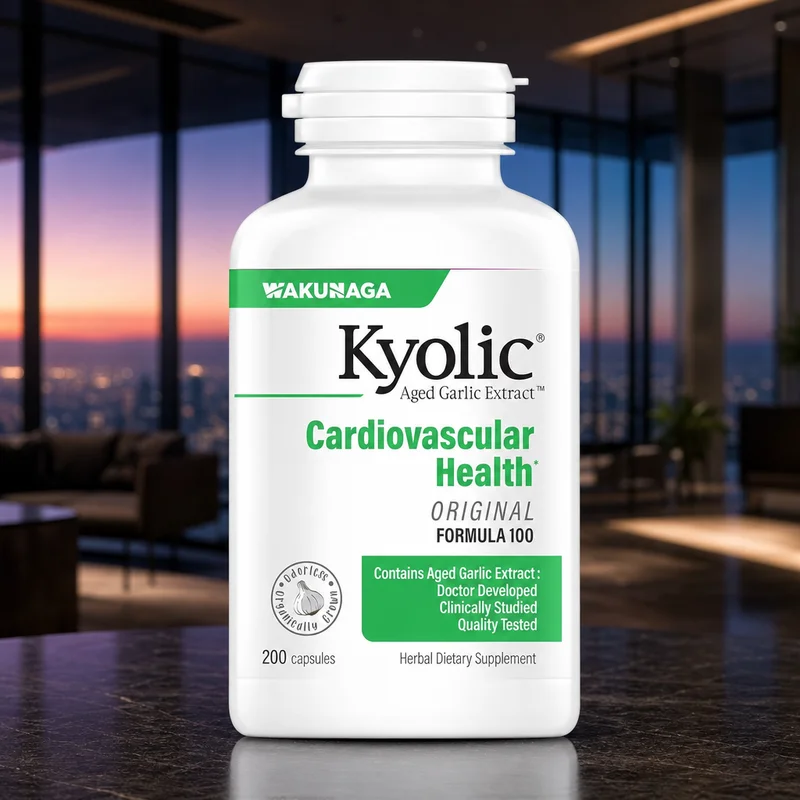
Kyolic Aged Garlic Extract Cardiovascular Formula 100
What is Garlic?
Garlic (Allium sativum) is a culinary bulb sold as a cardiovascular supplement in several distinct forms that are NOT interchangeable: Aged Garlic Extract (AGE, e.g. Kyolic), standardized garlic powder tablets rated for allicin "yield," enteric-coated allicin-potential tablets, oil-based odorless softgels, and fermented black garlic. The prized actives are allicin (an unstable thiosulfinate formed when raw garlic is crushed) and, in aged forms, the stable water-soluble compound S-allyl cysteine (SAC). Because allicin degrades within hours and is destroyed by stomach acid, the delivery form — aging versus enteric coating versus oil extraction — determines how much active actually reaches the bloodstream. AGE is the single most-studied form for heart health.
How it works
Garlic's cardiovascular actives are thought to increase hydrogen sulfide (H2S) and nitric oxide signaling in the vascular endothelium, relaxing blood vessels and modestly lowering blood pressure. Allicin and its breakdown products (ajoene, S-allyl cysteine) also have mild antiplatelet, antioxidant, and cholesterol-synthesis-inhibiting effects. The practical catch is stability: allicin is not present in an intact pill — it forms when the enzyme alliinase acts on alliin, and stomach acid inactivates alliinase. That is why the two forms with the best cardiovascular evidence solve the delivery problem differently: AGE sidesteps allicin entirely by aging garlic for up to 20 months into stable SAC, while enteric-coated powder tablets protect the alliin + alliinase so conversion happens in the less-acidic upper intestine. Oil-macerated softgels are odorless but deliver very little bioactive allicin, which is why they show the weakest effects.
At-a-glance facts
- Best-studied form
- Aged Garlic Extract (Kyolic)
- Typical BP effect
- ~5 mmHg systolic drop in hypertensives
- Cholesterol effect
- Small (~8 mg/dL total cholesterol)
- Key actives
- Allicin & S-allyl cysteine (SAC)
- Common dose
- 600–1,200 mg AGE or 300–900 mg powder daily
- Time to BP effect
- 8–12 weeks of daily use
- Odor control
- Aging or enteric coating (not oil softgels)
- Main caveat
- Antiplatelet — stop before surgery / caution with blood thinners
Evidence: Multiple meta-analyses consistently show a modest ~5 mmHg systolic drop in hypertensive adults and a small cholesterol reduction, but a Cochrane review found insufficient evidence that garlic prevents actual cardiovascular events.
Who it's for — and who it isn't
- Adults with mildly elevated or stage-1 hypertension looking for an evidence-backed adjunct alongside diet, exercise, and any prescribed medication
- People who want a food-derived cardiovascular supplement with a genuine (if modest) blood-pressure signal in meta-analyses
- Those who found raw garlic effective but cannot tolerate the odor or GI burn and want an aged or enteric odor-controlled form
- Anyone building a heart-health stack who wants a well-tolerated, low-cost foundational ingredient
- People on blood thinners (warfarin, clopidogrel, DOACs) or scheduled for surgery — garlic has antiplatelet activity and can increase bleeding risk
- Anyone expecting garlic to replace antihypertensive or lipid-lowering medication — the effect is modest and not a substitute for prescribed therapy
- People with significant hypertension who need reliable, larger reductions, or those taking saquinavir/certain HIV protease inhibitors (garlic can lower drug levels)
- Those with GERD or garlic-sensitive stomachs who react even to enteric or aged forms
Week-by-week, what happens
- Weeks 1–2No measurable cardiovascular change yet; some people notice mild GI adjustment or garlic breath with non-odor-controlled forms
- Weeks 4–6Early, often sub-threshold blood-pressure movement begins in people who start hypertensive
- Weeks 8–12Peak measured effect in trials: roughly 5 mmHg systolic / 2–3 mmHg diastolic reduction in hypertensives, small total-cholesterol dip
- Ongoing / discontinuationEffect persists only with continued daily use; blood pressure drifts back toward baseline within weeks of stopping
Safety & contraindications
- Antiplatelet effect: garlic can increase bleeding risk, especially combined with warfarin, aspirin, clopidogrel, or DOACs — stop supplemental garlic 7–10 days before surgery or dental procedures
- Can reduce plasma levels of saquinavir and possibly other drugs via CYP enzyme effects; check interactions if on HIV protease inhibitors or narrow-therapeutic-index medications
- GI side effects (heartburn, reflux, nausea, garlic body odor/breath) are the most common complaints, generally milder with aged or enteric forms
- Not a replacement for prescribed antihypertensive or statin therapy — the BP effect is real but small and the event-prevention evidence is insufficient
- Generally recognized as safe in food amounts; supplemental doses in pregnancy/breastfeeding beyond dietary intake are not well studied — consult a clinician
All articles on Garlic
Best Garlic Supplements
9 garlic supplements ranked on form and bioavailability, standardization and dose, third-party testing, tolerability and value.
Read →Garlique Healthy Blood Pressure Formula Review
A purpose-built BP caplet pairing enteric standardized garlic with B-vitamins, folate, magnesium and vitamin C — but the added micronutrients do much of the lifting.
Read →Horbaach Aged Black Garlic Extract Review
An affordable, odorless entry into aged black garlic — but the form's blood-pressure data is preliminary and there's no standardized active yield.
Read →Kwai Heart Care Garlic 300 mg One-A-Day Review
The standardized garlic powder (LI-111 lineage) used in many older BP and cholesterol trials — historically important, but the trials themselves were mixed.
Read →Kyolic Aged Garlic Extract Cardiovascular Formula 100 Review
The single most-studied garlic form for blood pressure, and the only one with its own dedicated RCTs — odorless, stable, and honest about a modest ~5 mmHg effect.
Read →Nature's Bounty Odorless Garlic 1000 mg Review
A cheap, everywhere-available oil-based softgel — odorless and fine for general use, but it delivers little standardized allicin for measurable heart effects.
Read →Nature's Way Garlinase 5000 Review
A vegan, enteric-coated single tablet delivering 5000 mcg allicin potential — the most convenient credible allicin option, with the same honest caveats.
Read →NOW Foods Garlic 5000 Review
Enteric-coated tablet standardized to 5000 mcg allicin yield from a facility with real GMP oversight — the honest value pick for the allicin route.
Read →Nutricost Garlic 1000 mg Review
The lowest cost-per-serving here — 240 odorless softgels — but the same unstandardized oil extract means it's for general use, not measurable heart effects.
Read →Pure Encapsulations Garlic Complex Review
The purest, most allergen-free formula here — aged black garlic plus extract — but black garlic's BP evidence is earlier and thinner than allicin or AGE.
Read →FAQ
Does garlic actually lower blood pressure?
Yes, modestly. Across several meta-analyses, standardized garlic supplements lower systolic blood pressure by roughly 5 mmHg and diastolic by 2–3 mmHg in people who start out hypertensive, with little effect in people who are already normotensive. It is a real signal but far smaller than a blood-pressure medication, and it works best as an adjunct to diet, exercise, and prescribed therapy.
What about cholesterol — does it help?
Only a little. Updated meta-analyses show a small reduction in total and LDL cholesterol (on the order of 8 mg/dL total when used for at least two months), and effects on HDL and triglycerides are minimal or inconsistent. Do not expect garlic to meaningfully move a lipid panel the way a statin does.
Which form is best — aged extract, allicin tablets, or odorless softgels?
Aged Garlic Extract (Kyolic) has the most cardiovascular research behind it, and enteric-coated standardized-allicin tablets are the next best because the coating protects the allicin precursors from stomach acid. Oil-based odorless softgels are convenient and cheap but deliver very little active allicin, so they are the weakest choice if measurable BP or cholesterol change is your goal.
Why do labels list 'allicin yield' or 'allicin potential' instead of allicin?
Because intact pills contain essentially no allicin — it is unstable and forms only when the enzyme alliinase acts on alliin after crushing. 'Allicin yield/potential' is a lab estimate of how much allicin the tablet could release under ideal conditions. It is a useful standardization marker, but a higher number on the label does not linearly translate into a larger blood-pressure drop.
Is odorless garlic as effective as smelly garlic?
It depends on how the odor is removed. Aging (as in AGE) and enteric coating control odor while preserving or protecting the actives, so they keep their cardiovascular effect. Oil maceration removes odor but also strips much of the bioactive allicin, so those odorless softgels tend to be the least effective form for heart health.
Can I take garlic with my blood pressure or blood-thinning medication?
Talk to your clinician first. Garlic is generally safe with most antihypertensives and may add a small extra reduction, but it has antiplatelet activity that can raise bleeding risk with warfarin, aspirin, clopidogrel, or DOACs, and it should be stopped about a week before surgery.
Sources & further reading
- Ried K, Frank OR, Stocks NP, Fakler P, Sullivan T. Effect of garlic on blood pressure: a systematic review and meta-analysis. BMC Cardiovasc Disord. 2008;8:13.Effect of garlic on blood pressure: a systematic review and meta-analysis
Meta-analysis of garlic vs placebo found a mean systolic reduction of ~4.6 mmHg overall and ~8.4 mmHg in hypertensive subjects.
- Ried K, Toben C, Fakler P. Effect of garlic on serum lipids: an updated meta-analysis. Nutr Rev. 2013;71(5):282-299.Effect of garlic on serum lipids: an updated meta-analysis
Garlic modestly reduced total cholesterol (~8 mg/dL) and LDL when taken for more than two months, with negligible effect on HDL or triglycerides.
- Ried K. Garlic Lowers Blood Pressure in Hypertensive Individuals, Regulates Serum Cholesterol, and Stimulates Immunity: An Updated Meta-analysis and Review. J Nutr. 2016;146(2):389S-396S.Garlic Lowers Blood Pressure in Hypertensive Individuals, Regulates Serum Cholesterol, and Stimulates Immunity: An Updated Meta-analysis and Review
Updated meta-analysis confirmed an average ~8/5 mmHg BP reduction in hypertensives, comparable in direction to first-line medication but smaller.
- Stabler SN, Tejani AM, Huynh F, Fowkes C. Garlic for the prevention of cardiovascular morbidity and mortality in hypertensive patients. Cochrane Database Syst Rev. 2012;(8):CD007653.Garlic for the prevention of cardiovascular morbidity and mortality in hypertensive patients
Cochrane review found no reliable evidence that garlic reduces cardiovascular events or mortality, citing a lack of long-term outcome trials.
- Ried K, Frank OR, Stocks NP. Aged garlic extract lowers blood pressure in patients with treated but uncontrolled hypertension: a randomised controlled trial. Maturitas. 2010;67(2):144-150.Aged garlic extract lowers blood pressure in patients with treated but uncontrolled hypertension: a randomised controlled trial
Four capsules/day of aged garlic extract lowered systolic BP by ~10 mmHg vs placebo in patients whose hypertension was uncontrolled on medication.
- Rohner A, Ried K, Sobenin IA, Bucher HC, Nordmann AJ. A systematic review and metaanalysis on the effects of garlic preparations on blood pressure in individuals with hypertension. Am J Hypertens. 2015;28(3):414-423.A systematic review and metaanalysis on the effects of garlic preparations on blood pressure in individuals with hypertension
Pooled RCTs in hypertensive patients showed garlic reduced systolic BP by ~9 mmHg and diastolic by ~4 mmHg versus placebo.