
NatureBell Glutathione 2,000 mg Review
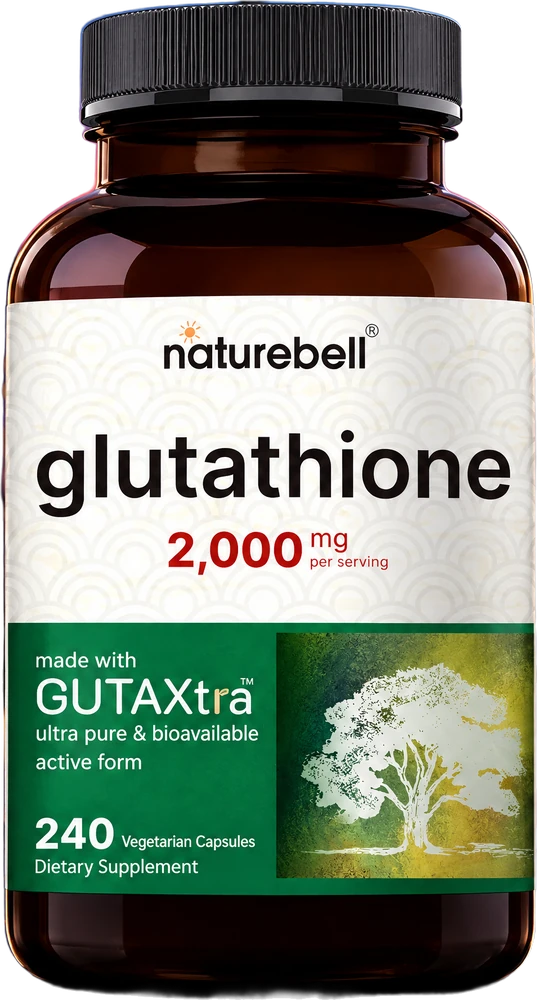 #10 of 10 · Highest dose per serving✓ Label verified · Supplement Facts read Oct 18, 2026
Real retailer photo, cut out. Label unedited.
Consider it if you want a high-dose plain glutathione in a 60-day bottle at about $0.42 a serving. The panel prints 2,000 mg per 4-capsule serving, which is twice the highest dose studied, and the GUTAXtra name and the testing claims cannot be checked.
$24.99 / 240 capsules (60 servings)≈ $0.42 / 2,000 mg serving (≈ $0.10 per 500 mg)
Why It Scores 7.0 — And The Label Line Behind Each Number
Form & absorption strategy
30% of scoreThe panel prints Glutathione (Reduced form), which is the plain reduced form with the most debated oral absorption (Witschi 1992 and Allen 2011 found little in the short term; Richie 2015 found body stores rose over six months). The name GUTAXtra sits above the glutathione line and the back label calls it a trademark of irvine Health Research, but the panel prints no Setria or OPITAC wording and we found no manufacturer or specification for it. The high bioavailability and free form tiles on the listing are not panel claims. We score it a step above Nutricost (6.0), whose panel prints only the generic reduced form, and below Jarrow (7.0).
- Form
- Glutathione (Reduced form), printed under the name GUTAXtra
- Source name
- GUTAXtra, a trademark of irvine Health Research per the back label; no Setria or OPITAC wording on the panel
Dose vs studied range
25% of score2,000 mg per 4-capsule serving is twice the 1,000 mg a day top dose in Richie 2015, whose range was 250 to 1,000 mg. It is not under-dosed, and the single 3 g dose in Witschi 1992 did not raise plasma glutathione, so more is not shown to be better. The sibling 500 mg capsules sit inside the studied range and score 9.0 to 9.5 (NOW Foods 9.0, Jarrow and Nutricost 9.5), so we hold this one lower for going beyond the evidence and for needing four capsules to reach the printed serving. It stays above the 100 mg S-acetyl pick (7.0), whose lower dose is offset by its delivery form.
- Per serving
- 2,000 mg glutathione per 4 vegetarian capsules (500 mg per capsule)
- Studied range
- Twice the 1,000 mg a day top dose in Richie 2015 (250 to 1,000 mg)
- Directions
- Adults take four capsules daily, preferably with meals
Testing & label transparency
20% of scoreThe panel itself is complete and legible: one ingredient with its form and amount, a serving size, servings per container, four other ingredients, directions and a manufacturer address. The testing is where it stops. The pack carries a Third-Party USA Lab Tested badge, a 3rd Party Certified for Purity & Potency seal and a generic Certification of Analysis graphic marked Passed, and none names a lab, a lot or a result. The NSF International dietary-supplement listing returned no NatureBell match on October 18, 2026, and the brand site has no certificate page. We score it level with Nutricost (6.0) and below Jarrow (6.5), a long-trusted brand with no seal, and far above Healthy Origins (2.0), whose panel could not be read.
- Inactives
- Rice flour, magnesium stearate, silicon dioxide, vegetable cellulose capsule
- Seals
- Double Sealed, UV Protected Amber Bottle, Third-Party USA Lab Tested, 3rd Party Certified for Purity & Potency, cGMP facility, Gluten Free, Made in USA with Global Ingredients
- Testing
- No lab, lot or result named; not in the NSF International listing (checked October 18, 2026); no certificate page on naturebellusa.com
Value per day
15% of score$24.99 for 60 servings is about $0.42 for the printed 4-capsule day, and about $0.10 per 500 mg of glutathione, the same per-500 mg cost as Nutricost. Because the label directs four capsules, the daily cost is the $0.42 serving, not the $0.10, which puts it between NOW Foods (7.5) and Jarrow (9.0). Price is a tie-breaker in our method, and part of what you pay for is dose beyond the studied range, so we do not score it higher.
- Count
- 240 capsules = 60 servings (60 days at the printed 4 capsules a day)
- Price
- $24.99 = about $0.42 per serving = about $0.10 per 500 mg (Amazon buy box, checked October 18, 2026)
Real-world fit
10% of scoreFour vegetarian capsules a day, preferably with meals, is the printed direction, against one capsule a day for Nutricost, Jarrow and NOW Foods (8.0 to 9.0). The formula is a single ingredient with rice flour, magnesium stearate and silicon dioxide, free of wheat, gluten, soy, dairy and tree nuts per the back label, in a UV-protected amber bottle that lasts 60 days at the printed dose. The pill count is what holds the score down.
Label verified. Every figure read from the Supplement Facts photo, Oct 18, 2026.
Marketing Claims Vs. Reality
2,000 mg of reduced glutathione per serving.
The Supplement Facts panel prints Glutathione (Reduced form) 2,000 mg per serving, and a serving is 4 vegetarian capsules, so each capsule is 500 mg.
High purity glutathione.
A purity percentage appears on a listing tile and in the listing text. The Supplement Facts panel prints only the 2,000 mg amount and no purity or assay figure, and the gallery's Certification of Analysis graphic shows no measured values.
Made with GUTAXtra, an ultra pure and bioavailable active form.
The panel prints GUTAXtra above the glutathione line and the back label calls it a trademark of irvine Health Research. We found no manufacturer, specification or study for it, so the ultra pure and bioavailable wording has nothing to check against. The form on the panel is plain reduced glutathione.
Third-party lab tested for purity and potency.
The pack and the listing say so, with a generic Certification of Analysis graphic listing microbiology and heavy-metal items as Passed. No lab, lot or numbers are named, the NSF International dietary-supplement listing returned no NatureBell match on October 18, 2026, and the brand site has no certificate page.
High bioavailability, free form.
This is a tile on the listing, not a panel line. Plain oral glutathione is the form whose absorption is debated: Witschi 1992 saw no plasma rise after a single 3 g dose and Allen 2011 saw no biomarker change over 4 weeks, while Richie 2015 saw body stores rise over six months.
Free of wheat, gluten, soy, dairy and tree nuts.
The back label prints Free of: wheat, gluten, soy, dairy & tree nuts, and the other-ingredients line lists only rice flour, magnesium stearate, silicon dioxide and the vegetable cellulose capsule, which is consistent with it. The listing adds more allergen claims that are not on the back label.
Shows benefits for nearly every cellular function; skin whitening; complete liver health.
These are listing statements, not panel claims, and none is supported by the oral-dose trials we cite. The pack carries the standard statement that the product is not intended to diagnose, treat, cure or prevent any disease.
What Our Test Actually Found
The dose is the biggest in the category, and bigger is not shown to be better
The panel prints 2,000 mg per serving, double the 1,000 mg top dose in Richie 2015 and four times a single 500 mg capsule like those the plain-form picks use. The trial evidence we cite is for 250 to 1,000 mg a day taken for months. The one test of a very large single dose, 3 g in Witschi 1992, did not raise plasma glutathione. A higher dose is a fact on the label, not a benefit we can score.
Plain reduced glutathione under a brand name
The panel puts the name GUTAXtra above one line reading Glutathione (Reduced form). That is the same plain reduced form as Nutricost and Jarrow, so the oral-absorption debate applies in full. The back label says GUTAXtra is a trademark of irvine Health Research, but the panel prints no Setria or OPITAC wording, and we could not find a manufacturer or a specification for the name. The listing's ultra pure and bioavailable wording is not backed by anything on the panel.
Every test claim is an unnamed one
The pack prints three testing statements and the gallery adds a Certification of Analysis graphic with microbiology and heavy-metal items marked Passed. No lab, lot number or measured value appears anywhere. We searched the NSF International dietary-supplement listing on October 18, 2026 and found no NatureBell entry, and we could not query Informed Choice or USP Verified. Absence from a list is not a failed test; it means nothing here is checkable. Ask the seller for the lot's certificate of analysis if it matters to you.
Four capsules a day, but the same cost per 500 mg as the bulk pick
At $24.99 for 60 servings the label day costs about $0.42, which is about $0.10 per 500 mg, the same per-500 mg cost as Nutricost Glutathione 500 mg. The difference is the pill count: one capsule a day there, four here. If you want about 500 to 1,000 mg a day you can reach it with one or two of these capsules, but the printed serving is four, and the bottle then lasts longer than 60 days.
The brand site is real, the domain in the name is not
The panel's web address, naturebellusa.com, is a working Shopify store that lists this product with the same third-party wording. It has no lab-results or certificate page. The domain naturebell.com, which is the obvious guess, is a for-sale page. Only the Amazon gallery and the brand store speak for the product, which is why every number in this review comes from the panel image and the buy-box price.
Full analysis: all pros & cons (8), buy if / skip if
- 2,000 mg reduced glutathione per serving, every figure printed on the panel
- About $0.42 a serving, the same per-500 mg cost as the bulk-value pick; 60-day bottle
- Single ingredient in a vegetarian capsule; free of wheat, gluten, soy, dairy and tree nuts per the back label
- UV-protected amber bottle and a complete, legible panel
- 2,000 mg is twice the highest dose studied and the plain form's absorption is debated
- Four capsules a day; one-capsule products are easier to keep up for months
- No lab, lot or result behind the test badges; not in the NSF International listing
- GUTAXtra has no source or specification we could find; no Setria wording on the panel
- You want a high-dose plain reduced glutathione and a 60-day bottle at about $0.42 a serving
- You are comfortable taking four vegetarian capsules a day with meals
- You accept the plain-form absorption debate and want a dose at or above the studied range
- You want to stay inside the studied dose range; one or two capsules of a 500 mg product does that more simply
- You want a named source such as Setria, or a testing record you can check; the panel prints neither
- The plain-form absorption debate bothers you; a liposomal or S-acetyl product is built to answer it
Each 4-capsule serving delivers 2,000 mg of reduced glutathione, printed on the panel, for about $0.42 a serving in a 60-day bottle. That is twice the 1,000 mg top dose in the Richie 2015 trial, the form is the plain reduced one whose oral absorption is debated, and the panel prints no Setria or other source wording. The pack carries third-party lab badges, but no lab is named and NatureBell is not in the NSF International listing. Nutricost Glutathione 500 mg costs about the same per 500 mg and needs one capsule a day. Buy NatureBell if you want the high dose in one bottle and accept an unverified source and test claim.
NatureBell Glutathione is a vegetarian-capsule glutathione sold on Amazon as a 240-capsule bottle. The Supplement Facts panel is a single line: under the name GUTAXtra, Glutathione (Reduced form) 2,000 mg per serving, with a serving of 4 capsules and 60 servings in the bottle. The other ingredients are rice flour, magnesium stearate, silicon dioxide and the vegetable cellulose capsule. The Amazon offer we checked on October 18, 2026 was $24.99, about $0.42 a serving, or about $0.10 per 500 mg of glutathione. That makes it the highest-dose glutathione on the list, and it is the same plain reduced form as Nutricost and Jarrow, with the same debated oral absorption. What the pack does not give you is proof. GUTAXtra is a brand name with no source or specification that we could find, the test badges name no lab, and the NSF International listing has no NatureBell entry.
A high-dose plain glutathione bought on trust: fair price, four capsules a day, nothing to check.

NatureBell Glutathione is a fair choice for someone who wants a high-dose plain reduced glutathione in a long-lasting bottle and has already accepted the form debate. The panel is clear on the part that matters most: 2,000 mg of reduced glutathione per 4-capsule serving, a short list of other ingredients and about $0.42 a serving on the price we checked, which is the same per-500 mg cost as Nutricost. What holds the score at 7.0 is what the pack cannot show. The dose is twice the highest one studied, the form is the plain reduced one whose oral absorption is debated, the GUTAXtra name has no source or specification behind it that we could find, and the test badges name no lab while the NSF International listing has no NatureBell entry. It lands below Nutricost, Jarrow and Healthy Origins, which share its form. Choose Nutricost if you want the same cost per 500 mg and a single daily capsule, or Core Med Science Liposomal Glutathione if the absorption debate is your concern. Pick NatureBell for the dose and the bottle size, ask the seller for a certificate of analysis, and judge it over months, not days.
If This Doesn’t Fit — Try These
Nutricost Glutathione 500 mg
The same plain reduced form at about the same cost per 500 mg, as one capsule a day instead of four.
Jarrow Formulas Glutathione Reduced
500 mg of reduced glutathione per capsule, one capsule a day, in the studied range, from a long-established brand.
Core Med Science Liposomal Glutathione
The pick if absorption is your real concern: a liposomal product built to answer the plain-form debate, at a higher cost per serving.
Quick Answers
How much glutathione is in NatureBell, and how many capsules is that?
The Supplement Facts panel prints Glutathione (Reduced form) 2,000 mg per serving, and a serving is 4 vegetarian capsules, so each capsule carries 2,000 divided by 4, or 500 mg. The bottle holds 240 capsules, which is 60 servings. The back label tells adults to take four capsules daily, preferably with meals.
Is 2,000 mg of glutathione a day too much?
It is more than the human repletion work we cite used. Richie 2015 gave 250 mg and 1,000 mg a day for six months, so a 2,000 mg serving is twice the highest dose in that trial. Witschi 1992 gave a single 3 g dose and saw no rise in plasma glutathione. We found no evidence in the sources used on this list that 2,000 mg works better than 500 to 1,000 mg, so we do not score the extra milligrams as a benefit. If you want to stay inside the studied range, you could take fewer capsules, but the label directs four.
What is GUTAXtra, and is it Setria?
GUTAXtra is the name printed above the glutathione line on the panel, and the back label says it is a trademark of irvine Health Research. The panel prints no Setria or OPITAC wording, so we make no Setria claim. We could not find a manufacturer, a published specification or a study for GUTAXtra. It is plain reduced glutathione under a brand name, and we score it as such.
Is NatureBell third-party tested?
The pack says so, but we could not verify it. The panel image carries a Third-Party USA Lab Tested badge, the back label carries a 3rd Party Certified for Purity & Potency Lab Tested seal, and the gallery shows a generic Certification of Analysis graphic with microbiology and heavy-metal items marked Passed. None of them names a lab, a lot number or a measured value. On October 18, 2026 the NSF International dietary-supplement listing returned no match for NatureBell. We could not query Informed Choice or USP Verified reliably, so those are not checked. The brand site, naturebellusa.com, has no certificate-of-analysis page.
The listing says high purity. Is that on the label?
No. A purity percentage appears on a listing tile and in the listing text, not on the Supplement Facts panel, which prints only the 2,000 mg figure. We treat it as an unverified claim and it earns nothing in the score. The same goes for the high bioavailability and free form tiles.
How does the price compare with the other glutathione capsules?
The Amazon offer on October 18, 2026 was $24.99 for 240 capsules, or about $0.42 for each 4-capsule serving. Per 500 mg of glutathione that is about $0.10, the same as the list entry for Nutricost Glutathione 500 mg, which needs one capsule a day instead of four. Jarrow Formulas costs about $0.23 per 500 mg capsule on its list entry. Prices move, so check the listing before you buy.
Sources & Further Reading
3 peer-reviewed sources, each linked to PubMed
- [1] Richie 2015 PMID 24791752 — Randomized controlled trial of oral glutathione supplementation on body stores of glutathione. 250-1000 mg/day oral glutathione raised body stores over 6 months — the repletion evidence behind a plain-form capsule, and the top of the dose range this product's 2,000 mg serving doubles.
- [2] Witschi 1992 PMID 1362956 — The systemic availability of oral glutathione. A single 3 g oral dose didn't raise plasma glutathione — 'negligible' availability. The plain-form absorption caveat that a bigger dose does not resolve.
- [3] Allen 2011 PMID 21875351 — Effects of oral glutathione supplementation on systemic oxidative stress biomarkers in human volunteers. 500 mg/day for 4 weeks moved no oxidative-stress biomarkers — the short-term null result that means a plain capsule should be judged over months.
Affiliate disclosure: every Amazon link uses our Associates tag (superachieverclub-20). We earn a small commission at no cost to you; it funds independent reviews. We never accept payment to change a ranking.