
Top 8 Best Bee Pollen & Royal Jelly Supplements (2026)
 01 · Best overall✓ Label verified · Supplement Facts read Sep 7, 2026
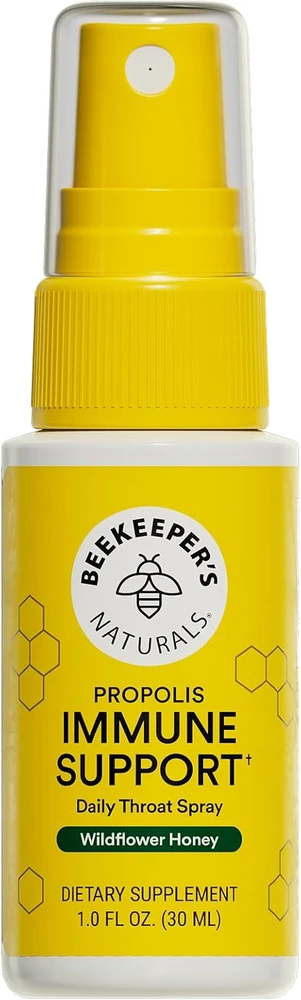
Best overall: Beekeeper's Naturals Propolis Throat Spray
The category's most recognised propolis product — a clean, alcohol-free 95%-extract throat spray, third-party tested for pesticides, in the one bee-product format (propolis for the throat) that actually has credible human evidence behind it.
$14 / 1.0 oz (~60 servings)~$0.23 / 4-spray serving (85 mg propolis)
Why it wins: all five scores, pros & cons, full label
- 95% bee propolis extract on a honey base — no alcohol, no refined sugar, gluten-free
- Third-party lab tested for pesticide residue and contaminants — the trust axis bee products most often fail
- Propolis-for-the-throat is the bee-product use with the most credible human data (mouthwash cut oral mucositis in RCTs)
- Best-selling and hugely reviewed (20,000+ ratings) in a convenient, travel-friendly spray
- Propolis can trigger reactions in anyone with a bee-product or pollen allergy — patch/spot-test before regular use
- A liquid spray delivers a modest 85 mg propolis dose versus concentrated capsules (see #3)
- Flavonoid content is described qualitatively, not given as an exact mg or %
- Per serving
- 85 mg propolis (4 sprays)
- Type
- Propolis (95% bee propolis extract)
- 10-HDA
- N/A — 10-HDA is a royal-jelly marker, not propolis
- Form
- Liquid throat spray (alcohol-free, honey base)
- Count
- 1.0 oz / ~60 servings
- Testing
- Third-party tested for pesticide residue + chemicals
- Flavonoids
- Marketed as polyphenol/flavonoid-rich; exact % not numerically disclosed
Our take — Beekeeper's Naturals earns the top slot not on hype but on the two things that are actually verifiable: it's a clean, transparently-labelled 95% propolis extract, and it's third-party tested for the pesticide residue that bee products so often carry. It also happens to be the one format whose underlying ingredient has the strongest human evidence — propolis applied in the mouth/throat, where mouthwash trials reduced oral mucositis. It won't out-dose a concentrated propolis capsule, and like everything here it's a bee/pollen allergen, so spot-test first. But for most people wanting one trustworthy, easy bee product, this is the bottle to start with.
 02
 03
 04
 05
 06
 07
 08
Who Wins Which Aspect
Sorted by overall SAC Product Score™ — the official ranking.
| # | Pick | Score | Source purity & freshness30% | Active content (propolis)25% | Testing & label transparency20% | Value per serving15% | Real-world use & tolerance10% | Cost Per Dose | Buy |
|---|---|---|---|---|---|---|---|---|---|
| 01 | | 9.5 | 9.51 | 9.01 | 10.01 | 9.52 | 9.51 | ~$0.23 / 4-spray serving | Check price |
| 95% bee propolis extract on a honey base — no alcohol, no refined sugar, gluten-freePropolis can trigger reactions in anyone with a bee-product or pollen allergy — patch/spot-test before regular use | |||||||||
| 02 | | 8.3 | 9.02 | 8.52 | 7.0 | 9.52 | 6.5 | ~$0.16 / ~5 g | Check price |
| Large 2 lb supply at strong value per ounce — the cheapest pollen here per gramBee/pollen allergy caveat — test a few granules first | |||||||||
| 03 | | 8.2 | 8.0 | 8.03 | 8.52 | 9.03 | 7.0 | ~$0.14 / capsule | Check price |
| Potent 5:1 concentrate delivering a 1,500 mg propolis equivalent per capsulePropolis allergy / bee-sensitivity caveat applies — test cautiously | |||||||||
| 04 | | 8.1 | 8.53 | 7.0 | 7.0 | 10.01 | 9.02 | ~$0.11 / 500 mg capsule | Check price |
| From NOW Foods, an established GMP-certified brand with broad in-house and third-party testingBee pollen is a known allergen — anyone with a pollen or bee allergy should test cautiously first | |||||||||
| 05 | | 8.1 | 8.0 | 9.01 | 8.03 | 7.5 | 7.0 | ~$0.80 / 2-tablet serving | Check price |
| All three bee actives in one chewable — royal jelly, Anatolian propolis, and bee pollenA triple bee-product blend means triple the allergen exposure — high caution for anyone bee/pollen-sensitive, and royal jelly's asthma/anaphylaxis risk applies | |||||||||
| 06 | | 7.6 | 9.51 | 7.0 | 6.0 | 7.0 | 7.0 | ~$0.55 / ~¼ tsp serving | Check price |
| USDA Certified Organic, Non-GMO, GMP and gluten-free, with no additives or fillersRoyal jelly is a potent allergen and is specifically NOT advised for asthma or severe-allergy sufferers — it can trigger serious reactions | |||||||||
| 07 | | 7.4 | 9.02 | 8.52 | 3.0 | 8.0 | 8.03 | ~$0.43 / ~5 g | Check price |
| 100% pure whole granules with low-moisture handling to protect freshnessStrong floral/bitter taste isn't for everyone | |||||||||
| 08 | | 6.8 | 7.5 | 7.5 | 5.5 | 5.0 | 8.03 | $1.50 | Check price |
| Three hive products with each amount printedNo 10-HDA percentage for the royal jelly | |||||||||
The Other 7, Ranked
- 02
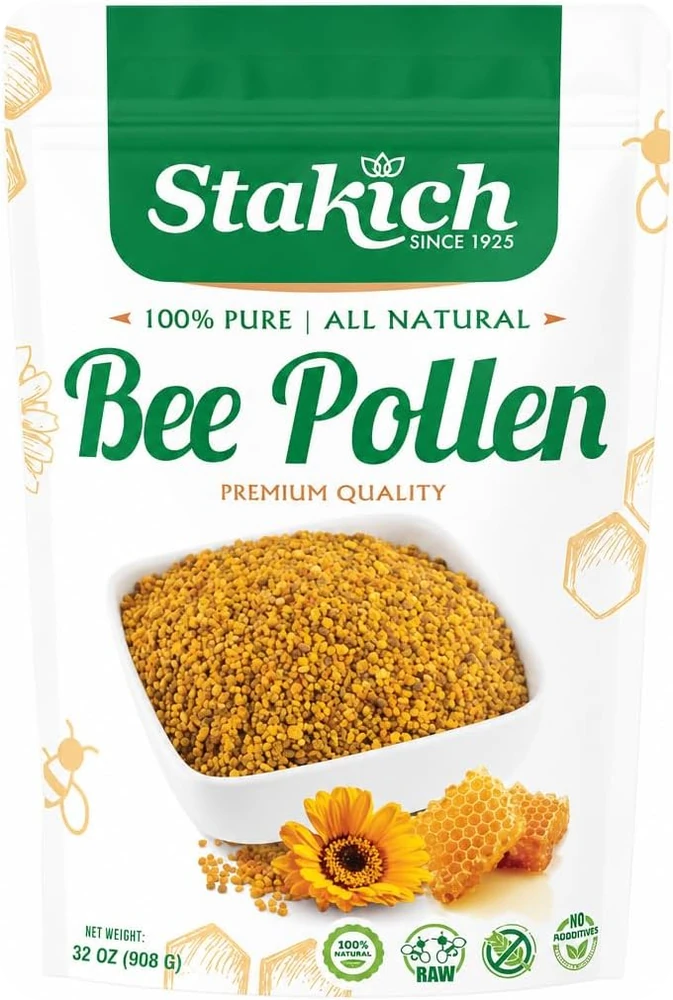
Best bulk value: Stakich Bee Pollen Granules
8.3SAC Score™The value bulk pick — 2 lb of raw, never-heated whole pollen granules at a low cost-per-ounce, for daily smoothie and yogurt users who go through pollen quickly.
StrongestValue per serving9.52WeakestReal-world use & tolerance6.5- Per serving
- ~1 tsp (~5 g) daily, work up gradually per label
- Type
- Bee pollen (100% pure, raw, unprocessed)
- 10-HDA
- N/A — royal-jelly marker only
All five scores, pros & cons, full label
What We Like- Large 2 lb supply at strong value per ounce — the cheapest pollen here per gram
- Raw and unprocessed — never heated or dried, preserving heat-sensitive nutrients
- Single-ingredient pure pollen, versatile to mix into foods
What You Live With- Bee/pollen allergy caveat — test a few granules first
- Large bag must be sealed and kept cool/refrigerated to stay fresh over its long life
- The 1 lb size (B001LQXU8Q) currently reads unavailable; this 2 lb SKU is the in-stock option
- Form
- Granules (raw, never heated or dried)
- Count
- 2 lb
- Processing
- Never heated or dried; no fillers
Our take — Stakich is for the committed pollen user who blends a teaspoon into a smoothie every morning and doesn't want to re-order constantly. Two pounds of raw, never-heated granules at roughly sixteen cents a serving is the best raw cost-per-gram on the page, and the never-heated processing preserves the heat-sensitive nutrients purists care about. The catch is simply volume: a bag this size needs sealing and cool storage to stay fresh, and the allergy spot-test still applies. For bulk value pollen, it's the one.
- 03
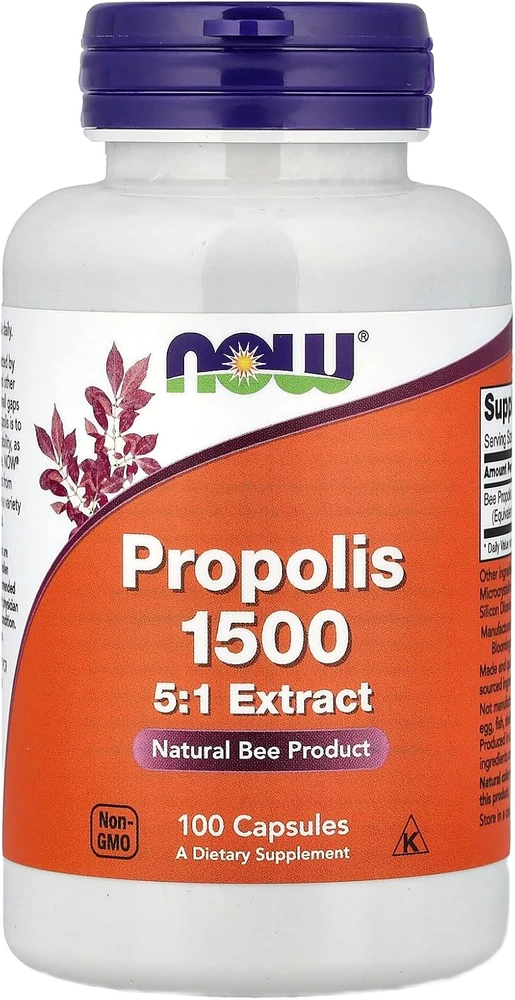
Best propolis capsule: NOW Foods Propolis 1,500 mg
8.2SAC Score™A concentrated 5:1 propolis in convenient veg capsules — the capsule alternative to tinctures and sprays for a daily flavonoid-bearing immune dose from a trusted GMP brand.
StrongestValue per serving9.03WeakestReal-world use & tolerance7.0- Per serving
- 1,500 mg propolis equivalent (1 veg capsule)
- Type
- Propolis (1,500 mg equivalent from 5:1 concentrate)
- 10-HDA
- N/A — royal-jelly marker only
All five scores, pros & cons, full label
What We Like- Potent 5:1 concentrate delivering a 1,500 mg propolis equivalent per capsule
- Vegetarian capsules; propolis collected from active, healthy hives per NOW
- Established GMP brand with broad third-party testing
What You Live With- Propolis allergy / bee-sensitivity caveat applies — test cautiously
- Flavonoid content is stated only qualitatively, not as a guaranteed %
- This single-bottle SKU sometimes routes through 'See All Buying Options' rather than direct Add-to-Cart
- Form
- Vegetarian capsule
- Count
- 100 veg capsules
- Flavonoids
- Naturally-occurring bioflavonoids; exact % not numerically disclosed
Our take — When you want propolis as a swallow-and-go daily capsule rather than a throat spray, NOW's 1,500 mg (5:1 concentrate) is the sensible, affordable pick. It delivers a much larger propolis equivalent per dose than the #1 spray, in veg caps, from a brand with real QC — for about fourteen cents a capsule. It doesn't disclose an exact flavonoid percentage and, like all propolis, carries the bee-allergy caveat. But for a concentrated daily propolis at a value price, it's the capsule to reach for.
- 04
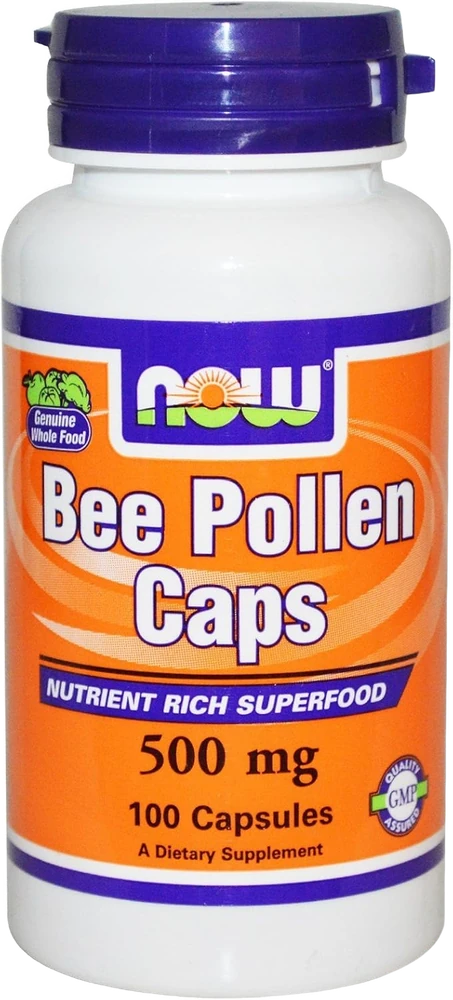
Best budget: NOW Foods Bee Pollen Caps, 500 mg
8.1SAC Score™The trusted-brand, no-fuss way to take bee pollen — 500 mg of encapsulated whole granules from a GMP manufacturer, for people who want the whole-food micronutrient matrix without the bitter, floral taste of loose granules.
StrongestValue per serving10.01WeakestActive content (propolis)7.0- Per serving
- 500 mg (1 capsule)
- Type
- Bee pollen (whole granular pollen)
- 10-HDA
- N/A — 10-HDA applies only to royal jelly
All five scores, pros & cons, full label
What We Like- From NOW Foods, an established GMP-certified brand with broad in-house and third-party testing
- Capsule format sidesteps the bitter/floral taste of loose granules and travels well
- Inexpensive and easy to dose at a standard 500 mg — the cheapest credible entry to bee pollen
What You Live With- Bee pollen is a known allergen — anyone with a pollen or bee allergy should test cautiously first
- Encapsulated pollen is marginally less "whole-food raw" than fresh-frozen granules (#2, #7)
- Pollen potency and nutrient profile vary naturally by foraging season and region
- Form
- Capsule
- Count
- 100 capsules
- Brand QC
- NOW Foods — established GMP-certified, widely third-party-tested
Our take — If bee pollen is what you're after and you don't want to chew bitter granules off a spoon, this is the obvious budget pick. NOW's GMP pedigree and testing make it a low-risk way to get the whole-food pollen matrix — protein, B-vitamins, polyphenols — in a tidy 500 mg capsule at about eleven cents a dose. It's encapsulated rather than fresh-frozen, so purists chasing maximum rawness will prefer granules, and the usual allergy caveat applies. But for value and convenience, NOW is hard to beat.
- 05
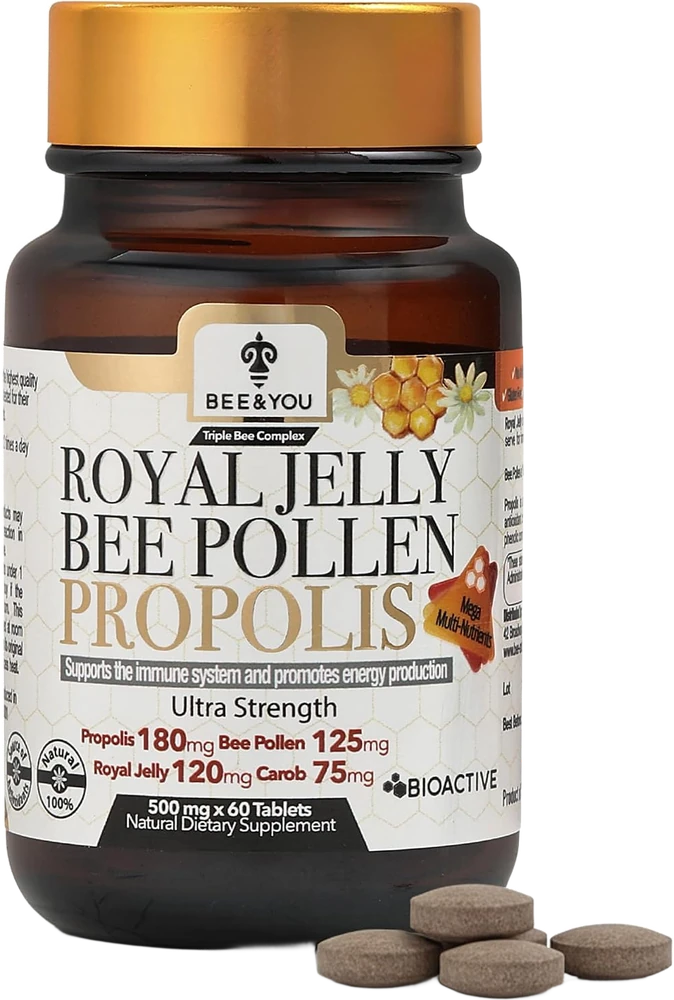
Best 3-in-1 (discloses 10-HDA): BEE&YOU Royal Jelly + Propolis + Bee Pollen Tablets
8.1SAC Score™A true three-in-one bee complex — royal jelly, propolis and pollen in one chewable — whose royal jelly carries a stated >4% 10-HDA, making it one of the very few combos to publish a real 10-HDA figure instead of an adjective.
StrongestActive content (propolis)9.01WeakestReal-world use & tolerance7.0- Per serving
- 2 tablets, 1–2× daily (500 mg per tablet)
- Type
- Combo: royal jelly + propolis + bee pollen
- 10-HDA
- Stated >4% (in the royal jelly fraction) — a rare disclosed figure
All five scores, pros & cons, full label
What We Like- All three bee actives in one chewable — royal jelly, Anatolian propolis, and bee pollen
- Royal jelly is specified at >4% 10-HDA — an unusually transparent potency claim for a combo
- Single-origin Anatolian sourcing; free of GMO, gluten, soy, dairy, gelatin and added sugar
What You Live With- A triple bee-product blend means triple the allergen exposure — high caution for anyone bee/pollen-sensitive, and royal jelly's asthma/anaphylaxis risk applies
- This ultra-strength SKU can intermittently read 'currently unavailable' on Amazon (the chewable sibling B07PVCNLJR is the in-stock fallback)
- Per-ingredient milligram breakdown isn't fully itemised on the listing
- Form
- Chewable tablet (powder-based, 500 mg each)
- Count
- 60 tablets
- Sourcing
- Single-origin Anatolian; no GMO, gluten, soy, dairy, gelatin or added sugar
Our take — BEE&YOU is the pick for someone who wants the whole hive in one tablet and — refreshingly — a real number to anchor it. Most combos hide behind "rich in royal jelly"; this one states >4% 10-HDA, the actual marker that matters, which is why it ranks despite a sometimes-shaky stock status. The flip side is the obvious one: stacking royal jelly, propolis and pollen together stacks three allergens, and royal jelly is the riskiest of them, so this is emphatically a spot-test-first product. For a transparent, single-origin three-in-one, it's the best of its kind here.
- 06
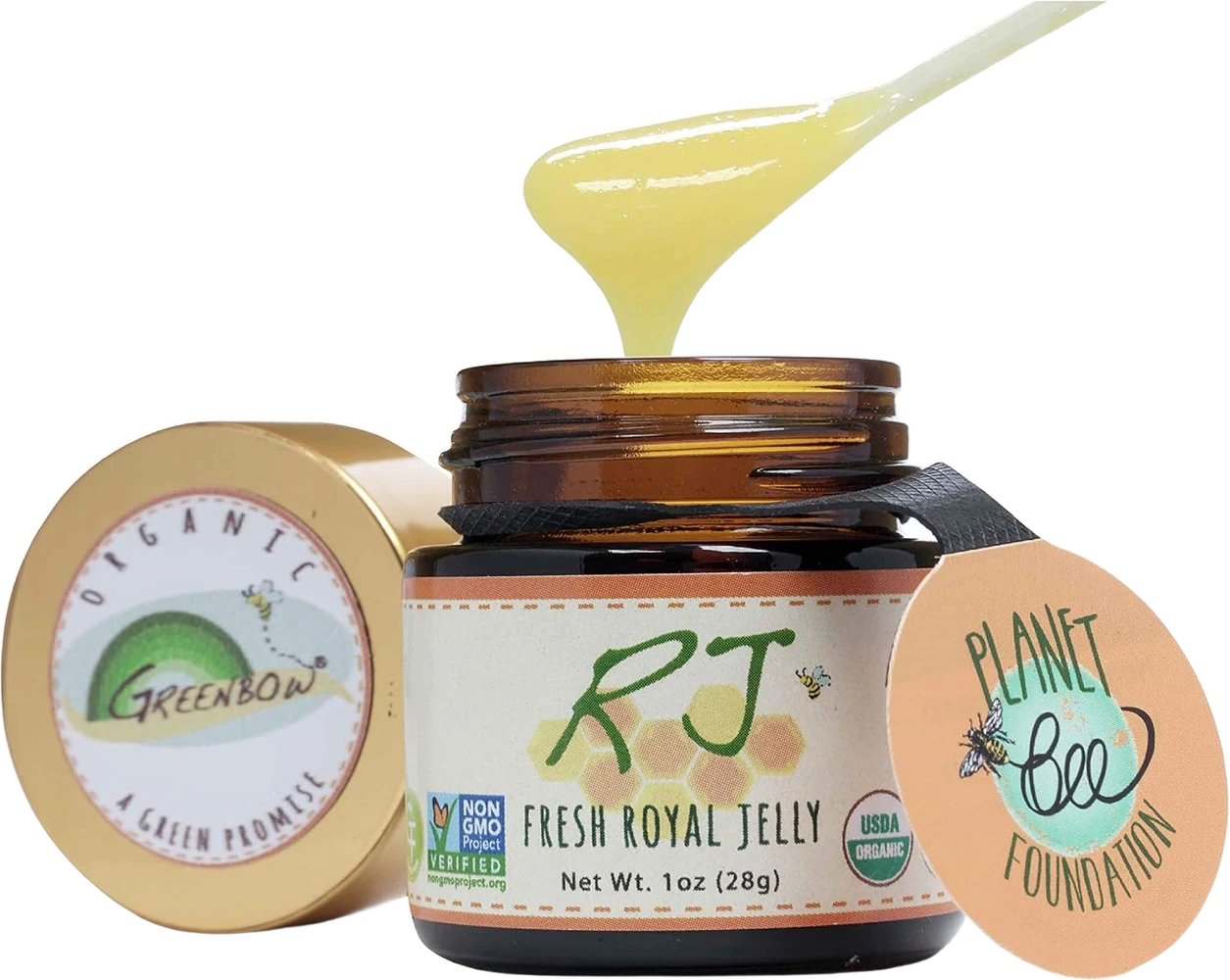
Best royal jelly (purest): Greenbow Organic Fresh Royal Jelly
7.6SAC Score™A genuinely raw, refrigerated fresh royal jelly that's USDA Certified Organic, Non-GMO and Halal — the pure, single-ingredient, no-additive form prized for 10-HDA-bearing vitality nutrition (note: it does not print an exact 10-HDA number).
StrongestSource purity & freshness9.51WeakestTesting & label transparency6.0- Per serving
- ~¼ teaspoon fresh royal jelly per label
- Type
- Royal jelly (100% fresh / raw)
- 10-HDA
- Not disclosed — no exact % stated on the listing
All five scores, pros & cons, full label
What We Like- USDA Certified Organic, Non-GMO, GMP and gluten-free, with no additives or fillers
- Fresh (not freeze-dried and reconstituted) raw royal jelly — the most bioactive form
- Pure single-ingredient: only royal jelly, nothing else
What You Live With- Royal jelly is a potent allergen and is specifically NOT advised for asthma or severe-allergy sufferers — it can trigger serious reactions
- Does not print an exact 10-HDA percentage on the listing, so its signature-marker strength is unverified
- Small 28 g jar at a premium price; must be kept refrigerated
- Form
- Fresh liquid/paste (refrigerated)
- Count
- 28 g jar
- Certifications
- USDA Certified Organic, Non-GMO, GMP, gluten-free
Our take — If you specifically want royal jelly in its purest form, Greenbow is the pick: genuinely fresh and refrigerated rather than reconstituted powder, USDA Organic, and a clean single ingredient. That freshness is the whole argument for it, since royal jelly's bioactives degrade in processing. Two honest caveats keep it at #6 rather than higher. It doesn't disclose a 10-HDA figure, so you're trusting the form rather than a verified number — and royal jelly is the most allergenic product on this page, explicitly not for asthmatics. Spot-test a tiny amount, keep it cold, and treat its vitality claims as traditional rather than proven.
- 07
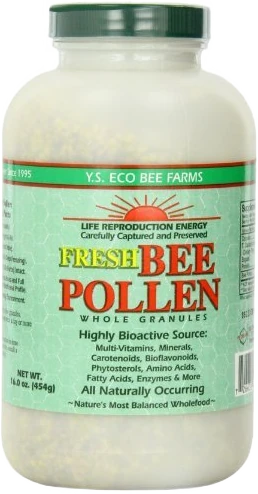
Best raw granules: Y.S. Eco Bee Farms Fresh Bee Pollen Whole Granules
7.4SAC Score™Raw, low-moisture whole pollen granules from a long-standing family bee farm — the closest-to-the-hive whole-food form for purists who want to taste and chew the actual pollen, or blend it into food.
StrongestSource purity & freshness9.02WeakestTesting & label transparency3.0- Per serving
- ½–1 tsp (~5 g), 1–2× daily per label
- Type
- Bee pollen (100% whole granular pollen)
- 10-HDA
- N/A — royal-jelly marker only
All five scores, pros & cons, full label
What We Like- 100% pure whole granules with low-moisture handling to protect freshness
- Generous 16 oz jar; mixes easily into smoothies, yogurt, or oats
- Well-known heritage bee brand with a wide bee-product range
What You Live With- Strong floral/bitter taste isn't for everyone
- Bee/pollen allergy caveat — start with a few granules under the tongue to test tolerance
- Granules should be refrigerated after opening to preserve freshness
- Form
- Granules (loose, low-moisture, unprocessed)
- Count
- 16 oz (1 lb) jar
- Processing
- Low-moisture handling, no added fillers
Our take — For purists who believe the point of bee pollen is to eat it as close to raw as possible, Y.S. Eco Bee Farms is the pick. The low-moisture whole granules from a heritage family farm are about as close-to-the-hive as a shelf-stable jar gets, and the 16 oz size blends into smoothies and yogurt for weeks. The trade-offs are honest: the taste is strongly floral, it wants refrigeration once opened, and — as with all pollen — you should test a few granules first for allergy. A genuine whole-food choice for people who want to chew the real thing.
- 08
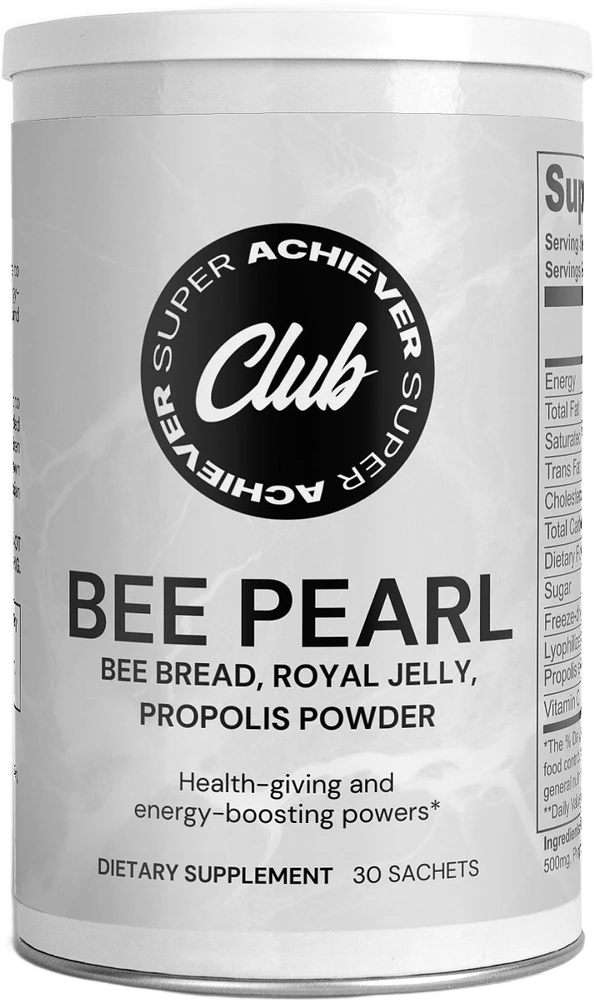
Our own brand: Super Achiever Bee Pearl (Bee Bread, Propolis, Royal Jelly)
6.8SAC Score™Our own bee blend: bee bread, royal jelly and propolis with each amount printed. It ranks here because it states no 10-HDA figure or residue test and costs $1.50 a day.
StrongestReal-world use & tolerance8.03WeakestValue per serving5.0- Per serving
- 2,500 mg bee bread + 500 mg royal jelly + 500 mg propolis extract, 1 sachet
- Cost per serving
- $1.50
- Box
- 30 sachets
All five scores, pros & cons, full label
What We Like- Three hive products with each amount printed
- Freeze-dried rather than heat-dried
- Single-serve sachets, origin stated (Latvia)
What You Live With- No 10-HDA percentage for the royal jelly
- No pesticide or contaminant testing stated
- Made in
- Latvia
- 10-HDA
- Not stated
Our take — Clearly labelled and convenient, at a premium price. Without a 10-HDA figure or a residue test it sits below the picks that publish one.
Bee Pollen & Royal Jelly In Four Short Lessons
Spot-test first: every bee product is an allergen.
All of these are recognised allergens, and royal jelly can trigger asthma flares and, rarely, anaphylaxis. It is not advised for asthmatics or anyone with severe allergies.
Know which hive product you are buying.
Bee pollen, royal jelly, propolis and bee bread are four different ingredients with different jobs. They are not interchangeable, and a propolis throat spray does nothing a pollen capsule does.
For royal jelly, look for a 10-HDA figure.
10-HDA is the fatty acid unique to royal jelly and the marker that matters. Only some products disclose it; treat 'not disclosed' as a mark against the label.
Ranked on source purity & freshness (30%), active content / 10-HDA (25%), testing & label transparency (20%), value (15%), and real-world use (10%). Human evidence cited in-file: propolis mouthwash reducing oral mucositis (Dastan 2020, PMID 33100913; Kuo 2018 meta-analysis, PMID 30022350), royal jelly on oxidative-stress markers (Taheri 2025, PMID 40656618) and skin barrier (Nakashima 2018, PMID 30396869); bee-pollen composition (Komosinska-Vassev 2015, PMID 25861358; Denisow 2016, PMID 27013064).
Bee products can't be scored on one benefit number because the popular benefits (energy, immunity, vitality) mostly aren't backed by large human trials — so ranking on them would be ranking on marketing. Instead we scored what's verifiable. Source purity and freshness carries the most weight, because for a whole-food hive product the value IS the unprocessed material: raw or low-heat handling, single-origin sourcing, and — critically for royal jelly — genuinely fresh, refrigerated product rather than reconstituted powder. Active content is next: for royal jelly that means a disclosed 10-HDA percentage (its unique marker), for propolis the extract strength, and for pollen the integrity of the whole granule — and a brand that publishes a real number beats one that leans on adjectives. Testing and label transparency is the trust filter: third-party pesticide/contaminant testing (bees concentrate environmental residues, so this genuinely matters), honest dosing, and an accurately stated count. Value per serving is the tiebreaker. Real-world use and tolerance — format, taste, ease, and how seriously the brand handles the allergy risk — settles the rest. Where a 10-HDA or flavonoid figure isn't disclosed, we never invent one; the absence is itself a small penalty.
Source purity & freshness · 30%
Raw or low-heat handling, single-origin or clearly-sourced material, no fillers, and — for royal jelly — genuinely fresh/refrigerated rather than reconstituted freeze-dried powder. For a whole-food hive product the unprocessed material is the product, so this is the heaviest axis.
Active content (10-HDA / propolis / pollen) · 25%
For royal jelly: a DISCLOSED 10-HDA % (the marker unique to royal jelly). For propolis: extract strength / concentration. For pollen + bee bread: whole-granule integrity and dose. A published number (e.g. BEE&YOU's stated >4% 10-HDA) beats a marketing adjective; non-disclosure is penalised, never papered over with an invented figure.
Testing & label transparency · 20%
Third-party testing for pesticide residue and contaminants (bees concentrate what's in their environment, so screening matters), plus honest dosing, an accurate count, and clearly disclosed actives. Certifications (USDA Organic, Non-GMO) earn credit here.
Value per serving · 15%
Cost per daily serving for the actual active delivered — bulk raw granules win on raw cost-per-ounce, concentrated extracts and fresh royal jelly cost more per serving but deliver more concentrated actives. Tiebreaker within a form tier.
Real-world use & tolerance · 10%
Format and convenience (capsule vs granule vs spray vs fresh jar), taste, refrigeration needs, and — importantly — how clearly the brand handles the bee/pollen allergy risk. Easy-to-take, honestly-labelled products score higher.

How bee products (pollen, propolis, royal jelly) work
- 1
Three products, three roles
Bee pollen (protein, vitamins, antioxidants), propolis (antibacterial/immune flavonoids), and royal jelly (the 10-HDA fatty acid) are distinct. Knowing which one you actually want for your goal is step one — the category's core confusion.
- 2
Propolis: the immune/throat player
Propolis carries the best evidence, for antibacterial and throat/immune support — which is why a well-made propolis spray tops this list. Its flavonoid content is the active worth verifying.
- 3
Royal jelly and 10-HDA
Royal jelly's signature compound is 10-HDA, studied for modest metabolic and skin effects. Freshness matters enormously — royal jelly degrades — so source purity and freshness is our heaviest axis.
- 4
Pollen as a nutrient concentrate
Bee pollen is a whole-food nutrient and antioxidant source with gentler, general benefits. Across all three, honest active content and clean testing separate a real product from an expensive novelty.
What to expect from bee products
Propolis acts fastest
A propolis throat spray can soothe an irritated throat quickly — the most immediate, best-evidenced effect in the category. Pollen and royal jelly are slower, subtler.
Nutrient and vitality margins
Bee pollen's antioxidant/nutrient support and royal jelly's mild effects build gradually with consistent use of a fresh product.
Match product to goal
Immune/throat: propolis. General nutrient boost: pollen. Skin/vitality curiosity: royal jelly. Buying the wrong one for your goal is the usual disappointment.
Allergy caution
Anyone with bee or pollen allergies should avoid these or test cautiously — reactions are the real risk. Freshness and clean sourcing matter more than exotic marketing.
The bottom line
Beekeeper's Naturals Propolis Throat Spray (#1) is the trustworthy default most people should start with.
It wins not on hype but on what's verifiable: a clean 95% propolis extract, alcohol-free, third-party tested for pesticide residue, and the one format whose underlying ingredient has the strongest human evidence — propolis in the mouth/throat, where mouthwash trials reduced oral mucositis. It won't out-dose a concentrated propolis capsule, and like everything here it's a bee/pollen allergen.
Choose by which bee product you actually want — the alternatives split cleanly by goal.
For bee pollen: Stakich (#2) is the bulk-value granule, NOW Bee Pollen Caps (#4) the cheap convenient capsule, Y.S. Eco Bee Farms granules (#7) the raw whole-food choice. For royal jelly, BEE&YOU (#5) is the transparent three-in-one that publishes a >4% 10-HDA figure while Greenbow (#6) is the purest genuinely-fresh form. NOW Propolis 1,500 mg (#3) is the concentrated propolis capsule.
Decide the product first, spot-test for allergy, and treat the vitality claims as promising-but-unproven.
Two things matter more than which pick you choose: every product is a bee/pollen allergen — royal jelly most of all — so spot-test a tiny amount before regular use and stop if you react. And be honest about the evidence: the genuinely encouraging human data is narrow (propolis mouthwash for oral mucositis; royal jelly nudging a couple of oxidative-stress and skin-barrier markers), not proven medicine.
Quick Answers
What is the best bee pollen & royal jelly pick overall?
Beekeeper's Naturals Propolis Throat Spray by Beekeeper's Naturals is our #1 pick (SAC score 9.5/10). Beekeeper's Naturals earns the top slot not on hype but on the two things that are actually verifiable: it's a clean, transparently-labelled 95% propolis extract, and it's third-party tested for the pesticide residue that bee products so often carry. It also happens to be the one format whose underlying ingredient has the strongest human evidence — propolis applied in the mouth/throat, where mouthwash trials reduced oral mucositis. It won't out-dose a concentrated propolis capsule, and like everything here it's a bee/pollen allergen, so spot-test first. But for most people wanting one trustworthy, easy bee product, this is the bottle to start with.
What is the best budget option?
NOW Foods Bee Pollen Caps, 500 mg at $11 / 100 capsules. If bee pollen is what you're after and you don't want to chew bitter granules off a spoon, this is the obvious budget pick. NOW's GMP pedigree and testing make it a low-risk way to get the whole-food pollen matrix — protein, B-vitamins, polyphenols — in a tidy 500 mg capsule at about eleven cents a dose. It's encapsulated rather than fresh-frozen, so purists chasing maximum rawness will prefer granules, and the usual allergy caveat applies. But for value and convenience, NOW is hard to beat.
How much do these picks cost?
Across our ranked picks, prices run from about $11 to $45 — exact price and cost per serving are listed on every pick card above.
How were these picks ranked?
Bee products can't be scored on one benefit number because the popular benefits (energy, immunity, vitality) mostly aren't backed by large human trials — so ranking on them would be ranking on marketing. Instead we scored what's verifiable. Source purity and freshness carries the most weight, because for a whole-food hive product the value IS the unprocessed material: raw or low-heat handling, single-origin sourcing, and — critically for royal jelly — genuinely fresh, refrigerated product rather than reconstituted powder. Active content is next: for royal jelly that means a disclosed 10-HDA percentage (its unique marker), for propolis the extract strength, and for pollen the integrity of the whole granule — and a brand that publishes a real number beats one that leans on adjectives. Testing and label transparency is the trust filter: third-party pesticide/contaminant testing (bees concentrate environmental residues, so this genuinely matters), honest dosing, and an accurately stated count. Value per serving is the tiebreaker. Real-world use and tolerance — format, taste, ease, and how seriously the brand handles the allergy risk — settles the rest. Where a 10-HDA or flavonoid figure isn't disclosed, we never invent one; the absence is itself a small penalty.
Every Claim Ranked Above Traces Back To One Of These
7 peer-reviewed sources, each linked to PubMed
- [1] Komosinska-Vassev 2015 PMID 25861358 — Bee pollen: chemical composition and therapeutic application. A detailed review of bee pollen's composition — proteins and free amino acids, B-vitamins, polyphenols/flavonoids, carotenoids, phytosterols, and enzymes — documenting the dense whole-food micronutrient matrix that underlies bee pollen's use, while noting therapeutic applications remain largely preliminary.
- [2] Denisow 2016 PMID 27013064 — Biological and therapeutic properties of bee pollen: a review. Reviews bee pollen's antioxidant, anti-inflammatory and antimicrobial activities, and stresses the central practical caveat we apply on this page: composition and biological activity vary widely with floral source and season, so potency is inherently variable batch to batch.
- [3] Nakashima 2018 PMID 30396869 — The effect of oral royal jelly administration on skin barrier function: a double-blind randomized placebo-controlled trial. A double-blind, placebo-controlled RCT of oral royal jelly measuring skin-barrier endpoints — one of the few controlled human trials of royal jelly. Cited as honest, narrow evidence: real RCT signal exists for specific endpoints, not for the broad energy/immunity claims marketing makes.
- [4] Taheri 2025 PMID 40656618 — Effects of royal jelly consumption on inflammation and oxidative stress: a systematic review and meta-analysis of randomized controlled trials. Meta-analysis of 7 datasets from 6 RCTs: royal jelly significantly reduced malondialdehyde (an oxidative-damage marker) and raised total antioxidant capacity, but did NOT significantly change hs-CRP (inflammation). The authors caution the trial base is small — exactly the measured, limited claim we make for royal jelly.
- [5] Dastan 2020 PMID 33100913 — Efficacy and safety of propolis mouthwash in management of radiotherapy induced oral mucositis; a randomized, double blind clinical trial. A randomized, double-blind, placebo-controlled trial in head-and-neck radiotherapy patients found propolis mouthwash significantly reduced oral-mucositis severity versus placebo, with no serious adverse effects. The strongest controlled human evidence on the page — for propolis applied in the mouth/throat, the use behind our #1 pick's format.
- [6] Kuo 2018 PMID 30022350 — Meta-analysis of randomized controlled trials of the efficacy of propolis mouthwash in cancer therapy-induced oral mucositis. Pooling 5 RCTs (209 participants), propolis mouthwash significantly lowered the incidence of severe oral mucositis versus control (OR 0.35, p=0.003). Corroborates the propolis-for-the-throat evidence at meta-analytic level — the one bee-product use with replicated controlled support.
- [7] Šedivá 2018 PMID 30544571 — 10-HDA, a major fatty acid of royal jelly, exhibits pH dependent growth-inhibitory activity against different strains of Paenibacillus larvae. Identifies 10-HDA (10-hydroxy-2-decenoic acid) as the major fatty acid unique to royal jelly and characterises its antibacterial activity in vitro. Cited to explain WHY a disclosed 10-HDA % is the meaningful royal-jelly marker we reward — while noting this is laboratory, not clinical, evidence.
Affiliate disclosure: every Amazon link uses our Associates tag (superachieverclub-20). We earn a small commission at no cost to you; it funds independent reviews. We never accept payment to change a ranking.