
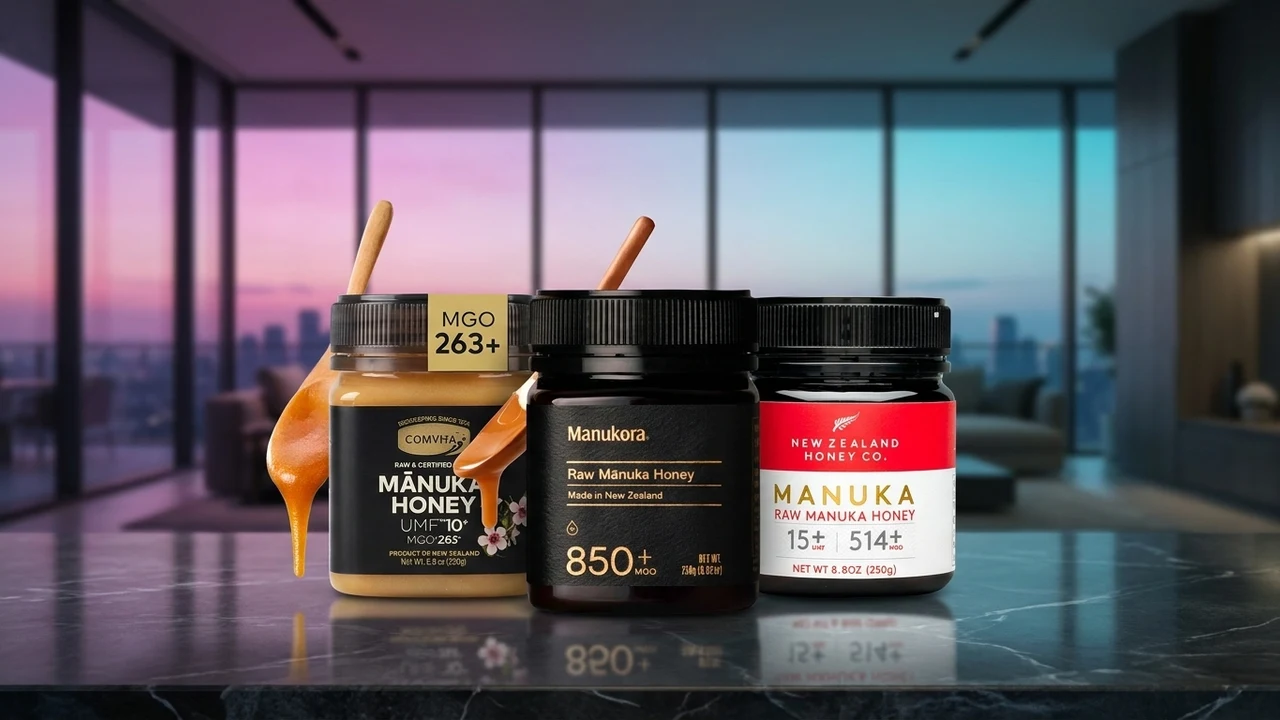
Top 7 Best Manuka Honey for Immunity (2026)
7 picks — ranked by our 50/50 methodology
- #1Best overall
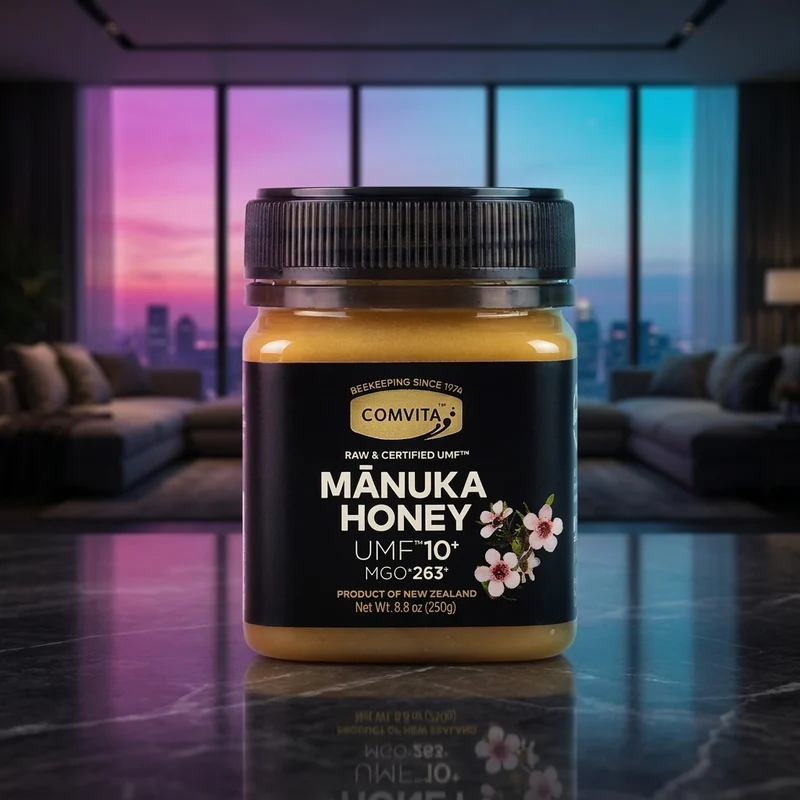
Comvita Manuka Honey UMF 10+ (MGO 263+)
Comvita · Certified UMF 10+ / MGO 263+ · 8.8 oz (250 g) jar9.3/10SAC Product Score™SAC Product Score™ — how it breaks down- UMF/MGO grade verification30%9.8
- Origin & licensing (NZ, traceability)25%9.1
- Independent testing & labeling honesty20%9.1
- Value per ounce at grade15%9.0
- Taste & daily use10%9.1
The category pioneer at the sweet-spot daily grade — fully UMF-certified 10+ / MGO 263+, full hive-to-shelf traceability, and the lowest per-ounce price of any certified 10+ here (~$3.75/oz). The right first jar of genuine manuka.
- Grade
- Certified UMF 10+ (MGO 263+)
- Certification
- UMF Honey Association — every batch (Leptosperin, DHA, MGO)
- Origin
- New Zealand · Comvita since 1974, ~40,000 hives
- Jar
- 250 g (8.8 oz) · raw, monofloral, Non-GMO
Pros- Independent UMF Honey Association certification on every batch — Leptosperin, DHA, and MGO tested
- The most established manuka brand: pioneer since 1974 with full hive-to-shelf traceability and mainstream availability
- UMF 10+ (MGO 263+) is the sweet-spot daily-wellness grade at ~$3.75/oz — the lowest per-oz price of any certified 10+ here
Cons- UMF 10+ is mid potency — buyers targeting concentrated throat-season support often step up to 15+ (#2, #5)
- A 250 g jar lasts only ~5 weeks at a teaspoon a day, so the per-month cost adds up
Our take — If you want one jar of genuine, independently certified manuka and you don't want to study the category, this is it. Comvita is the brand that built the category — certified UMF 10+ on every batch, traceable from hive to shelf, at the best per-ounce price of any certified 10+ in this lineup. UMF 10+ is the grade most daily buyers actually want: real, verified potency without paying 15+ or 20+ money. Step up to a 15+ only if your specific goal is concentrated throat-season support; for everyday wellness use, this is the rational default.
- #2Best premium value
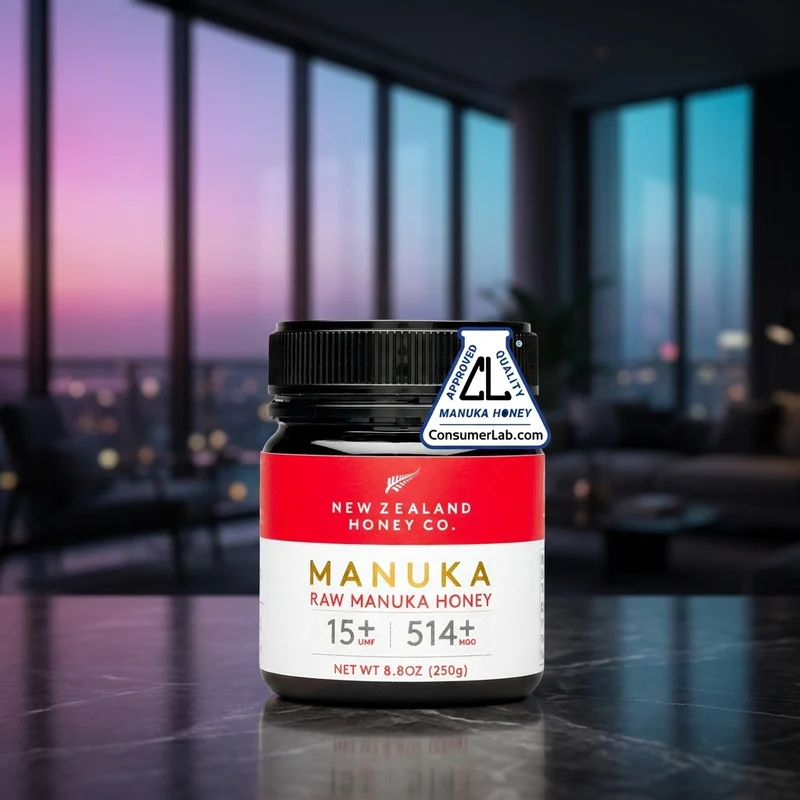
New Zealand Honey Co. Raw Manuka Honey UMF 15+ / MGO 514+
New Zealand Honey Co. · Certified UMF 15+ / MGO 514+ · 8.8 oz (250 g) jar9.1/10SAC Product Score™SAC Product Score™ — how it breaks down- UMF/MGO grade verification30%9.0
- Origin & licensing (NZ, traceability)25%9.7
- Independent testing & labeling honesty20%9.0
- Value per ounce at grade15%8.4
- Taste & daily use10%9.0
A certified UMF 15+ — the concentrated 'throat-season' potency tier — at ~$4.40/oz, the lowest list price per ounce of any certified 15+ here, with QR-code batch traceability on every lid.
- Grade
- Certified UMF 15+ / MGO 514+
- Certification
- Licensed UMF Honey Association member #2060 · independently tested
- Origin
- Foraged, packed & tested entirely in New Zealand
- Jar
- 250 g (8.8 oz) · monofloral · QR code per lid
Pros- Certified UMF 15+ / MGO 514+ with independent verification and a stated license number (2060)
- Cheapest certified UMF 15+ per ounce here (~$4.40/oz list) — undercuts same-grade rivals
- 100% NZ chain of custody (honey imports into NZ are illegal); QR code per jar pulls the certificate and origin
Cons- Thick, fudge-like consistency and complex herbaceous flavour is polarizing for first-time buyers
- Less mainstream-retail recognition than Comvita or Wedderspoon — mostly an online purchase
Our take — This is the pick when you want real, concentrated potency without overpaying for it. UMF 15+ is the tier most people mean by 'the strong stuff for when I feel something coming on,' and New Zealand Honey Co. delivers it certified, independently tested, and license-numbered at the lowest per-ounce price of any 15+ here. The QR code on every lid pulls the batch certificate and origin, which is exactly the traceability manuka demands. The honey is thick and herbaceous — genuine manuka usually is — so first-timers should expect a complex flavour, not clover sweetness. Best premium value on the list.
- #3Best premium (highest potency)
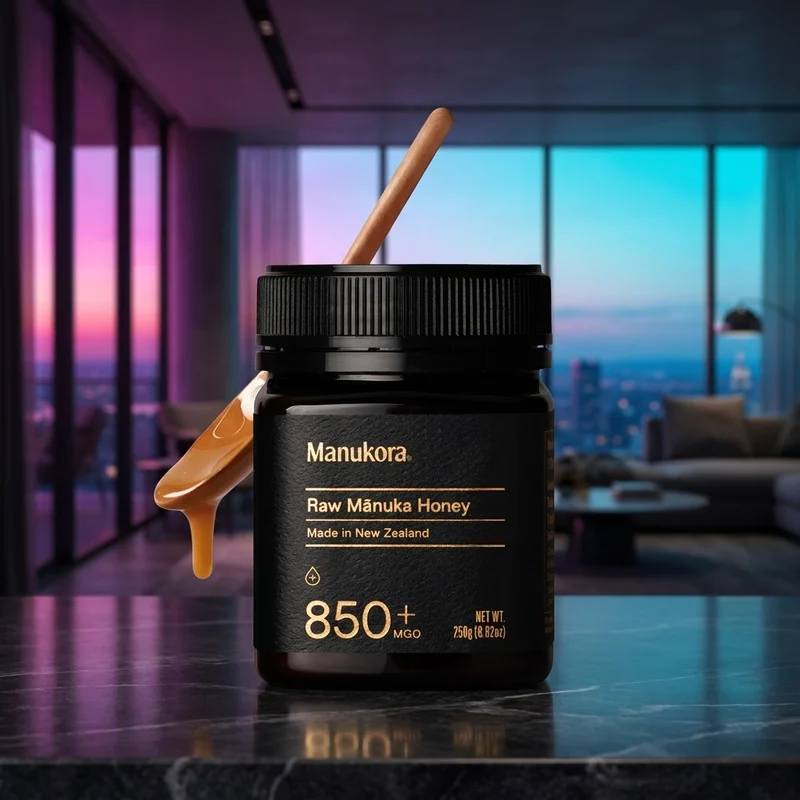
Manukora Raw Mānuka Honey MGO 850+
Manukora · MGO 850+ (UMF 20+ potency tier) · 8.8 oz (250 g) jar8.9/10SAC Product Score™SAC Product Score™ — how it breaks down- UMF/MGO grade verification30%8.9
- Origin & licensing (NZ, traceability)25%8.9
- Independent testing & labeling honesty20%9.5
- Value per ounce at grade15%8.2
- Taste & daily use10%8.9
The premium splurge — ultra-high MGO 850+, numerically above the UMF 20+ threshold (MGO 829), from a B-Corp with hive-to-hand QR traceability. The strongest jar in this lineup. Note: MGO-labeled, not UMF-certified.
- Grade
- MGO 850+ (≥850 mg/kg methylglyoxal — above the MGO 829 UMF 20+ threshold)
- Labeling
- MGO-labeled, NOT UMF-certified · 3rd-party MGO purity report via QR
- Origin
- New Zealand · B-Corp · hive-to-hand QR traceability
- Jar
- 250 g (8.8 oz) · monofloral · non-GMO · glyphosate-residue-free
Pros- MGO 850+ is the highest verified potency in this lineup — numerically above the UMF 20+ threshold (MGO 829)
- Hive-to-hand QR traceability: scan to see NZ origin, the beekeeper, and the jar's independently verified MGO report
- B-Corp certified, non-GMO, glyphosate-residue-free, small-batch ethical sourcing
Cons- ~$80 MSRP (~$9/oz) — by far the most expensive jar here; overkill for casual tea-sweetening
- Current listing is MGO-labeled only — no UMF™ seal in the title or bullets, so buyers who specifically want the UMF trademark must verify the jar label
Our take — When you want the strongest jar on the table and price is not the constraint, this is it. MGO 850+ exceeds the MGO 829 threshold that defines UMF 20+, so on potency alone it tops the lineup, and Manukora backs it with B-Corp sourcing and hive-to-hand QR traceability that resolves to a named beekeeper and an independent MGO report. The one honest caveat — and it matters — is that this listing is MGO-labeled, not UMF-certified: the 850+ number is third-party verified, but there is no UMF™ seal in the title or bullets, so if you specifically want the UMF trademark you must confirm it on the jar. For potency-maximizers who care about the MGO number itself, it's the splurge.
- #4Best MGO-labeled (certified)
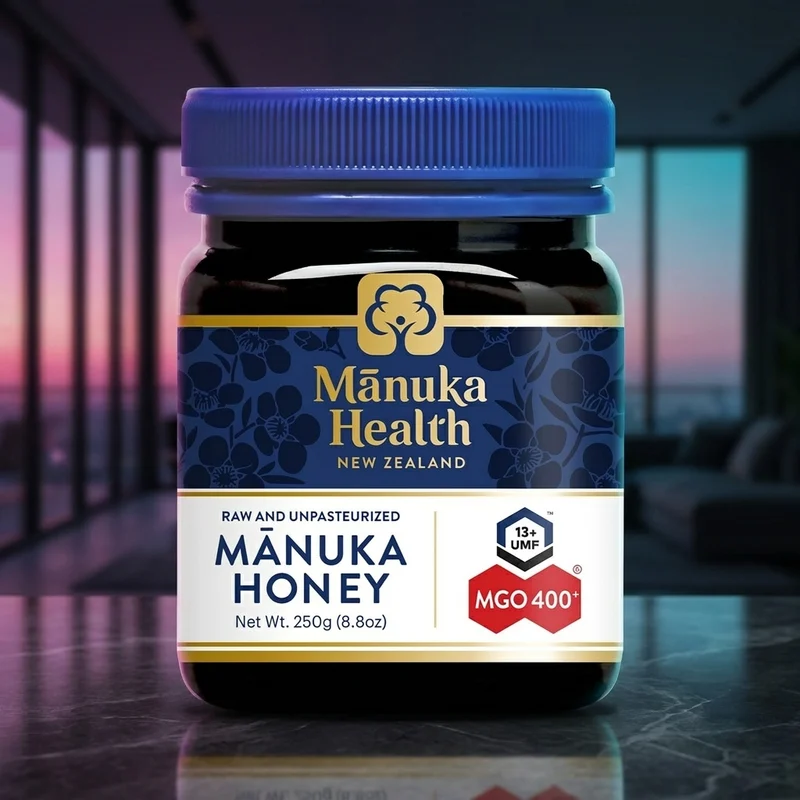
Manuka Health UMF 13+ / MGO 400+ Manuka Honey
Manuka Health · Dual-labeled UMF 13+ / MGO 400+ · 8.8 oz (250 g) jar8.7/10SAC Product Score™SAC Product Score™ — how it breaks down- UMF/MGO grade verification30%9.3
- Origin & licensing (NZ, traceability)25%8.6
- Independent testing & labeling honesty20%8.6
- Value per ounce at grade15%8.0
- Taste & daily use10%8.6
The MGO-number pick that's also UMF-certified — Manuka Health built its grading around the exact methylglyoxal figure, and this jar states both MGO 400+ and the UMF 13+ it maps to, triple-tested with full NZ traceability.
- Grade
- Dual-labeled UMF 13+ / MGO 400+
- Certification
- UMF-certified AND triple-tested for methylglyoxal level
- Origin
- Made, tested & sealed in New Zealand · QR traceability to the beekeeper
- Jar
- 250 g (8.8 oz) · raw, unpasteurized
Pros- MGO-first labeling gives an exact potency number (≥400 mg/kg methylglyoxal), not just a tier — and it is UMF-certified on top
- Triple-tested potency with full NZ traceability (QR on every lid back to the beekeeper)
- UMF 13+ is a useful middle step between the common 10+ daily grade and pricier 15+ jars
Cons- At ~$4.75/oz it costs nearly as much as the certified 15+ picks while carrying a lower 13+ grade
- Dual MGO/UMF labeling can confuse first-time buyers (MGO 400 'sounds' stronger than UMF 13)
Our take — Manuka Health is the brand that grades by the precise MGO number — the actual milligrams of methylglyoxal per kilo — and crucially, this jar is UMF-certified on top of stating MGO 400+, so you get an exact potency figure backed by independent certification. UMF 13+ slots neatly between the everyday 10+ and the concentrated 15+. The honest knock is value: at ~$4.75/oz it's priced like a 15+ while carrying a 13+ grade, so if cost-per-ounce-at-grade is your priority, the certified 15+ picks (#2, #5) do better. But if you want a named MGO number on a certified jar, this is the cleanest expression of that.
- #5Best certified-15+ deal
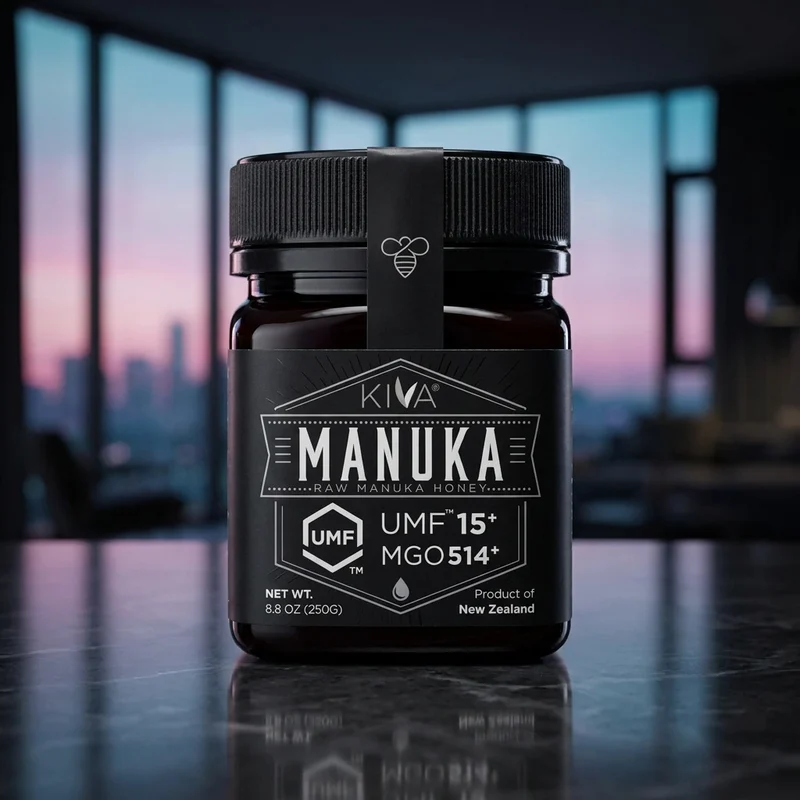
Kiva Raw Manuka Honey UMF 15+ / MGO 514+
Kiva · Certified UMF 15+ / MGO 514+ · 8.8 oz (250 g) jar8.6/10SAC Product Score™SAC Product Score™ — how it breaks down- UMF/MGO grade verification30%8.6
- Origin & licensing (NZ, traceability)25%8.6
- Independent testing & labeling honesty20%9.2
- Value per ounce at grade15%7.9
- Taste & daily use10%8.6
The deal-hunter's certified 15+ — the same UMFHA-certified UMF 15+ / MGO 514+ grade as pricier rivals, and its frequent ~$32 promotions make it the cheapest certified 15+ per ounce (~$3.65/oz) when on sale.
- Grade
- Certified UMF 15+ / MGO 514+
- Certification
- UMFHA quality mark · every batch independently tested (MGO, Leptosperin, DHA, HMF)
- Origin
- New Zealand · monofloral · QR code per jar
- Jar
- 250 g (8.8 oz) · raw
Pros- Full UMFHA certification at UMF 15+ / MGO 514+ with batch-level independent testing of signature compounds
- Frequently discounted — at its common ~$32 deal price it beats every certified 15+ here on cost per ounce
- QR-code verification of origin and authenticity on each jar
Cons- At its ~$42 list price the per-ounce cost rises above New Zealand Honey Co.'s 15+ (#2)
- Smaller brand with thin physical-retail presence — mostly an online purchase
Our take — Kiva is the certified 15+ you buy on a deal. The grade and certification are the real thing — full UMFHA quality mark, batch-tested for MGO, Leptosperin, DHA and HMF, with QR verification per jar — so you're getting genuine concentrated potency, not a number on a label. The catch is the price swing: at its ~$42 list it's pricier per ounce than New Zealand Honey Co.'s 15+ (#2), but at its frequent ~$32 promo it becomes the cheapest certified 15+ on the list (~$3.65/oz). The play is simple — if Kiva is on its deal price, buy it; if it's at full list, buy #2 instead.
- #6Best value entry into certified UMF
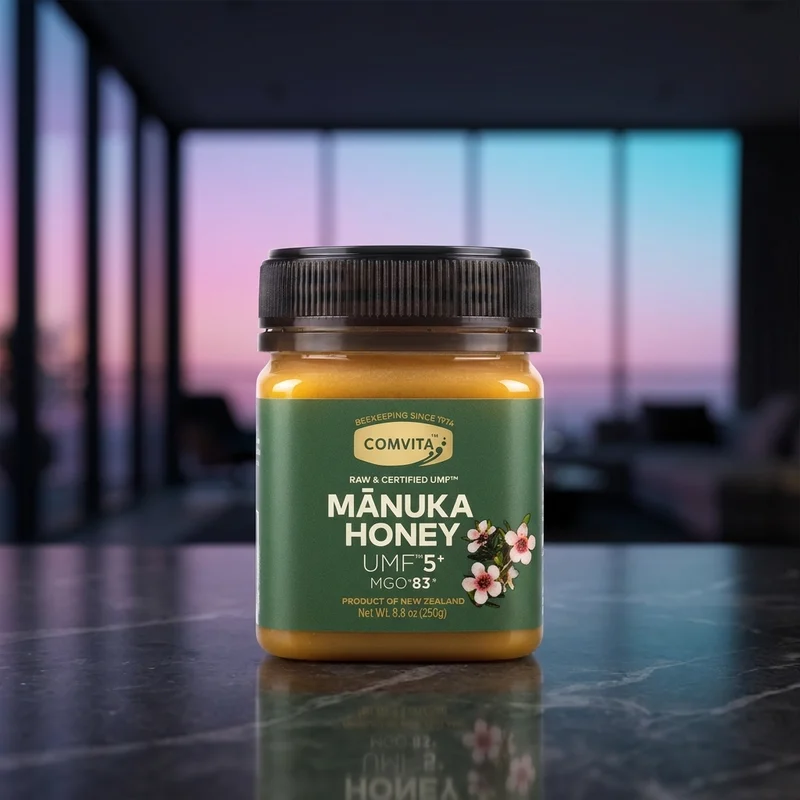
Comvita Manuka Honey UMF 5+ (MGO 83+)
Comvita · Certified UMF 5+ / MGO 83+ · 8.8 oz (250 g) jar8.2/10SAC Product Score™SAC Product Score™ — how it breaks down- UMF/MGO grade verification30%7.5
- Origin & licensing (NZ, traceability)25%8.4
- Independent testing & labeling honesty20%8.4
- Value per ounce at grade15%8.8
- Taste & daily use10%8.4
The cheapest genuinely certified jar here (~$2.20-2.60/oz) — the same Comvita batch certification and 50-year pedigree as the 10+, at the entry UMF 5+ grade for everyday food use. The honest, rational way into real UMF.
- Grade
- Certified UMF 5+ (MGO 83+)
- Certification
- UMF Honey Association — batch-tested (Leptosperin, DHA, MGO)
- Origin
- New Zealand · Comvita 50-year pedigree
- Jar
- 250 g (8.8 oz) · raw, wild, monofloral, Non-GMO
Pros- Lowest price per ounce of any certified-UMF jar here (~$2.20-2.60/oz) — the rational entry grade
- Identical UMF Honey Association batch certification and 50-year Comvita pedigree as the higher grades
- Ideal for daily tea/yogurt/smoothie use where a 15+ or 20+ jar would be wasted
Cons- UMF 5+ (MGO 83+) is the entry grade — the wrong pick if you are buying specifically for concentrated potency
- Still 2-3× the price of high-quality regular raw honey for what is, at this grade, mostly a taste/identity upgrade
Our take — This is the honest entry point into genuine UMF, and the right answer for a lot of buyers. You get the exact same UMF Honey Association batch certification and Comvita pedigree as the #1 jar, at the lowest per-ounce price of any certified manuka here — perfect for daily tea, yogurt, or smoothie use where a 15+ or 20+ would be wasted. Two honest caveats keep it at the value-entry slot rather than higher: UMF 5+ (MGO 83+) is the floor of real potency, so it's the wrong pick if you're buying for concentrated antibacterial strength; and at this grade you're paying 2-3× the price of a great raw honey largely for the manuka identity and flavour. If you want certified manuka without overpaying, start here.
- #7Best grocery-store pick (read the label note)
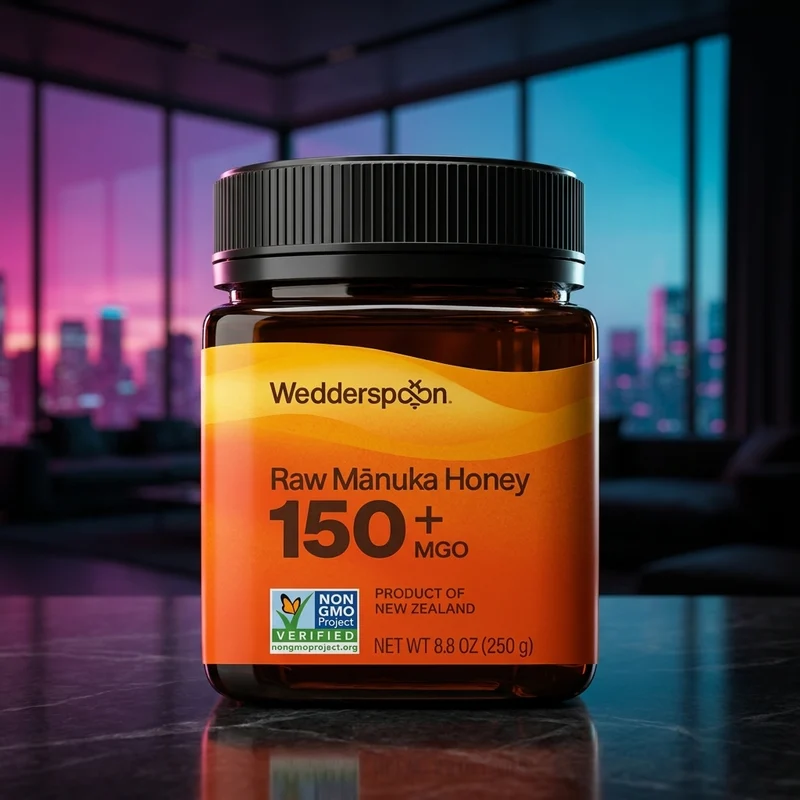
Wedderspoon Raw Monofloral Mānuka Honey KFactor 16 (150+ MGO)
Wedderspoon · KFactor 16 / 150+ MGO (in-house standard, NOT UMF) · 8.8 oz (250 g) jar7.6/10SAC Product Score™SAC Product Score™ — how it breaks down- UMF/MGO grade verification30%6.9
- Origin & licensing (NZ, traceability)25%7.8
- Independent testing & labeling honesty20%7.8
- Value per ounce at grade15%8.2
- Taste & daily use10%7.8
The grocery-store favorite, framed honestly: KFactor is Wedderspoon's OWN grading system — it verifies pollen purity and traceability but is NOT a UMF potency certification. The newly disclosed 150+ MGO puts its potency between UMF 5+ (MGO 83+) and UMF 10+ (MGO 263+), at a friendly ~$3.20/oz.
- Grade
- KFactor 16 / 150+ MGO — between UMF 5+ (83) and UMF 10+ (263)
- Labeling
- KFactor = Wedderspoon's in-house pollen-purity + traceability standard, NOT the UMF potency panel
- Origin
- New Zealand (South Island) · monofloral · raw · Non-GMO · BPA-free jar
- Jar
- 250 g (8.8 oz)
Pros- Strong everyday value at ~$3.20/oz for a raw, monofloral, unpasteurized NZ manuka
- Now transparently MGO-labeled (150+ MGO), so potency can finally be compared against UMF-graded jars
- Widely available, Non-GMO, BPA-free packaging, sourced from New Zealand's South Island
Cons- Not UMF-certified — KFactor measures pollen purity/traceability, not the UMF potency panel, so there is no independent UMFHA grade behind it
- 150+ MGO is below the UMF 10+ threshold (MGO 263+): weaker than every certified pick above it in this list
Our take — Wedderspoon is the jar most people meet first on a grocery shelf, and it deserves an honest framing rather than a dismissal. The good: it's a genuine raw, monofloral New Zealand manuka at a friendly ~$3.20/oz, and it now discloses 150+ MGO so you can finally compare its potency directly. The thing to understand: KFactor 16 is Wedderspoon's OWN standard — it certifies pollen purity and traceability, not the UMF potency panel, so it is not a UMF grade and there's no independent UMFHA potency certification behind it. And that disclosed 150+ MGO sits below even UMF 10+ (263). Buy it as an affordable everyday manuka with eyes open; if you want certified, verified potency, step up to a UMF jar (#1, #2, #5).

▸ Affiliate disclosure: every Amazon link uses our Associates tag (superachieverclub-20). We earn a small commission at no cost to you; it funds independent reviews. We never accept payment to change a ranking.
Best Manuka Honey (2026): The Grade Is the Whole Decision
- 01
The 5-10x premium is justified by one measurable thing: MGO.
Methylglyoxal — derived from the dihydroxyacetone in manuka nectar — gives genuine New Zealand manuka its dose-dependent antibacterial activity, sold to you as a graded potency tier. So the whole purchase reduces to three checks: is the grade independently verified, is the honey genuinely from New Zealand and traceable, and what are you paying per ounce at that grade.
- 02
UMF is the gold standard because it verifies authenticity, not just potency.
UMF certification tests three markers — Leptosperin, DHA, and MGO — on every batch through the independent UMF Honey Association. An MGO number alone is legitimate when third-party tested, but a brand can legally print it without holding UMF certification, so the number tells you potency, not who checked it.
- 03
K-Factor is not a UMF grade — conflating them is how buyers overpay.
K-Factor is Wedderspoon's own in-house standard: it verifies pollen purity and traceability, not the UMF potency panel. A 'KFactor 16' jar is not a 'UMF 16' jar — they are not the same scale, and conflating them is the most common way buyers overpay for less potency than they think.
- 04
Be honest about the evidence: strong topical, traditional oral.
Manuka's strongest, best-documented benefit is topical — medical-grade honey has real, MGO-driven antibacterial activity in wound and burn care. The throat, immune, and gut benefits people buy a jar for are traditional and supportive, a soothing ritual rather than a clinical promise. If you don't care about MGO, manuka is functionally just very expensive honey.
Ranked on grade verification (30%), NZ origin & licensing (25%), independent testing & labeling honesty (20%), value per ounce at grade (15%), and taste (10%) — full scoring in the methodology below. Antibacterial evidence: Mavric 2008 (PMID 18210383), which identified methylglyoxal as the dominant antibacterial constituent of NZ manuka; Adams 2008 (PMID 18468589) on the DHA-to-MGO conversion; and the Jull 2015 Cochrane review of 26 trials (3,011 participants) supporting topical wound/burn care.
How we ranked these seven
Manuka can't be ranked on price or popularity because the thing you're paying for — MGO potency — is invisible without third-party testing, and the grading labels are designed to be confused with one another. So we weighted grade verification highest: a potency tier only counts if it is real and independently tested, which is why UMF™ certification (Leptosperin + DHA + MGO on every batch) scores above an MGO number printed without it. Origin and licensing comes next, because genuine New Zealand provenance and full traceability are what separate authentic manuka from adulterated or mislabeled honey (importing honey into NZ is illegal, so a true NZ chain of custody is verifiable). Independent testing and labeling honesty is its own axis — and the place we are hardest on the category: K-Factor is Wedderspoon's in-house pollen-purity standard, NOT a UMF potency certification, and an MGO-only label is not the same as UMF certification. We reward jars that disclose exactly what their number means and penalize implied-but-absent certification. Value per ounce at grade is the tiebreaker: we divide price by ounces and normalise to the potency tier, so a cheap low-grade jar doesn't out-rank a fairly-priced high-grade one. Taste and daily use settles the rest — texture, flavour, and how pleasant it is to take a spoonful every day.
- UMF/MGO grade verification30%
Is the potency tier real and independently tested? UMF™ certification verifies MGO, Leptosperin, and DHA on every batch through the UMF Honey Association — the gold standard, because it confirms authenticity as well as potency. A third-party-tested MGO number is legitimate and earns strong marks; an MGO figure printed without independent verification earns less. The grade is the entire reason manuka costs what it does, so getting it verified is the highest-weighted axis.
- Origin & licensing (NZ, traceability)25%
Genuine New Zealand provenance and a traceable chain of custody. Importing honey into NZ is illegal, so a real 'foraged, packed and tested in New Zealand' supply chain is verifiable and meaningful. UMFHA license numbers, QR-code batch certificates, and named-apiary traceability all earn credit. This is the authenticity filter — manuka is one of the most adulterated honeys in the world, so provenance is not a marketing nicety.
- Independent testing & labeling honesty20%
Does the label tell the truth about what its number means? K-Factor (Wedderspoon's in-house standard) verifies pollen purity and traceability but is NOT the UMF potency panel — it is not a UMF grade, full stop. An MGO-only jar is potency-labeled but may not carry UMF certification. We reward brands that disclose exactly what they test and penalize labels that imply a certification they don't hold. This axis is where the category's worst marketing gets caught.
- Value per ounce at grade15%
Price divided by ounces, normalised to the potency tier — so a certified UMF 15+ at $4.40/oz is judged against other 15+ jars, not against an entry-grade 5+. This stops a cheap low-grade jar from out-ranking a fairly-priced high-grade one on raw price alone. Manuka spans roughly $2.20/oz (entry UMF 5+) to ~$9/oz (MGO 850+); the question is always cost per ounce AT the grade you actually want.
- Taste & daily use10%
Texture, flavour, and how pleasant the daily spoonful is. Genuine manuka runs thick, fudge-like, and herbaceous — that complex flavour is polarizing for first-time buyers expecting clover-honey sweetness. Smooth spoonability, neutral-enough taste for tea or toast, and packaging quality settle ties. A minor axis, because you're buying manuka for MGO, not dessert — but daily-use friction is real if the flavour stops you taking it.


The bottom line
- 01
Best overall: Comvita UMF 10+ (#1).
The category pioneer at the sweet-spot daily grade — fully UMF-certified 10+ (MGO 263+), traceable hive to shelf, at the lowest per-ounce price of any certified 10+ here (~$3.75/oz). UMF 10+ is the grade most daily buyers actually want: real, verified potency without paying 15+ or 20+ money.
- 02
Match the grade to the goal across the certified ladder.
For concentrated 'throat-season' potency, step up to certified UMF 15+: New Zealand Honey Co. (#2) at the best list price per ounce, or Kiva (#5) when its frequent ~$32 promo makes it the cheapest 15+. Manukora MGO 850+ (#3) is the strongest jar but MGO-labeled, not UMF-certified; Manuka Health UMF 13+ / MGO 400+ (#4) puts a precise number on a certified jar; Comvita UMF 5+ (#7) is the ~$2.20-2.60/oz entry into real UMF.
- 03
Buy manuka for MGO — and understand Wedderspoon before you click.
The premium over ordinary honey is justified by methylglyoxal content and the antibacterial activity it drives; if you don't care about MGO, a great $8 raw honey does the breakfast-table job. The one pick to understand is Wedderspoon KFactor 16 (#6): a genuine raw NZ manuka, but KFactor is not a UMF grade and its disclosed 150+ MGO sits below even UMF 10+ (263) — buy it with eyes open, not mistaken for UMF 16.
Every claim ranked above traces back to one of these
Peer-reviewed studies, meta-analyses and clinical trials behind the picks. Click any citation to read the abstract on PubMed.
- [1]Mavric 2008
Identification and quantification of methylglyoxal as the dominant antibacterial constituent of Manuka (Leptospermum scoparium) honeys from New Zealand
Identified methylglyoxal (MGO) as the dominant antibacterial constituent of New Zealand manuka honey, with MGO concentrations 20-1000× higher than in conventional honeys and a direct correlation between MGO content and non-peroxide antibacterial activity. This is the foundational paper behind MGO grading — the reason the MGO number on a jar is the meaningful potency metric, and why UMF certification tests for it.
- [2]Adams 2008
Isolation by HPLC and characterisation of the bioactive fraction of New Zealand manuka (Leptospermum scoparium) honey
Demonstrated that the non-peroxide antibacterial activity of manuka honey arises from methylglyoxal, which forms in the honey from dihydroxyacetone (DHA) present in manuka nectar during maturation. Explains the DHA→MGO conversion that underpins why UMF certification tests both DHA and MGO, and why genuine manuka potency develops from the nectar's chemistry rather than being added.
- [3]Jull 2015 (Cochrane)
Honey as a topical treatment for wounds
A Cochrane systematic review of 26 trials (3,011 participants) found honey may shorten healing time in partial-thickness burns and post-operative infected wounds versus some conventional dressings, while evidence for other wound types was of low certainty. Cited here for honesty: manuka's best-supported benefit is TOPICAL wound/burn care — not the oral immune or throat claims, which remain traditional and supportive rather than clinically proven.