
Vitamin B12: Benefits, Dosage & Side Effects (2026)
Vitamin B12 (cobalamin) is an essential cofactor for red-blood-cell formation, nerve function, and energy metabolism — and correcting a real deficiency reliably resolves the associated fatigue, but taking extra B12 gives no energy boost in people who are already replete.
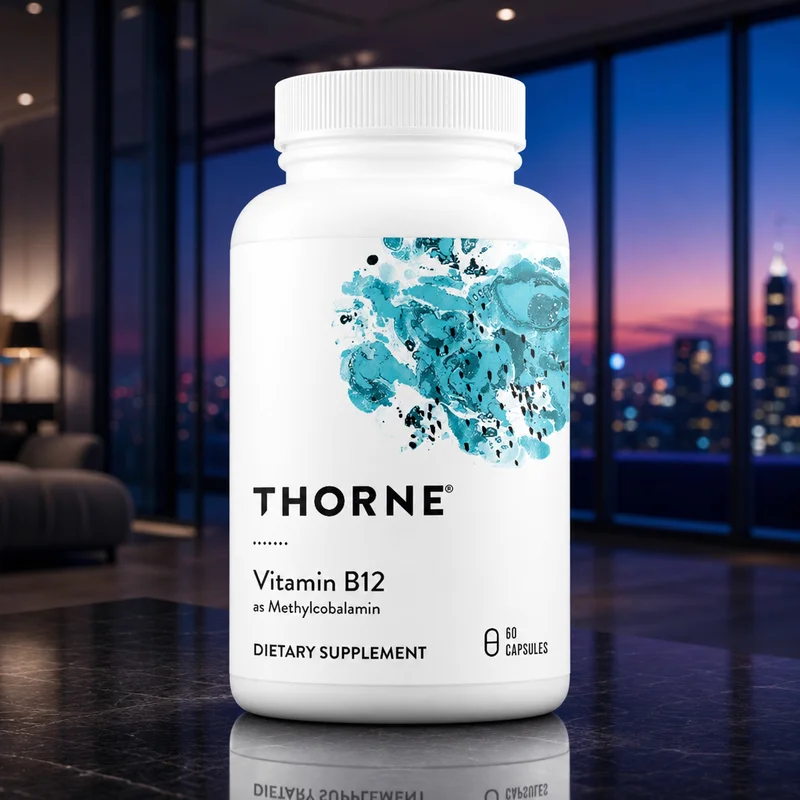
THORNE Vitamin B12 (as Methylcobalamin) - 60 Capsules
What is Vitamin B12?
Vitamin B12 (cobalamin) is a water-soluble B vitamin and the largest, most chemically complex of all the vitamins. It is the cofactor for two essential human enzymes and is required for DNA synthesis, red-blood-cell production, maintenance of the myelin sheath around nerves, and normal energy-yielding metabolism. Uniquely among vitamins, B12 is manufactured only by bacteria — no plant or animal makes it — so humans obtain it almost entirely from animal foods: meat, fish, eggs, and dairy. It comes in several forms — cyanocobalamin (the cheap, stable synthetic form in most supplements and fortified foods) and the "active" forms methylcobalamin, adenosylcobalamin, and hydroxocobalamin — all of which the body can use to correct a deficiency.
What makes B12 unusual is its absorption pathway and its storage. To extract B12 from food, the stomach needs adequate acid to release it from protein, and the gut needs intrinsic factor — a protein made by the stomach lining — to absorb it in the small intestine. The liver then holds several years' worth of reserves. Because of that large buffer, deficiency develops slowly and silently, often over years, and is almost always a problem of absorption or long-term inadequate intake rather than a casual day-to-day shortfall.
The single most important thing to understand about B12 is the gap between its reputation and the evidence. It is marketed as the "energy vitamin," dosed into every energy drink and B-complex shot, and widely assumed to fight tiredness in anyone. It does not. For a person whose B12 status is already normal, extra B12 produces no measurable lift in energy — the surplus is simply excreted in urine. B12 relieves fatigue in exactly one situation: when you were genuinely deficient to begin with. The practical value of a B12 supplement therefore turns entirely on a single question — are you actually in one of the groups that runs low? Vegans and long-term vegetarians, adults over 50, and people on long-term metformin or acid-reducing drugs are, and for them B12 is one of the most important supplements there is. For everyone else, it is a solution to a problem they don't have.
How it works
B12 does its work as the cofactor for two enzymes, and the energy story runs through both. Methylmalonyl-CoA mutase uses B12 to feed products of fat and branched-chain amino-acid breakdown into the citric-acid cycle, the pathway that generates cellular energy — which is the biochemical basis for calling B12 an "energy" nutrient. Methionine synthase uses B12 to convert homocysteine to methionine, driving the methylation reactions and the folate cycle that DNA synthesis depends on. When B12 runs out, DNA synthesis in the fast-dividing bone marrow fails first, producing large, immature red blood cells (megaloblastic anemia); fewer functional red cells means less oxygen delivered to tissues, and that oxygen shortfall is a real, mechanistic cause of the fatigue, weakness, and breathlessness of deficiency (Stabler 2013, PMID 23301732). In parallel, faltering methylation damages the myelin sheath, producing the tingling, numbness, balance problems, and cognitive fog of advanced deficiency.
This is why the honest framing is "correction, not boost." Tardy 2020 (PMID 31963141) reviewed the biochemistry and clinical evidence and confirmed that B vitamins including B12 are genuine cofactors in energy-yielding metabolism and that inadequate or marginal status contributes to fatigue — but the same review gives no basis for an energy benefit once status is already adequate. B12 fills a hole; it does not overclock a system that is already fully supplied. That places B12 in the same category as iron: correcting the deficiency reliably fixes the symptom, but there is no dose-response "more is better" effect above sufficiency.
Everything therefore hinges on who actually runs low, and each at-risk group has a clear mechanism. Vegans and vegetarians simply lack the dietary source, and deficiency is common among them, especially those who don't supplement (Pawlak 2013, PMID 23356638). Older adults develop atrophic gastritis, losing the stomach acid needed to free B12 from food. Metformin measurably impairs B12 absorption — a placebo-controlled trial over four years found it lowered serum B12 by roughly a fifth and raised the risk of deficiency (de Jager 2010, PMID 20488910). Long-term proton-pump inhibitors and H2-blockers suppress the same stomach acid, and two-plus years of use is associated with increased deficiency risk (Lam 2013, PMID 24327038). In these groups, restoring B12 reliably resolves the fatigue — and for most, high-dose oral supplementation works as well as injections (Wang 2018, PMID 29543316).
At-a-glance facts
- Vitamin type
- Water-soluble B vitamin (cobalamin); the liver stores several years' worth of reserves
- Real benefit for energy
- Only correcting a deficiency — no energy boost if you're already replete
- Dietary source
- Animal foods only (meat, fish, eggs, dairy); plants contain essentially none
- Most at-risk groups
- Vegans/vegetarians, adults 50+, metformin users, long-term PPI / acid-reducer users
- Forms
- Cyanocobalamin (cheap, stable) and methylcobalamin / adenosylcobalamin (active forms); all correct deficiency
- Typical dose
- 250-1,000 mcg/day oral; high-dose oral usually works as well as injections (Wang 2018, Cochrane)
- Time to felt effect
- Weeks to months in true deficiency — never a same-day lift
- Safety
- Very safe, water-soluble, no established upper limit; excess is excreted in urine
Evidence: Two very different claims sit under "B12 for energy." That correcting a genuine B12 deficiency resolves the associated fatigue and anemia is well established — as reliable as iron for iron-deficiency (Stabler 2013, PMID 23301732; Tardy 2020, PMID 31963141). That B12 boosts energy in people who are already replete is essentially unsupported: the "energy vitamin" reputation behind B12-loaded drinks and shots has no basis once status is normal. The saving grace is that deficiency is genuinely common in specific groups — vegans and vegetarians (Pawlak 2013, PMID 23356638), adults over 50, long-term metformin users (de Jager 2010, PMID 20488910), and PPI/H2-blocker users (Lam 2013, PMID 24327038) — so the entire question is whether you're actually one of them. Score = 4: strong evidence for the deficiency-correction use, none for the general "boost" use.
Who it's for — and who it isn't
- Vegans and long-term vegetarians — a plant diet has essentially no bioavailable B12, and deficiency is common in this group, so it's a can't-skip supplement (Pawlak 2013)
- Adults over 50-60 — atrophic gastritis and falling stomach acid impair B12 absorption from food even on a full omnivorous diet
- Anyone on long-term metformin — it measurably lowers B12 over years (de Jager 2010, BMJ), so periodic testing plus supplementation is standard practice
- Long-term users of PPIs or H2-blockers (acid reducers) — suppressed stomach acid blocks release of food-bound B12 (Lam 2013, JAMA)
- Anyone with lab-confirmed low or low-normal B12 plus unexplained fatigue, tingling, or brain fog — correcting a genuine deficiency reliably resolves those symptoms
- Healthy omnivores with normal B12 who just want an 'energy boost' — extra B12 on top of adequate status does nothing for energy; this is the single biggest myth about the vitamin
- Anyone treating fatigue without testing first — tiredness has many causes (iron, thyroid, sleep, mood), and B12 only helps if B12 is genuinely the problem
- People expecting a same-day lift — even in real deficiency, blood and nerve recovery takes weeks to months, not hours
- Anyone with severe deficiency plus neurologic signs — that's a medical situation needing a workup (e.g. for pernicious anemia) and possibly injections, not a self-serve OTC fix
Week-by-week, what happens
- Day 1-3Nothing to feel. If you're not deficient, there is simply no effect to notice. If you are, reserves are only just beginning to refill — this is not a stimulant.
- Week 1-4In genuine deficiency, red-blood-cell production restarts and the megaloblastic anemia begins correcting; early responders notice fatigue and brain fog starting to lift.
- Week 4-12Fuller resolution of fatigue and normalization of blood counts in deficiency. Neurologic symptoms (tingling, numbness) improve more slowly and can take several months.
- OngoingIn at-risk groups (vegan, 50+, metformin/PPI) the benefit only lasts with continued intake — stop, and status drifts back down over months to years.
Safety & contraindications
- B12 is one of the safest vitamins — water-soluble, with no established tolerable upper intake level; the body excretes excess in urine.
- Energy products megadose B12 (often 1,000-5,000 mcg). That isn't harmful, but it isn't more effective than modest doses for correcting deficiency — the extra is marketing, not benefit.
- Do not self-treat suspected deficiency that comes with neurologic symptoms (numbness, tingling, balance or memory problems). Get tested — untreated B12 neuropathy can become permanent, and severe deficiency may need injections and a workup for pernicious anemia.
- High-dose B12 (and folate) can mask the blood signs of a folate deficiency, so address B12 and folate together rather than folate alone.
- If you take metformin or a long-term PPI/H2-blocker, ask for a B12 level rather than assuming you're fine — depletion is gradual and often silent until it's advanced (de Jager 2010; Lam 2013).
All articles on Vitamin B12
Best Caffeine Pills
The best caffeine pills, ranked on dose accuracy, L-theanine pairing for smoother energy, purity and value - with honest caveats on tolerance, dosing and sleep.
Read →Best Rhodiola Rosea Supplements
9 rhodiola supplements ranked on standardization and extract match, dose against the clinical range, third-party testing, form and value per clinical dose.
Read →Best Vitamin B12 Supplements
9 vitamin B12 supplements ranked on form and bioavailability, dose against the clinical range, third-party testing, value per serving and GI tolerance.
Read →Country Life Active B-12 Dibencozide 3000 mcg with Folic Acid - 60 Sublingual Lozenges Review
The budget way into the adenosyl form — but it bundles in synthetic folic acid.
Read →Garden of Life mykind Organics B12 Organic Spray, Raspberry - 2 fl oz Review
A no-pills raspberry spray at the most physiological dose here — the clean-label pick for capsule-haters.
Read →Jarrow Formulas Methyl B-12 5000 mcg, Cherry - 60 Chewable Lozenges Review
A cherry-flavored 5,000 mcg megadose lozenge — cheap and palatable, with two weak-evidence choices baked in.
Read →Nature Made Vitamin B12 1000 mcg - 150 Softgels Review
The only USP Verified bottle in the field, at pennies a day — the seal-over-buzzwords pick.
Read →NOW Supplements Methyl B-12 (Methylcobalamin) 5,000 mcg - 120 Lozenges Review
The best-run version of a high-dose sublingual — a concept you probably don't need.
Read →Nutricost Vitamin B12 (Methylcobalamin) 1000 mcg - 240 Capsules Review
The lowest cost per serving in the field — and it's still the active methyl form.
Read →Pure Encapsulations Methylcobalamin 1,000 mcg - 180 Capsules Review
The hypoallergenic, physician-channel methyl B12 for sensitive systems — same active as a $16 bottle.
Read →Seeking Health Adeno B12 3000 mcg - 60 Lozenges Review
The methyl-free adenosyl pick — the mitochondrial form for people who react to methyl donors.
Read →THORNE Vitamin B12 (as Methylcobalamin) - 60 Capsules Review
Practitioner-grade active B12 at a drugstore price — the sensible-dose, trust-first pick.
Read →Shilajit vs Ashwagandha
Mineral resin vs adaptogen — ashwagandha's broad evidence base against shilajit's fulvic-acid energy + purity caveats.
Read →Tongkat Ali vs Shilajit
Tongkat ali's direct testosterone lever vs shilajit's mineral/energy resin — what the trials show, and why they stack.
Read →FAQ
Does B12 actually give you energy?
Only if you're deficient. B12 is a genuine cofactor in energy-yielding metabolism, so when you're short of it, fatigue is a real symptom and fixing the deficiency reliably relieves it (Tardy 2020, PMID 31963141). But for someone whose B12 is already normal, extra B12 does nothing for energy — the surplus is simply excreted. The 'energy vitamin' branding on drinks and shots is the biggest myth about it: B12 fills a hole, it doesn't overclock a system that's already fully supplied.
Who really needs a B12 supplement?
Four groups, each for a clear reason: vegans and long-term vegetarians (no dietary source — Pawlak 2013), adults over 50 (stomach acid drops and food-bound B12 is harder to absorb), people on long-term metformin (it lowers B12 over years — de Jager 2010), and long-term users of PPIs or H2-blockers (acid suppression blocks B12 release — Lam 2013). If you're in one of these groups, B12 is important. If you're not, get tested before assuming a deficiency is your problem.
Cyanocobalamin vs methylcobalamin — which form should I buy?
For most people it doesn't matter much. Cyanocobalamin is cheap, extremely stable, and the form used in most of the trials; the body converts it to the active forms. Methylcobalamin and adenosylcobalamin are the 'active' forms sold as premium options, and bioavailability differs modestly between forms (Paul & Brady 2017, PMID 28223907), but all of them correct a deficiency. Pick on price and dose unless you have a specific reason not to.
Do I need B12 injections, or do pills work?
For the large majority, high-dose oral pills work as well as injections. A Cochrane review found high-dose oral B12 (typically ~1,000 mcg/day) was as effective as intramuscular injections at correcting deficiency and normalizing blood markers, even in people with absorption problems (Wang 2018, PMID 29543316). Injections are reserved for severe deficiency, significant neurologic symptoms, or cases managed under medical supervision — not routine top-ups.
How long until I feel a difference?
If you're not deficient, you won't feel anything — there's no effect to feel. If you are deficient, expect weeks, not hours: red-blood-cell production restarts within the first weeks and fatigue lifts over roughly 4-12 weeks, while nerve-related symptoms like tingling can take several months to resolve. Anyone promising a same-day energy hit from B12 is selling the myth, not the biology.
Can I take too much B12?
It's very hard to. B12 is water-soluble with no established upper limit, and the body excretes what it doesn't use, which is why even large doses are considered safe. The catch isn't toxicity, it's futility: megadoses aren't more effective than modest ones for fixing a deficiency. One nuance — an unexplained high B12 level on a blood test you didn't cause with supplements is worth investigating, so 'higher is better' isn't a rule for serum B12.
Sources & further reading
- Stabler 2013 (NEJM clinical review)Clinical practice. Vitamin B12 deficiency
Authoritative clinical review: B12 deficiency causes megaloblastic anemia and progressive neurologic damage (neuropathy, cognitive changes), with fatigue and weakness among the common early symptoms. Chief causes are malabsorption (pernicious anemia, atrophic gastritis of aging) and inadequate intake (vegans); correcting the deficiency resolves the symptoms.
- Tardy 2020 (energy/fatigue narrative review)Vitamins and Minerals for Energy, Fatigue and Cognition: A Narrative Review of the Biochemical and Clinical Evidence
Review of the biochemistry and clinical evidence: B vitamins including B12 are genuine cofactors in energy-yielding metabolism, and inadequate or marginal status contributes to fatigue, so supplementation reduces fatigue when status is low. The review gives no basis for an energy benefit once status is already adequate — supporting 'correction, not boost.'
- Pawlak 2013 (vegetarian deficiency prevalence)How prevalent is vitamin B12 deficiency among vegetarians?
Review of prevalence studies across age groups: B12 deficiency is common among vegetarians and especially vegans, particularly those who do not supplement or use fortified foods. Confirms that plant-based diets carry a high, mechanistically obvious risk of B12 deficiency because the vitamin is absent from unfortified plant foods.
- de Jager 2010 (metformin RCT, BMJ)Long term treatment with metformin in patients with type 2 diabetes and risk of vitamin B-12 deficiency: randomised placebo controlled trial
Placebo-controlled RCT over ~4 years in type 2 diabetes: metformin lowered serum B12 by roughly 19% versus placebo and increased the risk of B12 deficiency. Establishes metformin as a cause of drug-induced B12 depletion that warrants periodic monitoring in long-term users.
- Lam 2013 (PPI/H2-blocker case-control, JAMA)Proton pump inhibitor and histamine 2 receptor antagonist use and vitamin B12 deficiency
Large case-control study: two or more years of proton-pump-inhibitor or H2-blocker use was associated with an increased risk of B12 deficiency, consistent with acid suppression impairing the release of food-bound B12. Identifies long-term acid reducers as an at-risk group for silent depletion.