
Super Achiever Bee Pearl (Bee Bread, Propolis, Royal Jelly) Review
 #8 of 8 · Our own brand
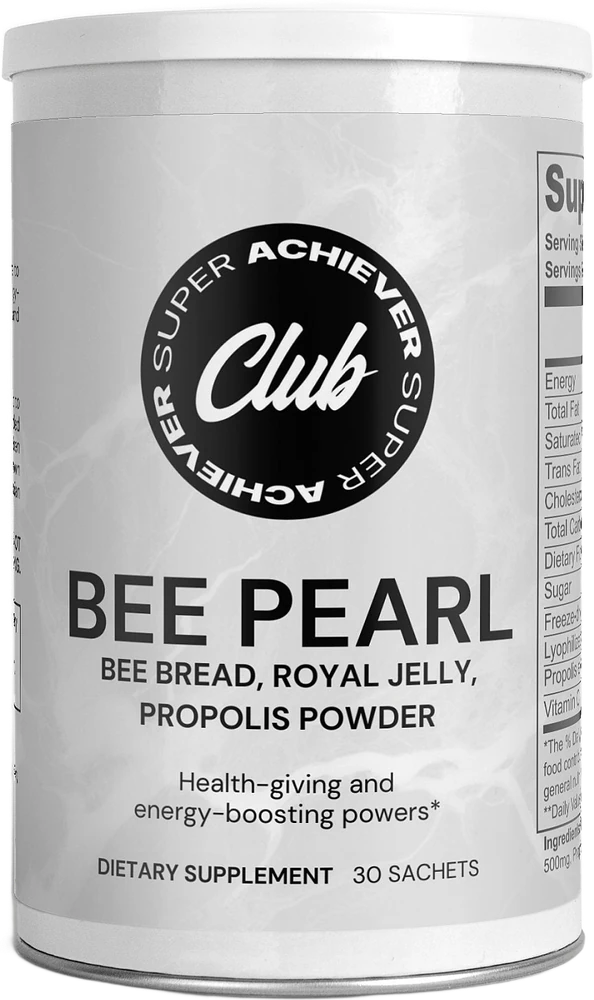
Real retailer photo, cut out. Label unedited.
Consider it if you want bee bread, royal jelly and propolis in one daily sachet with every amount printed. There is no 10-HDA figure, no residue test, and it costs $1.50 a day.
$45$1.50 / sachet · 30 sachets
Why It Scores 6.8 — And The Label Line Behind Each Number
Source purity & freshness
30% of scoreFreeze-dried bee bread and lyophilized royal jelly with no fillers on the ingredient list, and the country of origin is stated. Our method prefers fresh royal jelly to freeze-dried powder, which keeps this below the top marks.
- Per serving
- 2,500 mg freeze-dried bee bread + 500 mg lyophilized royal jelly + 500 mg propolis extract powder + 12 mg vitamin C, 1 sachet (4 g)
- Made in
- Latvia
Active content (10-HDA / propolis / pollen)
25% of scoreEach component has its amount printed: 2,500 mg, 500 mg and 500 mg. The royal jelly has no 10-HDA percentage and the propolis has no extract strength.
Testing & label transparency
20% of scoreThe amounts and the origin are clearly labelled. No pesticide, heavy-metal or contaminant testing is stated on the label or the shop page, and there is no certification.
- Certifications
- None on the label; no residue testing stated
Value per serving
15% of score$45 for 30 sachets is $1.50 a day. The capsule and granule picks on the list cost a fraction of that per serving.
- Price
- $45 · $1.50 per sachet
Real-world use & tolerance
10% of scoreSingle-serve sachets that mix into yogurt or a smoothie. The shop page carries the allergy warning for bee products.
- Format
- Powder sachet
- More Specs
- Box
- 30 sachets
- 10-HDA
- Not stated
- Label
- Supplement Facts panel read Oct 7, 2026
Marketing Claims Vs. Reality
Health-giving and energy-boosting powers
This line is on the front of the box. Controlled human evidence for bee bread and royal jelly is sparse, and none exists for this product.
Concentrated bee bread, propolis and royal jelly
The panel lists all three with their amounts: 2,500 mg, 500 mg and 500 mg per sachet.
One sachet provides the optimal daily intake of vitamins, microelements and antioxidants
This line is from the shop text. The panel declares only vitamin C, at 12 mg or 13% of the Daily Value.
What Our Test Actually Found
The label is better than the evidence
Every amount is printed, which is rare in this category. The research behind bee products is mostly lab work, with propolis for mouth and throat irritation the one use that has repeated controlled trials.
Two numbers are missing
Royal jelly is graded by its 10-HDA content and bee products by residue testing. Neither appears on the label or the shop page.
What would move the score
A stated 10-HDA percentage and a published pesticide and heavy-metal test would lift it into the middle of the list.
Full analysis: all pros & cons (7), buy if / skip if
- Three hive products with each amount printed
- Freeze-dried rather than heat-dried
- Single-serve sachets, origin stated (Latvia)
- Sold direct from our own shop
- No 10-HDA percentage for the royal jelly
- No pesticide or contaminant testing stated
- $1.50 a day, one of the dearest servings on the list
- You want bee bread, royal jelly and propolis together in a daily sachet
- You value a label that prints every amount and the country of origin
- You want to buy direct from the shop behind this site
- You are allergic to bee products or pollen: do not take this
- You want a published 10-HDA figure; BEE&YOU states one
- Price matters; the ranked capsules cost a fraction per day
Bee products concentrate whatever is in the bees' environment, so testing matters, and royal jelly is judged by its 10-HDA content. This product is open about amounts and origin but silent on both of those. The human evidence for bee products is thin outside propolis used in the mouth and throat, which is why a throat spray leads our list.
This is our own product, and we scored it with the same five criteria as every other bee product on our list. Each 4 g sachet holds 2,500 mg of freeze-dried bee bread, 500 mg of lyophilized royal jelly, 500 mg of propolis extract powder and 12 mg of vitamin C, and the panel prints every amount. It is made in Latvia. What the label does not give is a 10-HDA percentage for the royal jelly or any residue testing, and at $1.50 a day it is one of the dearest servings on the list.
Clear about what is inside, quiet about how it is tested

Bee Pearl is an openly labelled blend of three hive products in a convenient sachet. It ranks last because it costs the most per day and states neither a 10-HDA figure nor any residue testing. If you want the bee product with the best evidence, that is propolis for the throat, and the #1 pick covers it for a fraction of the price.
If This Doesn’t Fit — Try These
Beekeeper's Naturals Propolis Throat Spray
Propolis for the throat, the one bee-product use with repeated trials.
Stakich Bee Pollen Granules
Raw, unprocessed pollen at a low cost per serving.
BEE&YOU Royal Jelly + Propolis + Bee Pollen
A combination product that states its 10-HDA content.
Quick Answers
Is this your own product?
Yes. Super Achiever Club sells it in our own shop. We scored it with the same five criteria as every other product in this category, and it ranks where that score puts it.
Who should not take it?
Anyone with an allergy to bee products, pollen or bee stings. Bee products can trigger serious allergic reactions.
What is bee bread?
Pollen that bees have packed into the comb with nectar and fermented. Here it is freeze-dried, 2,500 mg per sachet.
Sources & Further Reading
2 peer-reviewed sources, each linked to PubMed
- [1] Kuo 2018 PMID 30022350 — Meta-analysis of randomized controlled trials of the efficacy of propolis mouthwash in cancer therapy-induced oral mucositis. Pooling 5 RCTs (209 participants), propolis mouthwash significantly lowered the incidence of severe oral mucositis versus control (OR 0.35, p=0.003). Meta-analytic confirmation that propolis-in-the-mouth is the one bee-product use with replicated controlled support.
- [2] Šedivá 2018 PMID 30544571 — 10-HDA, a major fatty acid of royal jelly, exhibits pH dependent growth-inhibitory activity against different strains of Paenibacillus larvae. Laboratory study identifying 10-HDA as a major fatty acid of royal jelly with antibacterial activity in vitro. It shows why 10-HDA is used as the quality marker; it is not a clinical trial.
Affiliate disclosure: every Amazon link uses our Associates tag (superachieverclub-20). We earn a small commission at no cost to you; it funds independent reviews. We never accept payment to change a ranking.