
Nutricost Zinc Gluconate 50 mg Review
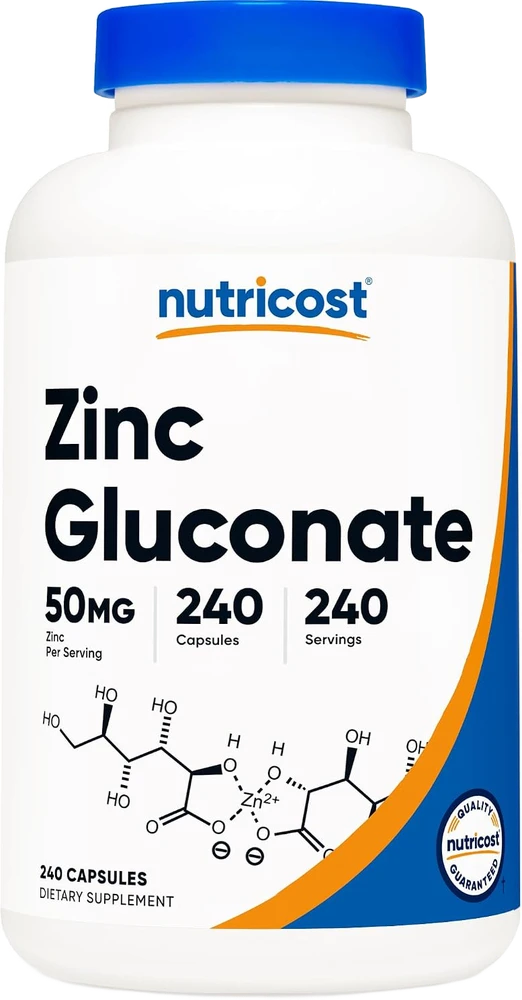 #9 of 10 · Budget 50 mg Gluconate✓ Label verified · Supplement Facts read Oct 18, 2026
Real retailer photo, cut out. Label unedited.
Consider it. A low-cost 50 mg zinc gluconate in a plain capsule, but the dose is above the 40 mg adult limit with no end date on the label, the panel declares no copper, and the testing claim names no lab. The same brand's picolinate has the same dose in a better form.
$14.95 / 240 capsules (240 servings · 240 days at one a day)~$0.06 / 50 mg capsule (about 12.5 cents per 100 mg of zinc)
Why It Scores 7.0 — And The Label Line Behind Each Number
Form bioavailability
30% of scoreZinc gluconate, printed as such on the panel. It sits in the same band as Nature Made's gluconate (6.0): better than oxide, below the picolinate and bisglycinate chelates, which we scored 9.0 to 9.5 (Solgar 9.0, Nutricost picolinate 9.5). The panel states the form clearly; it is simply the weaker form.
- Active form
- Zinc gluconate, printed on the panel as Zinc (as zinc gluconate)
Dose accuracy + cofactor compatibility
25% of score50 mg of zinc per capsule, 455% DV, so it is the zinc itself and not the weight of the salt. That is above the 40 mg adult upper limit, the label says one capsule daily with no end date, and the panel declares no copper. The dose and the cofactor picture are the same as Nutricost's picolinate (6.5), and weaker than Nature Made's 30 mg tablet (8.5), which sits inside the limit. A capsule cannot be cleanly split, so the dose stays at 50 mg.
- Per serving
- 50 mg zinc, 455% DV, per 1 capsule (one active line; the 455% confirms the zinc itself)
- Dose vs upper limit
- 50 mg per capsule is above the 40 mg a day Tolerable Upper Intake Level for adults; the label gives no end date
- Copper
- The panel declares no copper; zinc is the only active line
Third-party testing
20% of scoreThe back label prints Third Party Tested and the bottle frame shows a GMP Compliant Facility seal. No lab is named, the product page links no certificate of analysis, and neither NSF Certified for Sport nor NSF/ANSI 173 lists a Nutricost product (searched October 18, 2026). That is a plausible claim with no paper trail. It scores below Nature Made (9.0), which prints a USP Verified seal on its label, and below Solgar (8.0) and Nutricost's picolinate (7.5), whose testing we have not confirmed at a certifier either.
- Testing
- Third Party Tested printed on the back label; no lab named; no certificate of analysis on the product page; no Nutricost product in the NSF Certified for Sport or NSF/ANSI 173 listings (checked October 18, 2026)
- Certifications
- None verified. Printed seals: Vegetarian Product, GMP Compliant Facility, Non-GMO, Gluten-Free, Nutricost Quality Guaranteed. No NSF, USP or Informed mark.
Cost per active mg
15% of score$14.95 for 240 capsules on Oct 18, 2026: about 6 cents a capsule, about 12.5 cents per 100 mg of zinc. Per milligram that is well under half of Nature Made's $0.08 for a 30 mg tablet on the list (9.5), and close to Nutricost's picolinate, which the list prices at $0.05 a capsule (10.0). We kept it a notch under the picolinate.
- Price
- $14.95 for 240 capsules = about $0.06 per capsule (Amazon US, October 18, 2026)
- Cost per 100 mg
- About 12.5 cents per 100 mg of zinc
Real-world response evidence
10% of score50 mg is at the top of the 30-50 mg range the list cites from the acne literature, so the dose is in the studied window. The form is gluconate, which we scored level with Nature Made (7.0), and below Nutricost's picolinate (7.5). The label asks for water, not a meal, and zinc on an empty stomach is a common cause of nausea. We have no bottle-specific tolerance data.
- Suggested use
- 1 capsule daily with 8-12 oz of water or as directed by your healthcare professional; for healthy individuals 18 years and older (back label)
- Other ingredients
- Hypromellose (cellulose) capsule, rice flour, magnesium stearate (vegetable source)
- More Specs
- Bottle
- 240 capsules · 240 servings · 240 days at one capsule a day
- Manufacturer
- Nutricost, Vineyard, UT; made and quality tested in the USA with globally sourced ingredients
Label verified. Every figure read from the Supplement Facts photo, Oct 18, 2026.
Marketing Claims Vs. Reality
50 mg of zinc per capsule.
The panel lists Zinc (as zinc gluconate) 50 mg per capsule, 455% DV. The percentage matches 50 mg of zinc against the Daily Value, so the figure is the zinc itself, not the weight of the gluconate.
240 servings of zinc gluconate per bottle.
The panel prints a serving size of 1 capsule and 240 servings per container, and the front of the bottle says 240 capsules and 240 servings.
Third Party Tested.
Printed on the back label, and Nutricost's product page says an independent, accredited lab tests its products. No lab is named, no certificate is linked, and we found no Nutricost product in the NSF Certified for Sport listing or the NSF/ANSI 173 listings (searched October 18, 2026).
Non-GMO and gluten free.
Both are printed on the back label and the bottle frame, but no certifier mark such as the Non-GMO Project is shown. Zinc gluconate itself contains no gluten, and the capsule ingredients are hypromellose, rice flour and a vegetable stearate, so the claim is plausible.
Manufactured in a GMP compliant, FDA registered facility (Amazon bullet).
The GMP Compliant Facility seal is on the bottle frame and the FDA-registered wording is on the listing and the brand page. We did not check a GMP audit or an FDA registration; for a US supplement this is a baseline, not a quality signal on its own.
What Our Test Actually Found
One active ingredient, easy to read
The panel has a single line: zinc (as zinc gluconate), 50 mg. There is no blend and no proprietary total to decode. The 455% DV printed next to it is the check that the number is the zinc itself. The other ingredients are the capsule, rice flour and a vegetable magnesium stearate.
The dose is above the limit and the label gives no end date
The 40 mg a day upper limit for adults is a long-term ceiling that counts food as well as supplements. It is not a line where harm starts overnight, but it is the level above which regular intake can begin to lower copper status. This capsule is 50 mg, the back label says take one daily, and the bottle lasts 240 days at that rate. Read honestly: this is a product for a planned, limited stretch, ideally with a clinician and a blood test, and not a set-and-forget everyday zinc.
No copper on the panel
The panel declares no copper. High zinc intake competes with copper for absorption, which is why the list suggests copper on a separate meal for anyone running a high dose for long. This bottle gives you no help with that, and the label does not mention it. If you follow that advice, copper is a separate product.
Testing: printed, not proven
Third Party Tested appears on the back label and on the product page, but neither names a lab or links a certificate. We searched NSF Certified for Sport and NSF/ANSI 173 on October 18, 2026 and found no Nutricost product. The brand's product page also carries a California Proposition 65 notice about chemicals including lead; that is a legal notice with no amount, not a test result, and it is not on the bottle photos we read. Absence from a list is not proof of failed testing; it means there is nothing for us to check. If it matters to you, ask Nutricost for the certificate of analysis for your lot.
Same brand, same dose, a different form from the picolinate
Nutricost's zinc picolinate is a separate bottle with the same 50 mg, the same 240 capsules and the same other ingredients on its panel; only the form differs. If you decided on 50 mg from Nutricost, the picolinate is the better form. The gluconate is the lower-cost route, and gluconate is also the form on Nature Made's pharmacy tablet.
Full analysis: all pros & cons (8), buy if / skip if
- One active ingredient: 50 mg zinc (as gluconate) per capsule
- The 455% DV printed on the panel confirms the zinc figure
- About 12.5 cents per 100 mg of zinc, $14.95 for 240 days
- Vegetarian capsule, three other ingredients, no dyes or sweeteners
- 50 mg is above the 40 mg adult upper limit; the label gives no end date
- The panel declares no copper
- Third Party Tested names no lab and has no NSF listing
- Gluconate sits below picolinate and bisglycinate on the list
- You want a high-dose zinc capsule for a short, planned stretch and the lowest cost per milligram
- You are happy with gluconate and want a plain label: one active line and three other ingredients
- You want a vegetarian capsule and a bottle that lasts 240 days at one a day
- You want a daily zinc for the long run: a 30 mg bottle keeps you inside the 40 mg limit
- You want the better form at the same dose: Nutricost's own picolinate has it
- You want a named lab or an NSF or USP seal behind the testing claim; this bottle has neither
- You take zinc for months without copper or blood tests; this label gives no guidance for that
50 mg of zinc per capsule, about 6 cents each, nothing else active. The label is easy to read and the price is low. What holds the score at 7.0 is the combination: gluconate sits below picolinate and bisglycinate, 50 mg is above the 40 mg upper limit for adults with a label that says one capsule daily and nothing about copper, and the testing claim names no lab. Use it for a defined stretch you have agreed with a clinician, or pick a 30 mg bottle for everyday use.
Nutricost Zinc Gluconate is one ingredient in a capsule. The Supplement Facts panel lists a single line: zinc (as zinc gluconate), 50 mg per capsule, printed as 455% of the Daily Value, and the bottle holds 240 servings. The Amazon offer we checked on October 18, 2026 was $14.95, which is about 6 cents a capsule and about 12.5 cents per 100 mg of zinc. The back label prints Third Party Tested, but it names no lab, and we found no Nutricost product in the NSF Certified for Sport or NSF/ANSI 173 listings. The zinc is what the front says it is. The things to weigh are the dose, which sits above the 40 mg adult upper limit while the label says to take one capsule daily with no end date, the absence of copper on the panel, and the form: gluconate scores like Nature Made's, below the picolinate and bisglycinate picks. Nutricost's own picolinate has the same 50 mg and the same capsule ingredients.
A cheap 50 mg gluconate, but the dose needs a plan and the form is the weaker one.

Nutricost Zinc Gluconate gives you what the front says: 50 mg of zinc as gluconate, one active ingredient, and a plain label. At about 6 cents a capsule the price is low, and for a defined stretch of higher-dose zinc it does the job. What holds the score at 7.0 is what the label cannot show and what the dose asks of you. Fifty mg is above the 40 mg adult upper limit, the back label says one capsule daily with no end date, and the panel declares no copper. The testing claim names no lab, and we could not find the product at NSF. And gluconate is the weaker form: Nutricost's own picolinate, which we scored 8.2, has the same dose and the same capsule ingredients. Pick the gluconate for the price and a planned short course, not for a better zinc. For everyday use, a 30 mg bottle keeps you inside the limit.
If This Doesn’t Fit — Try These
Nutricost Zinc Picolinate 50 mg
The same brand, the same 50 mg and 240 capsules, in picolinate, the form the list ranks higher.
NOW Foods Zinc Glycinate 30 mg
Zinc bisglycinate at 30 mg in a softgel: a daily dose inside the 40 mg limit, in a better form, with NOW's own in-house testing.
Nature Made Zinc 30 mg
Also gluconate, at 30 mg, with a USP Verified seal on the label.
Quick Answers
How much zinc is in one Nutricost Zinc Gluconate capsule?
The Supplement Facts panel lists Zinc (as zinc gluconate) 50 mg per capsule, printed as 455% of the Daily Value. The 455% is the check that 50 mg is the zinc itself and not the weight of the gluconate salt. A serving is one capsule and the bottle holds 240 servings.
Isn't 50 mg a day above the safe limit?
It is above the 40 mg a day Tolerable Upper Intake Level for adults, which counts zinc from food and supplements together. That limit is set on long-term intake, because years of high zinc can lower copper status, so one day or one short course above it is not the same as a daily habit. The back label says to take 1 capsule daily, with no end date and no mention of copper. At that rate one bottle is 240 days. We would treat this as a bottle for a defined stretch chosen with your doctor, not as an everyday floor.
Does this product contain copper?
No. The panel lists only zinc, and the other ingredients are the capsule, rice flour and magnesium stearate. High zinc competes with copper for absorption, which is why the list suggests copper on a separate meal if you take this much for long. If you add copper, that is a second product with its own label.
Is Nutricost Zinc Gluconate third-party tested?
The back label prints Third Party Tested, and the Nutricost product page says an independent, accredited lab tests its products. Neither names the lab, and the page links no certificate of analysis. We searched the NSF Certified for Sport listing and the NSF/ANSI 173 listings on October 18, 2026 and found no Nutricost product in either. So the claim is plausible, but we could not verify it at any certifier.
Gluconate or picolinate: which one should I buy?
If you want 50 mg from Nutricost, the same brand's zinc picolinate has the same dose and the same capsule ingredients on its label, in a form the list ranks higher. The gluconate is the cheaper-per-milligram route, and gluconate is also the form on Nature Made's pharmacy tablet. If you want a daily dose inside the 40 mg limit, a 30 mg product is the better fit than splitting a 50 mg capsule.
Sources & Further Reading
2 peer-reviewed sources, each linked to PubMed
- [1] Maares & Haase 2020 PMID 32183116 — A guide to human zinc absorption: general overview and recent advances of in vitro intestinal models. Catalogues bioavailability by zinc form: bisglycinate and picolinate consistently outperform sulfate and gluconate, which both outperform oxide by roughly 2×. The reference paper for form-selection in supplemental zinc — the foundation of the 'bisglycinate ≈ picolinate > citrate >> oxide' hierarchy.
- [2] Cervantes 2019 PMID 29193602 — The role of zinc in the treatment of acne: A review of the literature. Comprehensive review of zinc-in-acne RCTs: 30-50 mg elemental zinc daily reduced inflammatory acne lesion counts comparable to low-dose oral antibiotics across multiple trials, without antibiotic-resistance risk. The reference review for zinc's skin/looksmaxxing mechanism.
Affiliate disclosure: every Amazon link uses our Associates tag (superachieverclub-20). We earn a small commission at no cost to you; it funds independent reviews. We never accept payment to change a ranking.