
Top 8 Best Green Tea Extract Supplements (2026)
 01 · Best overall✓ Label verified · Supplement Facts read Aug 27, 2026
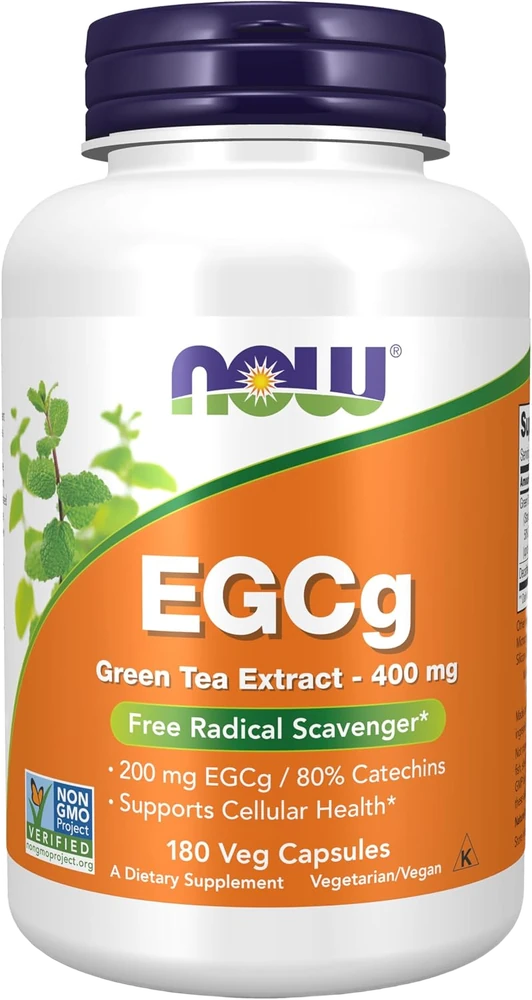
Best overall: NOW Foods EGCg Green Tea Extract 400 mg
A non-GMO-verified, well-tested extract delivering ~200 mg of EGCG with low caffeine per capsule, and a fully honest label. The sane, easy-to-dose default — taken with food.
Strong value — trusted brand, 180-countLow cost per active mg (180 ct, 1 cap/day)
Why it wins: all four scores, pros & cons, full label
- NOW's respected QC: Non-GMO Project Verified, GMP, vegan — at a fair price
- Honest, complete label — EGCG mg, catechin %, and caffeine all disclosed
- ~200 mg EGCG per cap with very low caffeine — a sane dose that's easy to take safely with food
- 180-count bottle makes the cost per active mg genuinely low
- ~200 mg EGCG is a moderate (not maximal) dose — by design, the safer choice
- Single, simple capsule — no decaf-vs-caffeinated choice within this SKU
- EGCG per serving
- ~200 mg EGCG (1 cap; 400 mg extract @ 50% EGCG, 80% catechins)
- Caffeine
- Low — up to ~4 mg per capsule (naturally occurring)
- Size
- 180 veg capsules (180 servings)
- Quality
- Non-GMO Project Verified, GMP, vegan, soy-free

Our take — If you want one green tea extract and you want it to be the safe, sensible choice, NOW's EGCg 400 mg is it. You get ~200 mg of EGCG with very low caffeine per capsule — a well-studied, easy-to-dose amount — from a brand whose Non-GMO-verified, GMP-backed QC is among the most trusted in the category, and the label honestly states the EGCG, catechin %, and caffeine so you can dose safely. It's not the highest-EGCG capsule here, and that's deliberate: a moderate dose taken with food is exactly the profile that keeps the rare liver risk rare. As an honest fat-loss adjunct on top of a calorie deficit — with caffeine and around training — it's the best-made, safest-to-dose option, which is why it's #1.
 02
 03
 04
 05
 06
 07
 08
Who Wins Which Aspect
Sorted by overall SAC Product Score™ — the official ranking.
| # | Pick | Score | EGCG standardization & dose35% | Purity & third-party testing30% | Safety & caffeine clarity20% | Value (cost per active mg)15% | Buy |
|---|---|---|---|---|---|---|---|
| 01 | | 9.0 | 8.82 | 9.21 | 9.21 | 8.81 | Check price |
| NOW's respected QC: Non-GMO Project Verified, GMP, vegan — at a fair price~200 mg EGCG is a moderate (not maximal) dose — by design, the safer choice | |||||||
| 02 | | 8.8 | 9.01 | 9.02 | 9.02 | 7.8 | Check price |
| Strong standardization — 725 mg extract at 98% polyphenols / 45% EGCG (~285 mg EGCG)Premium price — among the higher cost-per-active-mg picks | |||||||
| 03 | | 8.4 | 8.43 | 8.4 | 8.4 | 8.23 | Check price |
| ~250 mg EGCG per capsule at 50% EGCG / 95% polyphenols — a sensible, well-standardized doseBrand QC is good but not at the NOW / Life Extension tier | |||||||
| 04 | | 8.2 | 8.2 | 8.4 | 8.0 | 8.23 | Check price |
| Clean standardization — 95% polyphenols / 75% catechins / 45% EGCG (~225 mg EGCG)90-count bottle is a smaller supply than the value leaders | |||||||
| 05 | | 8.2 | 7.8 | 8.63 | 8.0 | 8.62 | Check price |
| Water-extracted (not solvent/acetone) from a long-respected supplement brandLower EGCG content than the high-standardization picks — a milder effect | |||||||
| 06 | | 7.9 | 7.4 | 8.4 | 8.83 | 7.0 | Check price |
| Highest standardization on the list — 98% standardized, ~450 mg EGCG per capsule~450 mg EGCG in one capsule is a high bolus — take with food and don't add a second cap | |||||||
| 07 | | 7.8 | 7.8 | 7.8 | 7.4 | 8.62 | Check price |
| Highly standardized (85% polyphenols / 75% catechins / 45% EGCG per the label) at a budget priceThe full 1800 mg/serving is a high EGCG bolus — read the serving size and don't take it fasted | |||||||
| 08 | | 7.7 | 7.6 | 7.8 | 7.4 | 8.23 | Check price |
| Standardized EGCG extract from an established value brandNo standout feature — no caffeine-control option, no elite testing, no premium standardization headline | |||||||
The Other 7, Ranked
- 02
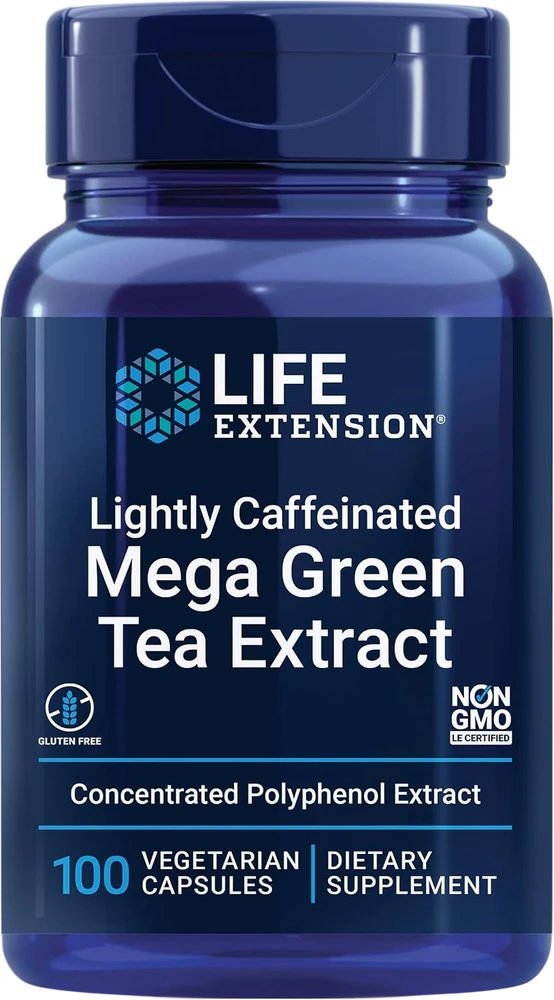
Best lightly caffeinated: Life Extension Mega Green Tea Extract (Lightly Caffeinated)
8.8SAC Score™A 98%/45%-standardized 725 mg extract (~285 mg EGCG) with caffeine clearly stated and a fully decaffeinated version available. The pick when controlling caffeine is the priority.
StrongestEGCG standardization & dose9.01WeakestValue (cost per active mg)7.8- EGCG per serving
- ~285 mg EGCG (1 cap; 725 mg extract @ 98% polyphenols / 45% EGCG)
- Caffeine
- ~25 mg per capsule (a decaffeinated version is sold separately)
- Size
- 100 vegetarian capsules (100 servings)
All four scores, pros & cons, full label
What We Like- Strong standardization — 725 mg extract at 98% polyphenols / 45% EGCG (~285 mg EGCG)
- Caffeine is clearly stated (~25 mg), and a fully decaffeinated SKU exists for sensitive users
- Life Extension's QC reputation is among the most respected in supplements
- Lightly-caffeinated dose pairs the catechin effect with a small caffeine synergy
What You Live With- Premium price — among the higher cost-per-active-mg picks
- 100-count bottle is a smaller supply than the value extracts
- Quality
- Non-GMO, made in USA, established premium-brand QC
Our take — Life Extension's Mega Green Tea Extract is the pick for anyone who wants to control caffeine without giving up a well-standardized dose. The lightly-caffeinated version delivers ~285 mg of EGCG with about 25 mg of caffeine — enough for the catechin-plus-caffeine synergy without coffee-level stimulation — and crucially, a fully decaffeinated SKU exists for sensitive users or late-day dosing. The standardization (98% polyphenols / 45% EGCG) and the brand's QC pedigree are excellent. It sits at #2 only on value: it's a premium price in a smaller 100-count bottle. Take it with food, pick caffeinated or decaf to match your tolerance, and it's an outstanding, honest choice.
- 03
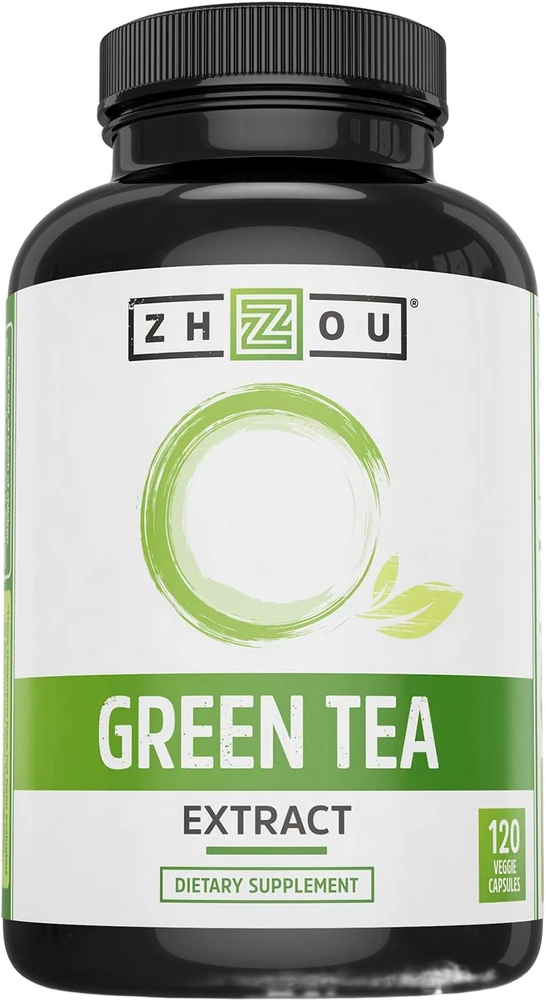
Best with caffeine stated: Zhou Green Tea Extract with EGCG
8.4SAC Score™A clean, popular 500 mg extract delivering ~250 mg EGCG with caffeine clearly stated (~15 mg) and l-theanine context. A well-balanced, transparent mid-list pick.
StrongestEGCG standardization & dose8.43WeakestValue (cost per active mg)8.2- EGCG per serving
- ~250 mg EGCG (1 cap; 500 mg extract @ 50% EGCG, 95% polyphenols)
- Caffeine
- ~15 mg per capsule (clearly stated)
- Size
- 120 veggie capsules (120 servings)
All four scores, pros & cons, full label
What We Like- ~250 mg EGCG per capsule at 50% EGCG / 95% polyphenols — a sensible, well-standardized dose
- Caffeine clearly stated (~15 mg) — easy to factor into your daily total
- Non-GMO, vegan, gluten-free, from a popular and widely-reviewed brand
- 120-count bottle at a fair price — good cost per active mg
What You Live With- Brand QC is good but not at the NOW / Life Extension tier
- Marketing leans on energy/metabolism claims — keep expectations honest
- Quality
- Non-GMO, vegan, gluten-free
Our take — Zhou's Green Tea Extract is a clean, transparent, well-balanced mid-list pick. You get ~250 mg of EGCG per capsule at a solid 50% EGCG / 95% polyphenol standardization, the caffeine is clearly stated at about 15 mg, and the label is non-GMO, vegan and gluten-free — all from a popular brand with lots of real reviews. It lands at #3 because its QC pedigree, while good, isn't quite at the level of the category leaders, and the marketing leans harder on energy and metabolism than the modest evidence warrants. Take it with food, count the small caffeine dose, and it's a sensible, fairly-priced extract that does exactly what it says.
- 04
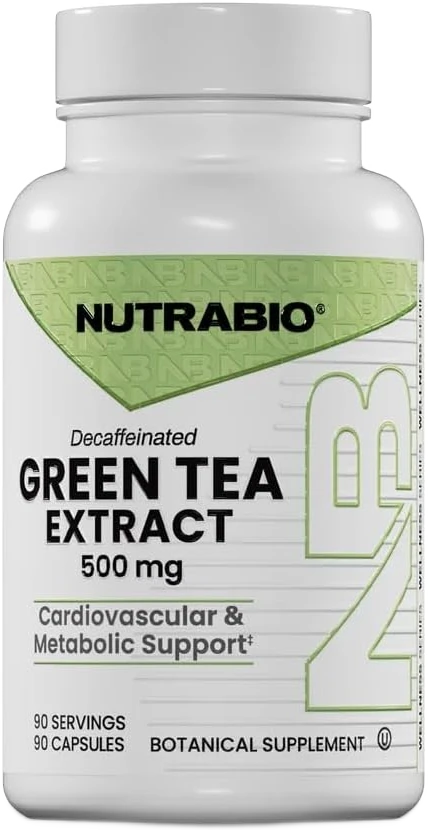
Best standardized value: NutraBio Green Tea Extract 500 mg
8.2SAC Score™A cleanly-standardized 500 mg extract (~225 mg EGCG) from a brand known for transparent, no-proprietary-blend labeling. An honest, well-made mid-list option.
StrongestPurity & third-party testing8.4WeakestSafety & caffeine clarity8.0- EGCG per serving
- ~225 mg EGCG (1 cap; 500 mg extract @ 45% EGCG, 95% polyphenols, 75% catechins)
- Caffeine
- Naturally occurring — read the label
- Size
- 90 capsules (90 servings)
All four scores, pros & cons, full label
What We Like- Clean standardization — 95% polyphenols / 75% catechins / 45% EGCG (~225 mg EGCG)
- NutraBio is known for transparent, no-proprietary-blend labels — you see exactly what's in it
- Sensible ~225 mg EGCG dose — easy to take safely with food
- Made in the USA in a GMP facility
What You Live With- 90-count bottle is a smaller supply than the value leaders
- Caffeine is naturally occurring rather than explicitly headlined — check the label
- Quality
- NutraBio's full-disclosure labeling, made in USA, GMP
Our take — NutraBio's Green Tea Extract is an honest, well-made mid-list pick from a brand that built its reputation on full-disclosure labeling. The standardization is clean (95% polyphenols / 75% catechins / 45% EGCG, about 225 mg of EGCG per capsule), the dose is sensible and easy to take safely with food, and the made-in-USA GMP production is reassuring. It ranks #4 mainly on supply and reach — the 90-count bottle is smaller than the value leaders, and the caffeine is naturally-occurring rather than spotlighted on the front label. If you value a transparent label and a sane EGCG dose over a big bottle, it's an easy, trustworthy choice.
- 05
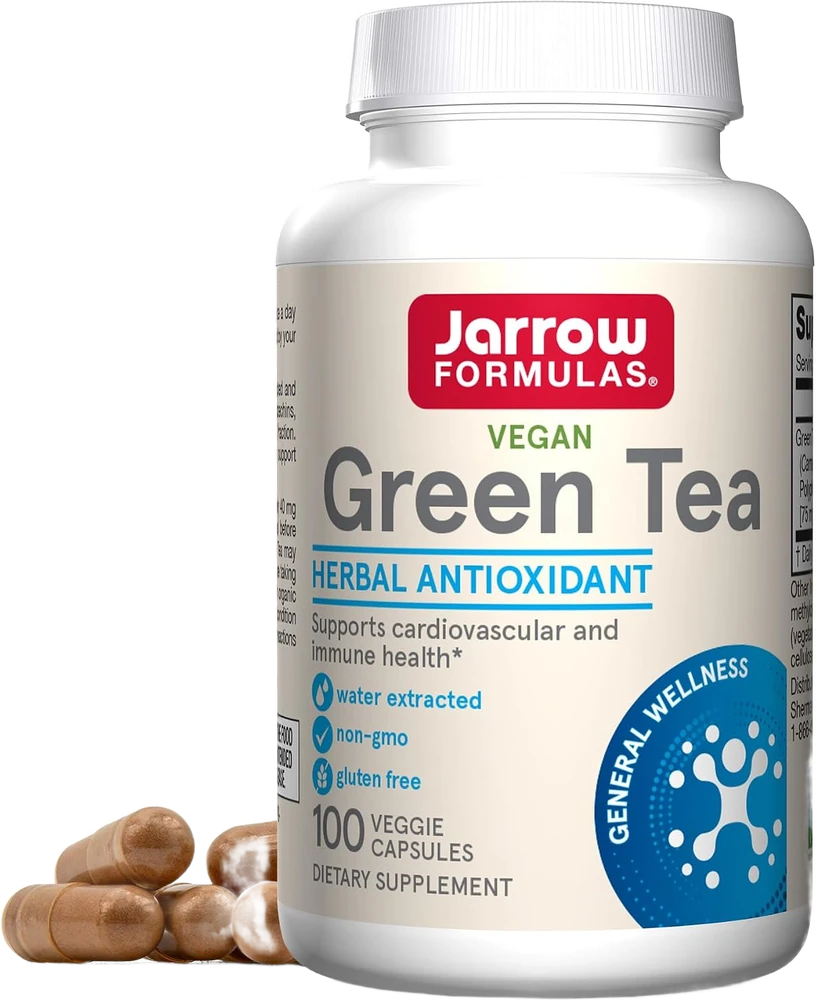
Best gentle / water-extracted: Jarrow Formulas Green Tea 500 mg
8.2SAC Score™A gentle, water-extracted green tea (50% polyphenols) from a respected brand — a lower, milder catechin dose that's a sensible, well-priced entry point. Honest budget buy.
StrongestPurity & third-party testing8.63WeakestEGCG standardization & dose7.8- Extract
- 500 mg water-extracted green tea (50% polyphenols, ~30% catechins)
- EGCG
- Lower EGCG fraction (~15% of catechins) — a gentle dose by design
- Caffeine
- ~40 mg per capsule (water-extracted; read the label)
All four scores, pros & cons, full label
What We Like- Water-extracted (not solvent/acetone) from a long-respected supplement brand
- Gentle, lower catechin dose — a sensible entry point that's hard to overdo
- Non-GMO, gluten-free, with Jarrow's established QC
- 100-count bottle at a strong price — low cost per dose
What You Live With- Lower EGCG content than the high-standardization picks — a milder effect
- Carries more caffeine (~40 mg) than the lightly-caffeinated picks
- Quality
- Water-extracted, non-GMO, gluten-free, cGMP suppliers
Our take — Jarrow's Green Tea is the gentle, water-extracted option and a genuinely sensible budget buy. It's a 500 mg water-extracted green tea at 50% polyphenols / ~30% catechins, which means a lower, milder EGCG dose than the high-standardization capsules — and for the liver-safety conscious, a dose that's hard to overdo is a feature, not a flaw. The brand's QC and water-extraction are reassuring, and the price per dose is strong. It ranks #5 because the lower EGCG means a more modest effect, and it carries a bit more caffeine (~40 mg) than the lightly-caffeinated picks. If you want a gentle, trustworthy, well-priced extract and aren't chasing maximum EGCG, it's an easy, honest choice — taken with food.
- 06
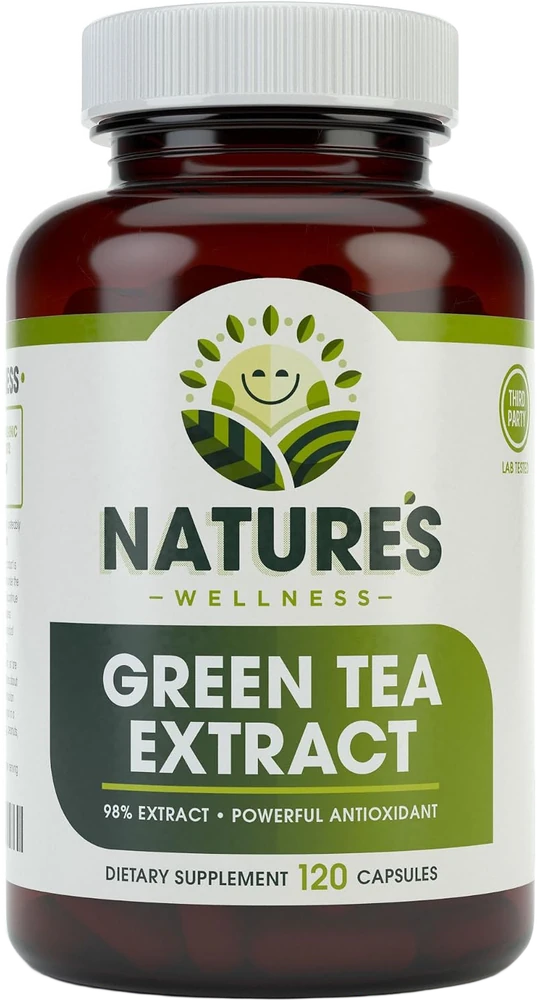
Highest standardization: Nature's Wellness Green Tea Extract 98% Standardized (EGCG)
7.9SAC Score™The highest standardized EGCG per capsule here — 98% standardized, ~450 mg EGCG — third-party lab tested. The max-EGCG pick, with an honest 'take with food, don't double up' caveat.
StrongestSafety & caffeine clarity8.83WeakestValue (cost per active mg)7.0- EGCG per serving
- ~450 mg EGCG (1 cap; 1000 mg extract @ 98% std / 45% EGCG)
- Caffeine
- Naturally occurring — read the label; single-cap bolus
- Size
- Capsule bottle (multi-month supply)
All four scores, pros & cons, full label
What We Like- Highest standardization on the list — 98% standardized, ~450 mg EGCG per capsule
- Third-party lab tested for purity and potency in a GMP facility
- High EGCG per dollar — a lot of active compound per capsule
- Single capsule hits a full studied EGCG dose with no stacking needed
What You Live With- ~450 mg EGCG in one capsule is a high bolus — take with food and don't add a second cap
- Smaller brand — testing transparency is good but not at NOW/Life Extension's tier
- Quality
- Third-party lab tested, made in a GMP-compliant facility
Our take — Nature's Wellness is the pick for someone who specifically wants the maximum standardized EGCG per capsule. At 98% standardization and ~450 mg of EGCG in a single cap, it delivers the most active compound here, it's third-party lab tested, and the cost per active mg is strong. The honest trade-offs are exactly why it ranks #6 rather than #1: a ~450 mg single-capsule bolus is the high end of a sensible daily EGCG intake, so it MUST be taken with food and you should not stack a second high-EGCG capsule on top of it — that's the dosing pattern the liver-safety reviews warn about. And as a smaller brand, its testing transparency, while solid, doesn't match the category leaders. Dose it sensibly and it's a strong, high-potency choice.
- 07
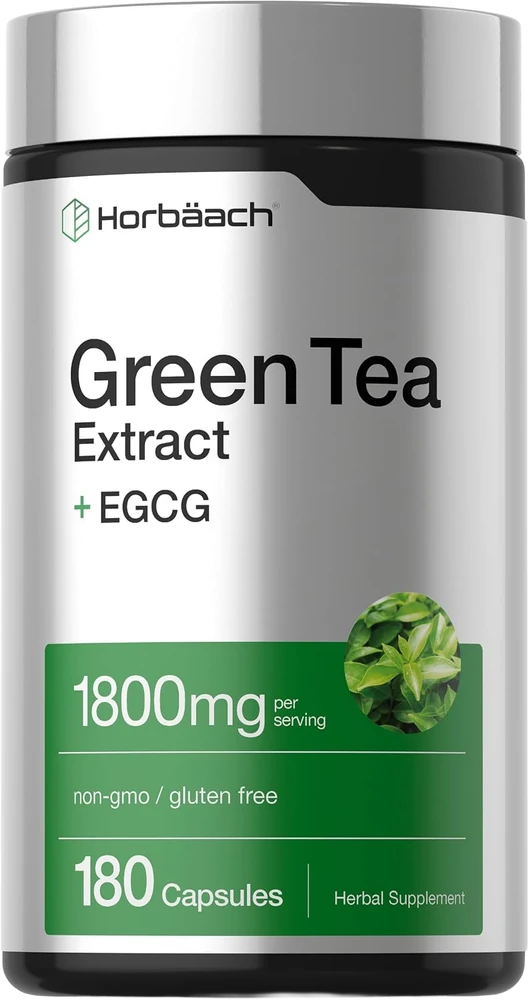
Highest-mg value: Horbäach EGCG Green Tea Extract
7.8SAC Score™A high-mg, value-priced standardized extract (1800 mg/serving, 45% EGCG) in a big 180-count bottle. A lot of EGCG per dollar — with an explicit 'mind the bolus, take with food' caveat.
StrongestValue (cost per active mg)8.62WeakestSafety & caffeine clarity7.4- EGCG per serving
- High — 1800 mg extract/serving @ 45% EGCG (read serving size: multiple caps)
- Caffeine
- Naturally occurring — read the label
- Size
- 180 capsules — large supply
All four scores, pros & cons, full label
What We Like- Highly standardized (85% polyphenols / 75% catechins / 45% EGCG per the label) at a budget price
- Big 180-count bottle delivers the lowest cost per active mg on the list
- Non-GMO and free of common allergens
- Flexible dosing — you can split the serving to control your EGCG intake
What You Live With- The full 1800 mg/serving is a high EGCG bolus — read the serving size and don't take it fasted
- In-house testing transparency is decent but not best-in-class
- Quality
- Non-GMO, gluten-free; Horbäach in-house QC
Our take — Horbäach is the high-mg value play, and an honest one as long as you dose it deliberately. The extract is well standardized (85% polyphenols / 75% catechins / 45% EGCG per the label — the listing's 95% polyphenol figure overshoots the bottle; corrected 27 Aug 2026), the 180-count bottle makes the cost per active mg the lowest here, and the label is non-GMO and allergen-friendly. The reason it sits at #7 is precisely the thing that makes it cheap: a full 1800 mg/serving is a high EGCG bolus, so you must read the serving size, take it WITH FOOD, and ideally split it rather than swallowing the whole serving fasted — that high-dose fasted pattern is exactly what the liver-safety reviews caution against. Its in-house testing is good rather than great. For maximum EGCG per dollar from someone who'll dose it sensibly, it works; for a worry-free dose, the moderate picks above are better.
- 08
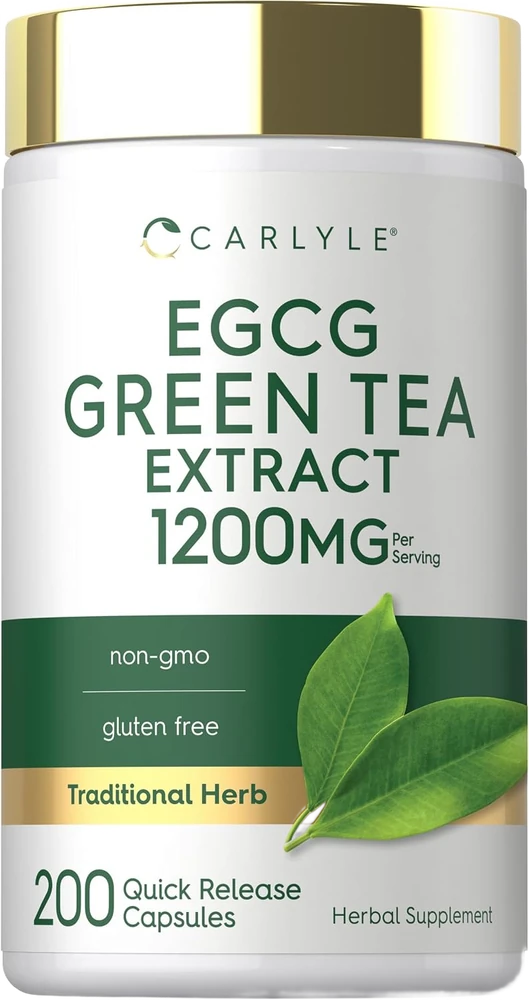
Simple budget EGCG: Carlyle EGCG Green Tea Extract
7.7SAC Score™A simple, no-frills standardized EGCG extract in a big 200-count bottle from an established value brand. Fine and inexpensive — it just brings nothing the higher picks don't do better.
StrongestValue (cost per active mg)8.23WeakestSafety & caffeine clarity7.4- Caffeine
- Naturally occurring — read the label
- Size
- 200 capsules — large supply
- Quality
- Non-GMO, gluten-free; Carlyle (Nature's Truth family) QC
All four scores, pros & cons, full label
What We Like- Standardized EGCG extract from an established value brand
- Large 200-count bottle keeps the cost per dose low
- Non-GMO and gluten-free, simple clean label
- Widely stocked and inexpensive — an easy grab
What You Live With- No standout feature — no caffeine-control option, no elite testing, no premium standardization headline
- Testing transparency is decent but not best-in-class
- Form
- Standardized EGCG green tea extract capsules
Our take — Carlyle is a perfectly fine, inexpensive, no-frills EGCG extract — it just doesn't do anything better than the picks above it, which is why it rounds out the list at #8. The label is clean and allergen-friendly (non-GMO, gluten-free), the 200-count bottle keeps the per-dose cost low, and the brand (part of the Nature's Truth family) is established and widely stocked. The knocks are simply about lacking an edge: no decaf/caffeine-control option, no elite third-party testing pedigree, and no standout standardization story. If you find it cheap and want a straightforward EGCG capsule — taken with food, at a sensible dose — it's a fine buy; for anything specific (caffeine control, max standardization, top-tier QC), one of the higher picks is the better tool.
The Guide In Four Short Lessons
What the evidence actually shows (and the safety ceiling)
- ~1.3 kg
- Mean weight change with green tea catechins in Hursel 2009's meta-analysis — modest, and stronger with caffeine
- + caffeine
- The catechin fat-oxidation effect is clearest WITH caffeine and exercise — not from EGCG alone
- 800 mg
- EGCG/day — EFSA's flagged threshold above which catechins raise a liver-safety concern; don't megadose
- With food
- Take green tea extract WITH FOOD, not fasted — fasted high-dose EGCG is where rare liver injury clusters
Sources: Hursel 2009 (PMID 19597519; catechins + body weight meta-analysis); Hu 2018 (PMID 29580974; GTE safety systematic review); Isomura 2016 (PMID 27188915; liver-related safety of GTE in RCTs).
Take it with food and stay under 800 mg of EGCG a day.
Rare liver injury clusters at large doses on an empty stomach, and EFSA flagged 800 mg of EGCG a day and above as a safety concern. Never megadose.
Find the EGCG number on the label.
Products that hide EGCG behind a big 'extract mg' are penalized. You want the EGCG, the catechin percentage and the caffeine all stated.
Expect about 1.3 kg, not a fat burner.
That is the pooled effect of green tea catechins across 11 studies (Hursel 2009), stronger with caffeine. It is an adjunct to a calorie deficit.
Evidence from Hursel 2009 (PMID 19597519), Hu 2018 (PMID 29580974), and Isomura 2016 (PMID 27188915); ranked on EGCG standardization & dose (35%), purity & third-party testing (30%), safety & caffeine clarity (20%), and value per active mg (15%).
Each pick was scored 0-10 across four criteria, then weighted to a final composite. EGCG standardization and dose carries the most weight (35%) because EGCG is the active compound — and we reward an HONEST, sane dose (clear EGCG mg, sensible per-serving amount), not a giant 'extract mg' that hides a megadose or buries the real EGCG number. Purity and third-party testing (30%) is next: extract quality varies enormously, so a COA, third-party lab testing, or an established brand's QC is what separates a trustworthy product from an anonymous one. Safety and caffeine clarity (20%) is unusually important for this category specifically because of the liver risk: we score up products that disclose both EGCG and caffeine and whose dose is sensible to take with food, and score down products that invite fasted high-dose use. Value (15%) is cost per active mg of EGCG. We do not invent numbers; the only clinical figures we cite are the published meta-analysis and safety reviews, and we state both the modest effect and the EFSA liver-safety flag plainly.
EGCG standardization & dose · 35%
How much actual EGCG is in a serving, how clearly it's standardized (e.g. '98% polyphenols / 45% EGCG'), and whether the per-serving dose is sane. We reward clear EGCG-mg labeling and a sensible dose; we penalize a big 'extract mg' that hides the real EGCG number or pushes toward a megadose. EGCG, not 'green tea extract', is the active part.
Purity & third-party testing · 30%
Label transparency, third-party lab testing or a public COA, non-GMO/vegan status, and an established brand's quality assurance. Extract quality and contaminant control vary a lot across this category, so verification is what separates a clean product from a sketchy one. NOW and Life Extension's QC pedigree scores highly here.
Safety & caffeine clarity · 20%
Because high-dose green tea extract carries a rare liver risk, this matters more than usual. We score up products that disclose BOTH the EGCG mg and the caffeine content, offer a decaf option, and whose dose is sensible to take with food. We score down products that bury caffeine or invite fasted, high-bolus dosing. 'Take with food' is the single most important safety habit.
Value (cost per active mg) · 15%
Price divided by total EGCG in the bottle (capsules × EGCG per capsule), not the sticker price. A big-count, honestly-standardized bottle from a trusted brand can beat a flashier tub on real cost per active mg — but value never overrides a safety or transparency problem.

What green tea extract does in the body (honestly)
- 1
EGCG (with caffeine) nudges fat oxidation
EGCG inhibits the enzyme that breaks down norepinephrine, modestly prolonging its fat-mobilizing signal — an effect amplified by caffeine. The result is a small bump in fat oxidation and energy expenditure. Real, measurable, but small, and clearest WITH caffeine and exercise.
- 2
The weight effect is modest and adjunctive
Pooled across studies (Hursel 2009), green tea catechins were associated with only ~1.3 kg of weight change, moderated by habitual caffeine intake and ethnicity. It's an adjunct to a calorie deficit, not a driver of one — the deficit does the work; EGCG is a nudge.
- 3
At high, fasted doses, a rare liver risk appears
Concentrated EGCG taken in large doses on an empty stomach has been linked to rare idiosyncratic liver injury; EFSA flagged ≥800 mg EGCG/day. Systematic reviews (Hu 2018, Isomura 2016) place the enzyme-elevation signal at high doses and fasted use. Hence: with food, sane dose, no megadosing.
What to honestly expect on green tea extract
A little energy, no dramatic change
With the caffeine and the ritual, some people feel mildly more energetic or alert, especially pre-workout. You will not feel fat 'melting' — that's normal and expected. Confirm it sits well with food and doesn't bother your stomach.
Maybe a small fat-oxidation edge
Paired with caffeine, exercise, and a deficit, EGCG may add a small edge to fat loss. Any scale movement is mostly your diet and training; the extract is a minor contributor. Keep dosing with food and watch your total caffeine.
Decide honestly (and watch for warning signs)
Track weight, waist, and energy. If nothing shifted beyond what diet explains — expected. Keep it only if it fits your routine. Stop immediately and see a doctor if you ever notice dark urine, jaundice, nausea, or unusual fatigue — the rare liver-injury warning signs.
The bottom line
NOW Foods EGCg 400 mg (#1) is the overall winner.
It delivers ~200 mg of EGCG and low caffeine per capsule from a non-GMO-verified, well-tested brand, with the EGCG, catechin %, and caffeine all honestly labeled, at a fair price. It's the safest-to-dose, best-made option.
Pick by need: caffeine control (#2), max EGCG (#6), mid-list or budget below.
Life Extension Mega Green Tea Extract (#2) is the pick to control caffeine (a decaf SKU exists) without giving up standardization; Nature's Wellness 98% (#6) gives the highest EGCG per capsule if you dose it with food and don't double up. Zhou (#3) and NutraBio (#4) are clean mid-list options; Jarrow's water-extracted 500 mg (#5) and Carlyle's 200-count (#8) are honest budget buys; Horbäach (#7) is the most EGCG per dollar.
The real lever is the deficit — take the pill with food, never megadosed.
The effect is modest and clearest with caffeine and exercise, so treat green tea extract as an adjunct to a calorie deficit, not a fat burner. High-dose extract carries a rare liver risk concentrated around big fasted doses above ~800 mg EGCG/day, so take it with food, keep EGCG in a sane range, and see a doctor if you notice dark urine, jaundice, nausea, or unusual fatigue. Sold as a fat burner, or swallowed fasted by the handful, it isn't worth the risk.
Quick Answers
Does green tea extract actually help you lose weight?
Modestly, and the honest answer is 'a little, mostly with caffeine.' The catechin EGCG produces a small bump in fat oxidation and energy expenditure, and the most-cited meta-analysis (Hursel 2009) pooled 11 studies and found green tea catechins were associated with only about 1.3 kg of weight change — an effect that was stronger in people with lower habitual caffeine intake and varied by ethnicity. So green tea extract is a mild adjunct: it can nudge fat loss a bit when paired with caffeine and exercise, but it won't override your calorie balance. Real fat loss comes from a sustained calorie deficit; EGCG is a small helper on top.
Is green tea extract safe for your liver?
For most people at sensible doses taken with food, yes — but there's a real caveat you shouldn't ignore. High-dose green tea extract has been linked to RARE but genuine liver injury (idiosyncratic hepatotoxicity). The risk rises with large bolus doses, dosing on an EMPTY STOMACH, and total intakes above roughly 800 mg of EGCG per day — a threshold European food-safety regulators (EFSA) specifically flagged in 2018. Systematic reviews of the safety data (Hu 2018; Isomura 2016) found liver-enzyme elevations clustered at high doses and fasted dosing. The practical rules: take it WITH FOOD, keep your daily EGCG in a sane range (most people do fine with a few hundred mg), don't megadose, and stop and see a doctor if you ever notice dark urine, jaundice, nausea, or unusual fatigue.
How much EGCG should I take, and how do I read the label?
Read the EGCG milligrams, not the 'green tea extract' milligrams — they're very different numbers. A 1,000 mg extract standardized to 45% EGCG delivers about 450 mg of EGCG; a 400 mg extract at 50% EGCG delivers about 200 mg. For the modest fat-oxidation effect, a few hundred mg of EGCG per day (with caffeine, with food) is a reasonable, well-studied range. Don't chase a bigger number: EFSA flagged 800 mg EGCG/day and above as a liver-safety concern, so stacking multiple high-EGCG capsules is the wrong move. The honest label gives you three things — the extract mg, the standardized EGCG %, and the caffeine content — so you can dose both effectively and safely.
Should I take it on an empty stomach for better absorption?
No — and this is the most important safety point on the page. While fasted dosing can raise EGCG blood levels, that's exactly the scenario where the rare liver-injury cases cluster, and it's why EFSA and multiple safety reviews single out empty-stomach, high-dose use as the risk case. The small absorption gain is not worth the elevated (if still rare) hepatic risk. Take your green tea extract WITH FOOD. You'll still get the modest catechin effect, and you meaningfully lower the chance of trouble.
How much caffeine is in green tea extract supplements?
It varies a lot, which is why caffeine labeling matters. Some extracts are decaffeinated; lightly-caffeinated ones run around 25 mg of caffeine per serving (about two-thirds of a cup of brewed green tea); and some standardized high-potency capsules carry naturally-occurring caffeine you should read off the label. Because the catechin fat-oxidation effect is clearest WITH caffeine, a little caffeine is arguably a feature — but if you're caffeine-sensitive, dosing in the afternoon, or already drinking coffee, pick a decaffeinated or clearly-labeled lightly-caffeinated extract and keep an eye on your total daily caffeine.
Is green tea extract better than just drinking green tea?
They serve different purposes. A cup of brewed green tea delivers a gentle, modest dose of catechins along with hydration and l-theanine, and it's essentially impossible to overdo — it's the safest way to get EGCG. An extract concentrates the EGCG into a single capsule, which makes it easy to hit a studied dose but also makes it easy to OVERDO, and it removes the natural buffering of a slowly-sipped beverage. If you mainly want the wellness and antioxidant angle with zero risk, brewed tea wins. If you specifically want a measured EGCG dose as a fat-loss adjunct, an extract is more practical — just respect the safety rules (with food, sane dose, watch the caffeine).
If the effect is modest, is green tea extract worth taking at all?
It can be, as an honest adjunct — not a centerpiece. The case for it: EGCG plus caffeine produces a small, real bump in fat oxidation, it's an inexpensive antioxidant, and for some people the mild energy and the 'on-plan' ritual help adherence to a deficit. The case against over-relying on it: the weight effect is small (~1.3 kg in the meta-analysis), it works best only alongside caffeine and exercise, and high doses carry a rare liver risk. So if you take it with food at a sensible EGCG dose, pair it with caffeine and training, and keep your expectations realistic, it's a reasonable small helper. Just don't pay a premium expecting it to do the heavy lifting — the deficit does that.
Every Claim Ranked Above Traces Back To One Of These
3 peer-reviewed sources, each linked to PubMed
- [1] Hursel 2009 PMID 19597519 — The effects of green tea on weight loss and weight maintenance: a meta-analysis. Meta-analysis of 11 studies: green tea catechins (typically with caffeine) were associated with a statistically significant but MODEST mean weight change of about −1.3 kg, and the effect was moderated by habitual caffeine intake and ethnicity (smaller in high-caffeine consumers). This is the most-cited human evidence for green tea and weight, and it shows a small adjunctive effect — not dramatic fat loss, and clearest alongside caffeine.
- [2] Hu 2018 PMID 29580974 — The safety of green tea and green tea extract consumption in adults — Results of a systematic review. Systematic review of green tea / green tea extract safety in adults: while green tea is generally safe, the review found that liver-related adverse effects (elevated transaminases, rare hepatotoxicity) were associated with high-dose green tea extract, particularly bolus catechin doses taken on an empty (fasted) stomach. Supports the practical guidance to take extracts WITH FOOD, keep EGCG doses moderate, and avoid high fasted intakes — the basis of this page's liver-safety warning.
- [3] Isomura 2016 PMID 27188915 — Liver-related safety assessment of green tea extracts in humans: a systematic review of randomized controlled trials. Systematic review of randomized controlled trials assessing liver-related safety of green tea extracts: liver-enzyme elevations were uncommon overall but clustered at higher EGCG doses, reinforcing a dose-dependent hepatic signal. Consistent with EFSA's later conclusion that catechin intakes of 800 mg EGCG/day and above raise a liver-safety concern — the rationale for keeping daily EGCG in a sane range and not megadosing.
Affiliate disclosure: every Amazon link uses our Associates tag (superachieverclub-20). We earn a small commission at no cost to you; it funds independent reviews. We never accept payment to change a ranking.