
BioPerine: Benefits, Dosage & Side Effects (2026)
BioPerine is a branded black pepper extract standardized to 95% piperine, added in 5 mg doses to raise absorption of other ingredients.
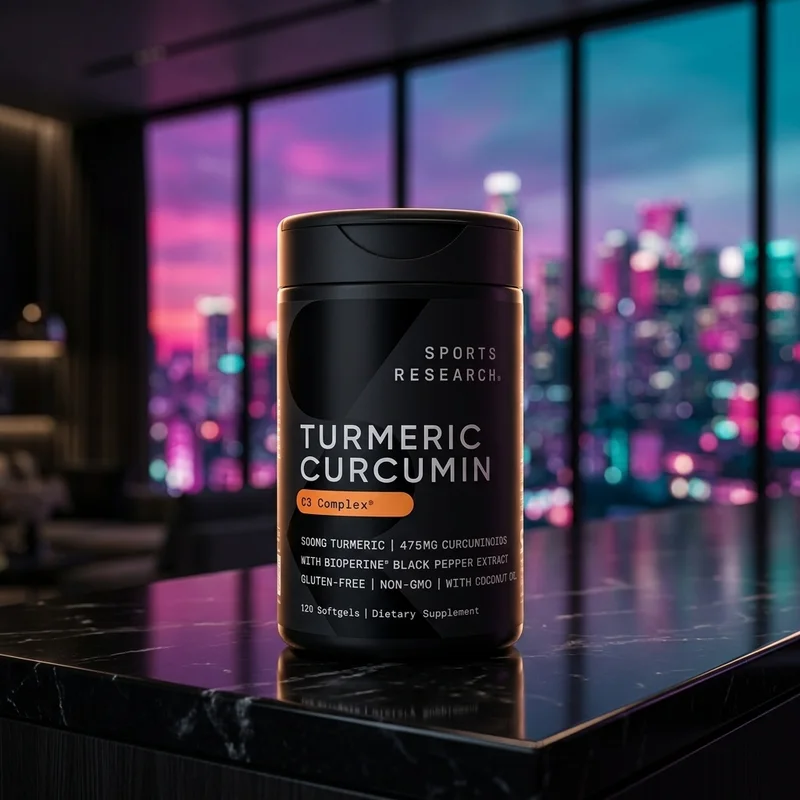
Sports Research Turmeric Curcumin C3 Complex + BioPerine
What is BioPerine?
BioPerine is the brand name of a black pepper fruit extract that Sabinsa Corporation sells to supplement makers as an ingredient. Its active compound is piperine, the alkaloid that gives black pepper (Piper nigrum) its bite (Srinivasan 2007). Labels that carry it describe it as black pepper extract standardized to 95% piperine.
You will rarely buy it on its own. It appears as a small line near the bottom of a Supplement Facts panel, most often next to curcumin, and also in CoQ10, ashwagandha, tongkat ali, creatine blends, pre-workouts and fat burners. On the labels we have verified for this site it is dosed at 2.5 mg or 5 mg per serving.
It is not there for an effect of its own. It is a bioavailability enhancer: an ingredient added so that more of the main ingredient reaches the blood.
How it works
Piperine slows the systems that clear foreign compounds from the body. In rat liver it acted as a nonspecific inhibitor of drug-metabolizing enzymes, including glucuronidation, with enzyme inhibition peaking within an hour and returning to normal within six (Atal 1985). In experiments on human cells and human liver tissue it inhibited both the transporter P-glycoprotein and the enzyme CYP3A4, two major parts of first-pass elimination (Bhardwaj 2002).
THE CURCUMIN RESULT is the reason it became famous. In healthy volunteers, 2 g of curcumin alone left serum levels undetectable or very low. With 20 mg of piperine, levels were much higher for the first hour and bioavailability rose by 2,000% (Shoba 1998). Note the dose: 20 mg is four times the 5 mg found in most capsules.
THE COQ10 RESULT is the one that used a label-sized dose. With 5 mg of piperine, a single dose and 14 days of CoQ10 produced no significant difference. After 21 days of 120 mg CoQ10, the area under the plasma curve was about 30% greater than with placebo (Badmaev 2000). That study came from Sabinsa, the company that sells the ingredient.
IT DOES NOT RAISE EVERYTHING. In a crossover trial, 20 mg of piperine did not change plasma levels of resveratrol or its metabolites, although blood flow in the frontal cortex during mental tasks was higher than with resveratrol alone (Wightman 2014).
At-a-glance facts
- What it is
- Branded black pepper (Piper nigrum) fruit extract, standardized to 95% piperine
- Who makes it
- Sabinsa Corporation; supplement brands buy it as an ingredient
- Typical label dose
- 5 mg per serving, 2.5 mg on some labels (verified labels in our catalog)
- Doses in human studies
- 5 mg with CoQ10, 10 mg a day with curcuminoids, 20 mg with curcumin, resveratrol and in the drug studies
- Best-known result
- Curcumin bioavailability up 2,000% with 20 mg of piperine (Shoba 1998)
- Label-dose result
- About 30% greater CoQ10 exposure after 21 days at 5 mg (Badmaev 2000)
- Where it did nothing
- No change in resveratrol blood levels at 20 mg (Wightman 2014)
- How long it acts
- Enzyme inhibition peaked within 1 hour and was back to normal within 6 hours in rats (Atal 1985)
- Main risk
- Raises blood levels of some drugs: phenytoin, propranolol, theophylline, nevirapine
- Evidence level
- 3 of 5 — the absorption effect is measured in small human studies; the outcome trials test it only together with curcuminoids
Evidence: Small human pharmacokinetic studies show higher blood levels of curcumin, CoQ10 and several drugs when piperine is taken alongside. The size of the effect depends on dose and partner, resveratrol levels did not change, and the clinical trials measure the combination rather than piperine itself.
Who it's for — and who it isn't
- People taking a plain 95% curcuminoid extract, the pairing with the strongest human absorption data
- CoQ10 users who take it daily for three weeks or longer, the only timeframe that showed a difference
- Buyers who want a lower-priced curcumin capsule rather than a branded phytosome form
- Healthy adults who take no prescription medication
- Anyone on prescription medication, above all drugs with a narrow dosing window such as phenytoin, theophylline or propranolol
- People who are pregnant, breastfeeding or trying to conceive; animal studies raised reproductive concerns and human safety data are missing
- Anyone expecting BioPerine to do something by itself; the trials test it as a helper for another ingredient
- People already using a phytosome curcumin, a form built to absorb without piperine
Week-by-week, what happens
- First hourIn the curcumin study the higher blood levels appeared between 15 minutes and 1 hour after the dose (Shoba 1998).
- About 6 hoursIn rats, enzyme inhibition was back to normal six hours after a dose (Atal 1985). Products put piperine in the same capsule as the ingredient it is meant to help.
- Day 21With 5 mg of piperine and 120 mg of CoQ10, a significant difference showed only after 21 days of daily use, not after one dose or after 14 days (Badmaev 2000).
- Week 8The length of the trial in which 1 g of curcuminoids plus 10 mg of piperine a day lowered C-reactive protein in adults with metabolic syndrome (Panahi 2015).
Safety & contraindications
- Drug interactions are the real risk. In human studies, 20 mg of piperine raised blood levels of phenytoin in patients with epilepsy (Pattanaik 2006), of propranolol and theophylline in healthy volunteers (Bano 1991), and of the HIV drug nevirapine, whose peak level rose by about 120% (Kasibhatta 2007). If you take any prescription medication, ask your doctor or pharmacist before using a product that contains it.
- The mechanism is broad. Piperine inhibited P-glycoprotein and CYP3A4 in experiments on human cells and liver tissue (Bhardwaj 2002); both contribute to the first-pass elimination of many oral drugs.
- One reassuring study, with limits. In eight healthy volunteers, a curcuminoid and piperine extract taken four times over two days did not change how the body handled midazolam, flurbiprofen or paracetamol (Volak 2013). That covers short-term use and three test drugs, not every medication.
- Risk assessors are cautious about isolated piperine. Scientists at the German Federal Institute for Risk Assessment reviewed piperine swallowed as a concentrated dose and advised taking the health risks into account, pointing to the drug interactions and to animal findings on sperm production, pregnancy and the embryo at higher doses (Ziegenhagen 2021).
- Pregnancy, breastfeeding and trying to conceive: avoid supplements with added piperine unless your doctor agrees. The animal findings have not been followed up in humans.
- Pepper on food is a different exposure. The concern in the risk review is piperine in isolated, concentrated form swallowed at once, not seasoning.
All articles on BioPerine
Best Curcumin Supplements
Curcumin supplements ranked by bioavailable form first (phytosome / BCM-95 / Longvida / C3 + BioPerine beat raw turmeric), then dose, third-party testing, and cost per absorbed mg.
Read →Doctor's Best High Absorption CoQ10 100 mg with BioPerine Review
CoQ10 vs Ubiquinol audit — form bioavailability, statin-depletion context, and the verdict for the age bracket that needs each.
Read →Doctor's Best High Absorption Curcumin C3 Complex + BioPerine Review
The cheapest curcumin that actually works — same C3 + BioPerine science, half the price.
Read →NusaPure Longjack Tongkat Ali 260,000 mg Review
The 260,000 mg label is extract weight × 200:1 ratio — a marketing manipulation. What it actually delivers + why the label is the red flag.
Read →Nutricost KSM-66 Ashwagandha 600 mg Review
Floor-price legitimate KSM-66 — same Ixoreal patent as Double Wood at $8/mo cheaper. The cycle-one validation pick.
Read →Nutricost Tongkat Ali 1000 mg Review
Six weeks on the cheapest legitimate Tongkat on Amazon — what $15/month at 200:1 with zero standardisation actually delivers.
Read →Pure Encapsulations Curcumin 500 with BioPerine Review
The cleanest standardized-extract label — same C3 + BioPerine, clinician-grade formulation.
Read →Sports Research Turmeric Curcumin C3 Complex + BioPerine Review
The default first-time curcumin pick — real absorption at the best price.
Read →Transparent Labs BULK Pre-Workout Review
The clinically-dosed, fully-disclosed benchmark — dosed to the milligram, no proprietary blends.
Read →Transparent Labs Creatine HMB Review
Creatine monohydrate + 1.5 g myHMB per scoop — where the HMB addition pays off (untrained) vs. doesn't (trained lifters per Wilson 2013).
Read →FAQ
What is BioPerine?
BioPerine is a branded black pepper fruit extract from Sabinsa Corporation, standardized to 95% piperine. Supplement makers add a few milligrams of it to raise the absorption of the main ingredient, most often curcumin.
Is BioPerine the same as piperine or black pepper extract?
Piperine is the compound, black pepper extract is the generic ingredient and BioPerine is one branded version of it. Labels in our catalog show both: some name BioPerine, others list an unbranded black pepper extract standardized to 95% piperine. The human studies used piperine itself (Shoba 1998) or a black pepper extract of at least 98% piperine (Badmaev 2000).
Does BioPerine really increase curcumin absorption by 2,000%?
That number comes from one study in healthy volunteers that gave 20 mg of piperine with 2 g of curcumin (Shoba 1998). Curcumin alone was undetectable or very low in serum, so the percentage is measured against a tiny baseline, and the higher levels were seen during the first hour. Most products contain 5 mg, a dose that study did not test.
How much BioPerine should I take?
There is no established dose for taking it on its own. The verified labels in our catalog carry 2.5 mg or 5 mg per serving, and the human studies used 5 mg to 20 mg alongside another ingredient. Do not add extra piperine on top of what a product already contains; a German risk review advised caution with isolated piperine (Ziegenhagen 2021).
Can I take BioPerine with medication?
Not without asking your doctor or pharmacist. In human studies piperine raised blood levels of phenytoin, propranolol, theophylline and nevirapine (Pattanaik 2006, Bano 1991, Kasibhatta 2007). One short study found no change for three test drugs (Volak 2013), which is not enough to clear every medication.
Do I need BioPerine with curcumin?
Plain curcumin is poorly absorbed, and piperine is one way around that. Phytosome forms such as Meriva are another, designed to absorb without piperine. If you take prescription medication, a piperine-free form is the safer choice. Our curcumin ranking covers both kinds.
Does BioPerine have benefits by itself?
A review of black pepper and piperine describes effects on digestive enzymes and antioxidant activity, most of them from laboratory and animal work (Srinivasan 2007). The human trials cited on this page test piperine alongside another ingredient, so they do not show what it does alone.
Sources & further reading
- Shoba G, et al. Planta Med. 1998;64(4):353-6.Influence of piperine on the pharmacokinetics of curcumin in animals and human volunteers
In healthy volunteers, 2 g of curcumin alone gave undetectable or very low serum levels; adding 20 mg of piperine produced much higher concentrations from 0.25 to 1 hour after the dose and raised bioavailability by 2,000%, with no adverse effects. In rats the increase was 154%.
- Badmaev V, et al. J Nutr Biochem. 2000;11(2):109-13.Piperine derived from black pepper increases the plasma levels of coenzyme Q10 following oral supplementation
A double-blind study from Sabinsa Corporation in healthy adult men: 5 mg of a black pepper extract of at least 98% piperine made no significant difference to coenzyme Q10 levels after a single dose or after 14 days, and gave an approximately 30% greater area under the plasma curve after 21 days of 120 mg coenzyme Q10 (p = 0.0348).
- Bhardwaj RK, et al. J Pharmacol Exp Ther. 2002;302(2):645-50.Piperine, a major constituent of black pepper, inhibits human P-glycoprotein and CYP3A4
In Caco-2 cells and human liver microsomes, piperine inhibited the drug transporter P-glycoprotein and the drug-metabolizing enzyme CYP3A4; the authors conclude that dietary piperine could affect plasma concentrations of drugs handled by these two proteins, in particular drugs taken orally.
- Atal CK, et al. J Pharmacol Exp Ther. 1985;232(1):258-62.Biochemical basis of enhanced drug bioavailability by piperine: evidence that piperine is a potent inhibitor of drug metabolism
In rats, piperine was a nonspecific inhibitor of drug metabolism that inhibited hepatic aryl hydrocarbon hydroxylase and UDP-glucuronyltransferase; after an oral dose, maximal inhibition was seen within 1 hour and activity was back to normal in 6 hours.
- Wightman EL, et al. Br J Nutr. 2014;112(2):203-13.Effects of resveratrol alone or in combination with piperine on cerebral blood flow parameters and cognitive performance in human subjects: a randomised, double-blind, placebo-controlled, cross-over investigation
In 23 adults, 250 mg of resveratrol with 20 mg of piperine increased cerebral blood flow during cognitive tasks compared with placebo and with resveratrol alone, while cognitive function, mood and blood pressure were unaffected and plasma concentrations of resveratrol and its metabolites did not differ between treatments.
- Panahi Y, et al. Clin Nutr. 2015;34(6):1101-8.Antioxidant and anti-inflammatory effects of curcuminoid-piperine combination in subjects with metabolic syndrome: A randomized controlled trial and an updated meta-analysis
In a randomized double-blind trial of 117 adults with metabolic syndrome, 1 g of curcuminoids with 10 mg of piperine a day for eight weeks improved superoxide dismutase activity and reduced malondialdehyde and C-reactive protein compared with placebo. The trial tested the combination, not piperine alone.
- Bano G, et al. Eur J Clin Pharmacol. 1991;41(6):615-7.Effect of piperine on bioavailability and pharmacokinetics of propranolol and theophylline in healthy volunteers
In a crossover study with six subjects per group, 20 mg of piperine daily for 7 days produced a higher peak concentration and a higher area under the curve for both propranolol and theophylline.
- Pattanaik S, et al. Phytother Res. 2006;20(8):683-6.Effect of piperine on the steady-state pharmacokinetics of phenytoin in patients with epilepsy
In 20 patients with epilepsy on steady phenytoin treatment, a single 20 mg dose of piperine significantly increased the area under the curve and the peak concentration of phenytoin.
- Kasibhatta R, Naidu MU. Drugs R D. 2007;8(6):383-91.Influence of piperine on the pharmacokinetics of nevirapine under fasting conditions: a randomised, crossover, placebo-controlled study
In eight healthy men, 20 mg of piperine each morning for 6 days and with the dose on day 7 raised the peak plasma concentration of nevirapine by approximately 120% and the area under the curve by approximately 167% to 170%.
- Volak LP, et al. Br J Clin Pharmacol. 2013;75(2):450-62.Effect of a herbal extract containing curcumin and piperine on midazolam, flurbiprofen and paracetamol (acetaminophen) pharmacokinetics in healthy volunteers
In eight healthy volunteers, 4 g of curcuminoids plus 24 mg of piperine given four times over 2 days produced no meaningful changes in the pharmacokinetics of midazolam, flurbiprofen or paracetamol; the authors conclude that short-term use is unlikely to cause a clinically significant interaction through CYP3A, CYP2C9 or the paracetamol conjugation enzymes.
- Ziegenhagen R, et al. Foods. 2021;10(9):2121.Safety Aspects of the Use of Isolated Piperine Ingested as a Bolus
A review from the German Federal Institute for Risk Assessment: isolated piperine taken as a bolus interacted with several drugs, in most cases increasing their bioavailability, and animal studies at higher doses indicated disturbed spermatogenesis and maternal reproductive and embryotoxic effects. The authors advise considering the potential health risks of isolated piperine in food supplements.
- Srinivasan K. Crit Rev Food Sci Nutr. 2007;47(8):735-48.Black pepper and its pungent principle-piperine: a review of diverse physiological effects
A review describing piperine as the alkaloid behind the bite of black pepper (Piper nigrum), with reported effects on pancreatic digestive enzymes and antioxidant activity from in vitro and experimental studies, and identifying its inhibition of drug-metabolizing enzymes in the liver and intestine as the basis of its bioavailability-enhancing property.