
Super Achiever Ashwagandha (1,300 mg + Black Pepper) Review
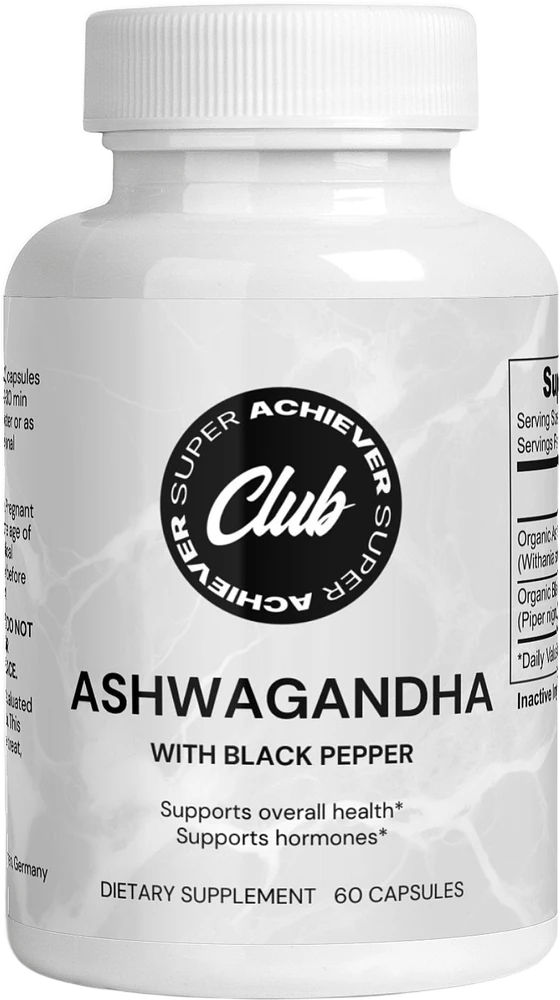 #8 of 8 · Our own brand
Real retailer photo, cut out. Label unedited.
Skip it if you want the effects from the ashwagandha trials: those used standardised extracts. This is organic root powder with black pepper, honestly labelled, with no withanolide figure and no test report.
$29$0.97 / serving · 60 capsules (30 servings)
Why It Scores 4.9 — And The Label Line Behind Each Number
Standardisation
30% of scoreThe panel reads Organic Ashwagandha (Withania somnifera) (root) 1300 mg. It is root powder, not an extract, and no withanolide percentage is printed. KSM-66 is standardised to 5%; this label guarantees none.
- Extract
- None. Organic ashwagandha root powder
- Per serving
- 1,300 mg organic ashwagandha root + 10 mg organic black pepper fruit, 2 capsules
Clinical source
25% of scoreThe trials behind ashwagandha's stress and strength results used standardised extracts, mostly KSM-66 at 600 mg a day (Wankhede 2015, Chandrasekhar 2012). Root is the right plant part, but results from those extracts do not carry over to unstandardised powder.
Lab transparency
20% of scoreThe ingredient line says organic, but the label shows no certifier's seal that we could read, names no manufacturer or lab, and the shop page shows no certificate of analysis.
- Certifications
- None on the label that we could read
- Manufacturing
- Made in the USA per the shop page; the manufacturer is not named
Trial-dose alignment
15% of score1,300 mg of root powder per serving. Without a stated withanolide content the active dose is unknown. The KSM-66 trial dose delivers about 30 mg of withanolides a day.
Price per active mg
10% of score$29 for a 30-day supply. Nutricost's licensed KSM-66 costs about $14 a month with 5% withanolides guaranteed; here the active amount is not stated at any price.
- Price
- $29 · $0.97 per serving
- More Specs
- Standardisation
- None stated; no withanolide percentage on the label
- Bottle
- 60 capsules · 30 servings
- Capsule
- Pullulan
- Label
- Supplement Facts panel read Oct 7, 2026
Marketing Claims Vs. Reality
Supports overall health. Supports hormones.
These lines are on the front label. The hormone and stress findings in the research come from standardised extracts; none of them was measured with unstandardised root powder at this dose.
With black pepper
10 mg of organic black pepper fruit is on the Supplement Facts panel. The label does not state a piperine content.
A powerful adaptogen that helps calm stress levels
This line is from the shop text. Extract trials support a stress effect (Chandrasekhar 2012); this product is not that extract.
What Our Test Actually Found
The label is honest, and that is why the score is low
Many bottles print a large milligram number and hide a weak extract behind it. This one prints exactly what it is: root powder. Our method rewards a guaranteed withanolide content, and root powder cannot give one.
What 1,300 mg of root powder is not
It is not 1,300 mg of extract. A 600 mg serving of 5% KSM-66 guarantees about 30 mg of withanolides. Root powder varies from harvest to harvest and the label states no figure.
What would move the score
A switch to a licensed, standardised extract at the trial dose and a published lab report would put it among the mid-table picks. That would be a different product from the one sold today.
Full analysis: all pros & cons (7), buy if / skip if
- Organic root, the plant part the main trials used
- Black pepper included; short ingredient list
- Every amount is printed on the panel
- Pullulan capsule
- Root powder, not an extract: no withanolide percentage on the label
- The trials behind ashwagandha used standardised extracts
- No third-party certificate or published lab report
- You specifically want traditional whole-root powder, not an extract
- You want organic ingredients in a pullulan capsule
- You want to buy direct from the shop behind this site
- You want the dose the trials used; Nutricost KSM-66 gives 600 mg in one capsule for about $14 a month
- You want the highest stated potency; Toniiq is standardised to 10% withanolides
- You want a published lab report
The stress, sleep and testosterone results people buy ashwagandha for come from standardised extracts, mostly KSM-66 at 600 mg a day. Root powder is the traditional form, and this one is organic and cleanly labelled, but the label cannot tell you how much of the active compounds a serving holds. At $29 a month it also costs about twice the cheapest licensed KSM-66.
This is our own product, and we scored it with the same five criteria as every other ashwagandha on our lists. The Supplement Facts panel reads Organic Ashwagandha (Withania somnifera) (root) 1300 mg, plus 10 mg of organic black pepper, in two capsules. It is root powder, not an extract, and the label gives no withanolide percentage. This category is scored hardest on exactly that, so the bottle ranks last on our list.
An honest root-powder capsule that the evidence does not favour

We would rather say it plainly: by our own criteria this is the weakest ashwagandha on the list. It is organic, cleanly labelled root powder, and the research people cite was done with standardised extracts. If you want what those trials tested, buy one of the KSM-66 picks above. If you want traditional whole-root powder and know the difference, this is an honest version of it.
If This Doesn’t Fit — Try These
Toniiq Ultra High Strength Ashwagandha
Standardised to 10% withanolides with a public certificate of analysis per lot.
Double Wood KSM-66 Ashwagandha 600 mg
Licensed KSM-66 at the 600 mg trial dose.
Nutricost KSM-66 Ashwagandha 600 mg
Licensed KSM-66, 600 mg in one capsule, about $14 a month.
Quick Answers
Is this your own product?
Yes. Super Achiever Club sells it in our own shop. We scored it with the same five criteria as every other product in this category, and it ranks where that score puts it.
Is it KSM-66 or another extract?
No. The panel lists organic ashwagandha root, 1,300 mg, with no extract name and no withanolide percentage. It is root powder.
Why does your own product rank last?
Because the criteria are the same for every bottle. Standardisation and clinical source carry more than half the score, and unstandardised root powder scores low on both.
Sources & Further Reading
3 peer-reviewed sources, each linked to PubMed
- [1] Wankhede 2015 PMID 26609282 — Examining the effect of Withania somnifera supplementation on muscle strength and recovery: a randomized controlled trial. Eight-week randomised trial in 57 young men doing resistance training: 600 mg a day of KSM-66 root extract produced larger strength gains and a larger rise in testosterone than placebo.
- [2] Chandrasekhar 2012 PMID 23439798 — A prospective, randomized double-blind, placebo-controlled study of safety and efficacy of a high-concentration full-spectrum extract of ashwagandha root in reducing stress and anxiety in adults. Randomised, double-blind trial in 64 adults with chronic stress: 600 mg a day of a high-concentration root extract for 60 days lowered serum cortisol and stress scores against placebo.
- [3] Lopresti 2019 (testosterone) PMID 30854916 — A randomized, double-blind, placebo-controlled, crossover study examining the hormonal and vitality effects of ashwagandha (Withania somnifera) in aging, overweight males. Crossover trial in overweight men aged 40 to 70: a standardised ashwagandha extract raised DHEA-S and testosterone against placebo.
Affiliate disclosure: every Amazon link uses our Associates tag (superachieverclub-20). We earn a small commission at no cost to you; it funds independent reviews. We never accept payment to change a ranking.