
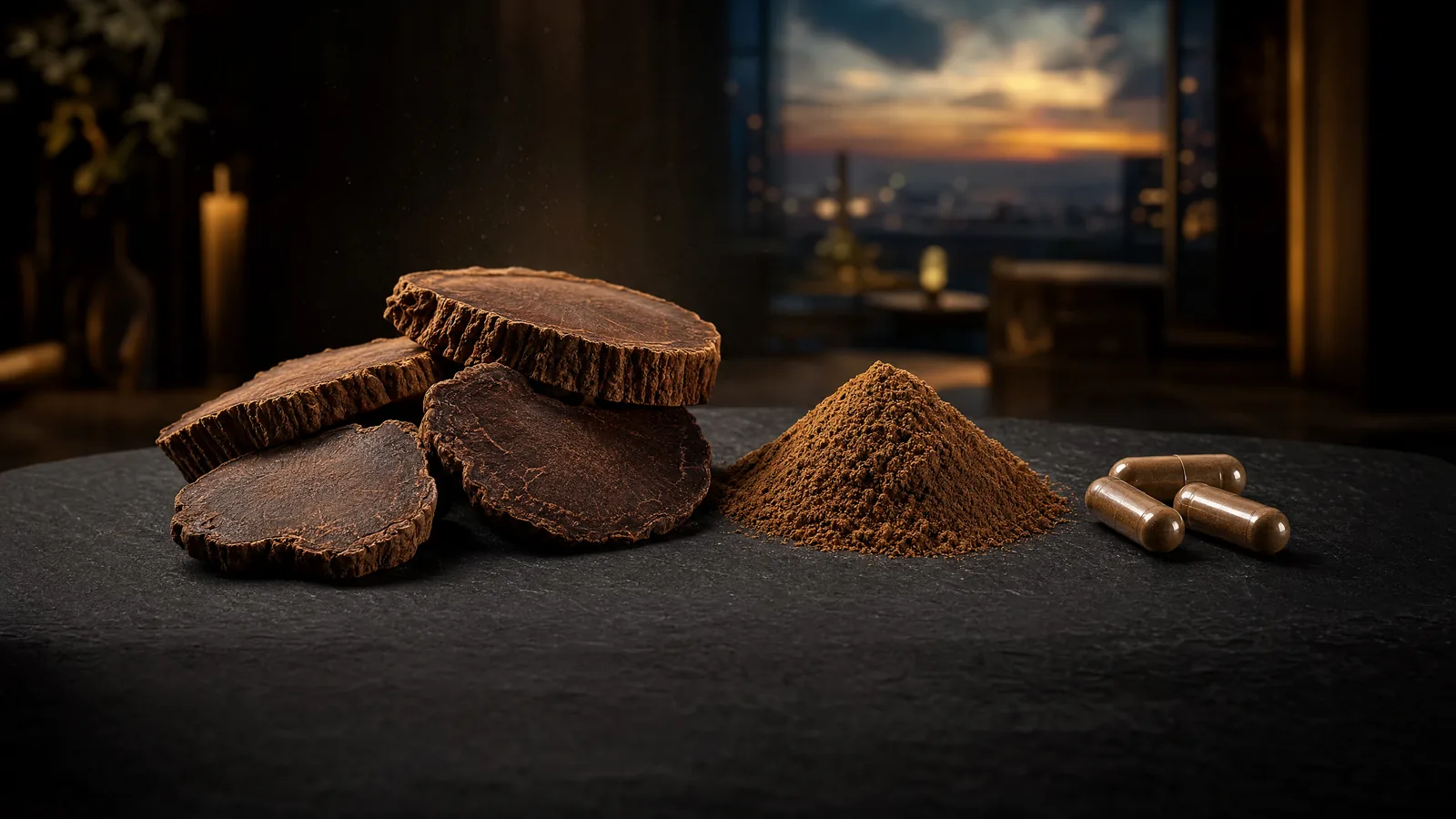
Cistanche: Benefits, Dosage & Side Effects (2026)
Cistanche is a desert plant taken as a testosterone, energy and longevity adaptogen; its quality is defined by standardization to echinacoside and verbascoside, though human evidence is still early.
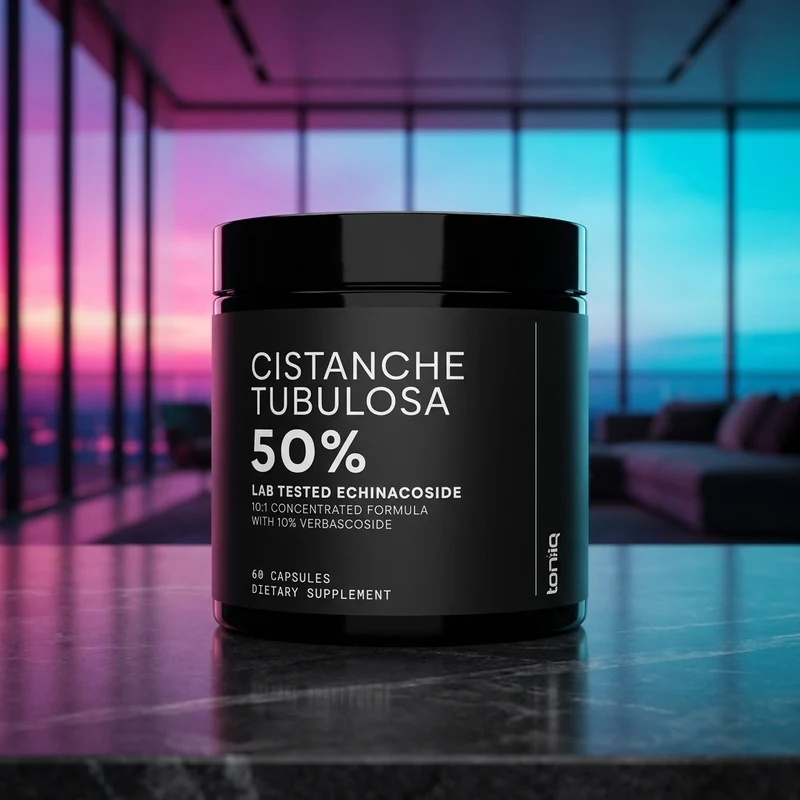
Toniiq Cistanche Tubulosa Extract (50% Echinacoside)
What is Cistanche?
Cistanche — often called 'desert ginseng' — is a parasitic desert plant (Cistanche tubulosa and Cistanche deserticola, 'Rou Cong Rong' in traditional Chinese medicine) that grows on the roots of host shrubs in arid regions of China and Central Asia. It has been used for centuries in TCM for vitality, kidney-yang support and 'tonifying' the body, and as a modern supplement it is sold mainly as a testosterone, energy/anti-fatigue, libido and longevity adaptogen. It is having a real moment in the men's-health and biohacking world — which is exactly why the honest part the marketing skips has to come first.
That honest part: cistanche's human clinical evidence is limited and early. Most of what's 'known' comes from traditional use plus a growing body of animal and test-tube research showing anti-fatigue, hormonal, neuroprotective and longevity signals. Those preclinical findings are genuinely interesting, but they are not the same as large human trials. The single randomized, placebo-controlled human study commonly cited tested a cistanche-PLUS-ginkgo combination for chronic-fatigue symptoms — not solo cistanche, and not a testosterone outcome — and the headline hormonal data is in rats. So the right mental model is a promising, well-tolerated experiment, not a proven testosterone lever. Treat any 'boost your testosterone' promise on a cistanche label as preliminary, not proven.
With expectations set honestly, the buying decision actually gets clearer, because cistanche has one decisive quality axis: standardization. The active compounds are two phenylethanoid glycosides — echinacoside and verbascoside (also written acteoside) — and the products worth your money disclose exactly how much of each they contain, along with the species. Cistanche tubulosa is the more echinacoside-rich species used in modern extracts; Cistanche deserticola is the other traditional species. A label that reads '10:1 extract, 50% echinacoside + 10% verbascoside, C. tubulosa' tells you precisely how much active compound is in each capsule. A label that just says 'pure cistanche' with no percentage is asking you to guess — and potency can swing batch to batch. That single number, the echinacoside percentage, is what a knowledgeable cistanche buyer is actually paying for.
How it works
Cistanche's proposed mechanisms run through its two phenylethanoid glycosides, and the honest framing is that the mechanism is plausible and broad while the human proof is thin.
The lead compound is ECHINACOSIDE, the glycoside the best extracts are standardized to. A systematic review of echinacoside (Baidya 2025, PMID 39361172) catalogues a wide range of reported activities — anti-diabetic, anti-inflammatory, anti-fatigue and neuroprotective — but it is a mostly preclinical evidence base, which is precisely why standardization to echinacoside is the decisive quality axis rather than proof of drug-like human effects. The second compound is VERBASCOSIDE (acteoside); a pharmacokinetic review (Xiao 2022, PMID 35724511) summarizes its antioxidant, anti-inflammatory, neuroprotective and cardiovascular activities but flags its POOR oral bioavailability — part of why human outcomes remain uncertain even when the test-tube activity looks strong.
Three mechanistic threads sit behind cistanche's reputation, and each is preclinical. For longevity/neuroprotection, a mechanistic review (Li 2022, PMID 35185590) describes echinacoside's antioxidant, mitochondrial-protective and anti-apoptotic effects in animal and cell models of neurodegeneration — explicitly not human trials. For the testosterone story, a rat study (Jiang 2016, PMID 27422164) found Cistanche tubulosa extract and echinacoside protected against bisphenol-A-induced testicular and sperm damage and helped normalize testosterone by upregulating steroidogenic enzymes — but that is an animal model of chemical-induced damage, so it suggests a mechanism, not a proven testosterone boost in healthy men. For the 'vitality/anti-aging' angle, an in-vitro study (Wu 2019, PMID 30781558) reported that echinacoside stimulated growth-hormone secretion in rat pituitary cells, putatively via the ghrelin receptor — a cell-based finding, not evidence of a GH or anti-aging effect in people.
The strongest HUMAN signal is also the most important caveat. A randomized, double-blind, placebo-controlled trial in 190 adults (Kan 2021, PMID 34901100) found a Cistanche-plus-Ginkgo botanical product (300-450 mg cistanche + 120-180 mg ginkgo daily for 60 days) improved chronic-fatigue-syndrome symptoms and quality-of-life scores versus placebo. That is real, controlled human data — but it tested a COMBINATION product for fatigue, not solo cistanche and not a testosterone endpoint. So the honest synthesis: the mechanism is coherent and broad, the animal and in-vitro signals are interesting, and one human RCT of a cistanche-containing combination is directionally encouraging for fatigue — but a large, replicated human trial of solo cistanche, especially for testosterone, does not yet exist. Buy it as an early-evidence experiment, and control the one thing you can: how much verified active compound you're getting.
At-a-glance facts
- What it actually is
- A desert-plant ('desert ginseng') adaptogen sold for testosterone, energy and longevity — promising but EARLY evidence, not a proven hormone lever
- The spec that matters
- Standardization to echinacoside % + verbascoside (acteoside) % — plus species (C. tubulosa is the echinacoside-rich one), not just 'pure cistanche'
- Active compounds
- Two phenylethanoid glycosides: echinacoside (lead marker) + verbascoside / acteoside
- Best species & extract
- Cistanche tubulosa, ideally a concentrated ratio (e.g. 10:1) standardized to 50% echinacoside + 10% verbascoside
- Human evidence
- Limited & early — mostly traditional use + animal/in-vitro; one human RCT (Kan 2021) tested a Cistanche+Ginkgo COMBINATION for fatigue, not solo cistanche
- Testosterone data
- Preclinical — the steroidogenesis/testosterone-normalizing result (Jiang 2016) is in RATS, not healthy men
- Time to effect
- Cumulative over weeks; the fatigue RCT dosed daily for 60 days — judge it after several weeks, not days
- Cost range (US)
- ~$0.10 to $0.53 per capsule depending on standardization, dose and count
- Biggest buyer decision
- Does the label disclose the echinacoside % (and verbascoside %)? A stated 50% extract is a different product from an unstandardized whole-herb powder
Evidence: Limited and early human evidence. The testosterone/energy/longevity claims rest mostly on traditional use plus animal and in-vitro research: echinacoside and acteoside reviews describe broad preclinical activity (Baidya 2025 PMID 39361172; Xiao 2022 PMID 35724511, the latter flagging poor oral bioavailability); the neuroprotective signal is animal/cell-model (Li 2022 PMID 35185590); the testosterone/steroidogenesis result is in RATS (Jiang 2016 PMID 27422164); and the growth-hormone signal is in-vitro (Wu 2019 PMID 30781558). The single human RCT (Kan 2021 PMID 34901100) tested a Cistanche+Ginkgo COMBINATION for chronic-fatigue symptoms — not solo cistanche and not a testosterone endpoint. Treat cistanche as a promising, well-tolerated early-evidence experiment, not a proven testosterone booster.
Who it's for — and who it isn't
- Men chasing a natural testosterone/vitality adaptogen who can hold the evidence honestly — the hormonal data is preclinical (rat steroidogenesis, Jiang 2016), so treat it as an experiment, not a guaranteed lever
- People targeting energy and anti-fatigue support — the one human RCT (Kan 2021) found a Cistanche+Ginkgo combination improved chronic-fatigue symptoms over 60 days
- Longevity and healthy-aging buyers drawn to the neuroprotective/antioxidant signal of echinacoside (Li 2022) — understanding it is animal/cell-model evidence
- Knowledgeable supplement buyers who will choose a Cistanche tubulosa extract with a DISCLOSED echinacoside % + verbascoside % over a 'pure cistanche' label with no stated percentage
- Adaptogen experimenters who want to run a well-tolerated, single-ingredient botanical for several weeks and judge it on the verifiable spec rather than the marketing claim
- Anyone expecting a proven, drug-like testosterone boost — the human evidence is limited and early, the hormonal data is in rats, and the one human RCT tested a combination product for fatigue, not solo cistanche for testosterone
- Buyers who won't check the species and standardization — a 'pure cistanche' bottle with no echinacoside/verbascoside percentage leaves the single decisive quality axis unstated and potency can drift batch to batch
- People wanting an acute, same-day effect — any benefit here is cumulative over weeks, not a stimulant kick
- Anyone pregnant, breastfeeding, on hormone-sensitive-condition treatment, or on medication without clinician input — an under-studied hormonal/adaptogenic botanical warrants caution
Week-by-week, what happens
- Day 1No felt change expected. Cistanche is not a stimulant — any acute 'boost' impression is easily placebo. Take it consistently and don't judge it yet; the actives work cumulatively.
- Week 1-2Still an onboarding window with no reliable signal. Confirm tolerability (mild digestive upset is the most common complaint) and that you're taking a standardized, disclosed-percentage extract so the experiment is actually meaningful.
- Week 3-4If anything is going to show, this is roughly where adaptogen users start to report steadier energy or reduced fatigue — but remember the supporting human RCT (Kan 2021) tested a Cistanche+Ginkgo combination, not solo cistanche, so keep expectations honest.
- Week 8+Maintenance phase. The one human trial dosed daily for 60 days; any benefit is cumulative and depends on consistent use. Reassess honestly — if a genuinely standardized extract has done nothing by ~8-12 weeks, it may not be a responder effect for you, and the testosterone claim in particular remains unproven in humans.
Safety & contraindications
- Cistanche is generally regarded as well tolerated, with mild digestive upset (nausea, loose stools) the most commonly reported complaint — take with food if sensitive, and start at the lower end of the label dose.
- Human safety data is limited because the human evidence base itself is limited and early; long-term safety in healthy adults has not been well characterized in large trials, so treat it as an under-studied botanical rather than a proven-safe staple.
- It is marketed as a hormonal/vitality adaptogen and the preclinical data touches steroidogenesis (Jiang 2016, in rats) — if you have a hormone-sensitive condition or take related medication, get clinician input before using it.
- Pregnancy and breastfeeding: evidence is insufficient — avoid unless specifically cleared by a clinician. Traditional use does not establish modern safety in these groups.
- Quality and identity matter most here: 'cistanche' on a label can be an unstandardized whole-herb powder with no disclosed echinacoside/verbascoside percentage, so you can't verify potency. Choose a Cistanche tubulosa extract that states its echinacoside % (and ideally verbascoside %) and, where available, third-party testing.
- It is not a substitute for proven approaches to low testosterone, fatigue or aging — see a clinician for persistent symptoms rather than relying on an early-evidence supplement.
All articles on Cistanche
Best Cistanche
The 9 best cistanche supplements ranked on standardization to echinacoside % and verbascoside, extract ratio and potency, third-party testing and value — with the honest frame that human evidence is limited and early (mostly preclinical), so a verified standardized extract is the decisive axis, not testosterone hype.
Read →Double Wood Cistanche Tubulosa Extract (500 mg) Review
The trusted, budget-friendly standardized capsule — disclosed 10%, not the concentrated 50%.
Read →Earthborn Elements Cistanche Tubulosa Review
The cheapest, cleanest-label cistanche — but it trades away the one number that defines quality.
Read →Life Extension Standardized Cistanche with Vitamin C Review
The research-brand, immune/longevity pick — clearly standardized, but a lighter 22% and only a month's supply.
Read →Nootropics Depot Cistanche tubulosa Capsules (700 mg) Review
A fuller-spectrum, larger-dose cistanche — disclosed, but standardized light at 5% echinacoside.
Read →Nootropics Depot Cistanche tubulosa Tablets (200 mg) Review
The reference-grade highest standardization at the best value — 180 tablets, guaranteed 50% floor.
Read →Nutricost Cistanche Tubulosa 500 mg Review
The lowest cost-per-serving with real facility credibility — just a light 10% standardization.
Read →Toniiq Cistanche Tubulosa Extract (50% Echinacoside) Review
The cleanest standardized-first cistanche — 50% echinacoside, stated third-party testing.
Read →VH Nutrition Cistanche Standardized Extract 700 mg Review
A high 700 mg men's-vitality dose — but the decisive echinacoside % isn't disclosed.
Read →WIXAR Naturals Cistanche Tubulosa (50% Echinacoside) Review
The 50% standardization spec at a value price — same active number, thinner paperwork.
Read →FAQ
Does cistanche actually boost testosterone — or is it hype?
Be honest and measured: it's promising, not proven. The testosterone reputation rests largely on a rat study (Jiang 2016, PMID 27422164) in which Cistanche tubulosa extract and echinacoside protected against chemical-induced testicular damage and helped normalize testosterone by upregulating steroidogenic enzymes — but that's an animal model of induced damage, not a demonstration of raised testosterone in healthy men. The single randomized, placebo-controlled human trial (Kan 2021, PMID 34901100) tested a Cistanche-plus-Ginkgo combination for chronic fatigue, not solo cistanche and not a testosterone endpoint. So treat any 'boost your testosterone' claim on a cistanche label as preliminary. It's a reasonable, well-tolerated experiment — not a guaranteed hormone lever.
What is echinacoside, and why does the percentage matter so much?
Echinacoside is the lead phenylethanoid glycoside in Cistanche tubulosa and the compound the best extracts are standardized to — it's the single number that decides cistanche quality. A systematic review (Baidya 2025, PMID 39361172) catalogues its broad reported activities (anti-fatigue, neuroprotective, anti-inflammatory), which is exactly why disclosing how much of it you're buying is the decisive quality axis. A label that states '50% echinacoside' is a fundamentally different, far more concentrated product than a whole-herb powder with no percentage at all, where potency can swing batch to batch. When two cistanche products look similar, the one that publishes its echinacoside percentage is almost always the better-trust buy. We never quote an echinacoside percentage a product doesn't state.
Cistanche tubulosa vs deserticola — which species should I buy?
For a modern standardized extract, Cistanche tubulosa is the species favoured by the best products, because it's the more echinacoside-rich of the two — and echinacoside is the marker compound the quality of the extract is judged on. Cistanche deserticola is the other traditional TCM species ('Rou Cong Rong'), but commercial high-standardization extracts (the 50% echinacoside products) are predominantly tubulosa. So if you want the chemically meaningful, most-concentrated product, look for a label that explicitly states Cistanche tubulosa AND a disclosed echinacoside percentage, rather than an unspecified-species 'cistanche' with no number.
What's the difference between echinacoside and verbascoside (acteoside)?
They're cistanche's two active phenylethanoid glycosides, and the better extracts disclose both. Echinacoside is the lead marker the standardization is built on (e.g. '50% echinacoside'); verbascoside — also written acteoside — is the second glycoside, usually stated at a lower percentage (e.g. '10% verbascoside'). A review of acteoside (Xiao 2022, PMID 35724511) summarizes its antioxidant, anti-inflammatory and neuroprotective activities but specifically flags its poor oral bioavailability, which is part of why human outcomes stay uncertain even when test-tube activity looks strong. Practically: a product disclosing both percentages (say 50% echinacoside + 10% verbascoside) is telling you more about what's in the capsule than one that lists only a vague 'standardized' claim.
How long until cistanche works, and how should I take it?
Give it weeks, not days — cistanche is not a stimulant, so any same-day 'lift' is likely placebo. The one human RCT (Kan 2021) dosed its Cistanche-plus-Ginkgo product daily for 60 days, so any real benefit is cumulative. Take a standardized Cistanche tubulosa extract consistently at the label dose, ideally with food if you're sensitive, and reassess honestly at around 8-12 weeks. Because the effect (if you're a responder) builds gradually, consistency matters far more than timing it to a workout. And keep the frame realistic: the supporting human data is for a combination product and for fatigue, not solo cistanche for testosterone.
Is cistanche safe, and who should avoid it?
For most healthy adults it's generally regarded as well tolerated, with mild digestive upset the main reported complaint. But the honest caveat is that human safety data is limited because the whole human evidence base is early — long-term safety in healthy people hasn't been well characterized in large trials. Because it's marketed as a hormonal/vitality adaptogen and the preclinical data touches steroidogenesis, anyone with a hormone-sensitive condition or on related medication should check with a clinician first. Pregnancy and breastfeeding: insufficient evidence, so avoid unless cleared. As with most herbal extracts, the biggest practical quality issue is buying an unstandardized whole-herb product — choose a Cistanche tubulosa extract that discloses its echinacoside percentage and, where available, third-party testing.
Sources & further reading
- Baidya 2025A systematic review of the traditional uses, chemistry, and curative aptitude of echinacoside-a phenylethanoid glycoside
A systematic review of echinacoside — the lead phenylethanoid glycoside in Cistanche tubulosa and the compound the best extracts are standardized to — cataloguing its traditional uses and reported pharmacological activities (anti-diabetic, anti-inflammatory, anti-fatigue, neuroprotective) along with its chemistry and mechanisms. The honest takeaway: a broad, mostly preclinical evidence base that explains why standardization to echinacoside is the decisive quality axis, not proof of drug-like human effects.
- Xiao 2022The pharmacokinetic property and pharmacological activity of acteoside: A review
A review of acteoside (verbascoside) — the second active glycoside the better cistanche extracts disclose — summarizing its anti-oxidant, anti-inflammatory, neuroprotective, cardiovascular and anti-diabetic activities, and flagging its poor oral bioavailability. Relevant because verbascoside % is the other half of the standardization spec, but the low bioavailability is part of why human outcomes remain uncertain.
- Li 2022Therapeutic Potential and Molecular Mechanisms of Echinacoside in Neurodegenerative Diseases
A mechanistic review of echinacoside in neurodegenerative disease models (Alzheimer's, Parkinson's, ALS), describing antioxidant, anti-inflammatory, mitochondrial-protective and anti-apoptotic effects. Explicitly preclinical — experimental and animal data, not human trials — and included here to show the neuroprotective/longevity signal behind the cistanche hype while making clear it has not yet been demonstrated in people.
- Jiang 2016Echinacoside and Cistanche tubulosa (Schenk) R. wight ameliorate bisphenol A-induced testicular and sperm damage in rats through gonad axis regulated steroidogenic enzymes
In rats, Cistanche tubulosa extract and echinacoside protected against bisphenol-A-induced testicular and sperm damage and helped normalize testosterone by upregulating steroidogenic enzymes. This is the kind of study behind cistanche's testosterone reputation — but it is an ANIMAL model of chemical-induced damage, so it suggests a mechanism, not a proven testosterone boost in healthy men.
- Wu 2019Echinacoside Isolated from Cistanche tubulosa Putatively Stimulates Growth Hormone Secretion via Activation of the Ghrelin Receptor
An in-vitro and molecular-modeling study reporting that echinacoside from Cistanche tubulosa stimulated growth-hormone secretion in rat pituitary cells, putatively by activating the ghrelin receptor. A plausible mechanism for the 'vitality/anti-aging' positioning — but a cell-based, preclinical finding, not evidence of a growth-hormone or anti-aging effect in humans.
- Kan 2021A Botanical Product Containing Cistanche and Ginkgo Extracts Potentially Improves Chronic Fatigue Syndrome Symptoms in Adults: A Randomized, Double-Blind, and Placebo-Controlled Study
A randomized, double-blind, placebo-controlled trial in 190 adults found that a Cistanche-plus-Ginkgo botanical product (300-450 mg cistanche + 120-180 mg ginkgo daily for 60 days) improved chronic-fatigue-syndrome symptoms and quality-of-life scores versus placebo. The strongest human evidence here — but it tested a COMBINATION product for fatigue, not solo cistanche and not a testosterone endpoint, which is exactly why this page treats cistanche's effects as early and unproven.