
Transparent Labs Mass Gainer (Chocolate Glaze) Review
 #8 of 8 · Label not verifiable✓ Label verified · Supplement Facts read Sep 7, 2026
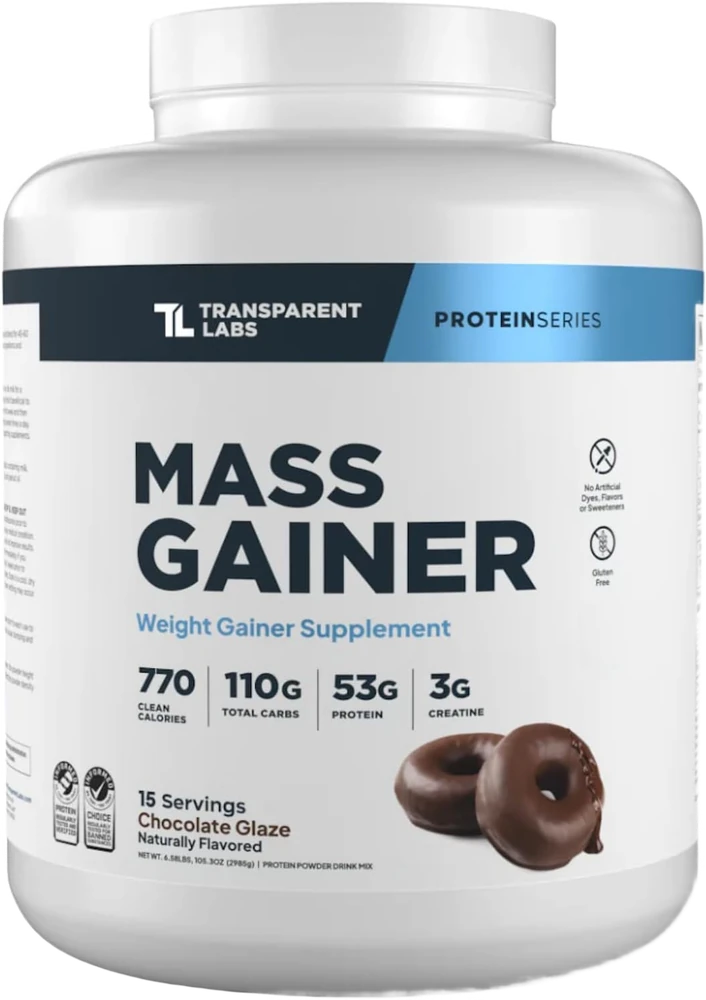
Real retailer photo, cut out. Label unedited.
Consider it. The listing claims the cleanest formula in the category — whole-food carbs, real protein, creatine, no added sugar — but no legible Supplement Facts panel exists to confirm it. Consider this one only if you trust the brand's claims. The listing claims 770 calories from oat flour, sweet potato and tapioca, 53 g grass-fed whey, 3 g creatine, zero added sugar and stevia/monk-fruit only.
$77$5.13 / serving ($0.67 / 100 kcal)
Why It Scores 6.6 — And The Label Line Behind Each Number
Carb ratio & carb quality
30% of scoreThe listing claims the carbs are oat flour, organic tapioca and sweet potato with 0 g added sugar (~15 g naturally occurring) and 8 g of fiber — genuine whole-food carbohydrate, not a maltodextrin-and-sugar base. We could not verify any of it: the listing's only photo is a front-of-tub marketing callout showing a rounded '110G Total Carbs' total, not a legible Supplement Facts panel with a carbohydrate or sugar breakdown. If accurate this would be among the cleanest carb sources in the category; scored here as a plausible but unverified listing claim, not a confirmed fact.
- Label check
- Not verifiable — no legible Supplement Facts photo in the listing (checked Sep 7, 2026)
Calorie & protein density
25% of scoreThe listing's front-of-tub photo does show rounded '53G Protein' and '770 Clean Calories' callouts — more evidence than most of this listing's other claims get — but it's still a marketing callout, not a legible Supplement Facts panel, so both figures are listing claims rather than audited facts. If accurate, 53 g sits at the top of the ideal 40-55 g protein window and 770 kcal (from the powder in water, no milk assumed) is enough to create a surplus for most, though moderate for the biggest hardgainers.
- Protein
- 53 g grass-fed whey concentrate
Ingredient quality
20% of scoreThe listing claims grass-fed whey concentrate, 3 g of creatine monohydrate (an effective clinical dose per Kreider 2017 if the amount holds up), MCTs, and stevia plus monk fruit as the only sweeteners — no sucralose, dyes or fillers. Only the '3G Creatine' figure is visible on the one product photo; the grass-fed sourcing, the MCTs, the sweetener list and the no-fillers claim have no legible Supplement Facts panel behind them and can't be verified. Scored down accordingly: this reads as a set of plausible brand claims, not a confirmed ingredient panel.
Value per calorie
15% of scoreAt roughly $0.67 per 100 kcal — using the listing's own 770 kcal figure, not a verified panel — it is the most expensive tub per calorie on the list. The reasoning that this premium buys whole-food carbs and built-in creatine no longer fully holds, since neither the carb sourcing nor the ingredient list can be confirmed from a legible label; you are paying the premium on the brand's word. The price itself is directly observable and isn't in question — only what it buys.
- Servings
- 15 per tub
- Price
- $77 / tub ≈ $5.13 per serving ($0.67 / 100 kcal)
Mixability & taste
10% of scoreA moderate 770-calorie, two-scoop serving blends far more easily than the seven-scoop 1,250-calorie bombs, and the Chocolate Glaze flavor is well regarded. Because it isn't a thick 1,200-calorie paste, it is one of the easier gainers here to actually drink day after day.
- More Specs
- Calories
- 770 kcal per serving (2 scoops, no milk needed)
- Carbs / Sugar
- 110 g total / 0 g added sugar (~15 g naturally occurring), 8 g fiber
- Carb source
- Whole-food: oat flour, organic tapioca, sweet potato
- Creatine
- 3 g creatine monohydrate (effective dose)
- Extras
- MCTs; stevia + monk fruit only — no artificial sweeteners, dyes or fillers
Label verified. Every figure read from the Supplement Facts photo, Sep 7, 2026.
Marketing Claims Vs. Reality
Whole-food carbs with no added sugar — the cleanest carb profile in the category.
The listing claims oat flour, organic tapioca and sweet potato as the carbohydrate sources with 0 g added sugar (~15 g naturally occurring) and 8 g fiber. We could not verify any of it: the listing's only photo is a front-of-tub marketing callout showing a rounded '110G Total Carbs' total, not a legible Supplement Facts panel with a carbohydrate or sugar breakdown. If accurate this would be genuine whole-food carbohydrate rather than the maltodextrin-plus-sugar base of the mainstream tubs — but treat it as an unverified listing claim, not a confirmed fact.
53 g of grass-fed whey per serving.
The listing claims 53 g of protein per serving, and a rounded '53G Protein' callout is visible on the one product photo — more evidence than most claims on this listing get, though it's a front-of-tub marketing number, not a legible Supplement Facts panel. If accurate, it sits at the top of the ideal 40-55 g window. 'Grass-fed' is a manufacturer sourcing claim with no supporting photo at all, so treat the protein amount as a plausible listing claim and the grass-fed sourcing as an unverified brand assertion.
3 g of creatine monohydrate built in.
A rounded '3G Creatine' callout is visible on the listing's one product photo, but with no legible Supplement Facts panel, the exact dose or form remains unverified. If the listing's figure holds, 3 g sits within the 3-5 g/day maintenance range the ISSN identifies as effective for strength and lean-mass support (Kreider 2017, PMID 28615996) — a real dose rather than a token amount, if accurate.
No artificial sweeteners — stevia and monk fruit only.
The listing claims stevia and monk fruit as the only sweeteners, with no sucralose, acesulfame-K or artificial dyes. No photo in the listing shows a legible ingredient panel or Supplement Facts label to confirm this — the one available image is a front-of-tub macro callout with no sweetener or ingredient information on it. Treat this as an unverified brand claim, not a confirmed point of difference from the sucralose-sweetened and dye-containing tubs lower on the list.
A 'mass' gainer — builds muscle mass.
At the listing's claimed 770 kcal, it would supply a surplus for most users — but no gainer builds muscle on its own: it works only alongside a sustained calorie surplus and resistance training with adequate protein (Slater 2019, PMID 31482093; Morton 2018, PMID 28698222). For an extreme hardgainer 770 kcal is moderate and may require two servings, so the 'mass' framing is accurate only within that context and only if the listing's calorie figure is correct.
What Our Test Actually Found
Label not verifiable: what we could and could not confirm
No photo in this listing's gallery shows a legible Supplement Facts panel — the only product image available is a front-of-tub marketing callout showing five unverified rounded numbers: 770 Clean Calories, 110G Total Carbs, 53G Protein, 3G Creatine and 15 Servings. We could confirm those five figures appear on the package front; we could not confirm anything else in this review — the oat flour/tapioca/sweet potato carb sourcing, the 0 g added sugar and 8 g fiber breakdown, the 'grass-fed' whey sourcing, the MCT and sweetener list, or the 'no fillers or dyes' claim — because no Supplement Facts photo exists to check them against. We re-checked the listing on Sep 7, 2026 and rewrote every sentence in this review that had presented a number as read 'from the label' to instead say the listing claims it, and lowered the criteria scores that had rewarded ingredient transparency we never actually saw.
This is the DIY shake in a tub — that's the whole point, if the listing is accurate
The formula we keep recommending readers make themselves — oats, whey, real carbohydrate, no added sugar — is what the listing says Transparent Labs put in this tub: oat flour, sweet potato and tapioca for the carbs, 53 g of grass-fed whey for the protein, and 3 g of creatine on top. We could not verify that ingredient list from a legible Supplement Facts panel, so if you were always going to blend your own oats-and-whey shake and just want the convenience, treat this as a plausible match on the brand's word, not a confirmed one.
You pay for the clean formula — it's the priciest calories here
At roughly $0.67 per 100 kcal (using the listing's own calorie figure), this is the most expensive tub per calorie on the entire list, several times the cost of ON Serious Mass or Dymatize. The listing frames that as the trade-off for whole-food carbs and built-in creatine, but we couldn't verify the ingredient claims behind that framing — no legible Supplement Facts panel exists for this listing. If your single priority is maximum calories for minimum money, this is not your pick regardless; if you're buying on quality, you're paying the premium on the brand's word.
770 calories is moderate for 'mass' — a big hardgainer runs two scoops
The listing's calorie headline (770 kcal) is smaller than the 1,250-calorie maltodextrin bombs elsewhere on the list. For most people that's plenty to create a surplus, but a true hardgainer with a fast metabolism may need two servings a day to move the scale — which also doubles the already-premium cost. Budget for that if you're bulking aggressively.
Creatine is claimed at an effective dose — worth it if the figure holds up
Most gainers either skip creatine or add a token 1 g. This one's listing claims 3 g of monohydrate — a number visible as a rounded callout on the package front, though not on a legible Supplement Facts panel — which, if accurate, sits inside the 3-5 g/day range the ISSN position stand identifies as effective (Kreider 2017). That would mean one fewer supplement to buy separately and a real dose rather than a token amount, if the listing's figure holds up.
Full analysis: all pros & cons (8), buy if / skip if
- Listing claims whole-food carbs (oat flour + sweet potato + tapioca) with 0 g added sugar — unverified, no legible Supplement Facts panel
- 53 g protein claimed, visible on the package front — grass-fed sourcing is an unverified brand claim
- 3 g creatine claimed, visible on the package front — an effective dose if accurate (Kreider 2017)
- Listing claims no artificial sweeteners, dyes or fillers — stevia and monk fruit only, unverified
- Moderate two-scoop serving mixes and tastes better than the seven-scoop bombs
- No legible Supplement Facts photo in the listing — every ingredient, dose and sugar claim here is a listing claim, not a confirmed fact
- Most expensive tub per calorie on the list (~$0.67/100 kcal, per the listing's own calorie figure) — you pay a real premium
- 770 kcal is moderate for a 'mass' gainer (per the listing); a big hardgainer needs two servings a day
- You're comfortable trusting the listing's claim of a whole-food, no-added-sugar carb profile — we could not verify it from a legible label
- You'd take grass-fed whey and 'no artificial sweeteners' on the brand's word, since no Supplement Facts panel confirms it
- You want creatine at the listing's claimed 3 g — a figure at least visible on the package front, unlike most of this listing's other claims
- You'd otherwise make a DIY oats-and-whey shake and are willing to trust this one matches that on the brand's word
- You want a review that could confirm the label's numbers — this listing has no legible Supplement Facts photo, so every ingredient and sugar claim here is unverified
- Your only priority is the cheapest possible calories — ON Serious Mass or Dymatize cost far less per 100 kcal
- You need a single 1,200+ calorie shake — 770 kcal (per the listing) means two servings for an extreme hardgainer
The listing claims 770 calories from oat flour, sweet potato and tapioca, 53 g grass-fed whey, 3 g creatine, zero added sugar and stevia/monk-fruit only. But no gallery photo shows a legible Supplement Facts panel — only a front-of-tub marketing callout with five rounded, unverified numbers (770 kcal, 110 g carbs, 53 g protein, 3 g creatine, 15 servings) is visible, so the carb sourcing, sugar/fiber split and sweetener list can't be confirmed. If the claims hold up, this would be a strong quality-first pick close to a DIY oats-milk-whey shake; we can't confirm they do. The two catches that stand regardless: it is the priciest per calorie here (~$0.67/100 kcal, based on the listing's own calorie figure), and 770 kcal is moderate for 'mass,' so a big hardgainer may run two scoops a day. Remember a gainer only builds muscle inside a calorie surplus plus hard training (Morton 2018; Slater 2019).
Transparent Labs Mass Gainer is marketed as proof the category's sugar habit is a choice, not a necessity. The listing says its 770 calories come from whole-food carbohydrates — oat flour, organic tapioca and sweet potato — rather than the maltodextrin-and-sugar base most gainers lean on, and that it carries 53 g of grass-fed whey plus 3 g of creatine monohydrate with zero added sugar and no artificial sweetener or dye. We could not verify any of that: the only product photo in this listing is a front-of-tub marketing callout (770 Clean Calories, 110G Total Carbs, 53G Protein, 3G Creatine, 15 Servings), not a legible Supplement Facts panel, so the carb sourcing, sugar/fiber breakdown and sweetener list are listing claims rather than confirmed facts. If the listing is accurate, this would be the formula closest to the clean homemade shake we keep telling readers to try first, just packaged for convenience — but we can't confirm it is. The honest catches are real regardless: it is the most expensive tub per calorie on the list, and at 770 calories a true hardgainer may need two servings a day to hit a surplus.
A promising formula we can't verify — worth considering only if you trust the brand's claims.

Transparent Labs' listing says the 770 calories come from real food — oat flour, sweet potato and tapioca — paired with 53 g of grass-fed whey and 3 g of creatine, with no added sugar and no artificial sweeteners or dyes. We could not verify any of that: the only photo in this listing's gallery is a front-of-tub marketing callout with five rounded numbers (770 Clean Calories, 110G Total Carbs, 53G Protein, 3G Creatine, 15 Servings), not a legible Supplement Facts panel. If the listing is accurate, this would be close to the clean DIY shake we keep recommending — but we can't confirm it is, so we can no longer call it the correct number one on that basis alone. The two honest catches stand regardless of verification: it is the priciest tub per calorie here (based on the listing's own calorie figure), and at 770 calories a serious hardgainer may need two scoops a day. Consider it if you're comfortable trusting the brand's claims about ingredient sourcing and are willing to let the surplus and the training do the actual muscle-building. If you want a mass gainer whose label we could actually confirm, or if pure cost per calorie is your priority, look elsewhere on this list.
If This Doesn’t Fit — Try These
 02
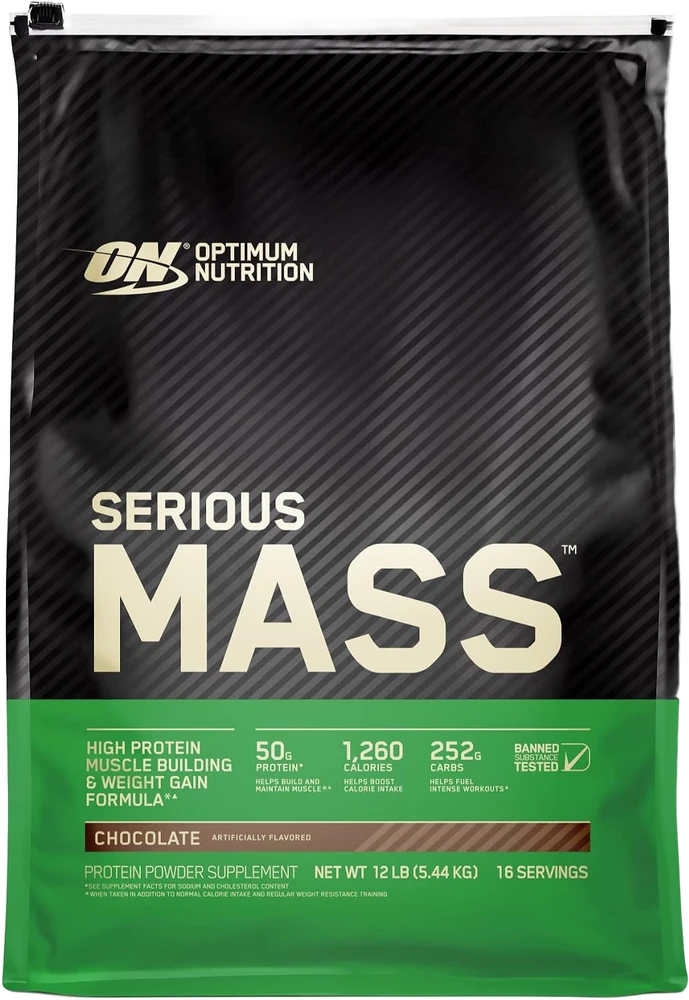
ON Serious Mass
Serious Mass is the category's default for a reason — it's the cheapest way to add real calories, at roughly six cents per 100, from a brand you can trust, with 50 g of protein, 25 vitamins and minerals and 3 g of creatine in the tub.
 03
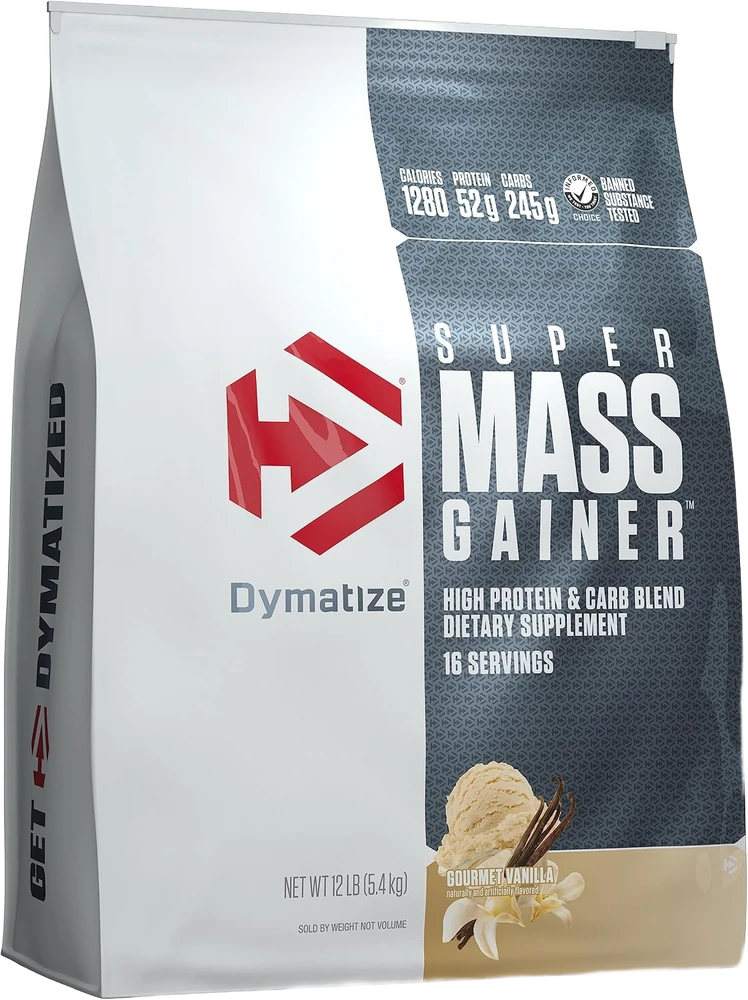
Dymatize Super Mass Gainer
Super Mass Gainer is essentially ON Serious Mass's closest rival, and on raw numbers it edges ahead — 1,280 calories and 52 g of a genuinely good whey-isolate-and-casein blend with 10.7 g of BCAAs, and it's frequently the cheapest tub per calorie on the whole list.
Quick Answers
Is this actually worth the premium over a $75 tub of Serious Mass?
It depends on what you're optimizing. Serious Mass is far cheaper per calorie, but its carbs are maltodextrin with ~31 g of sugar per serving. Transparent Labs costs more per 100 kcal and its listing claims whole-food carbs (oat flour, sweet potato, tapioca), no added sugar and 3 g of built-in creatine — though we could not verify that formula from a legible Supplement Facts panel. If you trust the listing and your priority is clean fuel and ingredient quality, the premium is aimed at a genuinely better formula. If your priority is maximum calories for minimum money, Serious Mass wins on that axis alone.
Is 770 calories enough for a mass gainer?
For most people, yes — the listing's claimed 770 kcal on top of your normal diet is a solid surplus. For a true hardgainer with a fast metabolism who genuinely struggles to eat, it may take two servings a day, which doubles the cost. Remember the calories only build muscle inside a sustained surplus plus resistance training (Slater 2019); the tub can't supply either for you.
Do I need to add milk?
No. The listing's 770-calorie figure is for two scoops in water, so you get that full number without adding anything. You can blend it with milk for extra calories and protein if you want, but unlike some tubs, the headline number here isn't secretly counting the milk you add.
Does it really have no added sugar?
The listing claims 0 g added sugar, with roughly 15 g of naturally occurring sugar from the whole-food carbs, plus 8 g of fiber — but we could not verify that split. No gallery photo for this listing shows a legible Supplement Facts panel, only a front-of-tub marketing callout with rounded calorie, carb, protein and creatine numbers, so the sugar and fiber breakdown is a listing claim, not a confirmed fact. Sweetness is said to come from stevia and monk fruit, not sucralose or added sugar. If accurate, that would separate it from the 25-35 g-of-sugar tubs in the mainstream tier — but treat it as unverified.
Sources & Further Reading
4 peer-reviewed sources, each linked to PubMed
- [1] Morton 2018 PMID 28698222 — A systematic review, meta-analysis and meta-regression of the effect of protein supplementation on resistance training-induced gains in muscle mass and strength in healthy adults. Across 49 studies (1,863 participants), protein supplementation increased resistance-training gains in muscle and strength, but the benefit plateaued above ~1.6 g/kg/day. This gainer's listing-claimed 53 g dose would sit at the top of the useful window if accurate; calories beyond the protein and surplus needs add fat, not muscle.
- [2] Slater 2019 PMID 31482093 — Is an energy surplus required to maximize skeletal muscle hypertrophy associated with resistance training. A modest positive energy balance supports hypertrophy alongside training, but the required surplus is small and individual, and a large surplus mainly adds fat. This gainer's listing-claimed 770 kcal would be a convenient way to supply that measured surplus, if accurate — not a substitute for the training.
- [3] Kreider 2017 PMID 28615996 — International Society of Sports Nutrition position stand: safety and efficacy of creatine supplementation in exercise, sport, and medicine. The ISSN identifies 3-5 g/day of creatine monohydrate as the effective maintenance dose for strength and lean-mass support. This gainer's listing-claimed 3 g would land in that range if accurate, unlike the sub-clinical 1 g in some rival tubs.
- [4] Moore 2009 PMID 19056590 — Ingested protein dose response of muscle and albumin protein synthesis after resistance exercise in young men. Muscle protein synthesis rose dose-dependently and was near-maximally stimulated around 20 g of high-quality protein per serving. At the listing's claimed 53 g, this gainer would comfortably clear the per-serving threshold that actually drives muscle protein synthesis, if that figure holds up.
Affiliate disclosure: every Amazon link uses our Associates tag (superachieverclub-20). We earn a small commission at no cost to you; it funds independent reviews. We never accept payment to change a ranking.