
Thorne Zinc Picolinate 15 mg Review
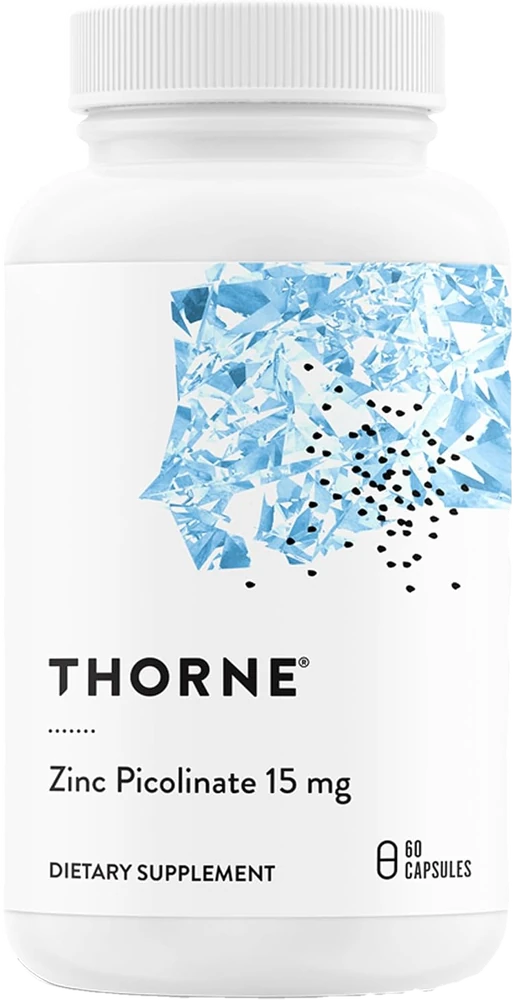 #5 of 7 · Best daily dose for women✓ Label verified · Supplement Facts read Oct 13, 2026
Real retailer photo, cut out. Label unedited.
Consider it. The right strength for daily use, at a higher price per milligram. 15 mg of zinc picolinate covers the daily requirement with room to spare and stays far below the 40 mg upper limit, even on top of a multivitamin.
$15.00 · 60 capsules (Amazon US, Oct 13, 2026)$0.25 per capsule (15 mg zinc)
Why It Scores 8.3 — And The Label Line Behind Each Number
Form bioavailability
30% of scoreZinc picolinate, the same form as the 30 mg capsule. In Barrie 1987, four weeks of zinc picolinate raised zinc in hair, urine and red blood cells, while citrate and gluconate did not change them significantly.
- Active form
- Zinc picolinate
- Other ingredients
- Microcrystalline cellulose, hypromellose capsule, leucine, silicon dioxide
Dose accuracy + cofactor compatibility
25% of score15 mg per capsule is 136% of the Daily Value. The label allows one capsule one to two times daily, so the range is 15 to 30 mg. One capsule sits below the 30 mg used in Prasad 1996; two match it. Nothing else in the capsule competes with zinc.
- Per serving
- 15 mg zinc (1 capsule), 136% of the Daily Value
Third-party testing
20% of scoreNSF lists Thorne Zinc Picolinate 15 mg under NSF/ANSI 173, which means the label contents were tested. It is not on the NSF Certified for Sport list (checked Oct 13, 2026). The listing image says "Third-Party Certified".
- Label directions
- Take 1 capsule one to two times daily, with a meal
- Testing
- NSF/ANSI 173 contents listing; not on the NSF Certified for Sport list (checked Oct 13, 2026)
Cost per active mg
15% of score$15.00 for 60 capsules on Oct 13, 2026: $0.25 per 15 mg capsule. Per milligram of zinc this is the most expensive product in our zinc reviews, about twice the 30 mg Thorne capsule.
- Bottle
- 60 capsules
- Price
- $15.00 for 60 capsules (Amazon US, Oct 13, 2026)
- Cost per capsule
- $0.25
Real-world response evidence
10% of scoreThe studies behind zinc for testosterone and acne used 30 mg or more. At one capsule this is a maintenance dose, which is what most people without a deficiency need. At two capsules it matches the study dose.
Label verified. Every figure read from the Supplement Facts photo, Oct 13, 2026.
Marketing Claims Vs. Reality
Each capsule provides 15 mg of zinc picolinate.
The panel reads "Zinc (as Zinc Picolinate) 15 mg". That is 15 mg of zinc supplied as picolinate, not 15 mg of the picolinate compound. The listing wording is loose; the panel is clear.
3rd party contents certified.
NSF lists Thorne Zinc Picolinate 15 mg in its NSF/ANSI 173 dietary supplement listings, which covers identity and quantity of the declared ingredients.
Zinc balances the body's normal testosterone production.
In Prasad 1996, zinc raised testosterone in older men who were marginally zinc deficient, at 30 mg a day. That is two capsules, and the effect was shown in deficiency, not in men with normal zinc status.
What Our Test Actually Found
15 mg fits daily use better than 30 mg
The recommended intake is 8 mg a day for women and 11 mg for men, and the upper limit for adults is 40 mg from all sources. A 15 mg capsule covers the requirement and leaves room for the zinc in food and in a multivitamin. A 30 mg capsule on top of a multivitamin can reach the limit.
One bottle, two doses
The label says one capsule one to two times daily. That makes this the flexible pick: one capsule for maintenance, two for a few months when you want the 30 mg used in the studies. Taken twice a day, the bottle lasts 30 days.
Tested for contents, not certified for sport
Thorne has two different NSF statuses in its zinc range. The 30 mg capsule is on the NSF Certified for Sport list. The 15 mg capsule is in the NSF/ANSI 173 contents listing only. For most buyers that is enough; drug-tested athletes should buy the 30 mg version.
You pay for the smaller dose
At $0.25 per capsule the price is close to the 30 mg bottle, for half the zinc. If you will take two capsules a day for good, the 30 mg bottle is the cheaper way to do it.
Full analysis: all pros & cons (8), buy if / skip if
- 15 mg per capsule, well below the 40 mg upper limit
- Picolinate, a well-absorbed form
- Label allows 15 mg or 30 mg a day
- NSF contents listing
- Four other ingredients, no colors or sweeteners
- Highest price per mg of zinc in our zinc reviews
- Not on the NSF Certified for Sport list
- One capsule is below the 30 mg study dose
- You want a daily zinc that stays well under the 40 mg upper limit
- You already get some zinc from a multivitamin or your diet
- You want the option of 15 mg or 30 mg from one bottle
- You want the lowest price per mg: the 30 mg capsule costs less per milligram
- You are drug-tested and need the Certified for Sport mark: that is the 30 mg version
- You plan to take 30 mg every day anyway
15 mg of zinc picolinate covers the daily requirement with room to spare and stays far below the 40 mg upper limit, even on top of a multivitamin. Two capsules reach 30 mg when you want the study dose. NSF lists the product as tested for label contents. It is not on the NSF Certified for Sport list; the 30 mg version is.
Thorne sells its zinc picolinate in two strengths. This is the smaller one: 15 mg of zinc per capsule, which is 136% of the Daily Value. For most adults that is closer to what a daily supplement should do than the 30 mg capsule, because the recommended intake is 8 mg a day for women and 11 mg for men and the upper limit for adults is 40 mg. The label says to take one capsule one to two times daily, so the same bottle also reaches the 30 mg used in the zinc studies. The price per milligram is the weak point: you pay more for half the zinc.
The daily-dose version of a zinc we already rate highly

Buy this if you want zinc as a daily mineral and not as a short course: 15 mg of picolinate covers the requirement and keeps you far from the upper limit. It scores below the 30 mg capsule for two reasons, the price per milligram and the missing Certified for Sport listing. Take it with a meal. If you take zinc for longer than a few months at 30 mg or more, add copper or pick a product that includes it.
If This Doesn’t Fit — Try These
 01
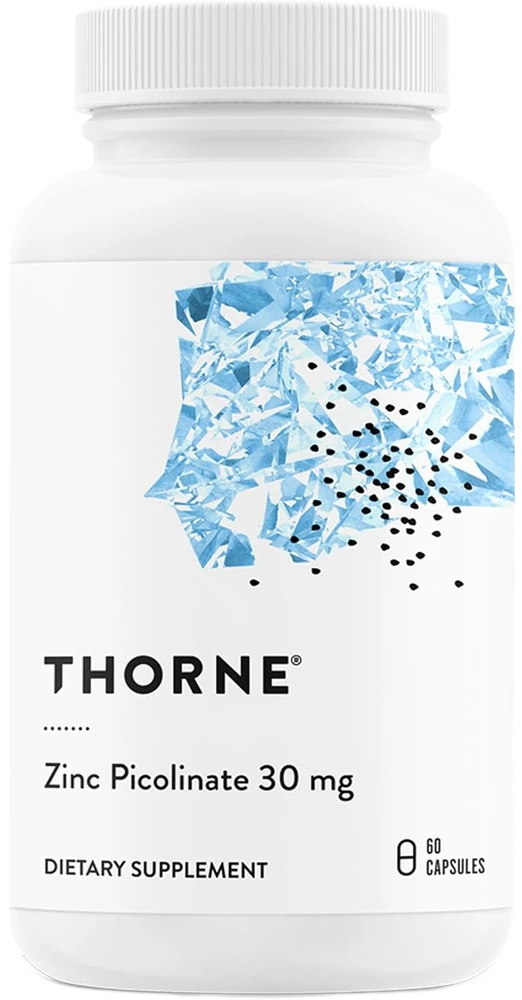
01Thorne Zinc Picolinate
If your main reason for buying zinc is inflammatory or hormonal acne, this is the sharpest pick.
 04
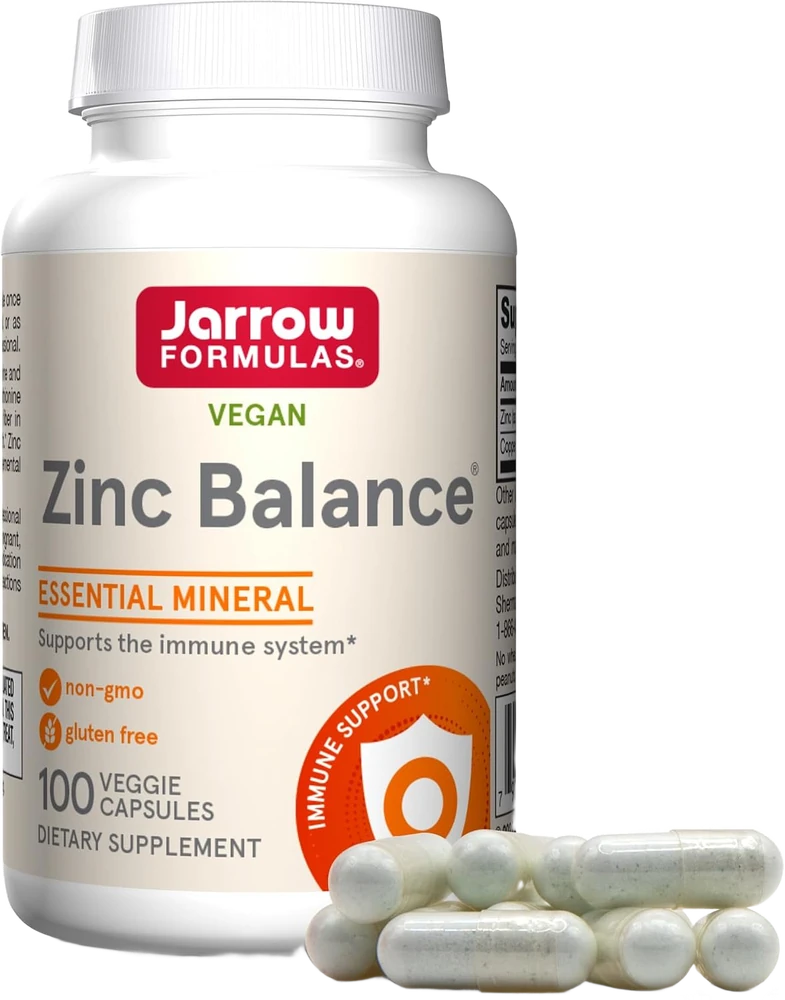
04Jarrow Zinc Balance
Long zinc courses are common in women: three months for acne, longer for hair.
 07
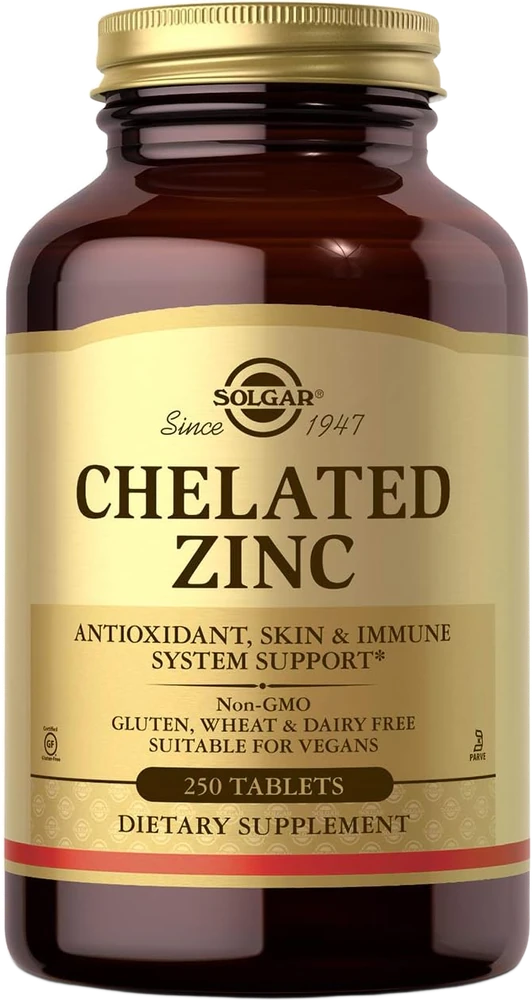
07Solgar Chelated Zinc
Solgar Chelated Zinc is the bottle your integrative-medicine clinician likely recommended a decade ago — and for a woman, its 22 mg dose is arguably better-pitched than the 30 mg picks for plain maintenance and immune support, no splitting required.
Quick Answers
Is 15 mg of zinc enough?
For daily use, yes. The recommended intake is 8 mg a day for women and 11 mg for men, and 15 mg is 136% of the Daily Value. The zinc studies on testosterone and acne used 30 mg or more, which is two capsules.
Can I take two capsules a day?
Yes, the label says one capsule one to two times daily. Two capsules stay under the 40 mg upper limit for adults, but count the zinc in your multivitamin as well.
Is Thorne Zinc Picolinate 15 mg NSF Certified for Sport?
No. On Oct 13, 2026 the NSF Certified for Sport list showed the 30 mg capsule only. The 15 mg capsule is in the NSF/ANSI 173 contents listing, which confirms the label contents.
Should I take it with food?
Yes. The listing recommends taking it with a meal, and zinc on an empty stomach often causes nausea.
Sources & Further Reading
4 peer-reviewed sources, each linked to PubMed
- [1] Barrie 1987 PMID 3630857 — Comparative absorption of zinc picolinate, zinc citrate and zinc gluconate in humans. Fifteen volunteers took zinc picolinate, citrate, gluconate or placebo for four weeks each. Only picolinate raised zinc in hair, urine and red blood cells significantly.
- [2] Prasad 1996 PMID 8875519 — Zinc status and serum testosterone levels of healthy adults. Zinc at 30 mg a day for six months raised serum testosterone in marginally zinc-deficient older men. Two capsules of this product match that dose.
- [3] Maares & Haase 2020 PMID 32183116 — A guide to human zinc absorption: general overview and recent advances of in vitro intestinal models. Review of human zinc absorption: absorption depends on the form and on what is eaten with it; phytate in grains and legumes lowers it.
- [4] Fosmire 1990 PMID 2407097 — Zinc toxicity. High zinc intake over time interferes with copper. The reason to keep a daily dose moderate.
Affiliate disclosure: every Amazon link uses our Associates tag (superachieverclub-20). We earn a small commission at no cost to you; it funds independent reviews. We never accept payment to change a ranking.