
Paula's Choice CLINICAL 1% Retinol Treatment Review
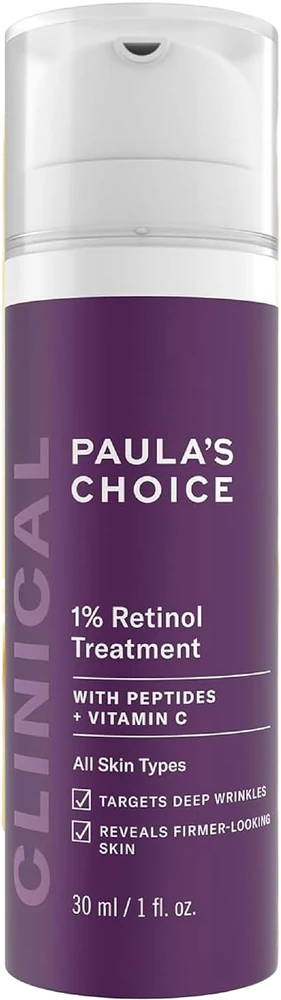 #4 of 8 · Best premium 1%✓ Product photos checked Sep 7, 2026
Real retailer photo, cut out. Label unedited.
Buy it. The best-built 1% retinol here — for experienced skin willing to pay for a complete formula. A real 1% retinol with a controlled-release system to temper how hard it hits, plus peptides and vitamin C for complementary pathways and licorice to counter redness — fragrance-free, in stability-minded opaque packaging.
$60 / 1 fl oz≈ $20 / month of use
Why It Scores 8.5 — And The Label Line Behind Each Number
Form + proven mechanism
30% of scoreA real, disclosed 1% retinol delivered through a controlled-release system — strong on delivered active, and the highest mechanism score among the retinols here. It still can't match a receptor-active retinoid: it's raw retinol paying the two-step conversion penalty, which is precisely why it sits below adapalene despite the higher percentage.
Tolerability + barrier support
25% of scoreBetter than a bare 1%: controlled-release tempers the peak, and licorice extract helps counter redness and pigmentation. But at full 1% strength it remains potent, and the barrier team is lighter than the ceramide/niacinamide-led sensitive-skin picks — so it scores mid-pack on tolerability, and beginners still shouldn't start here.
- Support
- Peptides + vitamin C + licorice extract
Evidence + concentration for the user
20% of score1% is a real, well-evidenced strength for experienced skin (Mukherjee 2006), and the complementary peptides and vitamin C add plausible extra pathways. The high score reflects strength matched to a tolerant user; it isn't higher because the supporting actives' individual contributions are modest and the retinol still needs conversion.
- Active
- Retinol 1% (controlled-release delivery; disclosed)
Formulation quality + stability
15% of scoreThe standout axis. Fragrance-free, opaque airless-style packaging that protects a light- and air-sensitive active, controlled-release delivery, and a thoughtfully complete supporting cast — this is the best-formulated product on the list on pure build quality.
Cost per month of real use
10% of scoreThe weakest axis: at about $60 for 1 fl oz (~$20/month) it's the most expensive per-ounce pick here, several times the cost of adapalene. It behaves well and the airless packaging aids hygiene and stability, but on pure cost per month it's the priciest option.
- Size
- 1 fl oz treatment
- Price
- ≈ $60 / 1 fl oz (≈ $20 per month of use)
- More Specs
- Base
- Fragrance-free
- Packaging
- Opaque, airless-style — protects the active from light and air
- Best for
- Experienced users wanting a complete high-% formula
- Mechanism note
- Raw retinol — still pays the conversion penalty adapalene avoids
Photos checked.This product has no Supplement Facts panel; the retailer's listing photos were reviewed Sep 7, 2026.
Marketing Claims Vs. Reality
Contains a full 1% retinol.
The 1% concentration is disclosed on the label — a real, high-strength dose, easy to verify against the product listing. This is a genuine 1%, not a token amount.
Controlled-release delivery makes a strong dose more usable.
Controlled-release is a plausible, disclosed formulation approach that can temper the irritation peak, and Kong 2016 supports gentler delivery of retinol helping tolerability. But the specific tolerability benefit for this SKU rests on manufacturer framing rather than an independent head-to-head, so it's supported in principle, not proven for the product.
Peptides and vitamin C add complementary anti-aging pathways.
Peptides and vitamin C have supportive but modest individual evidence for anti-aging, so they plausibly complement the retinol — but their contribution is secondary and smaller than the retinol's, and the claim shouldn't be read as doubling the effect.
Licorice extract helps counter redness and hyperpigmentation.
Licorice-derived actives (e.g. glabridin) have some anti-inflammatory and brightening evidence, so the direction is fair — but the effect is modest and concentration-dependent, and it mitigates rather than eliminates the redness a 1% retinol can cause.
Fragrance-free with stability-minded packaging.
Fragrance-free and opaque, airless-style packaging are checkable formulation facts and genuine stability measures for a light- and air-sensitive active. These are manufacturer formulation statements, not clinical endpoints.
What Our Test Actually Found
The most complete 1% on the shelf
If you've decided on a 1% retinol, this is the best-built version: controlled-release delivery to temper the hit, peptides and vitamin C for complementary pathways, licorice to counter redness, all fragrance-free in stability-minded packaging. On pure formulation quality, nothing else on the list matches it.
But it can't beat adapalene on mechanism
For all the sophistication, it's still retinol — it pays the two-step conversion tax that a receptor-active retinoid like adapalene sidesteps. That's why a well-formulated 1% retinol sits below a 0.1% adapalene here: the number on the box is not the same as delivered active at the receptor.
The priciest pick — several times the cost of #1
At about $60 for 1 fl oz it's the most expensive per-ounce option on the list, and adapalene delivers a stronger mechanism for a fraction of the price. You're paying for the complete formula and the packaging — worth it if you specifically want a premium 1%, hard to justify purely on results-per-dollar.
Still a 1% — not a beginner's start
The controlled-release and licorice temper it, but it's a full 1% retinol, so it's potent and can irritate. A newcomer should build tolerance on a gentler pick (CeraVe #2, or The Ordinary's lower steps) before graduating here, and even then should ramp slowly.
How to run it
Start twice a week, buffer with moisturizer, and ramp over weeks. The airless packaging keeps the active fresh and dosing hygienic. Wear SPF 30+ every morning — a 1% retinol raises photosensitivity — and never use it in pregnancy or breastfeeding.
Full analysis: all pros & cons (7), buy if / skip if
- A real 1% retinol built with a controlled-release system to temper how hard it hits
- Peptides and vitamin C add complementary anti-aging pathways beyond the retinol
- Licorice extract helps counter the redness and hyperpigmentation retinol can provoke
- Fragrance-free with opaque, airless-style packaging — the best-built formula on the list
- The most expensive per-ounce pick here — several times the cost of adapalene at #1
- Still a full 1% retinol: potent, and not where a beginner should start despite the buffering
- As raw retinol it can't escape the conversion penalty a receptor-active retinoid avoids
- You've built tolerance and want a 1% retinol formulated properly rather than bare
- You value complementary actives (peptides, vitamin C, licorice) in the same bottle
- You want fragrance-free, stability-minded opaque/airless packaging
- You're willing to pay a premium for the most complete high-% formula on the list
- You're a beginner or have sensitive skin — a full 1% is too much to start on, buffering or not
- You want the deepest evidence base and lowest cost — adapalene (#1) beats it on both
- You're pregnant or breastfeeding — no topical retinoid is appropriate
A real 1% retinol with a controlled-release system to temper how hard it hits, plus peptides and vitamin C for complementary pathways and licorice to counter redness — fragrance-free, in stability-minded opaque packaging. It's the most complete 1% on the list. The catches: it's the priciest per ounce, it's still potent (not a beginner's start), and as retinol it can't escape the conversion penalty adapalene sidesteps. Buffer, ramp slowly, SPF daily, never in pregnancy.
Paula's Choice CLINICAL 1% Retinol Treatment is the pick for someone who has decided they want a 1% retinol and wants it built properly rather than bare. It's a real 1% retinol paired with a controlled-release delivery system, plus peptides and vitamin C for complementary anti-aging pathways and licorice extract to counter the redness and hyperpigmentation retinol can provoke. The whole thing is fragrance-free and comes in stability-minded, opaque, airless-style packaging — a genuinely complete formulation. What it can't do is beat adapalene on mechanism: it's still retinol paying the conversion tax, and it's the most expensive per-ounce pick here, several times the cost of #1. It's also still a 1%, so it's potent and not where a beginner should start despite the buffering. For an experienced user who values a complete, high-end 1% formula and will pay for it, this is the premium choice.
The premium 1% — buy it if you want retinol built properly and will pay for it.

If you've decided you want a 1% retinol and you want it formulated properly rather than bare, this is the one. The controlled-release delivery, peptides, vitamin C, and licorice turn a strong dose into a comparatively usable one, and the whole package is fragrance-free and stability-conscious — the best build quality on the list. What it can't do is beat adapalene on mechanism: it's still retinol paying the conversion tax, and it costs several times more than #1. For an experienced user who values a complete high-end 1% and will pay for it, it's the premium pick; for the deepest evidence and lowest cost, adapalene wins, and for a first retinol, start gentler. Buffer, ramp slowly, SPF daily, never in pregnancy.
If This Doesn’t Fit — Try These
 03
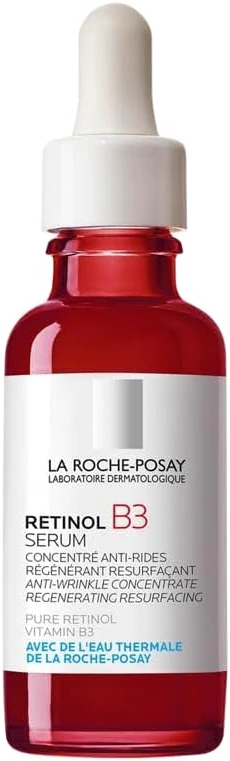
03La Roche-Posay Retinol B3
When sensitive skin still wants a properly-built retinol rather than a token one, this is the pick.
 01
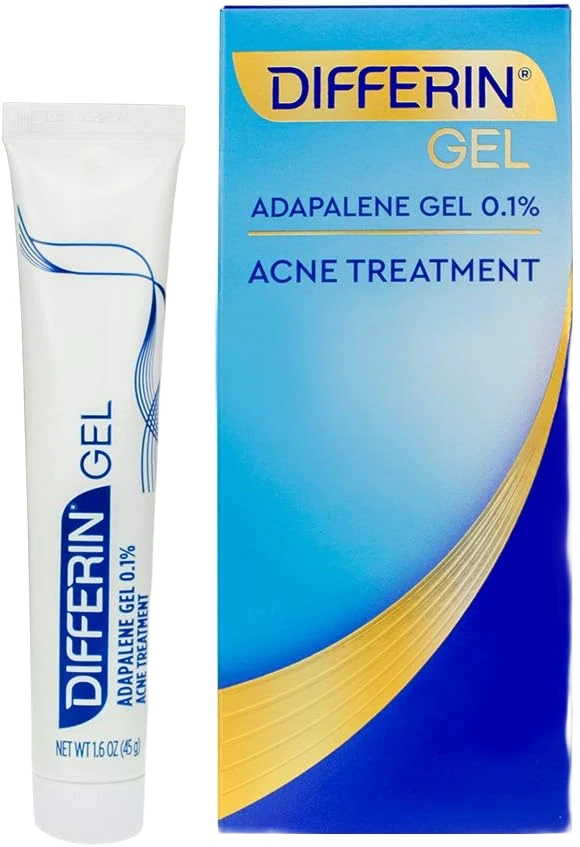
01Differin Adapalene Gel 0.1%
If you only take one thing from this list, take this: the most effective retinoid you can buy without a doctor is also one of the cheapest.
 02
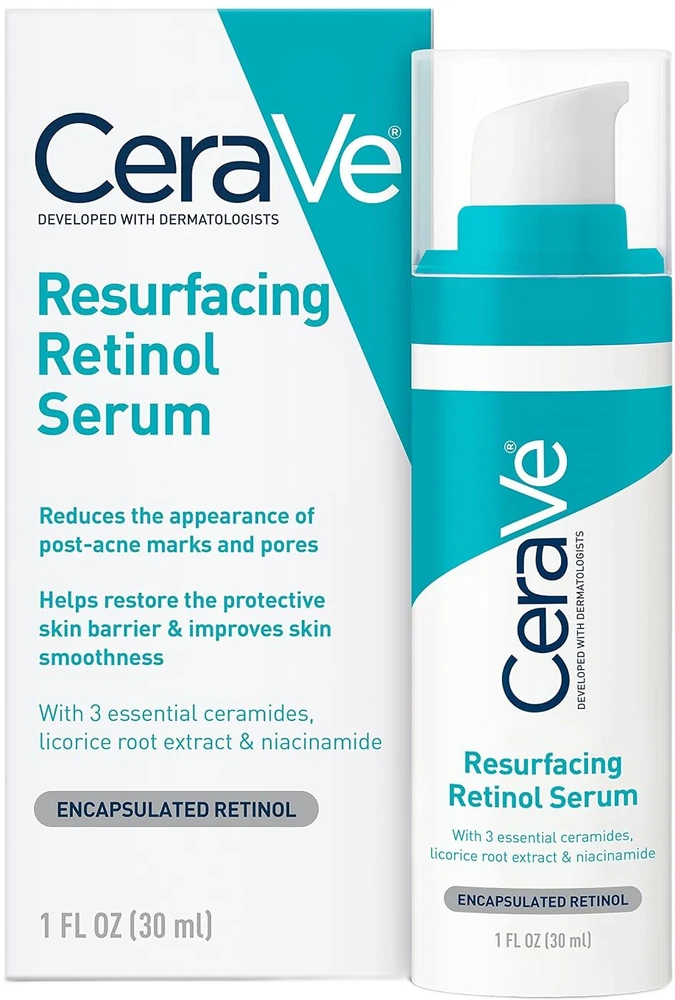
02CeraVe Resurfacing Retinol Serum
This is the retinol we hand to anyone starting out, because the biggest reason retinol "doesn't work" is that people quit it — and this one is built to be kept.
Quick Answers
Is this worth it over The Ordinary's 1%?
Only if you specifically want a complete, buffered formula. Both deliver a real 1% retinol, but Paula's Choice adds controlled-release delivery, peptides, vitamin C, and licorice in stability-minded packaging — build quality you're paying a large premium for. If you just want a real 1% for the least money and will supply your own support, The Ordinary (#5) is far cheaper.
Why does a 1% retinol rank below a 0.1% adapalene?
Because percentage isn't delivered strength. Retinol must convert through two enzymatic steps before your receptors can read it, losing potency each step, while adapalene is already receptor-active. Even the best-formulated 1% retinol pays that conversion tax, so on mechanism it sits below adapalene — and adapalene is also far cheaper.
Can a beginner use it if it's controlled-release?
It's better to build tolerance first. The controlled-release and licorice temper it, but it's still a full 1% retinol and can irritate. Start on a gentler pick like CeraVe (#2) or The Ordinary's 0.2–0.5%, and graduate here once your skin handles retinol comfortably — then still ramp slowly, twice a week to start.
Do the peptides and vitamin C actually add much?
They plausibly complement the retinol, but their individual contribution is modest — the retinol is doing most of the work. Think of them as sensible extras that round out a premium formula, not as ingredients that double the result. The main reason to buy this is the well-built, controlled-release 1% retinol itself.
Sources & Further Reading
2 peer-reviewed sources, each linked to PubMed
- [1] Mukherjee 2006 PMID 18046911 — Retinoids in the treatment of skin aging: an overview of clinical efficacy and safety. Overview confirming retinol improves fine lines, wrinkles and texture via receptor binding and collagen stimulation, while noting OTC retinol must convert to retinoic acid and is milder than prescription forms. Establishes both the efficacy of a real 1% retinol and the conversion penalty that keeps it below adapalene.
- [2] Kong 2016 PMID 26578346 — A comparative study of the effects of retinol and retinoic acid on histological, molecular, and clinical properties of human skin. Human-skin comparison showing a well-formulated retinol delivers genuine wrinkle and skin-quality improvement with better tolerability than retinoic acid. Supports both the efficacy of a proper 1% retinol and the value of controlled/gentler delivery for tolerability.
Affiliate disclosure: every Amazon link uses our Associates tag (superachieverclub-20). We earn a small commission at no cost to you; it funds independent reviews. We never accept payment to change a ranking.