
Micro Ingredients Glycine Powder Review
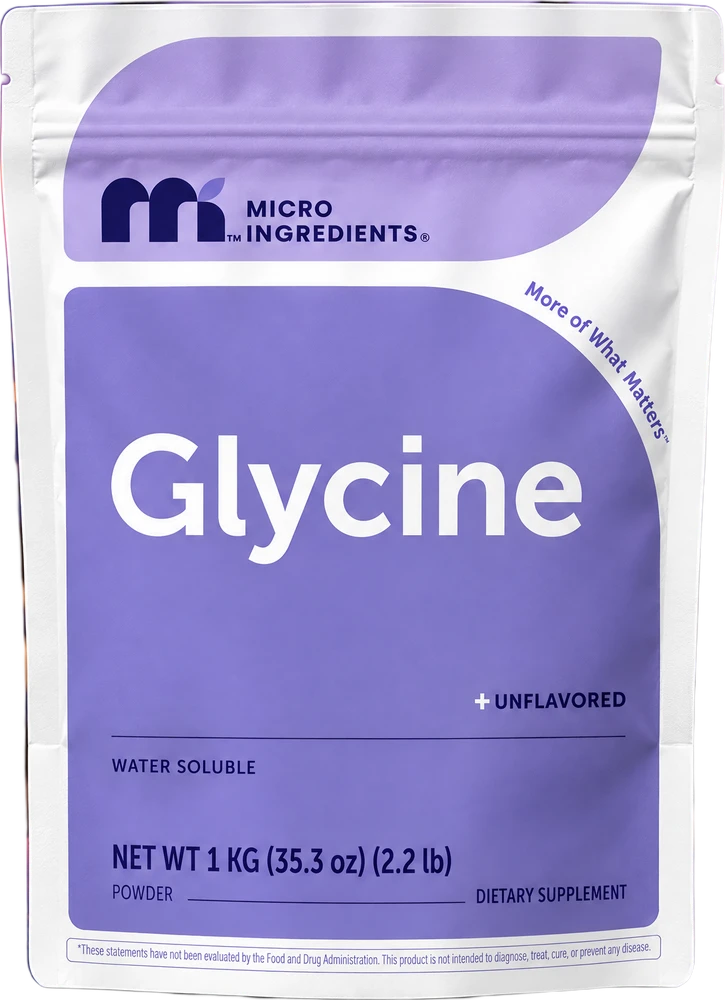 #6 of 9 · Big 1 kg Pouch✓ Label verified · Supplement Facts read Oct 18, 2026
Real retailer photo, cut out. Label unedited.
Consider it. Plain free-form glycine on a one-line panel and about 9 cents for a 3 g dose, but the scoop is 1 g so the studied dose is three scoops, the label suggests only one, and the testing claim names no lab.
$29.99 / 1 kg (1,000 servings of 1 g)About 9 cents per 3 g dose (three 1 g scoops)
Why It Scores 8.2 — And The Label Line Behind Each Number
Purity & form
25% of scoreThe panel lists Glycine (Free-Form) as the only ingredient and prints Other Ingredients: None. The back label says free of soy, dairy and gluten, and a Non-GMO seal is printed on the pack. That is the plain free-form glycine the sleep studies used, with no magnesium carrier, no NAC and no blend. It scores level with Nutricost (9.0) and NOW Foods (9.0), with nothing in the glycine itself to separate them.
- Active form
- Glycine (Free-Form), printed on the panel as Glycine (Free-Form); the only ingredient
- Other ingredients
- None
- Certifications
- None verified. Printed seals: Manufactured in a cGMP Facility, Non-GMO, Third Party Lab Tested. Back label: free of soy, dairy and gluten. No NSF, USP or Informed mark.
Third-party testing
25% of scoreThe pack prints Third Party Lab Tested and a cGMP facility seal, and the brand FAQ says products are third-party lab tested for heavy metals and micro-organisms. No lab is named, we found no certificate of analysis on the site, and the NSF Certified for Sport listing has no Micro Ingredients product (searched October 18, 2026). We could not read the USP or Informed Choice listings. That is a plausible claim with no paper trail. It scores below Nutricost (8.6), which says it uses ISO-accredited labs, and below BulkSupplements (9.0), whose per-batch testing is a listing claim we also could not check at a certifier.
- Testing
- Third Party Lab Tested seal printed on the pack; brand FAQ says tested for heavy metals and micro-organisms; no lab named; no certificate of analysis found; no Micro Ingredients product in the NSF Certified for Sport listing (checked October 18, 2026)
Dose accuracy (3 g)
20% of scoreThe panel is clear and readable: 1 scoop (1 g), 1,000 mg of glycine per serving. The catch is the size of the serving. The studied dose is 3 g, so you need three scoops, and the back label suggests one scoop at bedtime, a third of that dose. A gallery tile says the scoop measures 1/8 teaspoon, and we could not confirm that a level scoop of that volume holds 1 g, so a kitchen scale is the safe way to start. It scores below Nutricost (9.6) and NOW Foods (8.6), and above BulkSupplements (8.0) only because this panel can actually be read.
- Per serving
- 1,000 mg glycine per 1 scoop (1 g); Daily Value not established
- Scoop
- Scoop included. A gallery tile says it measures 1/8 teaspoon; not printed on the panel and not confirmed against 1 g
- Suggested use
- Adults take 1 scoop daily, preferably on an empty stomach at bedtime; for best results consult your physician (back label). That is 1 g; the studied dose is 3 g, three scoops
Taste & mixability
15% of scoreUnflavored, free-form and described by the brand as water soluble, so it should behave like the other plain glycine powders: it dissolves in water or tea and tastes faintly sweet, since glycine is naturally sweet. We scored it level with Nutricost (8.8). Three scoops is a little more stirring than one, and we have no bottle-specific taste or grit reports.
Value (per 3 g dose)
15% of score$29.99 for 1,000 servings of 1 g on October 18, 2026: about 3 cents a scoop and about 9 cents for a 3 g dose. That is bulk-pouch pricing for plain glycine, and a 1 kg pouch is a long supply at a dose a night. We kept it a notch under the 9.6 given to Nutricost and BulkSupplements, because price is only a tie-breaker and we did not re-check their current prices.
- Price
- $29.99 for 1 kg = about $0.03 per scoop (Amazon US, October 18, 2026)
- Cost per 3 g dose
- About 9 cents for three scoops
- More Specs
- Container
- 1 kg (2.2 lb) pouch · 1,000 servings of 1 scoop
- Manufacturer
- Distributed by Micro Ingredients, Montclair, CA
Label verified. Every figure read from the Supplement Facts photo, Oct 18, 2026.
Marketing Claims Vs. Reality
Glycine 1000mg per serving (Amazon title).
The panel prints Glycine (Free-Form) 1,000 mg per serving, and the serving is 1 scoop (1 g). The title is accurate, but it describes a 1 g serving, which is a third of the 3 g dose used in the sleep studies.
1,000 servings per pouch.
The panel prints 1,000 servings per container, and the 1 kg pouch divided by a 1 g serving gives the same count.
Free-form glycine with no other ingredients.
The panel lists Glycine (Free-Form) as the only ingredient and prints Other Ingredients: None. The back label adds free of soy, dairy and gluten.
Third-party lab tested for quality and consistency.
A Third Party Lab Tested seal is printed on the pack, and the brand FAQ says its products are tested for heavy metals and micro-organisms. No lab is named, no certificate of analysis is linked, and the NSF Certified for Sport listing has no Micro Ingredients product (searched October 18, 2026). The USP and Informed Choice listings could not be read.
Non-GMO and manufactured in a cGMP facility.
Both seals are printed on the back of the pack, but no certifier mark such as the Non-GMO Project is shown, and we did not check a GMP audit. For a US supplement this is a baseline, not a quality signal on its own.
Scoop measures 1/8 teaspoon (gallery tile).
This is on a marketing tile, not on the panel, and the panel says 1 scoop (1 g). We could not confirm that a level scoop of that volume holds 1 g of the powder.
Improves sleep at the studied dose.
Directionally supported by the human evidence on glycine, Yamadera 2007 and Bannai 2012, which used 3 g. That evidence is moderate, from a few small studies, and describes glycine generally, not this product. The label's own suggested use is 1 g.
What Our Test Actually Found
A one-line panel you can read in two seconds
The panel has a serving size of 1 scoop (1 g), 1,000 servings per container, and one line: Glycine (Free-Form), 1,000 mg. Other Ingredients reads None. There is no blend and no proprietary total to decode, and the back label adds free of soy, dairy and gluten. On purity this is as clean as the other plain powders on the list.
The title says 1000mg per serving, and that is the whole story on dose
The Amazon title is accurate: the serving is 1 g. The sleep studies used 3 g, so the studied dose is three scoops, and the back label suggests one scoop at bedtime, a third of it. That is not a defect in the glycine; it is a label that sells a small serving. Take three scoops if you are following the studies, and say so to yourself, because the label will not.
Weigh the first scoops
A gallery tile says the scoop measures 1/8 teaspoon, while the panel says 1 g. We could not confirm that a level scoop of that volume holds 1 g of this powder. Put a few level scoops on a kitchen scale once. If three scoops come to 3 g, count scoops from then on. If they come to less, add a scoop or weigh the dose.
Testing: printed, not proven
A Third Party Lab Tested seal is printed on the pack and the brand FAQ names what is tested, heavy metals and micro-organisms. It names no lab and links no certificate of analysis that we could find, and the NSF Certified for Sport listing has no Micro Ingredients product (searched October 18, 2026). We could not read the USP or Informed Choice listings. Absence from a list is not proof of failed testing; it means there is nothing for us to check. If it matters to you, ask the brand for the certificate of analysis for your lot.
The price is the draw
$29.99 for 1,000 servings of 1 g is about 3 cents a scoop and about 9 cents for three scoops. For a plain amino acid that is a low price per dose and a long supply. Same honest caveat as every glycine pick: it is a gentle aid backed by moderate evidence from a few small studies, so give 3 g one to two weeks before judging.
Full analysis: all pros & cons (8), buy if / skip if
- Glycine (Free-Form) is the only ingredient; Other Ingredients: None
- About 9 cents for a 3 g dose from a 1 kg pouch, 1,000 servings
- Free of soy, dairy and gluten, with a Non-GMO seal on the pack
- Scoop included and a readable, one-line panel
- The scoop is 1 g, so the studied 3 g dose is three scoops
- The label suggests one scoop, a third of the studied dose
- Third Party Lab Tested names no lab and has no NSF listing
- We could not confirm that a level 1/8 teaspoon scoop holds 1 g
- You want plain free-form glycine and the lowest price per dose from a large 1 kg pouch
- You are happy to count three scoops, or weigh 3 g, each night
- You want a one-line panel with Other Ingredients: None
- You want one scoop to equal the studied 3 g dose: Nutricost's scoop does that
- You want a named lab or an NSF, USP or Informed mark behind the testing claim; this pouch has none we could verify
- You would rather swallow capsules than mix a powder
One active line, Glycine (Free-Form), 1,000 mg per scoop, nothing else on the panel, 1,000 servings for $29.99 at the price we checked. The glycine is fine and the price is low. What holds the score at 8.2 is the dose routine and the evidence behind the testing claim: the studied dose takes three scoops, the label itself suggests one, we could not confirm that a level scoop holds 1 g, and Third Party Lab Tested names no lab and has no certifier listing we could find. Weigh the first scoops on a kitchen scale and it works well.
Micro Ingredients Glycine Powder is one ingredient in a pouch. The Supplement Facts panel lists a single line, Glycine (Free-Form), 1,000 mg per serving, with a serving of 1 scoop (1 g) and 1,000 servings per container. Other Ingredients reads None, the back label says free of soy, dairy and gluten, and the pack prints cGMP, Non-GMO and Third Party Lab Tested seals. The Amazon offer we checked on October 18, 2026 was $29.99, which is about 3 cents a scoop and about 9 cents for a 3 g dose. The glycine is what the front says it is. What to weigh is the scoop: at 1 g it takes three scoops to reach the 3 g dose used in the sleep studies, and the back label suggests one scoop at bedtime. The testing claim names no lab, and we found no Micro Ingredients product in the NSF Certified for Sport listing. That puts it in the middle of the powders on this list. It matches Nutricost's purity and gets close to it on cost, but it gives up the one-scoop routine that Nutricost's 3 g scoop offers, and its testing is a printed claim where Nutricost says it uses ISO-accredited labs. If you will count scoops and want a large, cheap pouch, it does the job. Here is the full breakdown.
A cheap, clean glycine in a big pouch, if you will count three scoops.

Micro Ingredients Glycine Powder gives you what the front says: free-form glycine, one line on the panel, Other Ingredients: None. At about 9 cents for a 3 g dose and 1,000 servings in the pouch, the price is low and the supply is long. What holds the score at 8.2 is the routine and the paper trail. The scoop is 1 g, so the studied dose is three scoops while the label suggests one, we could not confirm that a level scoop holds 1 g, and the testing claim names no lab and has no certifier listing we could find. Nutricost's 3 g scoop is the easier nightly routine and scores higher on testing; BulkSupplements has the label we could not read. Buy this one if the price and the pouch size matter more to you than a one-scoop dose. Weigh the first scoops on a kitchen scale, take 3 g, 30 to 60 minutes before bed, and give it one to two weeks.
If This Doesn’t Fit — Try These
Nutricost Glycine Powder
The same plain free-form glycine, with a 3 g scoop in the tub, so one scoop is the studied dose.
NOW Foods Glycine Pure Powder
Pure glycine from a household-name brand, widely stocked as an easy offline backup.
BulkSupplements Glycine Powder
A bulk bag with the lowest cost per gram on the list, though we could not read a Supplement Facts panel for it, so its dose and purity are listing claims.
Quick Answers
How much glycine is in one scoop, and how many scoops make the 3 g sleep dose?
The Supplement Facts panel prints a serving size of 1 scoop (1 g) and Glycine (Free-Form) 1,000 mg per serving, with 1,000 servings per container. The studied sleep dose is 3 g (Yamadera 2007; Bannai 2012, PMID 22529837), so you need three scoops. The back label suggests one scoop daily at bedtime, which is a third of the studied dose. The Amazon title says 1000mg per serving, and that is accurate: it is the label serving, not the sleep dose.
Is the scoop really 1 g?
The panel says 1 scoop (1 g), and a gallery tile says the scoop measures 1/8 teaspoon. We could not confirm that a level scoop of that volume holds 1 g of this powder. Weigh the first few scoops on a kitchen scale, then count scoops from there. Counting three small scoops each night is the main practical cost of this product against a 3 g scoop.
Is it plain glycine, or is it cut with anything?
The panel lists one ingredient, Glycine (Free-Form), and prints Other Ingredients: None. The back label also says free of soy, dairy and gluten, and a Non-GMO seal is printed on the pack. That is the plain free-form glycine the sleep studies used, so it passes the purity test this list applies.
Is Micro Ingredients Glycine third-party tested?
The pack prints a Third Party Lab Tested seal, and the brand FAQ says its products are third-party lab tested for heavy metals and micro-organisms. No lab is named and we found no certificate of analysis on the site. We checked the NSF Certified for Sport listing on October 18, 2026 and found no Micro Ingredients product. We could not read the USP or Informed Choice listings, so those are unchecked. The claim is plausible, but we could not verify it at a certifier.
Is a 1 kg pouch a good buy for glycine?
On cost, yes. The Amazon offer we checked on October 18, 2026 was $29.99 for 1,000 servings of 1 g, which is about 3 cents a scoop and about 9 cents for a 3 g dose. The trade is the scoop count: three scoops a night where Nutricost's scoop is the whole dose. If you want the tub with the 3 g scoop, Nutricost is the easier nightly routine.
Sources & Further Reading
3 sources — studies link to PubMed, product specs to the manufacturer
- [1] Bannai 2012 PMID 22529837 — The effects of glycine on subjective daytime performance in partially sleep-restricted healthy volunteers. In healthy volunteers whose sleep was restricted for three nights, 3 g of glycine before bed significantly reduced subjective daytime fatigue and sleepiness and improved reaction-time performance versus placebo. The best-replicated glycine sleep finding — but a small study, and the authors are affiliated with a glycine manufacturer (noted for transparency).
- [2] Kawai 2015 PMID 25533534 — The sleep-promoting and hypothermic effects of glycine are mediated by NMDA receptors in the suprachiasmatic nucleus. Mechanistic study in rats: oral glycine promoted sleep and lowered core body temperature by acting on NMDA receptors in the suprachiasmatic nucleus (the master circadian clock), increasing skin blood flow and heat loss. Provides the leading biological explanation for glycine's sleep effect — but it is an animal study, so extrapolation to humans is indirect.
- [3] Yamadera 2007 — Glycine ingestion improves subjective sleep quality in human volunteers, correlating with polysomnographic changes. In volunteers with unsatisfactory sleep, 3 g of glycine before bed improved subjective sleep quality and, on polysomnography, shortened latency to sleep onset and to slow-wave sleep. The canonical human glycine-sleep study and the source of the 3 g dose — but small (~11 subjects) and published in a journal PubMed does not index, so no PMID exists. Cited honestly without a fabricated identifier.
Affiliate disclosure: every Amazon link uses our Associates tag (superachieverclub-20). We earn a small commission at no cost to you; it funds independent reviews. We never accept payment to change a ranking.