
La Roche-Posay Anthelios Mineral SPF 50 Gentle Lotion Review
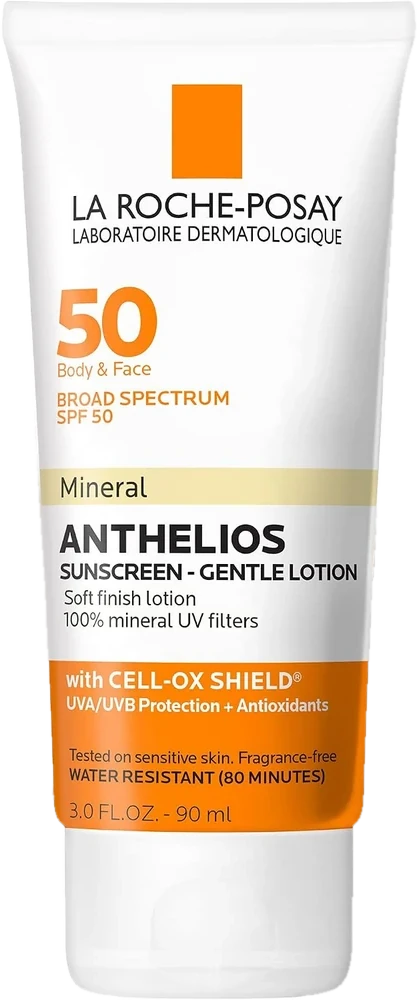 #1 of 8 · Best overall✓ Product photos checked Oct 10, 2026
Real retailer photo, cut out. Label unedited.
Buy it. Mineral filters and nothing UV-absorbing around them. SPF 50, about $19 for 3 fl oz. Zinc oxide 15% + titanium dioxide 5%, broad-spectrum SPF 50, antioxidant complex, oil-free, fragrance-free, water resistant (80 minutes), for face and body.
$19 / 3 fl oz tube~$0.18 / daily facial use
Why It Scores 9.2 — And The Label Line Behind Each Number
Filter safety + body-health
35% of scoreThe ceiling of this ranking. The only active ingredients are zinc oxide and titanium dioxide, so none of the six chemical filters from the FDA's JAMA absorption trials is involved. We also read the inactive list on the tube (Oct 10, 2026): it contains neither butyloctyl salicylate nor ethylhexyl methoxycrylene, the UV-absorbing helpers that cost the two CeraVe mineral formulas 1.4 points each on this axis.
Broad-spectrum protection + SPF 30+
25% of scoreSPF 50 broad-spectrum, with 15% zinc oxide carrying the UVA coverage, plus 80 minutes of water resistance stated on the tube. SPF 50 filters about 98% of UVB and forgives the common habit of under-applying.
Cosmetic elegance + daily wearability
20% of scoreA soft-finish, oil-free lotion — easier to wear than old chalky zinc, but not invisible. The brand's own listing says it can leave a white cast on some skin tones and gives a rub-in technique for it. We have not wear-tested it on deep skin tones. It scores below the cast-free picks on this axis and slightly above the richer CeraVe Hydrating tube.
Skin-friendliness
10% of scoreFragrance-free, oil-free, allergy-tested and tested on sensitive skin, with the brand's antioxidant complex. Among the gentlest profiles on the page; only the lack of a hydrating co-active such as ceramides keeps it below a perfect mark for very dry skin.
Value + cost per daily use
10% of scoreAbout $19 for 3 fl oz works out to roughly $0.18 per daily facial use, level with the cheapest mineral option on the page, and the tube also covers the body. A dermatologist brand at a drugstore cost per wear.
- Size
- 3.0 fl oz (90 mL) tube
- Price
- About $19 / 3 fl oz (~$0.18 per daily facial use)
- More Specs
- Filter type
- 100% mineral — zinc oxide 15% + titanium dioxide 5%; no UV-absorbing helper in the inactive list
- SPF
- SPF 50, broad-spectrum UVA + UVB; water resistant (80 minutes)
- Key actives
- Antioxidant complex (Cell-Ox Shield); oil-free, fragrance-free
- Finish
- Soft-finish lotion for face and body; can leave a white cast on some skin tones
- Skin fit
- Sensitive, reactive, allergy-prone; allergy-tested, tested on sensitive skin
- Label check
- Drug Facts and inactive ingredients read from the listing photo, Oct 10, 2026
Photos checked.This product has no Supplement Facts panel; the retailer's listing photos were reviewed Oct 10, 2026.
Marketing Claims Vs. Reality
100% mineral UV filters.
The Drug Facts panel lists titanium dioxide 5% and zinc oxide 15% as the only active ingredients, and the inactive list contains no salicylate ester and no methoxycrylene. On this label the claim holds for the whole formula.
Broad-spectrum SPF 50, water resistant (80 minutes).
Both are FDA-regulated label claims printed on the tube.
Tested on sensitive skin; fragrance-free; oil-free.
Stated on the tube and consistent with the ingredient list, which shows no added fragrance.
Cell-Ox Shield: UVA/UVB protection plus antioxidants.
The formula contains tocopherol and a cassia alata leaf extract, so 'plus antioxidants' is accurate. How much they add to protection on the skin is not shown by independent trials.
Soft finish.
Fair for a mineral lotion. The brand's own listing adds that a white cast is possible on some skin tones, so the finish depends on skin tone and on how well it is rubbed in.
What Our Test Actually Found
The label is what separates #1 from #2 and #3
All three top picks declare only mineral filters. When we read the inactive ingredients, the two CeraVe formulas each carried one UV-absorbing helper and this lotion carried none. That is the whole reason it leads: it is the only one of the three we can call mineral without an asterisk.
SPF 50 for face and body at about $0.18 a day
The 3 fl oz tube costs about $19, so the cost per facial use matches the cheapest mineral option on the page, and it doubles as a body sunscreen with 80 minutes of water resistance.
The cast is real and the brand says so
La Roche-Posay's listing states that a 100% mineral sunscreen can leave a white cast on some skin tones and explains how to work it in. We take that at face value. If the cast stops you wearing it, a sunscreen further down this list that you do wear is the better choice.
Not the Anthelios fluid
The brand also sells a Mineral Light Fluid in a 1.7 fl oz bottle. It is a different formula (titanium dioxide 6%, zinc oxide 5%) at a higher price, and its inactive ingredients are not readable in the listing photos. This review covers the Gentle Lotion only.
Full analysis: all pros & cons (7), buy if / skip if
- Zinc oxide and titanium dioxide are the only UV filters — and the inactive list has no UV-absorbing helper
- SPF 50 broad-spectrum with 80 minutes of water resistance
- Fragrance-free, oil-free, allergy-tested, tested on sensitive skin
- About $19 for 3 fl oz — roughly $0.18 per daily facial use, and it covers the body too
- Can leave a white cast, most visible on medium-to-deep skin tones — the brand says so itself
- A lotion, not a weightless fluid — oily skin may find it rich under makeup
- No hydrating co-active such as ceramides — very dry skin may want a moisturizer underneath
- You want a sunscreen whose only UV-active ingredients are zinc oxide and titanium dioxide
- You have sensitive, reactive or allergy-prone skin and want a fragrance-free, allergy-tested formula
- You want one tube for face and body with SPF 50 and 80 minutes of water resistance
- You want a dermatologist brand at a drugstore-level cost per use
- A mineral white cast is a dealbreaker on your skin tone — try CeraVe Invisible Mineral (#2) or Black Girl Sunscreen (#6)
- You want ceramides and a hydrating finish for dry skin — CeraVe Hydrating Mineral (#3)
- You want a weightless facial fluid under makeup — this is a lotion
Zinc oxide 15% + titanium dioxide 5%, broad-spectrum SPF 50, antioxidant complex, oil-free, fragrance-free, water resistant (80 minutes), for face and body. The inactive list has no salicylate ester and no methoxycrylene. Trade-offs: a white cast on some skin tones and a lotion feel rather than a weightless fluid. If the cast is the blocker, CeraVe Invisible Mineral (#2) is the next step down the list.
La Roche-Posay Anthelios Mineral SPF 50 Gentle Lotion is the sunscreen this ranking is built to end up at. Its Drug Facts panel lists two active ingredients, zinc oxide (15%) and titanium dioxide (5%), the only two filters the FDA proposes as GRASE (generally recognized as safe and effective). Mineral filters sit on the skin and scatter UV; they are not among the compounds the FDA's own JAMA trials measured in the bloodstream. What puts this tube ahead of the two CeraVe mineral sunscreens is the rest of the label: we read the inactive ingredients and found none of the UV-absorbing helpers that both CeraVe formulas carry. It is an oil-free, fragrance-free lotion for face and body with an antioxidant complex, water resistant for 80 minutes, at about $19 for 3 fl oz. The honest costs are a possible white cast, which the brand itself warns about, and a lotion texture that is richer than a facial fluid.
The one tube we can call mineral without an asterisk.

If you asked for one sunscreen and no lecture, this is it: zinc oxide and titanium dioxide at SPF 50 from a dermatologist brand, with nothing UV-absorbing hidden in the rest of the label, for about $19. Nothing here is among the filters the FDA measured in the bloodstream. The honest cost is a possible white cast and a lotion feel. If either stops you from wearing it daily, CeraVe Invisible Mineral (#2) solves the cast and CeraVe Hydrating Mineral (#3) suits dry skin, each with one helper ingredient we deduct for.
If This Doesn’t Fit — Try These
 02
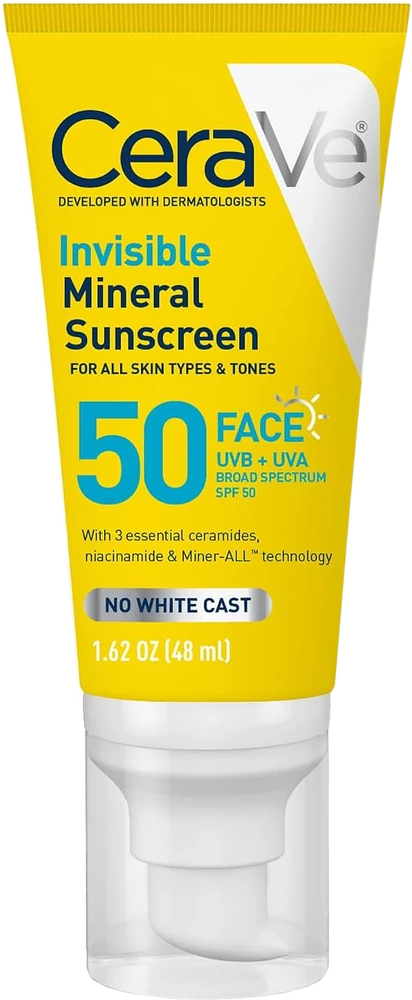
02CeraVe Invisible Mineral
CeraVe Invisible Mineral SPF 50 keeps you on zinc oxide and titanium dioxide, adds SPF 50 headroom, ceramides and niacinamide, and is sold as leaving no cast, all for about $14.
 03
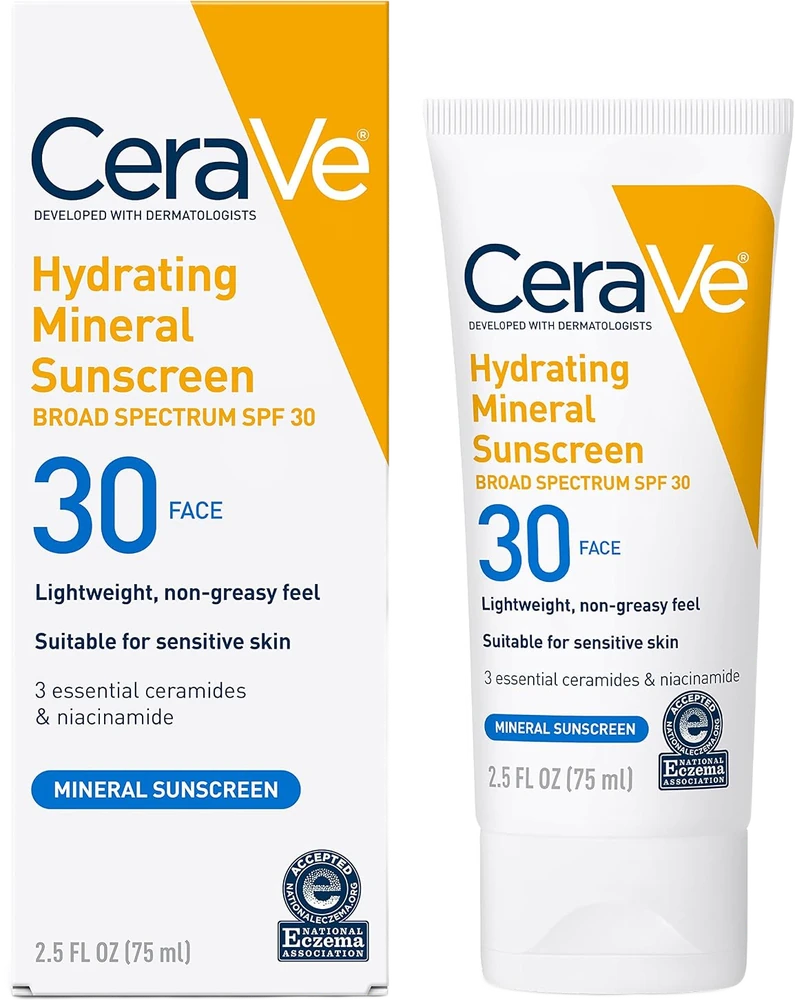
03CeraVe Hydrating Mineral
CeraVe Hydrating Mineral SPF 30 keeps you on zinc oxide and titanium dioxide and adds the ceramides and niacinamide the brand is known for, at about eighteen cents a day.
 04
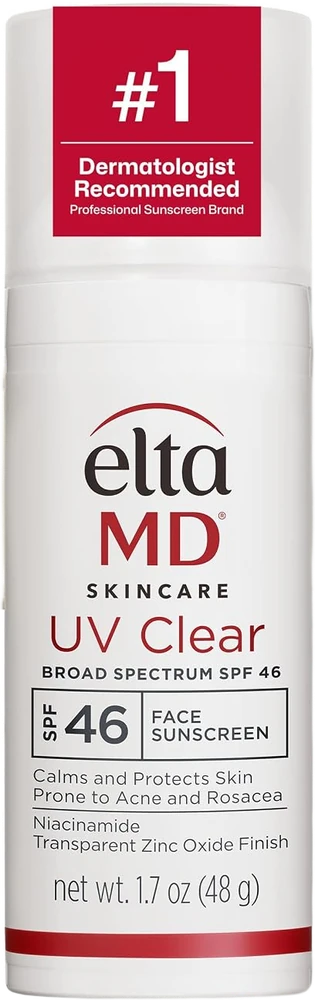
04EltaMD UV Clear
EltaMD UV Clear is the best skin-feel formula on this page and we're still demoting it, because honesty is the product here: 'zinc oxide' on the front of the tube shares the ingredient list with 7.5% octinoxate — absorbed systemically per the FDA's own trials, hormone-flagged in animal work, and simply unnecessary when the three picks above it do the same job without it.
Quick Answers
Why is this #1 when the two CeraVe mineral sunscreens are also mineral?
All three list only zinc oxide and titanium dioxide as active filters. The difference is in the inactive ingredients. CeraVe Invisible Mineral (#2) contains ethylhexyl methoxycrylene and CeraVe Hydrating Mineral (#3) contains butyloctyl salicylate, two compounds that formulators add to stabilise or boost sunscreens. This lotion's label lists neither. On the axis we weight most, filter safety, that is the gap between 9.8 and 8.4.
Will it leave a white cast?
It can. The brand says so on its own listing: a 100% mineral sunscreen can leave a white cast on some skin tones, and it recommends warming a small amount between the fingers and working it in section by section. On light-to-medium skin the cast usually fades once it sets; on medium-to-deep tones it can show. If a cast has kept you from wearing sunscreen at all, try CeraVe Invisible Mineral (#2), which is sold as cast-free, or Black Girl Sunscreen (#6), with its chemical filters stated plainly.
Is this the same as the Anthelios Mineral fluid in the small bottle?
No. La Roche-Posay sells two mineral SPF 50 products under the Anthelios name: a light fluid for the face in a 1.7 fl oz bottle, and this Gentle Lotion for face and body in a 3 fl oz tube. This review and our buy link are for the lotion. We read the lotion's full label; the fluid's inactive ingredients are not shown in its listing photos, so we have not ranked it.
Can I use it on my face every day?
Yes. It is labelled for face and body, oil-free, fragrance-free, allergy-tested and tested on sensitive skin. As a lotion it is richer than a facial fluid; oily skin may want a thin layer, very dry skin may want a moisturizer underneath.
Is it water resistant?
The tube states water resistant (80 minutes). Reapply after swimming, sweating or towel drying, and at least every two hours in real sun.
Sources & Further Reading
3 peer-reviewed sources, each linked to PubMed
- [1] Hughes 2013 PMID 23732711 — Sunscreen and prevention of skin aging: a randomized trial. Daily sunscreen users in the Nambour RCT showed no detectable skin aging over 4.5 years versus measurable aging in discretionary users — the reason a sunscreen people wear every day matters more than its SPF number.
- [2] Green 1999 PMID 10475183 — Daily sunscreen application and betacarotene supplementation in prevention of basal-cell and squamous-cell carcinomas of the skin: a randomised controlled trial. In the same Nambour population, regular daily sunscreen use significantly reduced squamous cell carcinoma and actinic keratoses.
- [3] Matta 2020 PMID 31961417 — Effect of sunscreen application on plasma concentration of sunscreen active ingredients: a randomized clinical trial. Six chemical filters exceeded the FDA plasma safety-testing threshold, several after one application. None of the six is an active ingredient of this product.
Affiliate disclosure: every Amazon link uses our Associates tag (superachieverclub-20). We earn a small commission at no cost to you; it funds independent reviews. We never accept payment to change a ranking.