
5% Nutrition Real Carbs + Protein (Banana Nut Bread) Review
 #1 of 8 · Best overall✓ Label verified · Supplement Facts read Sep 7, 2026
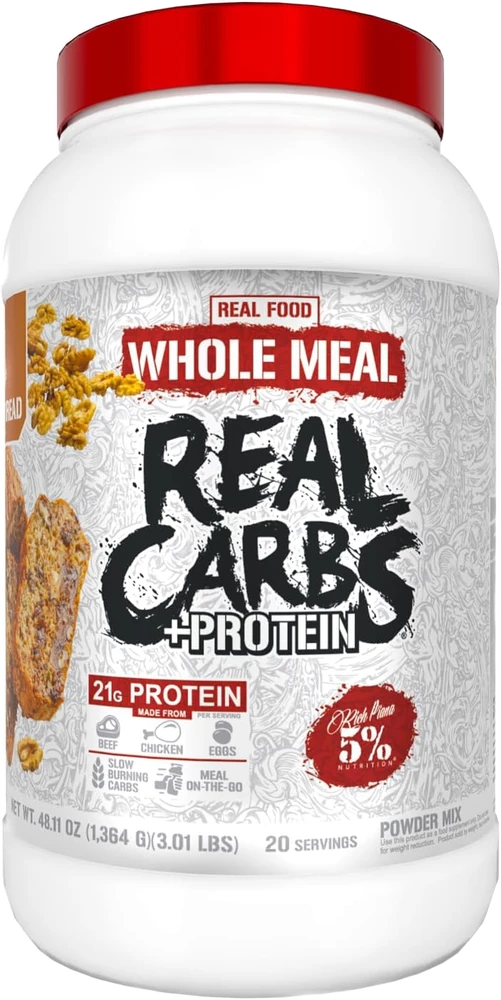
Real retailer photo, cut out. Label unedited.
Buy it. A real-food meal in a tub — oats, sweet potato and rice, 2 g sugar, no maltodextrin, no dairy. The cleanest option here. Whole-grain oats + sweet potato + brown rice for carbs, a beef-egg-chicken-chickpea protein blend, 6 g fiber and just 2 g sugar per ~260 kcal scoop.
$45$2.25 / serving ($0.87 / 100 kcal)
Why It Scores 8.8 — And The Label Line Behind Each Number
Carb ratio & carb quality
30% of scoreGenuine whole-food carbohydrate — whole-grain oats, sweet potato and brown rice — with just 2 g of sugar, 6 g of fiber and zero maltodextrin. On carb quality it is essentially tied with the #1 pick and clear of everything else. It scores a touch below only because the carb-to-calorie load per scoop is modest, so the whole-food quality has to be dosed up by volume.
Calorie & protein density
25% of score21 g of protein and ~260 kcal per scoop is the lowest single-serving density on the list — by design. It is a scalable meal, not a bulk bomb, so you multiply scoops to hit a surplus. That flexibility is a strength for controlled bulking but costs it points on raw density against the 1,200-calorie tubs.
- Protein
- 21 g whole-food blend (beef, egg, chicken, chickpea)
Ingredient quality
20% of scoreThe highest ingredient-quality score on the list. A whole-food animal-and-plant protein blend (beef, egg, chicken, chickpea), real micronutrients (iron, magnesium, potassium, vitamin A), 6 g of fiber, and dairy-free/lactose-free/whey-free formulation with no maltodextrin. This is the closest thing here to eating actual food.
Value per calorie
15% of scoreAt ~$0.87 per 100 kcal it is not cheap as pure calories, and the 20-serving tub is smaller so per-meal cost mounts when you scale the dose. It scores well anyway because you're buying a clean whole-food meal, not just calories — but if your metric is raw cost per calorie, the maltodextrin tubs are cheaper.
- Servings
- 20 per tub
- Price
- $45 / tub ≈ $2.25 per serving ($0.87 / 100 kcal)
Mixability & taste
10% of scoreA modest single-scoop serving blends easily without the thick paste of the seven-scoop bombs, and the Banana Nut Bread flavor is well liked. Because you control the serving size, it's easy to mix to a consistency you'll actually finish.
- More Specs
- Calories
- ~260 kcal per serving (1 scoop) — scale up servings to hit a surplus
- Carbs / Sugar
- 29 g total / 2 g sugar (0 g added), 6 g fiber
- Carb source
- Whole-food: whole-grain oats, sweet potato, brown rice
- Dietary
- Dairy-free / lactose-free / whey-free; no maltodextrin
- Micronutrients
- Iron, magnesium, potassium, vitamin A
Label verified. Every figure read from the Supplement Facts photo, Sep 7, 2026.
Marketing Claims Vs. Reality
Real whole-food carbs — no maltodextrin, no dextrin derivatives.
The label lists whole-grain oats, sweet potato and brown rice as the carbohydrate sources with no maltodextrin. This is verifiable from the ingredient panel and is the product's central, accurate differentiator against the maltodextrin-based mainstream tubs.
Only 2 g of sugar per serving.
The nutrition panel states 2 g of Total Sugars per scoop (0 g Added Sugars), among the lowest on the entire list. Combined with 6 g of fiber, this is the low-sugar, whole-food carb profile the product advertises, and it holds up against the label.
A whole-food protein blend from beef, egg, chicken and chickpea.
The 21 g protein blend from beef, egg, chicken and chickpea is label-stated and dairy-free. It is a genuine multi-source animal-and-plant blend; the amount and sources are verifiable, though 'whole-food' describes the sourcing rather than a certified digestibility metric.
A mass gainer for building size.
At ~260 kcal per scoop this is a scalable meal, not a high-calorie bomb, so it 'gains mass' only when you stack multiple servings into a genuine surplus alongside training (Slater 2019, PMID 31482093). Marketed and used as a clean meal it's excellent; treated as a single-shake bulk bomb it under-delivers on calories, so the framing is accurate only with the multi-serving caveat.
Dairy-free, lactose-free and whey-free.
The formulation contains no whey or dairy, using a beef-egg-chicken-chickpea blend instead, which is verifiable from the label. This is a real advantage for lactose-intolerant users that most gainers — built on whey and casein — cannot match.
What Our Test Actually Found
Correction: the label's total-carb and sugar figures
An earlier version of this review said this product has 30 g of total carbs and 2-3 g of sugar per scoop. The Supplement Facts panel reads 29 g Total Carbohydrate, 6 g Dietary Fiber, 2 g Total Sugars (0 g Added Sugars) per scoop. We re-read the label on Sep 7, 2026 and corrected the total-carb and sugar numbers throughout this review.
This is closer to eating a meal than drinking a supplement
Whole-grain oats, sweet potato and brown rice for carbs; a beef-egg-chicken-chickpea blend for protein; 6 g of fiber and real micronutrients. There's no maltodextrin and almost no sugar. If your objection to gainers is that they're refined sugar-bombs in a muscle costume, this is the answer — it's the closest thing on the list to blending actual food.
You control the calories — which means you have to do the math
At ~260 kcal a scoop this isn't a one-shake bomb; it's a scalable meal. That's a feature for a controlled lean bulk, but it means hitting a 500-800 kcal surplus takes two or three servings, and the 20-serving tub empties faster as you scale. Plan your dose around your surplus target rather than expecting one scoop to do the work of a 1,250-calorie tub.
The best pick on the list for lactose intolerance
Every other gainer here leans on whey and casein. This one is dairy-free, lactose-free and whey-free, using an animal-and-plant blend instead. If dairy wrecks your stomach — a common reason people abandon gainers — this removes the problem entirely while keeping the protein quality high.
No creatine and not the cheapest calories — know the trade-offs
Two honest gaps: there's no creatine (you'd add 3-5 g of monohydrate separately per Kreider 2017), and at ~$0.87 per 100 kcal the clean whole-food formula costs more per calorie than the maltodextrin tubs. You're paying for food quality, not calorie efficiency. If cheap bulk calories are the goal, this is the wrong tool.
Full analysis: all pros & cons (7), buy if / skip if
- Genuine whole-food carbs (oats + sweet potato + rice) with only 2 g sugar and no maltodextrin
- Highest ingredient-quality score on the list — a real meal, 6 g fiber, real micronutrients
- Dairy-free, lactose-free, whey-free animal-and-plant protein blend
- You control the serving size — ideal for a disciplined, scalable lean bulk
- Well-liked Banana Nut Bread flavor that mixes cleanly at a modest serving size
- Only ~260 kcal per scoop — hitting a real surplus takes multiple servings
- No creatine, and the smaller 20-serving tub costs more per calorie as you scale the dose
- You refuse to drink maltodextrin and 25-35 g of sugar — you want genuine whole-food carbs
- You want to control portion size and stack scoops to hit your own surplus target
- You need dairy-free, lactose-free, whey-free protein
- You value a clean, high-fiber meal over the biggest calorie headline
- You want a single 1,000+ calorie shake — at ~260 kcal a scoop this takes several servings
- You want the cheapest calories or built-in creatine — this has neither
Whole-grain oats + sweet potato + brown rice for carbs, a beef-egg-chicken-chickpea protein blend, 6 g fiber and just 2 g sugar per ~260 kcal scoop. It's the closest thing on the list to eating a clean meal, and you scale the calories by adding scoops. The catch is exactly that: at ~260 kcal it's not a one-shake bomb, so hitting a real surplus takes multiple servings and the cost adds up. Ideal for the disciplined hardgainer who'd rather under-dose calories than drink anything refined.
5% Nutrition Real Carbs + Protein is the honest hardgainer's tool: instead of chasing a giant calorie headline with maltodextrin and sugar, it's a clean whole-food meal whose size you control. The carbs are actual whole-grain oats, sweet potato and brown rice; the protein is a dairy-free beef-egg-chicken-chickpea blend; there's 6 g of real fiber and only 2 g of sugar, with no maltodextrin or dextrin derivatives at all. At roughly 260 calories per scoop it is deliberately not a one-shake bomb — you stack servings through the day to build your surplus, which is exactly how a thoughtful bulk should work. It loses the top spot only because reaching a big surplus takes several scoops and the per-meal cost mounts. For anyone who flatly refuses to drink a sugar-bomb, this is the cleanest gainer on the list.
The cleanest gainer on the list — a real-food meal you scale yourself, for the hardgainer who refuses a sugar-bomb.

Real Carbs + Protein is what a mass gainer looks like when you refuse the category's shortcuts. Instead of a giant calorie headline built on maltodextrin and sugar, it's a whole-food meal — oats, sweet potato and rice for the carbs, a dairy-free beef-egg-chicken-chickpea blend for the protein, 6 g of fiber and just 2 g of sugar. On ingredient quality it's the best on the list, and it's the only pick that solves lactose intolerance outright. It lands at #2 rather than #1 for one structural reason: at ~260 calories a scoop it's a scalable meal, not a single-shake bomb, so building a real surplus takes several servings and the cost mounts. There's also no creatine to add separately. But those are the honest costs of a genuinely clean formula, and for the disciplined hardgainer who'd rather stack clean scoops than drink anything refined, nothing here is cleaner. Buy it as a meal you control the size of — and let the surplus and training do the muscle-building.
If This Doesn’t Fit — Try These
015% Nutrition Real Carbs + Protein
Real Carbs + Protein is the honest hardgainer's pick: instead of chasing a giant calorie headline with maltodextrin and sugar, it's a clean whole-food meal you control the size of.
 03
03Dymatize Super Mass Gainer
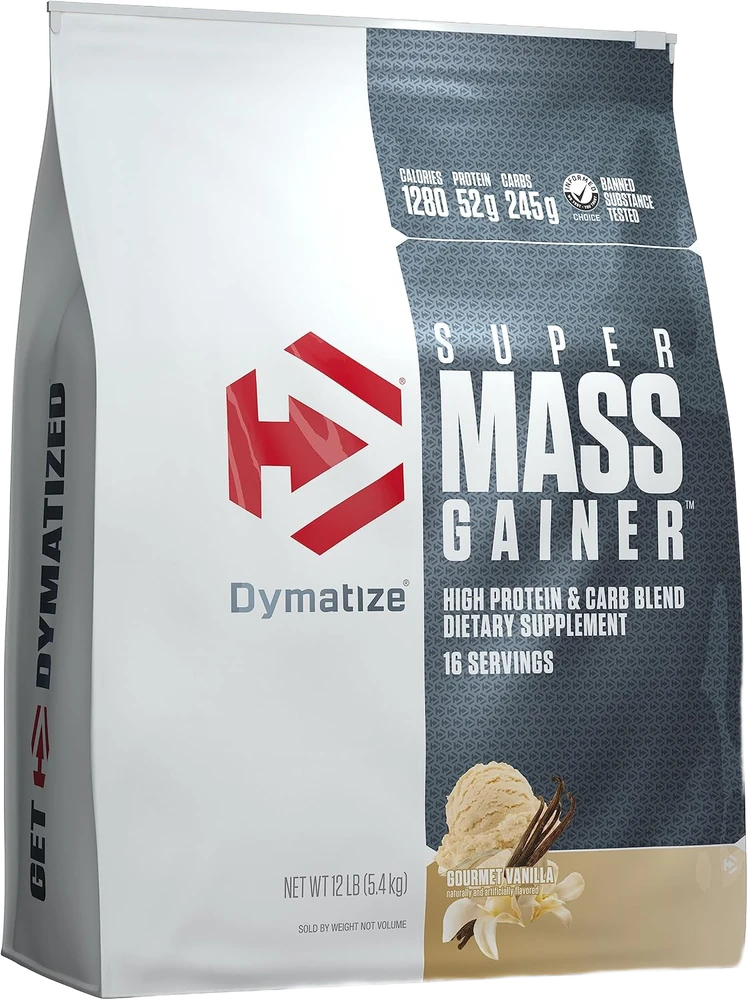
Super Mass Gainer is essentially ON Serious Mass's closest rival, and on raw numbers it edges ahead — 1,280 calories and 52 g of a genuinely good whey-isolate-and-casein blend with 10.7 g of BCAAs, and it's frequently the cheapest tub per calorie on the whole list.
 07
07MuscleTech Mass-Tech Extreme 2000
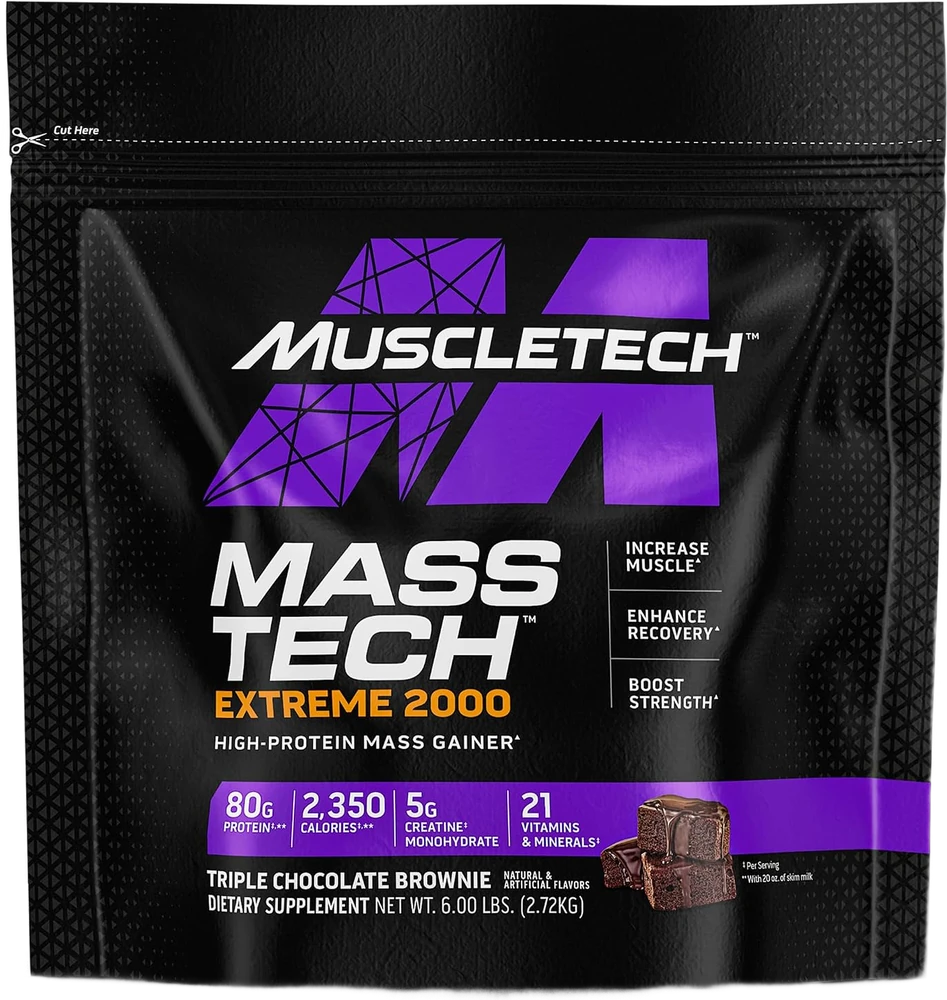
Mass-Tech Extreme 2000 is the maximum-calorie option, and it has one feature the others mostly lack — a full, effective 5 g of creatine plus 8.4 g of leucine.
Quick Answers
How many scoops do I need to actually gain weight?
That depends on your surplus target. At ~260 kcal a scoop, two scoops adds ~520 kcal and three adds ~780 kcal on top of your normal diet. Most hardgainers run two to three servings a day to hit a meaningful surplus. Track your weight weekly and add or remove a scoop to keep gaining at a controlled pace — the scalability is the whole point of the product.
Is it really dairy-free?
Yes. Unlike almost every other gainer here, it contains no whey or casein — the protein comes from a beef, egg, chicken and chickpea blend, and it's labeled dairy-free, lactose-free and whey-free. If dairy upsets your stomach, this is the pick that removes the problem entirely.
Why is it ranked above the 1,250-calorie tubs if it has fewer calories?
Because the ranking weights carb quality and ingredient quality above the raw calorie headline. Calories are the easy part — you can add them from anything — but this delivers them as whole-food oats, sweet potato and rice with almost no sugar, which is cleaner fuel than a wall of maltodextrin and 30 g of added sugar. The lower calorie density is a design choice, not a flaw.
Does it have creatine?
No. If you want creatine you'd add 3-5 g of monohydrate separately, which is the effective dose per the ISSN position stand (Kreider 2017). Some gainers, like Transparent Labs and MuscleTech, build creatine in; this one keeps the formula to whole-food carbs and protein and leaves creatine to you.
Sources & Further Reading
4 peer-reviewed sources, each linked to PubMed
- [1] Slater 2019 PMID 31482093 — Is an energy surplus required to maximize skeletal muscle hypertrophy associated with resistance training. A modest, individualized energy surplus supports hypertrophy alongside training, and a large surplus mainly adds fat. This product's scalable ~260 kcal servings let you dial a measured surplus precisely rather than overshooting with a 1,250-calorie bomb.
- [2] Morton 2018 PMID 28698222 — A systematic review, meta-analysis and meta-regression of the effect of protein supplementation on resistance training-induced gains in muscle mass and strength in healthy adults. Protein supplementation aids resistance-training gains up to ~1.6 g/kg/day. At 21 g per scoop you reach that target by distributing several servings across the day — which fits this product's stack-to-taste design.
- [3] Schoenfeld 2018 PMID 29497353 — How much protein can the body use in a single meal for muscle-building? Implications for daily protein distribution. The authors recommend ~0.4 g/kg of protein per meal across at least four meals to optimize muscle protein synthesis. A 21 g scoop is a sensible per-meal protein dose, supporting this product's distribute-across-the-day approach rather than a single mega-serving.
- [4] Moore 2009 PMID 19056590 — Ingested protein dose response of muscle and albumin protein synthesis after resistance exercise in young men. Muscle protein synthesis was near-maximally stimulated around 20 g of high-quality protein per serving. This product's 21 g per scoop meets that per-serving threshold cleanly, which is why distributing scoops works well.
Affiliate disclosure: every Amazon link uses our Associates tag (superachieverclub-20). We earn a small commission at no cost to you; it funds independent reviews. We never accept payment to change a ranking.