
Double Wood Tongkat Ali Complex 1020 mg Review
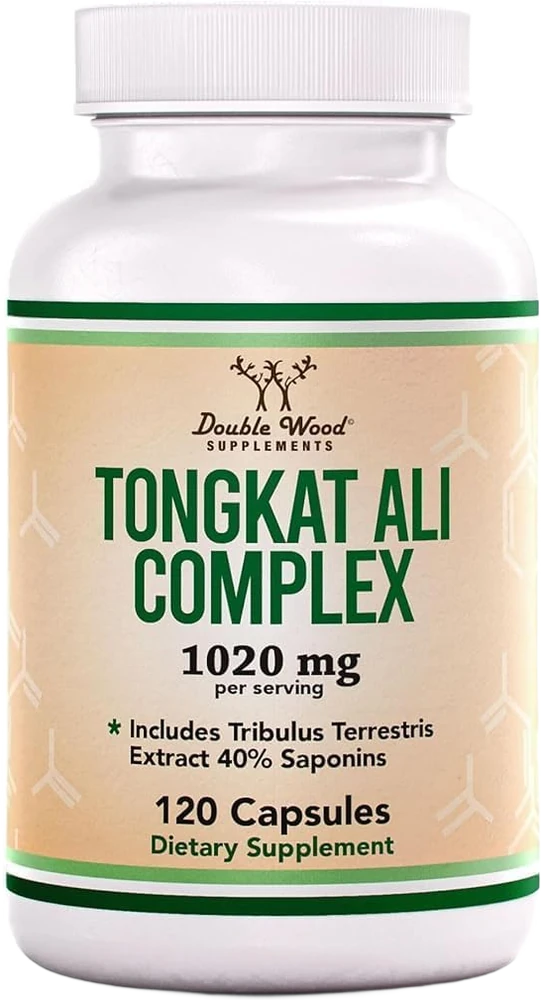 #8 of 9 · Cheapest tested✓ Label verified · Supplement Facts read Aug 27, 2026
Real retailer photo, cut out. Label unedited.
Consider it. Cheapest tested tongkat here — but it's a Complex, and the headline milligrams are padded. Roughly $25 buys a 120-capsule, 60-serving bottle with a dated third-party heavy-metal and microbial panel behind it — genuinely the lowest cost per tested serving on this list.
≈ $25 / bottle (≈ $12.50 / month)≈ $0.42 / 2-capsule serving
Why It Scores 6.7 — And The Label Line Behind Each Number
Active-ingredient potency
30% of score1000 mg of 200:1 root extract per 2-capsule serving, with no eurycomanone percentage declared anywhere on the label or listing. The gross milligrams are real and generous; the active content is unknowable, which is exactly the failure mode the tongkat literature warns about. The headline “1020 mg” is further inflated by 20 mg of Tribulus that contributes nothing at that dose. Marked down from the 7.5 this review previously carried, because a padded number is worse than a plain one.
- Active extract
- Tongkat Ali Root Extract 200:1 — generic, no patent, no declared eurycomanone %
- Second active
- Tribulus Terrestris Fruit Extract, 20 mg per serving (label: 40% saponins)
- Per serving
- 2 capsules = 1000 mg tongkat + 20 mg Tribulus (the “1020 mg”)
- Standardisation
- None declared (200:1 is a starting-material ratio, not a potency guarantee)
Label trust + lab transparency
25% of scoreEvery document here agrees. The Supplement Facts panel names both actives with their own milligram figures rather than hiding them in a proprietary blend; the front label prints “TONGKAT ALI COMPLEX” and “*Includes Tribulus Terrestris Extract 40% Saponins” directly beneath its own 1020 mg headline; and the current Amazon listing (re-checked September 2026) states “1,020mg” in the title and discloses the Tribulus complex in its bullets. An earlier version of this criterion said the front label and the Amazon title hid the second ingredient — that was wrong, and we've corrected it. The listing also publishes a dated third-party panel (Brand Nutraceuticals, Inc., 10/4/2024) covering lead, mercury, arsenic, cadmium plus Enterobacteriaceae, yeast, E. coli and Salmonella/Shigella. What still costs points: the COA is on request rather than a public per-batch lookup, it covers contaminants and not eurycomanone content, and the aggregated “1020 mg” figure can still read as more active ingredient than it is to a shopper who doesn't do the arithmetic. Raised from 6.5 because the “misleading front + title” finding that justified the lower score didn't hold up against the actual photos and the live listing.
- Manufacturer
- Double Wood Supplements · brand states cGMP-compliant facilities (not shown on the label)
- Lab transparency
- Third-party heavy-metal + microbial panel (Brand Nutraceuticals, 10/4/2024), COA on request
Cost per active dose
20% of scoreRoughly $25 for 60 servings is about $0.42 per label serving, or near $12.50/month — the cheapest bottle on this list with documented third-party testing behind it. The caveat is in the criterion's own name: cost per ACTIVE dose can't be computed when the active percentage is undeclared. What you can say honestly is that this is the least expensive tested tongkat here per gram of extract.
- Bottle size
- 120 capsules · 60 servings · 60-day supply at the label dose
- Price
- ≈ $25 / bottle · ≈ $0.42 per serving · ≈ $12.50 / month
Formulation + stack
15% of scoreCorrected from 9.0. This review previously claimed a “single-ingredient formula — no Tribulus, no Maca, no BioPerine”, which was simply false: the product is a two-ingredient Complex. Tribulus at 20 mg is roughly 2% of the 750-1500 mg used in Tribulus trials, so it adds a marketing ingredient without adding an effect, and it makes the bottle harder to reason about in a stack. Inactives are clean (hypromellose, rice flour, vegetable stearate) and the 2-capsule protocol is simple, which keeps this from scoring lower.
- Per capsule
- 500 mg tongkat extract + 10 mg Tribulus
- Inactives
- Hypromellose (capsule), rice flour, vegetable stearate
Real-world response
10% of scoreNo published trial has tested this specific SKU. Tongkat's evidence base — Talbott 2013, Tambi 2012, Henkel 2014, Leitão 2021, and the pooled meta-analysis — was built on standardised, characterised extracts at 200-400 mg/day, not on generic 200:1 material at 1000 mg/day. This bottle inherits the category's directional effect and none of its precision. We are not publishing a response rate for it: we don't have trial data on this material, and we don't invent member statistics.
- More Specs
- vs. Double Wood LJ100
- Same brand, roughly a third of the price, no patent, no declared actives, plus a Tribulus you didn't ask for
Label verified. Every figure read from the Supplement Facts photo, Aug 27, 2026.
Marketing Claims Vs. Reality
“Tongkat Ali 1,020mg, 200:1 … Third-Party Tested” (current Amazon listing title, re-checked September 2026).
The current title states 1,020 mg — not a rounded-down “1000 mg” single-ingredient figure — and the listing's own bullets disclose “Long Jack complex with Tribulus.” Both match the Supplement Facts panel: 1000 mg of 200:1 tongkat extract plus 20 mg of Tribulus. An earlier version of this review quoted a different title (“Ultra High Potency 200:1 … 1000mg per Serving”) and said it read as single-ingredient; that title is not what's live on Amazon as of September 2026, and we've withdrawn the claim it was rebutting. “Ultra High Potency” still attaches to a ratio, not to any measured active-compound content — that limitation is real and covered under Active-ingredient potency.
1020 mg per serving.
Arithmetically true and materially misleading. The figure is 1000 mg of tongkat extract plus 20 mg of Tribulus. Tribulus is studied at roughly 750-1500 mg/day, so 20 mg is a rounding error with no plausible effect — its contribution is to the number on the front of the bottle. Compare this product to others as a 1000 mg tongkat bottle, not a 1020 mg one.
“200:1” ratio / “Full Potency Per Serving” (label and listing-image language).
Neither the panel nor the current listing actually uses the word “standardised” — a “200:1 standardised extract” is not a claim this product makes, and an earlier version of this review rebutted a claim it hadn't found. What the label does print is a “200:1” ratio and a companion image reading “Full Potency Per Serving.” The distinction still matters: a 200:1 ratio tells you how much root was concentrated, not how much active compound survived, and this label declares no eurycomanone percentage to close that gap — so treat the ratio as a starting-material claim, not a potency guarantee.
Third party tested.
Supported. The listing shows a dated certificate-of-analysis card naming the lab (Brand Nutraceuticals, Inc., 10/4/2024) with passed results for lead, mercury, arsenic and cadmium plus Enterobacteriaceae, yeast, E. coli and Salmonella/Shigella. (Double Wood separately states its facilities are cGMP-compliant; that isn't shown on the label or the COA card itself.) Two limits worth stating: the documentation is “available upon request” rather than a public per-batch lot lookup, and the panel covers contaminants, not eurycomanone content.
Supports natural testosterone production and male health.
Directionally true for the category — tongkat supports testosterone in stressed and androgen-deficient populations (Talbott 2013, Tambi 2012, Leitão 2021) — but every one of those trials used a standardised, characterised extract at 200-400 mg/day. Neither this generic 200:1 material nor the 20 mg Tribulus has been trialled. The benefit is real at the herb level and inherited indirectly at the product level.
Vegan-friendly, non-GMO, gluten-free.
Not stated on the label. No vegan, non-GMO, or gluten-free seal or wording appears on the Supplement Facts panel, the front label, or the COA card, and the current listing page doesn't use these words either. Double Wood makes this claim on other brand channels, not on this bottle. The declared inactives — hypromellose capsule, rice flour, vegetable stearate — are all plant-derived with no wheat-based excipients, which is consistent with the claim, but consistency isn't confirmation.
What Our Test Actually Found
Correction: the front label and the current Amazon listing both disclose the Tribulus complex
An earlier version of this review said the front of the bottle and the Amazon title read as a single-ingredient “Ultra High Potency 200:1 — 1000mg” extract and that this was “the thing the listing works hardest not to say.” The front-label photo actually prints “TONGKAT ALI COMPLEX” and “*Includes Tribulus Terrestris Extract 40% Saponins” directly under its own 1020 mg headline, and the live Amazon listing, re-read on Sep 3, 2026, titles the product “Tongkat Ali 1,020mg, 200:1 … Third-Party Tested” with bullets stating “Long Jack complex with Tribulus.” Neither document hides the second ingredient. We revised the Label trust + lab transparency score from 6.5 to 8.0, the overall score from 6.3 to 6.7, and rewrote every place in this review that repeated the “hidden ingredient” claim.
The only inflation left is in the aggregated “1020 mg” figure itself
Once the (incorrect) claim that Double Wood was hiding the Tribulus is set aside, the real critique is simpler: 1020 mg is 1000 mg of tongkat extract plus 20 mg of Tribulus, added together and printed as one headline number. Both the panel and the front label disclose the two ingredients separately, but no document on the bottle or the listing breaks out what each ingredient contributes at its dose — and 20 mg of Tribulus is far too small to do anything (see below). Read the panel, not the headline number, when comparing this bottle to a single-ingredient extract.
20 mg of Tribulus is a number, not an ingredient
Tribulus terrestris has been studied at roughly 750-1500 mg/day, and even at those doses its testosterone evidence is weak. At 20 mg — between one and three percent of a studied dose — there is no mechanism by which it does anything measurable. What it does do is let the label print 1020 instead of 1000 and add the word “Complex”, which reads as more rather than less. Watch for this pattern across the category: when a bottle's headline milligram figure ends in an odd number, check whether a second ingredient at a token dose is making up the difference.
The 200:1 ratio is marketing, not chemistry
Read enough tongkat marketing and “200:1 standardised extract” starts to sound like a potency claim. It is not. The ratio means 200 g of starting root was concentrated to 1 g of extract — a yield ratio, not an active-compound guarantee. A 200:1 extract from premium standardised root might contain 2% eurycomanone; a 200:1 from low-quality root might contain 0.2%, a tenfold difference behind an identical label. Patented extracts (LJ100, Physta) solve this by also guaranteeing a percentage of the active compound. This bottle does not, so the 1000 mg on the panel cannot be converted into a trial-comparable dose.
The label dose overshoots the published trial window, and can't be tuned to it
The published tongkat RCTs ran at 200-400 mg/day of standardised extract. This label directs 2 capsules per day: 1000 mg of tongkat extract. Even one capsule is 500 mg. On a gross-weight basis both sit above the trial range, and because the eurycomanone content is undeclared there's no honest conversion between this bottle's milligrams and the trial dose — you cannot dose down to the window because you don't know where the window is on this label. Our listicle methodology penalises exactly this, which is why the product's composite fell from 8.6 to 6.3 when we re-scored it against its real panel.
Where Double Wood's QC still earns something
The criticism above is about characterisation, not contamination. Most generic 200:1 tongkat on Amazon ships from supply chains with no published testing at all. Double Wood publishes a dated third-party panel from a named lab covering four heavy metals and four microbial markers, states its facilities are cGMP-compliant (not shown on the label itself), and will send the documentation on request. At roughly $12.50/month that is the cheapest tested tongkat on this list. It's a real, if narrow, reason to prefer this bottle over an anonymous one at the same price — just not a reason to prefer it over a characterised extract.
The honest upgrade path
If you want to know what you're taking, two bottles answer that from the same shelf. Double Wood's own LJ100 (#2) carries the patented extract behind Talbott 2013 and Tambi 2012, with 22% eurypeptides and 40% glycosaponins declared, at 2 capsules a day for the trial dose. Toniiq UHP (#3) carries the highest standardised eurycomanone concentration on the consumer market. If your constraint is purely price and you want single-ingredient tongkat without the Tribulus, Nutricost (#4) is $15. Whichever you run: pull a baseline testosterone panel, run one product for 8 weeks, and re-test. The bottle is one variable in a five-variable system.
Full analysis: all pros & cons (10), buy if / skip if
- Cheapest bottle on our list with documented third-party testing — roughly $12.50/month
- Supplement Facts declare each active with its own mg figure — not a proprietary blend
- Named third-party lab and a dated heavy-metal + microbial panel shown on the listing
- Clean inactives (hypromellose, rice flour, vegetable stearate) and a simple 2-capsule protocol
- 120-capsule bottle is a genuine 60-day supply at the label dose
- It is a Tongkat + Tribulus Complex, not a single-ingredient extract — disclosed on the front label and the current title, but easy to miss on a skim
- The 20 mg of Tribulus is ~2% of a studied dose — it pads the “1020 mg” headline and nothing else
- No declared eurycomanone %, so the active content of the 1000 mg is unknowable
- Label dose of 1000 mg/day overshoots the 200-400 mg standardised trial window, with no way to convert down
- COA is on request, not a public per-batch lookup, and covers contaminants rather than active compound
- You want the lowest cost per third-party-tested serving on this list
- You already know you respond to tongkat and are running it on a budget
- You want documented heavy-metal and microbial testing at roughly $12.50/month
- The Tribulus being decorative rather than active genuinely doesn't bother you
- You want a declared eurycomanone % — Toniiq UHP (#3)
- You want the extract the published trials used — Double Wood LJ100 (#1) or AKARALI Physta (#2)
- You want cheap single-ingredient tongkat with no Tribulus — Nutricost (#4) at $15
- You intend to dose to the 200-400 mg standardised window — this label can't be converted to it
Roughly $25 buys a 120-capsule, 60-serving bottle with a dated third-party heavy-metal and microbial panel behind it — genuinely the lowest cost per tested serving on this list. What it does not buy is a number you can dose against: the extract is a generic 200:1 with no eurycomanone percentage, the label dose of 1000 mg/day sits well past the 200-400 mg standardised trial window, and the “1020 mg” on the front only reaches that figure by adding 20 mg of Tribulus — roughly 2% of any dose Tribulus has been studied at. Buy it if you want cheap tested tongkat with your eyes open. Buy Toniiq UHP or Double Wood's own LJ100 if you want to know what you're taking.
This is the cheapest third-party-tested tongkat bottle on our list, and — as of our most recent re-check in September 2026 — the label, the front of the bottle, and the current Amazon listing all agree on what's inside: a two-ingredient Complex, not a single-ingredient extract. The bottle says “TONGKAT ALI COMPLEX 1020 mg per serving · *Includes Tribulus Terrestris Extract 40% Saponins” directly under its own headline number, and the Supplement Facts panel breaks that down exactly: 1000 mg of generic 200:1 tongkat root extract plus 20 mg of Tribulus terrestris fruit extract, in a 2-capsule serving, 60 servings per 120-capsule bottle. We rewrote this review on 2026-07-27 after auditing that panel against what we had published — the earlier version described a single-ingredient 60-capsule bottle with a public per-batch COA, and none of that was accurate. On 2026-09-03 we re-checked the front label and the live Amazon listing against that panel: both disclose the Complex, so the “the listing hides it” framing in our July correction was itself overstated, and we've corrected that below. Here is what the label actually supports.
Cheap and genuinely tested — the label just doesn't say how much of the tongkat is active.

Double Wood's Tongkat Ali Complex is the least expensive third-party-tested tongkat on our list, and both sides of the packaging are honest about what it is: two actives, each declared with its own milligram figure — on the Supplement Facts panel and on the front label — plus clean inactives and a dated contaminant panel from a named lab. If your only constraint is cost per tested serving, roughly $12.50 a month is hard to beat. What the label doesn't do is tell you how much of that 1000 mg tongkat extract is actually active. The 1020 mg headline is 1000 mg of generic 200:1 root extract plus 20 mg of Tribulus — disclosed on the front as “*Includes Tribulus Terrestris Extract 40% Saponins,” but never broken into what each ingredient contributes, and Tribulus at 20 mg is a dose somewhere between one and three percent of what it's actually been studied at. Strip the decoration away and you have 1000 mg of a 200:1 extract with no eurycomanone percentage, directed at a daily dose that sits past the 200-400 mg window every published tongkat trial used, with no way to convert your way back into that window because the label never states how much active compound is in there. We scored this bottle 8.6 and ranked it #1 for longer than we should have, on the strength of claims — a single-ingredient formula, a public per-batch COA, a per-capsule dose inside the trial window — that its own Supplement Facts panel contradicts. We corrected that on 2026-07-27, re-scoring it to 6.3, but overcorrected in one place: we wrote that the front label and the Amazon title were hiding the Tribulus, when the front label prints “COMPLEX” and “Includes Tribulus” directly under the 1020 mg number, and the current Amazon listing (re-checked 2026-09-03) states “1,020mg” in its own title and “Long Jack complex with Tribulus” in its bullets. That raised Label trust to 8.0 and the overall score to 6.7. It still sits last on this list — not because Double Wood is hiding anything, but because a generic, uncharacterised 200:1 extract can't tell you what dose of active compound you're taking, and on a shelf where standardisation is the entire question, that gap is enough to rank it behind every bottle that discloses one. Buy Toniiq UHP (#3) or Double Wood's own LJ100 (#2) if you want that answer. Buy this one only if price is the binding constraint and you're content to run an uncharacterised extract knowingly.
If This Doesn’t Fit — Try These
 03
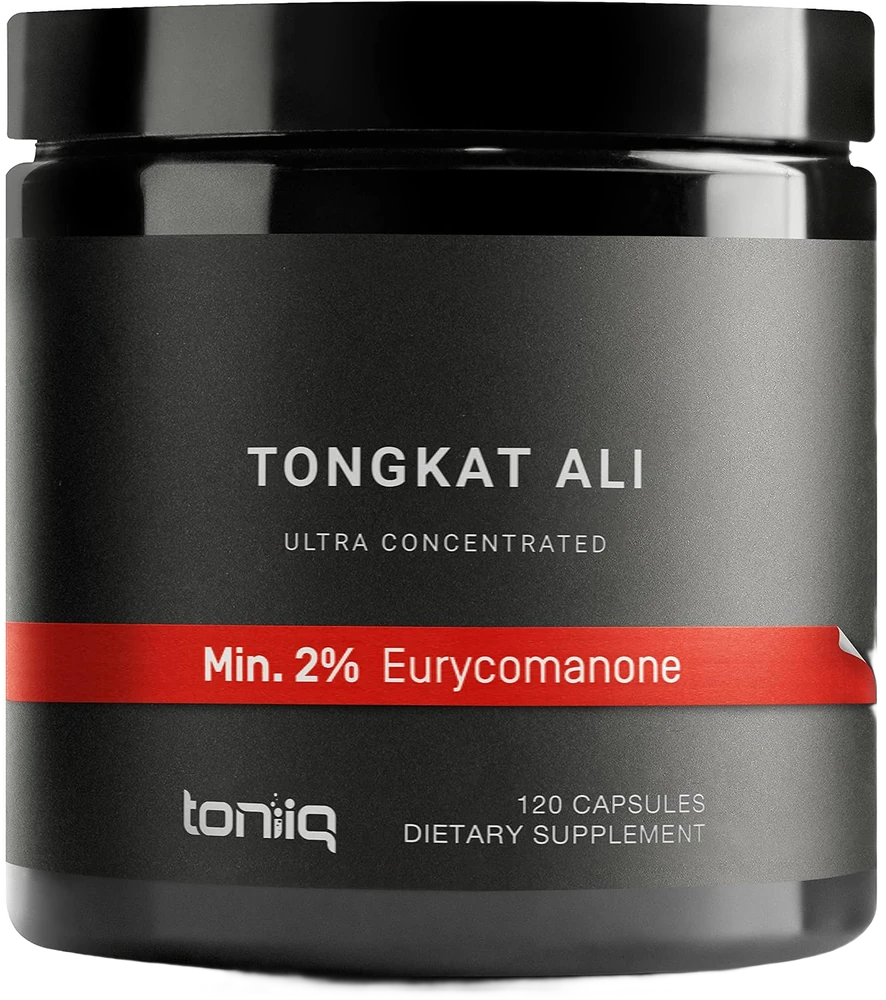
Toniiq Ultra Tongkat Ali
If you want the most label-guaranteed active mg per capsule, this is it.
 01
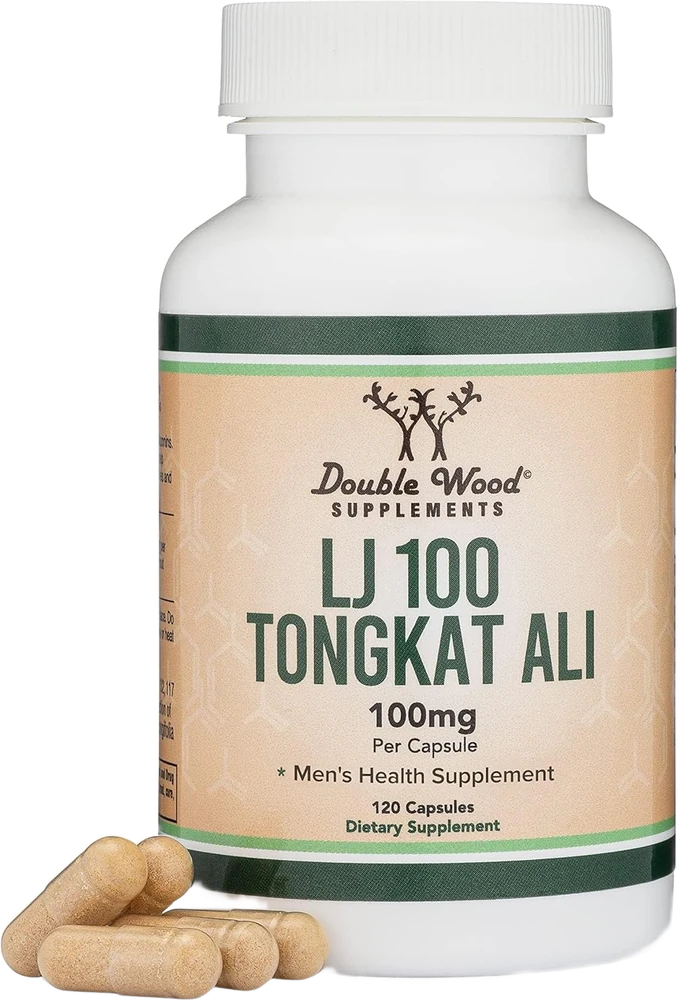
Double Wood LJ100 Tongkat Ali
When the question is 'which bottle gives me the exact thing the studies used', the answer is LJ100.
 04
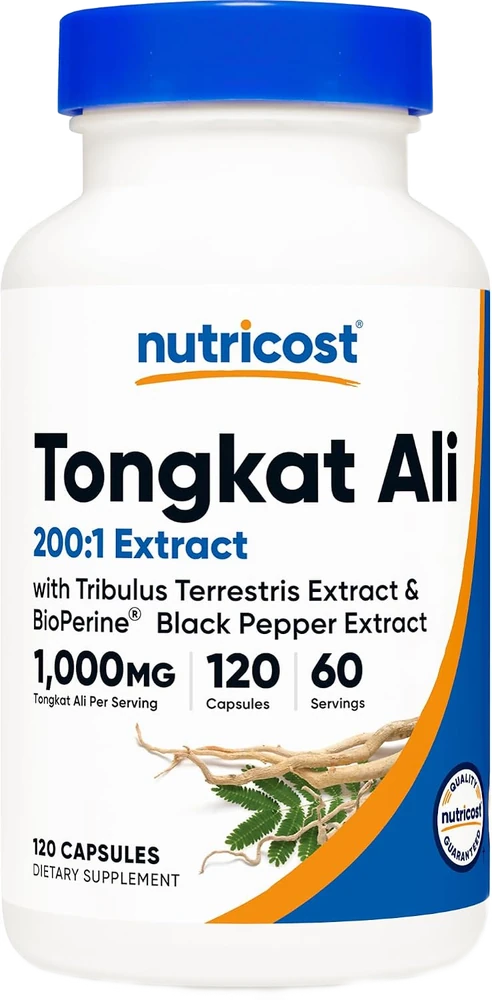
Nutricost Tongkat Ali
If you want to test the waters without committing $30+/month, Nutricost is the right starting point.
Quick Answers
Is this a pure Tongkat Ali extract?
No. The bottle is labelled “TONGKAT ALI COMPLEX 1020 mg per serving · *Includes Tribulus Terrestris Extract 40% Saponins” — printed directly under its own headline number — and the Supplement Facts panel lists two actives: Tongkat Ali Root Extract 200:1 at 1000 mg per 2-capsule serving, and Tribulus Terrestris Fruit Extract at 20 mg. As of our September 2026 re-check, the current Amazon title (“Tongkat Ali 1,020mg, 200:1 … Third-Party Tested”) and its bullets (“Long Jack complex with Tribulus”) disclose the second ingredient too — so the front label, the panel, and the listing all agree this is a two-ingredient Complex, not a single-ingredient extract. Credit where it's due — every one of those documents declares each ingredient with its own milligram figure, so this is not a hidden proprietary blend. But it is a blend, and the only thing that gets rounded up is the “1020 mg” headline, since 20 mg of Tribulus is far below any dose the herb has actually been studied at.
Does the 20 mg of Tribulus do anything?
Realistically, no. Tribulus terrestris trials run at roughly 750-1500 mg/day; 20 mg is one to two percent of that. Its function here is arithmetic — it turns “1000 mg” into “1020 mg” on the front of the bottle. Treat this product as a 1000 mg generic tongkat extract and ignore the Tribulus entirely when you compare it to single-ingredient bottles.
Is this the same as Double Wood's LJ100 bottle?
No — same manufacturer, different product. The LJ100 bottle (#2 on our listicle) contains a patented standardised extract with the trial evidence behind it: 22% eurypeptides, 40% glycosaponins, ≥2% eurycomanone, all declared. This Complex contains a generic 200:1 root extract with no eurycomanone percentage anywhere on the label, plus the token Tribulus. Double Wood states both are made in cGMP-compliant facilities (that claim isn't shown on either label); only LJ100 has published trial protocols behind the exact material.
How many capsules should I take?
The label says 2 capsules per day with food — that's 1000 mg of tongkat extract plus 20 mg of Tribulus. Be aware that this overshoots the published trial window: the RCTs behind tongkat used 200-400 mg/day of a standardised extract. Even a single capsule here is 500 mg of tongkat, above that range on a gross-weight basis. Because the eurycomanone content is undeclared, there is no way to convert this bottle's milligrams into a trial-equivalent dose — that is the core limitation of any generic 200:1 product, and the reason we rank standardised bottles above it.
What does “200:1 extract” actually mean?
200 g of dried root concentrated down to 1 g of extract. The number sounds impressive but tells you nothing about active-compound content. A 200:1 extract from low-quality root can carry less eurycomanone than a 100:1 from premium root. The ratio is a starting-material claim, not a potency claim. Always look for the standardised eurycomanone percentage (or a named LJ100 / Physta extract) instead.
Is the COA public?
No — it's on request. The listing's certificate-of-analysis card shows a passed panel (Enterobacteriaceae, yeast, E. coli, Salmonella/Shigella; lead, mercury, arsenic, cadmium), names the lab as Brand Nutraceuticals, Inc., and is dated 10/4/2024, but it closes with “Certificate of analysis and third-party lab result documentation available upon request.” That is real testing and better documentation than most bottles at this price — but it is not a per-batch public lot lookup, and this review previously described it as one. It does not include a eurycomanone assay.
So who should actually buy this?
Someone who wants the cheapest bottle on this list that has documented third-party testing behind it, and who understands they are buying an uncharacterised extract. At roughly $25 for a 60-serving bottle it is about half the cost per month of the patented tiers. If you want to know how much active compound you're taking — which is the entire point of the tongkat literature — buy Toniiq UHP (#3) or Double Wood's own LJ100 (#2) instead. If you simply want cheap single-ingredient tongkat with no Tribulus in it, Nutricost (#4) is $15.
Sources & Further Reading
5 peer-reviewed sources, each linked to PubMed
- [1] Talbott 2013 PMID 23705671 — Effect of Tongkat Ali on stress hormones and psychological mood state in moderately stressed subjects. 200 mg/day standardised Tongkat for 4 weeks reduced cortisol 16% and raised T 37% vs placebo. Note the dose: one fifth of this bottle's label serving, using a characterised extract.
- [2] Tambi 2012 PMID 21671978 — Standardised water-soluble extract of Eurycoma longifolia, Tongkat Ali, as testosterone booster for managing men with late-onset hypogonadism. 200 mg/day for 1 month raised total + free T above lower-normal in 90% of late-onset hypogonadism subjects. The word doing the work in the title is 'standardised' — the property this bottle lacks.
- [3] Henkel et al. 2014 PMID 23754792 — Tongkat Ali as a potential herbal supplement for physically active male and female seniors — a pilot study. 400 mg/day standardised Tongkat for 5 weeks improved muscle strength and free T in active seniors. 400 mg is the top of the studied range; this label directs 1000 mg.
- [4] Leitão et al. 2021 PMID 33541567 — A 6-month, double-blind, placebo-controlled, randomized trial to evaluate the effect of Eurycoma longifolia (Tongkat Ali) and concurrent training on erectile function and testosterone levels in androgen deficiency of aging males (ADAM). 200 mg/day standardised Tongkat for 6 months improved erectile function (IIEF-5) and testosterone in androgen-deficient aging men, strongest when paired with concurrent training. Six-month blinded safety and efficacy data at one fifth of this bottle's serving.
- [5] Leisegang 2022 PMID 36013514 — Tongkat Ali (Eurycoma longifolia) for testosterone in men: a meta-analysis of randomised placebo-controlled trials. Pooled five-RCT meta-analysis: standardised mean difference of 1.35 on total T vs placebo across 100-600 mg/day. Every pooled trial used a characterised extract — the effect size this generic 200:1 inherits indirectly and cannot be measured against.
Affiliate disclosure: every Amazon link uses our Associates tag (superachieverclub-20). We earn a small commission at no cost to you; it funds independent reviews. We never accept payment to change a ranking.