
This is generic tongkat's core weakness. A '200:1 extract' label tells you the extraction ratio and nothing about how much eurypeptide or eurycomanone survived into the capsule. Most generic bottles are never assayed for actives, so potency drifts lot-to-lot — the bottle that worked once may do nothing next batch. Unless a specific generic publishes a real COA, you genuinely do not know the dose you're taking.
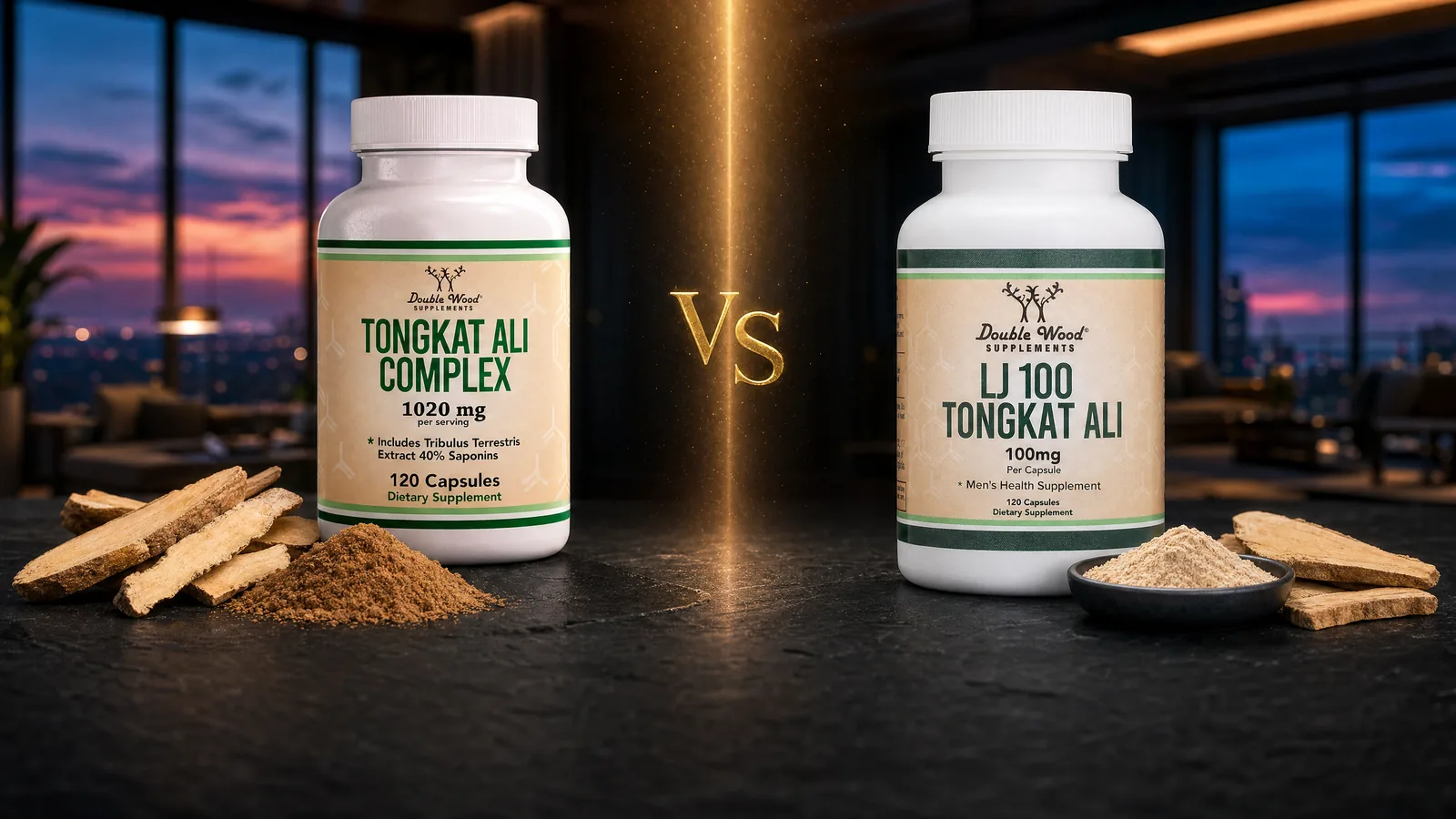
Tongkat Ali vs LJ100
Updated Jul 29, 2026 · by Felix Hesse · 6 peer-reviewed sources
If you searched 'tongkat ali vs LJ100' expecting two different herbs, here's the short version: they're the same plant. 'Tongkat ali' is Eurycoma longifolia; 'LJ100' is a specific patented, standardised extract of it (HP Ingredients, co-developed with the Government of Malaysia and MIT), assayed to ~22% eurypeptides, 40% glycosaponins, ~1% eurycomanone. So this is a FORM comparison — generic unstandardised tongkat vs the LJ100 grade — not a herb-vs-herb one. Below: 6 rounds on what the standardisation actually buys you, honest about where a well-tested generic still wins, and whether the LJ100 premium is worth paying.
Contender A
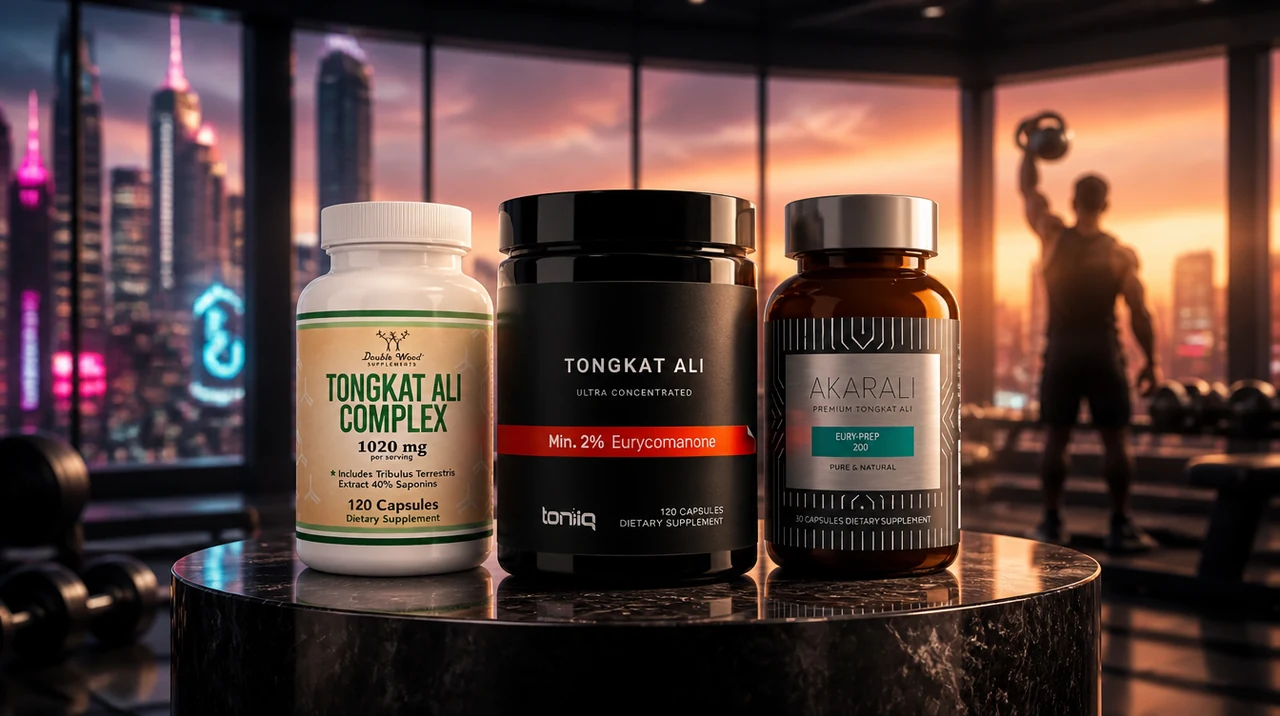
Generic / Unstandardised Tongkat
Same plant · unspecified '200:1' · potency unknown · $10-25/mo
Cheap and everywhere. The same herb as LJ100 — but with no guarantee of how much active compound is in the cap, and no trial run on the specific material. Legitimate only if it publishes a real COA.
6.8/10
Best forBudget test IF it has a third-party COA · price-first buyers
Read the full ranking →
Contender B
LJ100 (Standardised Extract)
Patented · ~22% eurypeptides · ~1% eurycomanone · trial-matched
The standardised, assayed grade of the exact same plant. Known actives in every cap, the material the human trials ran on, and dose precision the generic shelf can't promise. The confident default.
9.1/10
Best forTrial-matched material · known dose · tracked cycles · felt-nothing-on-generic readers
Read the full ranking →
How we scored each round
Five criteria that decide a real generic-vs-LJ100 purchase, weighted by what actually drives the buy. Each round scores both forms 0-10 against the published evidence and the plain reality of what's printed on the bottle. Higher score wins the round; ties are explicit when both genuinely land in the same place.
- Standardisation + consistency30%
Is the active-compound content fixed and assayed every batch, or a lot-to-lot unknown?
- Trial evidence on the material25%
Did human RCTs run on THIS specific extract, or only on a related one?
- Effect magnitude20%
Real, repeatable effect on testosterone / free T at the trial dose.
- Dose precision + safety15%
Can you actually hit the trial dose, and know what you took?
- Cost + availability10%
Monthly price at the trial dose and how easy the form is to find.
6 rounds — head-to-head on the criteria that matter
- Round 1
Round 1 · Standardisation + consistency
Is the active-compound content fixed and assayed?Generic / Unstandardised Tongkat5.5 LJ100 (Standardised Extract)9.3 Standardisation is LJ100's entire reason to exist. It's assayed to a fixed spec — ~22% eurypeptides, 40% glycosaponins, ~1% eurycomanone — batch after batch. Every capsule delivers a known quantity of the compounds that actually drive the effect. That consistency is precisely what let the trials measure a reproducible result, and it's what makes cycle two behave like cycle one.
- Round 2
Round 2 · Trial evidence on the material
Did human RCTs run on THIS specific extract?Generic / Unstandardised Tongkat4.0 There is essentially no published RCT on generic unstandardised '200:1' material specifically. When a study reports a tongkat result, it used a standardised patent (LJ100 or Physta) — not the anonymous powder on the budget shelf. So a generic buyer is extrapolating: 'the herb worked in trials, therefore my untested version should too.' Sometimes that holds; often the generic is too weak to replicate it.
LJ100 (Standardised Extract)9.0 LJ100 is one of the two standardised extracts the literature actually tested. Henkel 2014 (PMID 23754792) ran a standardised extract at 400 mg/day for 5 weeks in active seniors and saw significant total + free testosterone gains plus handgrip-strength improvement. George & Henkel 2014 reviewed the standardised-extract evidence as a TRT alternative, and Leisegang 2022 (PMID 24386995) pooled 5 standardised-extract RCTs for a large effect on total T (SMD 1.35). You're buying the studied material, not a lookalike.
- Round 3
Round 3 · Effect magnitude
Real, repeatable effect on total + free testosteroneGeneric / Unstandardised Tongkat6.5 Generic tongkat CAN work — it's the same plant — but the magnitude is unpredictable because the dose of actives is unpredictable. A well-made unstandardised extract might land near the trial effect; a weak one does nothing measurable. Without an assay you can't tell which you bought, so the expected effect is a wide, low-confidence range rather than a number.
LJ100 (Standardised Extract)9.0 Standardised extract has the actual numbers. Talbott 2013 (Physta, a standardised extract) reported +37% total T and −16% cortisol at 200 mg/4 wk; Tambi 2012 restored testosterone toward the normal range in ~90% of late-onset-hypogonadism men at 200 mg. LJ100's own Henkel 2014 showed total + free T gains at 400 mg. Pooled, standardised extract lands at SMD 1.35 — a large effect. LJ100 delivers that magnitude reliably because the dose is fixed.
- Round 4
Round 4 · Dose precision + safety
Can you hit the trial dose and know what you took?Generic / Unstandardised Tongkat5.0 You can't precisely hit the trial dose with an unstandardised extract because the active content per milligram is unknown — 200 mg of a weak generic isn't the trial's 200 mg. Safety-wise the herb is well-tolerated, but generic supply chains occasionally carry undeclared adulterants or heavy-metal contamination that only a COA would catch, which most budget bottles don't provide.
LJ100 (Standardised Extract)9.0 LJ100 lets you replicate the trial dose exactly: 200 mg/day of standardised extract is the Talbott/Tambi protocol, 400 mg the Henkel dose. You know precisely what you took. Chen 2014 (using standardised Physta at 400 mg for 6 weeks) found no abnormal testosterone:epitestosterone ratio and no liver/renal stress — the kind of safety dataset that exists for standardised extracts and not for anonymous generics.
- Round 5
Round 5 · Cost + availability
Monthly price at trial dose + how easy to findGeneric / Unstandardised Tongkat8.5 This is generic's clear win. An unstandardised extract runs $10-25/month, roughly half to a third of LJ100, and every supplement brand stocks one — grocery store, gas station, Amazon's front page. If budget is the binding constraint and you've found a generic that actually publishes a COA, the value case is real and the availability is unbeatable.
LJ100 (Standardised Extract)7.0 LJ100 runs $35-50/month and is only found in bottles that license the patent, so the shelf is narrower and the price is premium. That's the cost of the standardisation, the assay, and the patent ecosystem. For a confident buyer it's worth it; for a first-ever cheap test of the herb, it's more than some want to spend.
- Round 6
Round 6 · Is the LJ100 premium worth it?
Value — does standardisation justify the extra cost?Generic / Unstandardised Tongkat8.0 The honest case FOR generic: if a bottle publishes a real third-party COA with an assayed eurycomanone number, you've eliminated the standardisation gamble at half the price — and the value tilts hard toward generic. The problem is that most of the budget shelf doesn't test, so the cheap price often comes bundled with an unknown dose. Generic is great value only when it proves its potency.
LJ100 (Standardised Extract)8.0 The case FOR the LJ100 premium: you're paying roughly $15-25 extra a month to remove all doubt about what's in the cap and to run the exact material the trials used. For a cycle-one buyer trying to learn whether tongkat works for their body, or anyone tracking labs, that certainty is worth more than the saving — a wasted 12-week cycle on a dud generic costs more than the premium. For a validated responder on a budget with a COA'd generic, it's a genuine toss-up.
After 6 rounds
1
Generic / Unstandardised Tongkat
1
Ties
4
LJ100 (Standardised Extract)
Same herb, two tiers — LJ100 is the confident default; a COA'd generic is the only budget exception

After 6 rounds the scoreboard is 4-1 with 1 tie in LJ100's favour, and that tracks the reality: LJ100 isn't a different or 'better herb,' it's the standardised, assayed grade of the exact same plant. It wins standardisation, trial-matched evidence, repeatable effect magnitude, and dose precision — everything that flows from knowing what's actually in the capsule.
Be precise about the evidence so no brand misleads you: the famous +37% testosterone / −16% cortisol figure is from Talbott 2013, which used Physta — a DIFFERENT standardised patent, not LJ100. LJ100's own strongest human data is Henkel 2014 (total + free T + grip strength in seniors at 400 mg), and both LJ100 and Physta sit inside the Leisegang 2022 meta-analysis (pooled SMD 1.35 on total T). The takeaway isn't 'LJ100 beats Physta' — it's that BOTH standardised extracts beat generic unstandardised material, because the trials ran on standardised extract and the generic shelf mostly isn't tested.
The default recommendation: buy LJ100 (or Physta). 200 mg/day of standardised extract before 11 a.m., 8-12 weeks, with a baseline and a retest. You'll know your material matches the studies and your dose is real. If you felt nothing on a cheap tongkat before, this is almost certainly why — the powder was under-dosed, not your body unresponsive.
The one honest exception: a generic that publishes a real third-party COA with an assayed eurycomanone number is a legitimate, cheaper choice — you've removed the gamble that makes generic risky. Keep it, run it at 200 mg/day, and only upgrade if it underperforms.
The one wrong move: buying a '200:1' bottle with no COA and expecting the trial results. That's not the material the trials used, you don't know its dose, and a wasted 12-week cycle costs more than the LJ100 premium you were trying to save.
Every claim above traces back to one of these
- [1]Leisegang 2022
Eurycoma longifolia (Jack) Improves Serum Total Testosterone in Men: A Systematic Review and Meta-Analysis of Clinical Trials
Systematic review of 9 studies; meta-analysis of 5 RCTs on standardised Eurycoma longifolia extract found a significant increase in total testosterone (SMD 1.352, 95% CI 0.565-2.138, p=0.001). The pooled evidence is on standardised extracts — the LJ100/Physta tier — not generic unstandardised material.
- [2]Henkel 2014
Tongkat Ali as a potential herbal supplement for physically active male and female seniors — a pilot study
400 mg/day of standardised tongkat ali extract for 5 weeks in physically active seniors (57-72 yr) produced significant increases in total and free testosterone plus handgrip muscular force; the free-T rise tracked a fall in SHBG. The LJ100 research line's key strength-and-testosterone trial.
- [3]Talbott 2013
Effect of Tongkat Ali on stress hormones and psychological mood state in moderately stressed subjects
200 mg/day of standardised Physta extract for 4 weeks raised total testosterone +37% and lowered cortisol −16% vs placebo in moderately stressed adults. Precision note: this trial used PHYSTA, not LJ100 — both are standardised patents, and neither result comes from generic unstandardised material.
- [4]Tambi 2012
Standardised water-soluble extract of Eurycoma longifolia, Tongkat ali, as testosterone booster for managing men with late-onset hypogonadism
200 mg/day of a standardised water-soluble tongkat extract restored serum testosterone toward the normal eugonadal range in roughly 90% of men with late-onset hypogonadism. The trials that work use standardised extract — the material a generic '200:1' bottle can't guarantee it contains.
- [5]George & Henkel 2014
Phytoandrogenic properties of Eurycoma longifolia as natural alternative to testosterone replacement therapy
Review of the standardised Eurycoma longifolia extract evidence (LJ100 + Physta) concluding it can restore serum testosterone and improve sexual health as a natural alternative to TRT for sub-clinical decline, with no significant side effects at therapeutic doses. Frames the standardised-extract tier as the credible one.
- [6]Chen 2014
Supplementation of Eurycoma longifolia Jack extract for 6 weeks does not affect urinary testosterone:epitestosterone ratio, liver and renal functions in male recreational athletes
400 mg/day of standardised Physta extract for 6 weeks in male recreational athletes produced no abnormal urinary T:E ratio versus WADA thresholds and no adverse liver or renal markers. A contaminant-and-safety dataset that exists for the standardised tier and not for anonymous generic bottles (this trial used Physta, not LJ100).